This site is supported by our readers. We may earn a commission, at no cost to you, if you purchase through links.

Snakes are escape artists. A corn snake can squeeze through a gap the width of a pencil, and a ball python has the patience to work a loose latch for hours. Your enclosure is the only thing standing between your snake and an adventure inside your walls.
That’s why safe and secure snake cage ideas matter more than most keepers expect. The wrong material off-gasses chemicals that damage lung tissue, and a vent mesh wider than 1.5 mm is practically an open invitation.
These seven setups cover every species and skill level, built around specs that keep snakes in and hazards out.
Table Of Contents
- Key Takeaways
- 7 Safe and Secure Snake Cage Ideas
- Match Snake Cage Dimensions to Species and Adult Size
- Choose Nontoxic, Waterproof Materials and Safe Substrates
- Escape-Proof Every Door, Vent, Lid, and Cable Opening
- Maintain Safe Heat, Humidity, Ventilation, and Hygiene
- Frequently Asked Questions (FAQs)
- What are the best snake cages for keeping snakes?
- Are snakes happy in enclosures?
- What calms snakes down?
- How to escape proof snake enclosure?
- What is a DIY snake cage enclosure?
- How to build a safe snake enclosure?
- How to secure a snake cage?
- What materials do you need for a snake cage?
- Can you use wire mesh in a snake cage?
- What is a good substrate for a snake enclosure?
- Conclusion
Key Takeaways
- Your enclosure’s weakest point — a gap wider than 1.5 mm, a loose latch, or an unsealed cable hole — is all a snake needs to disappear into your walls.
- Match every dimension to your snake’s adult size from day one, since terrestrial species need floor space 1.5–2× their body length squared, while arboreal species need vertical height at least 1.2× their total length.
- Cedar, pine, and PVC panels with phthalates off-gas chemicals that damage lung tissue, so stick to inert plastics, glass, silicone-sealed surfaces, and safe substrates like aspen shavings or orchid bark.
- Consistent heat gradients, 50–70% humidity with cross-ventilation, daily spot-cleaning, and weekly full disinfection are what separate a snake that thrives from one that merely survives.
7 Safe and Secure Snake Cage Ideas

Not all snake cages are created equal, and choosing the right setup makes all the difference. Your snake’s species, size, and behavior should drive every decision you make. Here are seven safe, keeper-tested enclosure ideas to match almost any snake you’re keeping.
Whether you’re housing a slender corn snake or a hefty ball python, these best snake enclosure ideas give you a practical starting point for building a setup your animal will actually thrive in.
Front-Opening PVC Enclosure
Most keepers pick front-opening PVC enclosures as their go-to, and you’ll see exactly why. UV-stabilized PVC resists moisture and corrosion like a champ, and nontoxic materials mean your snake stays safe. Front access makes feeding and cleaning so much easier.
Match your snake enclosure size to 1.5 times the snake’s length. Add secure latches and dual-seal gaskets to stay escapeproof.
Clip-Locked Glass Terrarium
Glass terrariums give you that showroom visibility PVC just can’t match. The clip-locked glass terrarium uses a spring-loaded cam latch compressing a gasket along the frame for escapeproof design your snake can’t crack.
Snake enclosure security starts with latches flush on the frame. Misalignment creates gaps and ventilation breaches fast. Inspect for micro-cracks. Snakes find every weakness. Don’t let them.
Sealed Wooden Vivarium
Wood brings something glass simply can’t, warmth and charm. A sealed wooden vivarium built from sealed plywood or melamine-coated wood holds humidity perfectly for tropical species.
Keep it truly escapeproof with:
- Secure latches on every door and panel
- Epoxy coating sealing all interior surfaces
- Vents meeting ventilation requirements without heat-spot drying
Seal everything well. Your snake finds every weakness fast.
Staying on top of how often to clean a snake hide helps you spot cracks or worn seals before your snake does.
Tall Arboreal Terrarium
Now flip that vivarium vertical. Arboreal snakes belong up high! Vertical terrariums are built exactly for that. Your tall arboreal terrarium should stand at least 1.5 times your snake’s full length.
Pack in branches at varying angles every 20 cm; they’re natural perching spots. Use cork tubes sized to their girth. Secure latches on every panel keep it all escapeproof.
Wide Terrestrial Habitat
Many ground-dwelling snakes need a wide terrestrial habitat with room to stretch, coil, and patrol.
- Width: 0.5–2.0 m minimum
- Safe substrates: coconut fiber or cypress mulch
- Depth: 5–10 cm for burrowing
- Temperature gradients: 28–32°C basking zone
- Secure latches to stay escapeproof
Nail these and your snake stays safe, settled, and exactly where you left it!
Stackable Modular Cage
The stackable modular cage is basically a snake apartment building, and you’re the landlord. Stack up to six units high with secure latches that keep every level escapeproof.
Each level becomes its own microhabitat, so mastering ball python enclosure cleaning routines by unit keeps your whole stack hygienic without disrupting every tenant at once.
Sliding vent panels let you adjust ventilation requirements without touching the lid.
Interchangeable panels swap layouts from terrestrial to arboreal in 15 minutes, no tools needed and no DIY snake cage chaos!
Custom Built-in Enclosure
Think built-ins are only for pros? Think again. A custom snake enclosure gives you total control.
- Leave 12-20 mm framing gaps for ventilation requirements and cable runs.
- Back panels with corkboard to cut heat transfer.
- Seal joints with silicone gasket to stay escapeproof.
- Add secure latches and a removable access panel.
Your DIY reptile enclosure literally becomes the room’s focal point.
Match Snake Cage Dimensions to Species and Adult Size

A juvenile ball python fits in a shoebox today, but she’ll need a 4-foot enclosure by adulthood. That gap catches a lot of keepers off guard.
Your species-specific planning matters more than anything else here. Terrestrial snakes need floor space equal to 1.5 to 2 times their body length squared. Arboreal species need height, at least 1.2 times their total length vertically.
Always build your snake cage design plans around adult size, not current size. A corn snake tops out near 5 feet, so your reptile enclosure design needs to reflect that from day one.
Custom habitat dimensions save you money long-term. Buy or build for the adult you’ll have, not the hatchling curled up in your palm right now.
Choose Nontoxic, Waterproof Materials and Safe Substrates
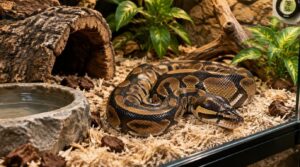
Your snake’s home is its entire world. Every material inside it matters.
Your snake’s home is its entire world, and every material inside it matters
Skip PVC panels with phthalates and avoid cedar or pine shavings entirely. They off-gas chemicals that irritate lung tissue fast. Instead, reach for inert plastics, glass, or silicone-sealed surfaces paired with safe substrates.
For substrate selection, here’s what works:
- Aspen shavings stay dry, resist mold, and suit most terrestrial species
- Orchid bark blends hold humidity well for tropical snakes
- HDPE trays or epoxy-sealed bases handle moisture without soaking through
- Target a pH of 6.5 to 7.5 to protect your snake’s skin
Waterproof sealing on your enclosure base prevents urine from pooling and bacteria buildup underneath. Use only silicone formulas approved for reptile use, and skip hardware store generics!
Escape-Proof Every Door, Vent, Lid, and Cable Opening
Your cage is only as secure as its weakest gap. Preventing snake escapes starts at the doors. Use silicone door seals along every edge, and keep magnetic seal gaps under 3 mm. No wiggle room, literally. Escapeproof latches that click audibly deter tampering and give you instant peace of mind.
Vents need stainless steel mesh with openings no wider than 1.5 mm, fixed with tamper-resistant fasteners. Overlapping louver flanges block lateral prying too.
For lids, go with a recessed internal latch design. No finger grip points means no way to pull or pry for your escape artist.
Don’t forget cable holes! Seal every opening with compressible grommet collars and waterproof sealing compound. Run monthly torque checks on all fasteners. Snakes are patient. Be thorough.
Maintain Safe Heat, Humidity, Ventilation, and Hygiene

Getting the environment right is what separates a thriving snake from a struggling one. Heat, humidity, ventilation, and hygiene each play a distinct role in keeping your setup safe and your snake healthy. Here’s how to nail every one of them.
Heat and Thermostat Setup
Because your snake can’t regulate its own body temperature, thermoregulation is fully on you. Temperature control isn’t optional.
Mount your heat source on one side only and pair it with a digital thermostat using floor and ambient probes. Run independent thermostats as backup. That’s basic heat safety.
Check your temperature monitoring logs weekly so drift doesn’t sneak up on you.
Humidity and Cross-Ventilation
Heat’s sorted. Now moisture needs your attention.
Humidity control is next. Most terrestrial snakes thrive at 50-70% relative humidity. Mist in short bursts, 3-5 seconds every 4-6 hours, to hit that sweet spot without pooling. For snake cage ventilation, position vents high and low. That cross-ventilation airflow keeps moisture management steady without soaking the enclosure or leaving it bone dry.
Lighting and UVB Safety
Lighting has a plot twist: UVB spectrum requirements vary wildly by species. Many snakes simply don’t need UVB at all. If yours does, standard glass blocks UVB light completely, so use UV-stabilized acrylic panels or mount your fixture inside. Stick to nontoxic materials for all hardware.
Set your light-dark cycle on a reliable timer. Twelve consistent hours on, twelve off.
Cleaning and Disinfection Schedule
Keep the timer habit going for cleaning too. Spot-clean daily: remove feces and shed skin before they build up. Full cleanouts happen weekly. Pull your snake out first, always.
Use a reptile-safe disinfectant, let it sit for the full contact time, then rinse thoroughly. Replace substrate completely; don’t try to disinfect it. Dry everything before reassembly. That’s biosecurity done right!
Frequently Asked Questions (FAQs)
What are the best snake cages for keeping snakes?
Think of your snake’s home like a vault with a view. The best safe and secure snake cage ideas pair escape-proof latches with the right species-specific dimensions and secure sturdy construction you can rely on.
Are snakes happy in enclosures?
Snakes can absolutely thrive in a well-built enclosure. When you nail habitat enrichment and provide proper hiding spots, they explore, bask, and eat on a schedule. Those are the signs of a genuinely content snake.
What calms snakes down?
A snake that’s safely hidden is a calm snake. Add multiple hiding spots for that cozy vibe, dial in your temperature gradients, and always skip the strong smells. A consistent daily routine does the rest.
How to escape proof snake enclosure?
Your enclosure is only as strong as its weakest gap. Fit escapeproof latches on every door, keep all gaps under 2 mm wide, and do thorough escape testing by pressing firmly on each closed opening.
What is a DIY snake cage enclosure?
A DIY snake cage is a custom-built home you design yourself from wood, glass, or plastic. You get to control the size, ventilation, secure latches, and nontoxic materials to perfectly match your snake’s exact needs.
How to build a safe snake enclosure?
Measure twice, cut once! Build your DIY snake cage from formaldehyde-free plywood or HDPE, seal every edge with aquarium-grade silicone, install secure latches on every single opening, then carefully fine-tune temperature control and humidity control.
How to secure a snake cage?
Lock every latch, seal all gaps with weatherstripping or silicone, and cover your vents with escape-proof mesh. Snakes will find and exploit each weak point. Use secure fasteners and wiggle-test closures before you walk away.
What materials do you need for a snake cage?
Think of it like building a tiny fortress. You’ll want marine-grade plywood or melamine-coated wood, tempered glass, stainless steel hardware, non-toxic sealant, and fine escape-proof ventilation mesh. That combo keeps your snake safe and secure.
Can you use wire mesh in a snake cage?
Yes, but choose carefully. Vinyl-coated or stainless steel mesh with openings of 1/4 inch or smaller prevents snake escape. Smooth every edge, inspect welds regularly, and you’ve got solid, reliable snake cage ventilation without drama.
What is a good substrate for a snake enclosure?
What’s the actual foundation of any great snake habitat setup? Aspen shavings, coconut husk, or cypress mulch work best. They hold moisture well, clean up fast, and feel completely natural. Just skip pine and sand.
Conclusion
Picture your snake pressed against a loose latch at midnight, patiently working it open like a tiny, relentless safecracker. That’s exactly the reality you’re designing against.
Safe and secure snake cage ideas aren’t just nice to have; they’re the real difference between a thriving pet and a lost one behind your drywall. Get the enclosure right, and everything else, the heat, humidity, substrate, falls into place naturally. Your snake deserves a home that actually holds.