This site is supported by our readers. We may earn a commission, at no cost to you, if you purchase through links.
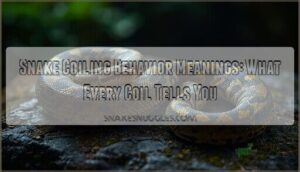
A snake doesn’t coil randomly. Every configuration of its body—tight spiral, loose heap, S-shaped tension—encodes specific physiological or behavioral information that, once you learn to read it, changes how you understand the animal entirely.
Snake coiling behavior meanings aren’t symbolic; they’re functional, driven by thermoregulation, threat assessment, predatory mechanics, and neurological stress responses. The same species that balls itself into a sphere to conserve heat will flatten and widen that same coil into a defensive shield within seconds of perceiving a threat.
Knowing the difference between those two states isn’t just academic—it tells you exactly what a snake needs, fears, or intends.
Table Of Contents
- Key Takeaways
- What is Snake Coiling Behavior?
- Thermoregulation: Coiling for Temperature Control
- Defensive Coiling: Protecting Against Threats
- Coiling in Predatory and Ambush Behavior
- Species-Specific Coiling Variations
- Stress and Discomfort Indicated by Coiling
- Coiling and Snake Communication
- Coiling During Rest and Energy Conservation
- Recognizing Healthy Vs. Concerning Coiling
- Frequently Asked Questions (FAQs)
- Conclusion
Key Takeaways
- Every coil a snake forms is a functional, physiologically driven response—tight spirals retain heat, S-curves store strike energy, and loose loops signal relaxed thermoregulation, so reading posture tells you exactly what the animal needs or intends.
- Defensive coiling isn’t panic; it’s a calculated sequence that shields vital organs, amplifies perceived body size, and escalates through readable warning stages before a strike ever lands.
- Coil tightness is one of your clearest health indicators—twisted loops, stargazing postures, or rigid unmoving coils are neurological and systemic red flags that demand immediate veterinary attention.
- Environmental conditions—temperature gradients, humidity, enclosure size, and lighting—directly govern coil behavior, meaning chronic stress coils are often a cage problem, not a snake problem.
What is Snake Coiling Behavior?
Snake coiling isn’t random — every position your snake takes tells you something specific about what it needs or feels. This behavior touches on temperature, defense, hunting, and rest all at once.
Once you start noticing these patterns, a good snake body language and care guide can help you connect the dots between posture, environment, and your snake’s overall wellbeing.
Here’s what each form of coiling actually means and why it matters.
Definition of Coiling in Snakes
Coiling isn’t just a snake curling up to look cute—it’s a deliberate, controlled body flexion where hundreds of vertebrae bend in precise coordination to form stable loops.
This coiled posture compresses the snake’s full length into a compact structure, elevating the head and activating specific muscle chains.
Understanding this snake body language gives you real insight into what’s actually happening in that moment. For a deeper look at typical defensive posture cues, consider how coiling can signal a snake is feeling threatened.
Basic Forms of Coiling
From that precise muscular coordination, four distinct coil patterns emerge — each revealing something specific about snake posture and intent.
- Tight defensive coil: body compressed, head shielded at center
- Loose resting coil: relaxed loops, head exposed, muscles tension-free
- S-shaped strike coil: stored elastic energy, primed for launch
- Thermoregulatory coil: adjusted surface area for thermal regulation and body language signaling
Why Coiling is Crucial for Snakes
Every pattern you just saw isn’t random — it’s a masterclass in survival.
Through coiling mechanics, a snake controls its temperature, dodges threats, and strikes with precision. Snake thermoregulation depends on it. Predator evasion relies on it. Energy efficiency is built into it.
Understanding snake behavior and survival means recognizing that each coil is a deliberate defensive strategy and energy management decision rolled into one. Snakes belong to the reptilian order Squamata, which includes lizards and showcases their unique evolutionary adaptations.
Thermoregulation: Coiling for Temperature Control
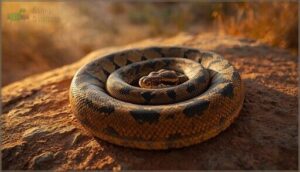
A snake’s coil isn’t just a resting position — it’s a precision temperature tool. Snakes don’t have the luxury of generating their own body heat, so every coil they form is a calculated response to the thermal environment around them.
Here’s how that actually works, from trapping warmth to shedding excess heat.
How Coiling Aids Heat Retention
Think of a tightly wound coil as a snake’s built-in thermal vault. Through ectothermy, your snake can’t generate its own heat — so it banks what it absorbs. Tight coiling slashes surface area exposure, slowing convective heat loss and locking warmth into the core.
Field data confirms coiled individuals run 1–2°C warmer than stretched counterparts. That’s coiling efficiency as thermal regulation, masterfully executed.
Loosening Coils to Cool Down
When your snake’s body temperature peaks, coil relaxation becomes its most precise instrument of heat dissipation. Watch those tight loops soften and spread — that’s thermal regulation in real time, ectothermy doing exactly what it evolved to do. Loosening coils increases exposed surface area, accelerating heat exchange with cooler ambient air.
- Loose coils pressed against tile or stone drive conductive cooling directly through contact
- A “radiator loop” extended into a cooler zone dumps excess heat while the core stays warm
- Looser coils reduce trapped warm air between body segments, letting circulation carry heat away
- Cooling snakes shift gradually from stacked coils to open S-curves as temperature control progresses
- Environmental adaptation means using both surface temperature and airflow as active cooling strategies
Environmental Factors Impacting Coiling
Beyond temperature alone, your snake’s coiling reacts to a web of environmental factors — humidity levels, substrate types, space constraints, and lighting conditions all shape what you’re seeing.
Drop humidity below 40%, and moisture-sensitive species coil tighter around the warmest microspot. Cramped enclosures restrict thermoregulation entirely. Bright, constant lighting drives snakes into compressed defensive coils, disrupting the natural temperature effects that healthy behavioral thermoregulation depends on.
These overlapping stressors compound during the shedding cycle, when snake hiding spot needs during shedding become especially critical for recovery and comfort.
Defensive Coiling: Protecting Against Threats

When a snake feels threatened, coiling isn’t panic — it’s a calculated defense system built into its biology. Every tight loop fulfills a specific purpose, from guarding critical anatomy to sending unmistakable warning signals.
Here’s what each defensive coiling behavior is actually telling you.
Coiling to Shield Vital Organs
When a snake pulls into a tight coil, it isn’t just sitting still — it’s activating one of the most effective snake defensive mechanisms in nature. That coil anatomy creates layered muscle and scale barriers that protect essential organs from direct attack.
Here’s what that defensive posture actually does:
- Organ protection starts deep: the heart and lungs shift toward the coil’s center
- Essential shielding relies on overlapping body loops that absorb and deflect impact
- Mechanical advantage comes from distributing strike force across multiple coiled layers
- Vulnerable anatomy — soft ventral tissue — gets pressed against the ground
- A coiled posture keeps the head tucked, shielding the brain from overhead strikes
Making Themselves Appear Larger
Size is power — and snakes have mastered the illusion of it. Through Body Flattening, Elevated Coiling, Head Shaping, and Puffing Displays, they command space far beyond their true dimensions. Mimicry Tactics let non-venomous species appear larger and more dangerous through deimatic defense.
| Behavior | Mechanism | Effect |
|---|---|---|
| Body Flattening | Rib spreading | Doubles visible width |
| Elevated Coiling | Stacked loops | Projects mass and height |
| Puffing Displays | Air inflation | Inflates body circumference |
Warning Displays and Threat Postures
When a snake’s had enough, it doesn’t whisper — it broadcasts. Warning Postures and Threat Signals escalate in precise, readable steps: tight Coiling Behaviors anchor the body while the neck rises into an S-curve, delivering unmistakable Visual Cues. Cobras hood. Rattlesnakes buzz.
Combined, these Defensive Mechanisms and snake body language form a coiled posture that commands retreat before a single bite lands.
Coiling in Predatory and Ambush Behavior

A snake’s coil isn’t just a resting position — it’s a weapon loaded and ready to fire. When a snake shifts into predatory mode, every loop of its body fulfills a calculated purpose, from storing energy to locking down a precise strike.
Here’s what’s actually happening beneath those coils.
Spring-Loaded Strike Mechanics
That tight S-curve coil isn’t just posture — it’s a loaded weapon. Coil tension builds through isometric muscle contraction along the front trunk, storing elastic energy in curved vertebrae and stretched tissue. When released, strike velocity can exceed explosive accelerations of 700 m/s². Prey capture happens before most mammals can even register a threat.
A snake’s S-curve coil stores elastic energy so explosive that prey is captured before most mammals can register a threat
- Elastic energy accumulates in the curved spine before any visible movement
- Peak muscle contraction fires in near-simultaneous bursts, not sequential waves
- Full strike-to-contact can occur in under 100 milliseconds
Anchoring for Accurate Strikes
Raw speed means nothing without control. Body anchoring converts that kinetic energy into a precise, repeatable strike position — belly scales pressing the substrate, multiple coil bends acting as passive brakes. Tail movement counteracts forward momentum, keeping coil stability intact.
Friction control determines everything: on loose ground, snakes redistribute downward pressure to maintain accuracy. That’s predatory mechanics of snakes working at an almost mechanical level of precision.
Ambush Postures in Different Species
Anchoring gives the strike precision — but species deploy that precision in radically different ways.
- Pit vipers hold a tight S-coil along rodent trails, heat-sensing organs timing the perfect moment
- Pythons drape loose coils near water, collapsing forward the instant prey steps close
- Arboreal snakes saddle branches, pivoting freely toward birds or lizards below
- Puff adders flatten into camouflage methods beside paths, nearly invisible until contact
Each ambush posture reflects the same predatory mechanics of snakes — controlled, calculated, lethal.
Species-Specific Coiling Variations
Not every snake coils the same way, and that’s not an accident. Each species has developed its own coiling signature shaped by millions of years of adaptation.
Here’s what three common species reveal through the way they curl up.
Ball Python Coiling Patterns

Ball pythons have mastered the art of coiling styles as a direct expression of their inner state. When threatened, their snake body language shifts dramatically — the snake posture collapses inward, head tucked deep, forming a compact sphere.
Calm captive specimens show relaxed coil formation, loops spread openly across their hide. Reading these ball python habits gives you real control over every interaction.
Boa Constrictor Defensive Coils

Where ball pythons collapse inward, boa constrictors command space. Their Constrictor Tactics rely on elongated Coil Variations — thick, stacked loops that run along the body’s length rather than forming a compact sphere.
These Defensive Postures signal serious intent, functioning as both Predator Deterrents and Ambush Strategies. That S-curved neck raised above anchored coils? That’s a boa telling you exactly how far its reach extends.
Corn Snake Thermoregulatory Coiling
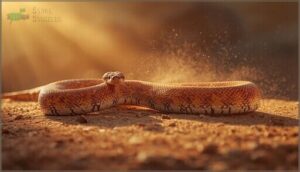
Corn snakes are quiet masters of Thermal Regulation — slender bodies built for precision over power. Their Thermoregulatory Behavior is less about brute heat retention and more about fine-tuned Environmental Adaptation:
- Loose coils spread across warm and cool zones simultaneously
- Coil Tightness increases after basking to lock in heat
- Flat coils optimize Heat Absorption from substrate contact
- Metabolic efficiency improves through constant micro-adjustments
- Snake behavior shifts with ambient temperature throughout the day
Stress and Discomfort Indicated by Coiling
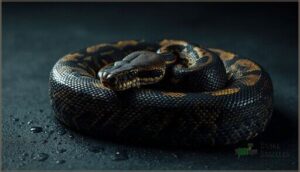
Snakes don’t just coil for comfort—sometimes, the way they twist and tuck is a clear signal something’s off. When stress and discomfort hit, you can spot the difference just by paying attention to their posture. Here’s what to look for when their coils are telling you more than you realize.
Tight Coiling Due to Stress
Tight coiling under stress isn’t subtle — your snake’s body becomes rigid, muscles locked, head pulled deep into the center of the coil like a fortress closing its gates. These snake stress signals often accompany rapid tongue flicks and shallow breathing.
Environmental factors like inconsistent temperatures or poor handling techniques intensify the response. Recognizing these coiling patterns is the first step toward reclaiming your snake’s wellness.
Defensive Vs. Relaxed Coils
Reading coil patterns correctly hands you real control. A defensive posture tells a clear story: tight, overlapping loops, tense musculature, rapid tongue flicks, and a head tracking your every move with sharp precision.
Relaxed coiling looks entirely different — loose, sprawling loops, slow breathing, unhurried tongue flicks. Mastering this snake body language means you decode every threat response before it escalates.
Environmental Triggers of Stressful Coiling
Your enclosure design, temperature fluctuations, and humidity control aren’t optional details — they’re the difference between a snake that thrives and one locked in chronic stress. Inconsistent thermoregulation forces tighter, defensive coils. Poor noise reduction keeps snakes hyperalert. Rough handling techniques compound the problem.
Master these environmental factors affecting snake behavior, and you’ll see defensive postures disappear, replaced by calm, confident snake coiling.
Coiling and Snake Communication

Snakes don’t speak, but they communicate clearly — if you know what to look for. Every coil, curve, and body position carries a specific message about how a snake is feeling and what it’s about to do.
Here’s what those signals actually mean.
Body Language as a Warning
A coiled snake isn’t just sitting still — it’s speaking. Warning signs are layered into every tension change, from loose resting loops shifting into a rigid, springy coil as you approach.
Defensive postures, stress signals, and threat displays combine into a clear message: back off.
Hissing, musking, and sudden stillness are all snake body language you can learn to read before defensive behaviors escalate further.
S-Shape and Head Positioning
The S-curve formation isn’t decoration — it’s a loaded weapon. When a snake shifts into S-shaped postures, neck alignment tightens, head elevation rises, and defensive positioning locks in.
That elevated head tracks you with fixed precision, not casual curiosity. Defensive postures like the S-curve signal strike posture readiness: muscles tensed, head flattened in vipers, snake body language broadcasting one unmistakable command — don’t push it.
Combining Coiling With Hissing or Tail Vibration
When coiling locks in alongside hissing and tail vibration, you’re reading a full defensive package — not a single cue. Here’s what that escalation actually looks like:
- Soft hiss with loose coil — early warning
- Tightening coil plus intensified hissing — threat displays ramping up
- Audible tail vibration against substrate — vibration patterns mimicking rattlesnakes
- Rapid rattling with rigid coil — strike imminent
Recognize it. Respect it.
Coiling During Rest and Energy Conservation

Not every coil a snake makes signals danger or hunger — sometimes, it’s just rest.
When a snake settles in to conserve energy, its body tells a specific story through how it arranges itself.
Here’s what those resting coil patterns actually mean.
Sleeping and Resting Coil Positions
Rest isn’t passive for a snake — it’s architectural. When your snake sleeps, its coil shapes and resting postures speak volumes about comfort and security.
| Relaxation Signs | Sleep Patterns | Coil Variations |
|---|---|---|
| Soft muscle tension | Hours-long stillness | Donut or stacked loops |
| Head resting on coils | Minimal tongue flicking | Arboreal branch draping |
| Flat, still tail tip | Slow wake response | Hide-wedged compact bundle |
Recognizing these signals transforms how you read snake behavior entirely.
Minimizing Energy Loss
A snake’s architecture of rest is also a masterclass in metabolic control. When your snake settles into a tight coil, it’s executing a precise Energy Conservation strategy — reducing exposed surface area to slow heat loss and keep Metabolic Rates low. That’s reptile physiology working efficiently, not lazily.
- Thermal Regulation through compact Coiling Strategies lets snakes retain body temperature without burning extra energy
- Heat Retention improves when body loops stack vertically over warm substrate
- Thermoregulation and coiling together reduce how often snakes must relocate to warmer spots
Differences Between Resting and Defensive Coils
Once you understand energy conservation, reading coil tightness becomes almost instinctive. A resting snake keeps loose, soft loops — head resting low, body posture relaxed and sprawling.
A defensive coil pulls tight, raises the front third, and tucks the head deep for head protection. Rapid tongue flicking, rigid muscle tension, and fixed body posture are your clearest signals that defensive strategies, not rest, are at work.
Recognizing Healthy Vs. Concerning Coiling
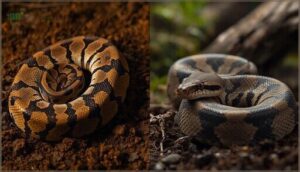
Not every coil your snake forms means the same thing, and learning to read the difference can be the line between catching a health issue early and missing it entirely.
A snake’s body doesn’t lie — changes in how it coils can signal anything from a normal shed cycle to something that needs a vet’s attention.
Here’s what to watch for.
Signs of Illness in Coiling Behavior
Ever notice a snake balled up tight for hours, barely moving? That’s your warning flag waving. Abnormal Postures and rigid Coiling Patterns, especially with Respiratory Signs or Lethargy Indicators, signal underlying distress. Neurological Clues—like corkscrewing or uneven loops—demand urgent attention.
Here’s a quick breakdown:
| Pattern | Symptom | Action Needed |
|---|---|---|
| Tight, unmoving | Lethargy | Veterinary check |
| Twisted coils | Neurological | Immediate care |
| Upright, strained | Respiratory | Assess promptly |
Coiling Changes During Shedding
Shedding rewires your snake’s coiling behavior from the inside out. Pre-shed, vision dims and vulnerability spikes—watch for tighter, more protective coils and prolonged stillness in hides. Once peeling begins, coordinated brace-and-push coils replace relaxed thermoregulation entirely.
| Shedding Phase | Coiling Pattern |
|---|---|
| Pre-shed (blue) | Tight, head-tucked |
| Active peel | Braced, forceful |
| Mid-shed | Stacked, shifting |
| Post-shed | Loose, relaxed |
| Retained patches | Repeated, strained |
When to Seek Veterinary Advice
Not every unusual coil warrants panic—but some do demand immediate action. Recognizing the difference between normal snake behavior and genuine animal distress signals is where reptile welfare lives or dies.
| Coiling Abnormality | Veterinary Signs | Action Required |
|---|---|---|
| Stargazing posture | Neurological disease | Emergency Care |
| Rigid, unrelenting coils | Pain or internal illness | Reptile Consultations |
| Corkscrewing/twisted spine | Inclusion Body Disease | Urgent Health Checks |
| Open-mouth breathing while coiled | Respiratory infection | Same-day veterinary care |
| Limp, unresponsive coiling | Late-stage systemic disease | Immediate snake stress signals assessment |
Frequently Asked Questions (FAQs)
Do snakes coil when scared?
Yes, snakes absolutely coil when scared. Fear response triggers a tight defensive posture, coiling mechanism activates instantly, and snake anxiety drives species like ball pythons to curl into protective balls, shielding essential organs from threats.
Can coiling behavior indicate a snakes age?
Coiling intensity can hint at snake development, but it won’t reveal exact age. Juveniles tend toward tight, reactive coils, while mature snakes show more measured responses.
Growth patterns and size offer better maturation signs.
How does pregnancy affect snake coiling habits?
Pregnancy transforms a snake’s coiling into deliberate, sustained postures.
Gravid coiling reflects pregnancy thermoregulation needs, energy conservation, and defensive postures shielding developing young — maternal incubation instincts rewriting every curl she makes.
Do snakes coil differently in captivity vs. wild?
Captive snakes coil differently due to Enclosure Limits, constrained Feeding Habits, and amplified Stress Responses. Restricted space triggers Abnormal Patterns in coiling and body language that wild environmental interaction and defensive behaviors rarely produce.
Can coiling patterns vary between male and female snakes?
Isn’t it uncanny how Sexual Coiling patterns shift with gender? Male Courtship coils are tighter and more active, while Female Brooding coils dominate with broader, stable loops—clear Coil Dimorphism reflecting Gender Differences in snake behavior and survival strategies.
How does humidity influence a snakes coiling behavior?
Humidity directly shapes coil tightness — dry air drives snakes into tighter, moisture-conserving postures, while proper humidity levels allow looser, relaxed coils.
This reflects how environmental adaptation and snake hydration govern thermoregulation and overall snake behavior and survival.
Conclusion
Research shows snakes spend up to 85% of their lives in some form of coiled position—which means understanding snake coiling behavior meanings isn’t a niche skill, it’s foundational knowledge for anyone serious about these animals.
Every configuration carries a specific message: thermal need, predatory intent, defensive urgency, or neurological stress. Once you learn to read those signals accurately, you’re not just observing a snake—you’re interpreting a living system communicating in the only language it has.
- https://www.britannica.com/animal/reptile/Striking-and-biting
- https://reptifiles.com/corn-snake-care-guide/corn-snake-handling-body-language/
- https://www.news18.com/lifestyle/coiled-and-calculated-why-cobras-wind-up-before-they-strike-ws-dkl-9339649.html
- https://californiaherps.com/behavior/snakelifehistorydefense.html
- http://reptileintelligence.blogspot.com/2018/03/understanding-snake-body-language.html