This site is supported by our readers. We may earn a commission, at no cost to you, if you purchase through links.
Your snake’s heating pad isn’t just a comfort accessory—it’s a lifeline when temperatures plummet. Ectothermic reptiles can’t generate their own body heat, so when your home drops below their thermal comfort zone, cold stress sets in fast.
Lethargy, refused meals, and compromised immune function follow within days, turning a minor temperature dip into a medical emergency. Cold climates demand heating solutions that maintain precise thermal gradients without creating hot spots or electrical hazards.
The right heating pad delivers consistent warmth where your snake needs it most, supporting everything from digestion to disease resistance. Choosing equipment that balances safety, reliability, and species-specific temperature requirements protects your reptile through harsh winters and unpredictable cold snaps.
Table Of Contents
- Key Takeaways
- Why Snakes Need Heating Pads in Cold Climates
- Key Temperature Requirements for Popular Snake Species
- Choosing The Right Heating Pad for Cold Environments
- Safe Installation and Use of Snake Heating Pads
- Top 9 Snake Heating Pads for Cold Climates
- Benefits and Drawbacks of Heating Pads in Cold Homes
- Tips for Optimizing Heat and Humidity Balance
- Frequently Asked Questions (FAQs)
- Conclusion
Key Takeaways
- Snakes can’t generate their own body heat, so heating pads become essential lifelines in cold climates to prevent digestive shutdown, weakened immunity, and potentially fatal hypothermia when temperatures drop below species-specific comfort zones.
- Different snake species require precise temperature gradients—ball pythons need 88-92°F warm sides, corn snakes thrive at 84-88°F, and proper thermal zones must always be paired with reliable thermostats to prevent deadly overheating or cold stress.
- Heating pad selection demands careful attention to enclosure coverage (25-40% of floor space), waterproof construction with safety certifications like UL or IPX4, and external thermostat compatibility since most pads lack built-in temperature regulation.
- Thick substrates and bioactive setups create serious heat distribution problems by trapping warmth beneath the surface, while improper installation without thermostats and regular monitoring can cause thermal burns, electrical fires, or complete equipment failure.
Why Snakes Need Heating Pads in Cold Climates
Your snake’s survival in cold climates depends on one critical truth: these ectothermic animals can’t generate their own body heat. Without supplemental warming, your pet faces cold stress, digestive shutdown, and potentially fatal hypothermia.
In cold climates, snakes can’t generate their own body heat—without supplemental warming, they face digestive shutdown and potentially fatal hypothermia
Understanding why heating pads become a lifeline for captive snakes starts with grasping how temperature affects every aspect of their physiology.
Risks of Cold Stress and Hypothermia
Cold stress sneaks up fast when temps dip below your snake’s comfort zone. Your snake’s metabolic engine slows, digestion stalls, and immunity weakens—opening the door to infections and weight loss. Watch for these hypothermia prevention red flags:
- Lethargy and minimal movement in the enclosure
- Reduced appetite or refusing meals entirely
- Slower breathing and heart rate
- Regurgitation after eating
- Unusual shedding patterns or restlessness
Environmental monitoring isn’t optional—it’s your snake’s lifeline against thermal shock and reptile mortality. Regular health checks can help identify potential issues, similar to a scientific study audit that ensures the accuracy of research findings.
Thermoregulation and Snake Physiology
Understanding thermoregulation is your key to proper snake care. Snakes are ectothermic—they can’t generate body heat internally like you do. Instead, they rely on behavioral strategies: basking under heat, seeking cooler spots, and positioning their bodies to absorb or release warmth.
This thermal regulation drives their entire physiology, from metabolism to activity levels. Without a proper thermal gradient and temperature control in your reptile heating setup, your snake’s physiological adaptations simply can’t function.
Impact on Digestion and Immune Health
When temperatures drop, your snake’s digestion slows dramatically—gastric enzymes lose efficiency, and meals sit undigested for dangerously long periods. Cold stress doesn’t just impact digestive health; it suppresses immune function at the cellular level, reducing leukocyte activity and leaving your snake vulnerable to infections.
Temperature stability through proper reptile care safeguards gut integrity, aids thermoregulation and digestion, and keeps metabolic processes running smoothly.
Key Temperature Requirements for Popular Snake Species
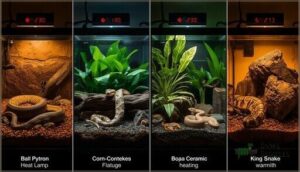
Getting your snake’s temperature right isn’t one-size-fits-all—each species has its own thermal sweet spot. Understanding these specific needs is your first step toward creating a safe, comfortable habitat, especially when outside temps drop.
Here’s what four popular pet snakes need to thrive in cold climates.
Ball Python Heating Needs
Your ball python’s lifeline hinges on precise heat sources that support snake thermoregulation. Target a warm side of 88–92°F and a cool side around 78–82°F to establish the temperature gradient these ectotherms require.
Heat mats paired with reliable temperature control prevent overheating, while 50–60% humidity control aids shedding. Reptile heating equipment isn’t optional—it’s critical for digestion and immune function in cold climates.
Corn Snake Temperature Ranges
Corn snakes thrive with heat sources that create a thermal gradient from 84–88°F on the warm side to 72–75°F on the cooler end. This temperature control facilitates natural thermoregulation without the stress of overheating.
- Target basking spots around 84–88°F for active digestion
- Maintain cool zones near 72–75°F for temperature gradients
- Keep humidity levels at 40–60% during thermal cycles
- Use thermostats to prevent sudden drops that disrupt metabolism
- Monitor multiple points to verify consistent reptile heating
Boa Constrictor Warmth Preferences
Boas need sturdy thermal management with basking zones around 88–92°F and cooler refuges near 78–82°F. Your boa constrictor care strategy should prioritize stable thermal gradients that support digestion without stress.
Heat mats anchor one side of your boa habitat, while humidity control at 50–70% complements warmth levels. Thermoregulation depends on consistent reptile heating—prolonged exposure below 78°F compromises immune function and metabolism.
King Snake Adaptability
King snakes showcase impressive cold climate adaptability, tolerating brief fluctuations that would stress tropical species. Your King Snake care starts with a warm side at 82–86°F and a cool zone near 72–78°F.
Adaptive heating through a controlled thermal gradient facilitates natural snake behavior, allowing relocation between microhabitats. Thermoregulation tips emphasize consistent heat distribution—avoiding cold spots preserves digestion and fortifies reptile care in your snake habitat.
Choosing The Right Heating Pad for Cold Environments

Not all heating pads are created equal, especially when you’re fighting frigid temperatures. The right pad needs to fit your enclosure properly, maintain precise temperature control, and stand up to the demands of long-term use in cold climates.
Here’s what to look for when you’re selecting equipment that’ll keep your snake warm and safe.
Size and Fit for Enclosures
You need a heat mat that covers 25–40% of your enclosure floor to create proper thermal gradients without overheating confined zones. Match pad sizing to your enclosure dimensions—glass terrariums and PVC setups respond differently to heat distribution.
Substrate depth matters too; thicker bedding insulates heat, so you’ll need a larger pad. For most reptile enclosures, a properly sized heat mat prevents dangerous cold spots.
Temperature Control Features
Thermostat settings give you precision control down to half-degree increments—critical when your snake’s thermoregulation depends on a reliable thermal gradient. Look for these features:
- Digital displays showing real-time temperature readouts for instant monitoring
- Adjustable ramp rates that warm gradually, minimizing stress on ectothermic animals
- High-limit cutoffs preventing dangerous overheating in cold climates
- Closed-loop feedback maintaining your heat mat’s target zone
- External probe compatibility measuring substrate hotspots accurately
Proper temperature gradients separate safe heating from guesswork.
Moisture Resistance and Safety Certifications
Waterproof materials with UL-listed electrical insulation protect your heat mat from humid enclosure conditions—critical when moisture control meets temperature control. Check for IPX4 ratings or higher indicating splash resistance. Safety marks like UL or CE certify moisture testing and compliance with certification standards.
Pair your pad with a reliable thermostat featuring sealed connections; proper certification standards prevent short circuits that turn lifesaving warmth into electrical hazards.
Safe Installation and Use of Snake Heating Pads
Installing a heating pad correctly is your first line of defense against cold stress and thermal burns. Even the best equipment can fail your snake if you skip proper placement, temperature regulation, or routine safety checks.
Here’s how to set up and maintain heating pads that keep your snake warm without putting them at risk.
Proper Pad Placement and Positioning

Position your heat mat under one side of the enclosure to establish a thermal gradient—your snake’s lifeline for thermoregulation. This placement creates distinct thermal zones: a warm basking area (28–32°C) and a cooler retreat (20–25°C).
Align the pad with your enclosure design to avoid dead zones where heat sources can’t reach. Never place it directly beneath hides; overheating in tight spaces compromises safety features you’ve carefully planned.
Using Thermostats for Temperature Regulation
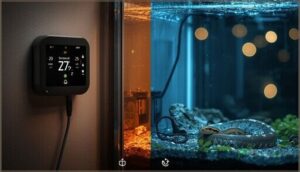
A reliable thermostat transforms your heat pad from a simple warmer into a precision heating system. Set your basking zone to 28–32°C, cool end to 20–25°C—the thermostat’s probe inside the enclosure reads temperatures constantly, adjusting power to maintain that thermal gradient.
Look for models with safety shutoffs and temperature alarms. They prevent dangerous spikes while you sleep, ensuring reptile safety around the clock.
Monitoring With Thermometers and Hygrometers

Your thermostat’s working—now verify it. Place temperature probes at both the basking zone and cool retreat to map your thermal gradient accurately.
Position hygrometers near the substrate surface to track humidity control shifts throughout the day.
Use at least two independent thermometers per enclosure; sensor calibration matters when you’re protecting an ectothermic life that can’t tell you something’s wrong.
Preventing Burns and Electrical Hazards
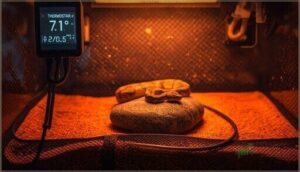
Even with accurate temperature monitoring, heating equipment can still injure your snake. Pair your heat mats with a reliable thermostat featuring overheat protection—auto shutoff prevents surface temps from exceeding safe thresholds.
Look for water-resistant pads with IP44 ratings or higher to minimize electrical safety risks in humid enclosures.
Inspect cords and plugs weekly; frayed wiring near moisture creates real burn risk factors you can’t ignore.
Top 9 Snake Heating Pads for Cold Climates
Not all heating pads are built the same, especially when you’re dealing with cold climates that demand reliable, consistent warmth. You need equipment that won’t fail your snake when temperatures drop and house heating struggles to maintain adequate thermal gradients.
Here are nine heating pads that deliver dependable performance for cold-weather reptile keeping.
1. Aiicioo Reptile Heating Pad
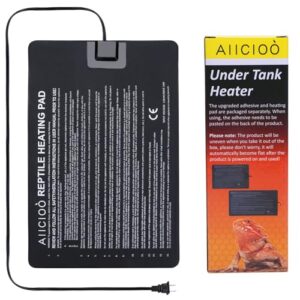
You’ll find the Aiicioo Reptile Heating Pad hits a sweet spot for budget-conscious keepers needing reliable warmth. This 16-watt mat suits medium 30-40 gallon enclosures, delivering gentle heat through its ultra-thin design with adhesive backing for external tank mounting.
Temperature Control remains critical—you must pair it with a separate thermostat since there’s no built-in regulation.
While Heat Mat Safety concerns arise from durability reports showing units failing within a year, proper Pad Installation with rubber feet elevation and regular electrical inspections minimize risks, supporting healthy thermoregulation when monitored closely.
| Best For | Budget-conscious reptile owners with 30-40 gallon terrariums who already own a reliable thermostat and need a basic, energy-efficient heating solution for snakes, lizards, or hermit crabs. |
|---|---|
| Power | 16W |
| Material | Polyvinyl Chloride |
| Voltage | 120V |
| Installation Method | Adhesive mounting |
| Temperature Control | No thermostat |
| Suitable For | Reptiles, snakes, lizards |
| Additional Features |
|
- Energy-efficient 16-watt design provides gentle, uniform heat across medium-sized enclosures without hot spots or high electricity costs.
- Ultra-thin profile with adhesive backing and rubber feet makes installation straightforward on glass tank exteriors.
- Affordable price point ranks it #1 in terrarium heat mats, offering solid value for basic heating needs.
- Requires separate thermostat purchase since there’s no built-in temperature control, adding to total setup cost.
- Durability concerns are common, with many units reportedly failing within the first year of use.
- Adhesive quality is inconsistent and may not hold properly on all surfaces, requiring alternative mounting solutions.
2. Reptile Heat Pad Mat
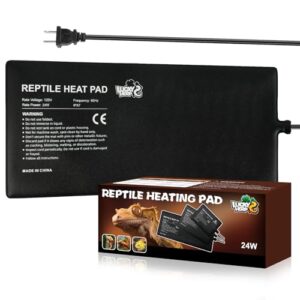
This 24-watt waterproof PVC mat delivers uniform heat distribution across its 8×18-inch surface, raising ambient temperatures 10-20°F—critical for thermoregulation in cold homes. You’ll appreciate the dual-layer protection system and moisture-sealed connections that prevent electrical hazards.
However, adhesive failures plague some installations, and you must pair it with external thermostat controls since there’s no built-in regulation.
The ultra-thin mat materials conform well to glass terrariums, but substrate thickness dramatically impacts energy efficiency—thick bedding creates frustrating hot-mat-cold-snake scenarios that defeat proper reptile heating.
| Best For | Reptile owners needing a reliable, energy-efficient heat source for glass terrariums in cooler environments, especially those willing to invest in a separate thermostat for proper temperature control. |
|---|---|
| Power | 8W |
| Material | Glass, Plastic |
| Voltage | 120V |
| Installation Method | Adhesive mounting |
| Temperature Control | No built-in |
| Suitable For | Bearded dragons, snakes |
| Additional Features |
|
- Waterproof PVC construction with dual-layer safety protection makes it durable and safe for humid reptile enclosures
- Energy-efficient 24W design provides consistent 10-20°F temperature increase across the full 8×18-inch surface
- Thin, flexible mat conforms well to glass tanks and works for multiple pets including turtles, snakes, lizards, and hermit crabs
- Adhesive backing frequently fails to stick properly, requiring careful installation and sometimes additional securing methods
- No built-in thermostat means you must purchase a separate controller to prevent dangerous overheating
- Thick substrate layers block heat transfer, creating uneven warming that can leave your reptile too cold despite a hot mat
3. Aiicioo Reptile Heat Pad Thermostat
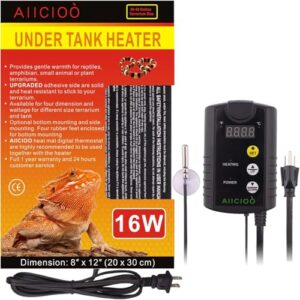
You’ll need a reliable thermostat to prevent fatal overheating—this digital controller adjusts from 32-140°F, letting you dial in species-specific thermal gradients with precision. The sensor reads pad surface temperatures continuously, cycling power to maintain your setpoint within 2-3 degrees.
Proper pad placement under one-third of the enclosure creates that critical temperature gradient ball pythons and boas demand. While it lacks overheat auto-shutoff found in premium models, its simple three-button interface and clear display make daily temperature control straightforward for both novice and experienced keepers managing reptile heating in cold homes.
| Best For | Snake keepers in cold climates who need precise temperature control for species like ball pythons, corn snakes, and boas that require specific thermal gradients between 28-32°C on the warm side. |
|---|---|
| Power | 24W |
| Material | Waterproof PVC |
| Voltage | N/A |
| Installation Method | Adhesive mounting |
| Temperature Control | Constant temp |
| Suitable For | Turtles, lizards, snakes |
| Additional Features |
|
- Digital display with adjustable range (32-140°F) lets you set exact temperatures and monitor them continuously without guesswork
- Creates proper thermal gradients when placed under one-third of the enclosure, giving snakes both warm and cool zones they need for healthy digestion
- Simple three-button interface makes daily adjustments easy, even for first-time reptile owners setting up heating systems
- Lacks automatic overheat shutoff found in higher-end models, requiring you to monitor temperatures with a separate thermometer for safety
- Adhesive quality can be inconsistent, with some units losing grip over time and requiring repositioning or additional mounting solutions
- Durability concerns reported by users, with some thermostats failing within the first year of regular use
4. Hapinary Reptile Heating Pad Mat
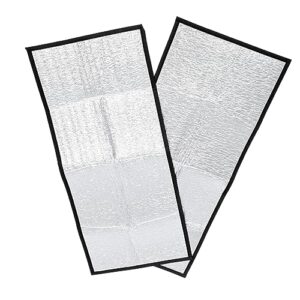
This ultra-thin mat delivers an ambient temperature increase of 10-20°F, enough to establish meaningful temperature gradients for corn snakes and king snakes in drafty homes. Its aluminum film construction with pearl cotton backing distributes heat uniformly across 26.77 inches, preventing hotspots that torch scales.
While the assorted-color design won’t win aesthetics awards, moisture-sealed electrical connections resist humidity exposure. You’ll appreciate its flexibility for custom positioning, though durability concerns in wet bioactive setups mean you’ll want a protective barrier between substrate and heating surface for long-term reptile comfort.
| Best For | Snake owners in cooler climates who need a reliable, low-profile heating solution to maintain proper temperature gradients in glass terrariums without taking up vertical space. |
|---|---|
| Power | 16W |
| Material | Adhesive |
| Voltage | 120V |
| Installation Method | Adhesive mounting |
| Temperature Control | Digital thermostat |
| Suitable For | Hermit crabs, lizards |
| Additional Features |
|
- Provides consistent 10-20°F ambient temperature increase with uniform heat distribution across 26 inches, preventing dangerous hotspots that can burn reptile scales
- Ultra-thin profile at 0.04 inches allows flexible placement under tanks or along walls without disrupting enclosure setup or substrate depth
- Moisture-sealed electrical connections offer better humidity resistance than standard pads, reducing short-circuit risks in moderate-moisture environments
- Assorted color design looks cheap and may show through transparent tank bottoms, affecting display aesthetics
- Durability questions in bioactive setups with high moisture mean you’ll need protective barriers, adding installation complexity
- Lacks integrated thermostat requiring separate purchase to prevent overheating, unlike competitor products with built-in temperature control
5. Reptile Heat Pad With Thermostat
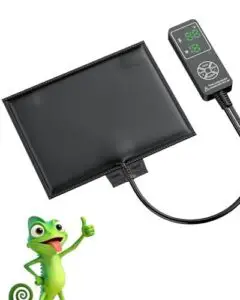
When you pair a heat mat with a reliable thermostat, you’re building a reptile heating solution that maintains the temperature gradient your snake’s thermoregulation demands. This combination gives you adjustable setpoints from 68-135°F, letting you dial in ball python basking zones at 88-92°F or corn snake warmth near 85-90°F.
The graphene pad materials conduct heat evenly while safety features like auto-shutoff prevent those nightmare overheating scenarios.
Position the probe directly on the mat surface—that’s where temperature control matters most for consistent, burn-free warmth.
| Best For | Reptile owners who want precise temperature control for species like ball pythons, corn snakes, and boas that need consistent warm zones between 82-92°F. |
|---|---|
| Power | N/A |
| Material | Aluminum film |
| Voltage | N/A |
| Installation Method | Insulation mat |
| Temperature Control | No thermostat |
| Suitable For | Spiders, tortoises, snakes |
| Additional Features |
|
- Adjustable digital thermostat with wide range (68-135°F) lets you dial in exact temperatures for different species and prevents dangerous overheating
- Graphene material heats evenly across the entire 8″ x 5.9″ surface, eliminating hot spots that could burn your reptile
- IPX7 waterproof rating and auto-shutoff safety features make it reliable for humid terrariums and reduce fire risk
- 8″ x 5.9″ size may be too small for larger enclosures or multiple reptiles
- 5.8-foot cord can be limiting depending on where your outlet is relative to the tank
- Requires careful probe placement and regular calibration checks to maintain accurate temperature readings
6. Reptile Terrarium Heat Mat Pad
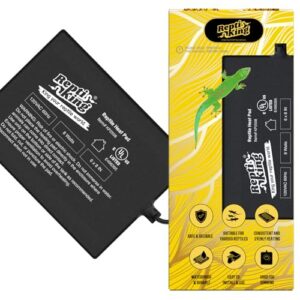
This 6″ × 8″ model delivers 8 watts of targeted warmth through waterproof materials and adhesive backing that simplify pad installation under tanks. The design works beautifully for creating temperature gradients in glass enclosures, but skip it for acrylic tanks where heat mats risk warping.
You’ll appreciate the even heat distribution that aids reptile thermoregulation without hot spots, though you must add an external thermostat—there’s no built-in control.
Regular mat maintenance checks and careful placement prevent burns while your snake regulates its core temperature naturally.
| Best For | Snake owners with glass terrariums who need a straightforward heat source and already own a reliable thermostat to maintain safe temperature gradients. |
|---|---|
| Power | 7W |
| Material | Graphene |
| Voltage | N/A |
| Installation Method | Adhesive mounting |
| Temperature Control | Digital thermostat |
| Suitable For | Reptiles, amphibians |
| Additional Features |
|
- Compact 6″ × 8″ size with 8W output delivers consistent, even warmth perfect for smaller enclosures or targeted warm zones
- Waterproof construction and adhesive backing make installation quick and secure under glass tanks
- Energy-efficient operation keeps electricity costs low during continuous use while supporting natural reptile thermoregulation
- No built-in thermostat means you’ll need to buy a separate controller to prevent dangerous overheating
- Limited 48-square-inch coverage may require multiple pads for larger tanks, adding to total cost
- Not compatible with acrylic enclosures or heat-sensitive materials that could warp or melt
7. Repti Home Reptile Heat Pad Thermostat
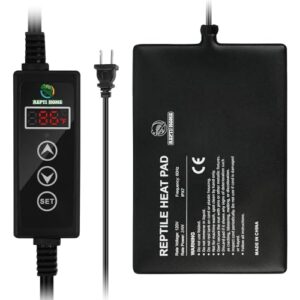
This 8″ × 18″ heat mat pairs 24 watts with an intelligent PID thermostat that holds temperatures between 68°F and 122°F—perfect for fine-tuning basking zones in cold rooms.
The IPX7 waterproof rating and strong adhesive backing handle humid enclosures, though some keepers report sticky residue on glass during removal.
You’ll get uniform heat distribution that aids steady thermoregulation, but always verify thermostat settings with a separate thermometer since calibration drift occasionally occurs.
Energy efficiency stays solid for 24/7 operation in chilly climates.
| Best For | Snake keepers in cold climates who need a reliable heat source with precise digital temperature control for maintaining consistent warm zones year-round. |
|---|---|
| Power | 8W |
| Material | Waterproof |
| Voltage | N/A |
| Installation Method | Adhesive mounting |
| Temperature Control | No thermostat |
| Suitable For | Bearded dragons, snakes |
| Additional Features |
|
- PID thermostat lets you dial in exact temperatures between 68°F and 122°F, so you can create stable basking spots even when room temps drop
- IPX7 waterproof rating handles high-humidity setups without shorting out, making it solid for tropical species
- 24-watt output runs efficiently around the clock without spiking your electric bill
- Adhesive can leave stubborn residue on glass that’s tough to remove if you ever reposition the mat
- Some users find the thermostat drifts from the set point, so you’ll want a backup thermometer to double-check temps
- Instructions don’t always match the actual controls, which makes initial setup confusing
8. Reptile Vivarium Heat Mat
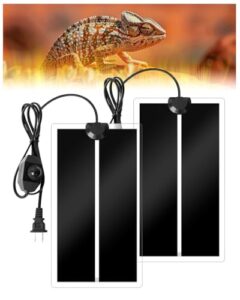
For enclosures in genuinely cold homes, this silicone-encased mat delivers 3W to 24W of steady under-tank warmth—perfect when ambient air hovers near freezing.
You’ll need to pair it with a thermostat that maintains setpoint accuracy within ±1–2°C; otherwise, continuous heat without regulation risks dehydration and thermal runaway.
Digital probes placed near the basking zone confirm true substrate temperature, since thick bedding slows heat transfer.
Check mat surfaces weekly for wear or hotspots, and never fold or insulate the edges—that blocks proper heat distribution and endangers your snake’s thermoregulation.
| Best For | Reptile owners in cold homes who need reliable under-tank heating for snakes, lizards, or other belly-heat species and are willing to invest in a separate thermostat for safe temperature control. |
|---|---|
| Power | 24W |
| Material | Waterproof |
| Voltage | N/A |
| Installation Method | Adhesive mounting |
| Temperature Control | PID thermostat |
| Suitable For | Hermit crabs, turtles |
| Additional Features |
|
- Delivers consistent 7W warmth across a 15 × 28cm surface, creating a stable thermal gradient when paired with a thermostat
- Thin 0.57mm profile and removable design make it easy to install under terrariums or along the side without taking up habitat space
- Slow-heating technology and damp-proof construction reduce the risk of sudden overheating or moisture damage in typical enclosures
- No built-in thermostat means you’ll need to buy a separate controller to avoid dangerous temperature spikes and dehydration
- Limited 7W output may struggle to warm larger enclosures or maintain proper heat in very cold rooms
- Lacks full waterproofing, so high-humidity setups or accidental spills can damage the mat over time
9. ZJchao Reptile Heating Pad
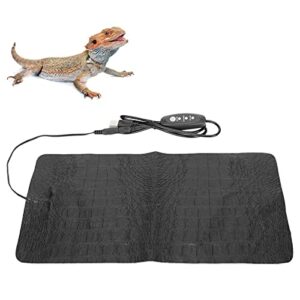
With flexible PU leather construction and three adjustable temperature settings, the ZJchao pad lets you fine-tune warmth for smaller snake species without overwhelming cold-climate enclosures.
Heat Mat Safety hinges on pairing this unit with an external thermostat—its modest wattage won’t self-regulate, risking cool spots during severe cold snaps.
Reptile Thermoregulation demands that you verify substrate temperatures with a probe thermometer, since the short cord may limit Pad Installation options.
Check nightly for even Temperature Gradients and inspect moisture-sealed connections to protect your snake’s health.
| Best For | Small snake owners who need affordable, adjustable heating for compact enclosures and are willing to monitor temperatures closely with a separate thermostat and thermometer. |
|---|---|
| Power | 7W |
| Material | Damp-proof |
| Voltage | N/A |
| Installation Method | Bottom or side |
| Temperature Control | Adjustment dial |
| Suitable For | Turtles, snakes, geckos |
| Additional Features |
|
- Three temperature settings let you dial in the right warmth level for your specific snake species and seasonal changes.
- Flexible PU leather design fits easily into tight spaces and cleans up quickly after spills or substrate changes.
- Low-profile installation keeps the heating element out of sight while providing consistent surface warmth for basking zones.
- Requires an external thermostat for safe operation since the unit won’t self-regulate temperature, adding to your initial setup cost.
- Short cord length can restrict where you place the pad inside or under your enclosure, limiting flexibility.
- Some users report inconsistent performance over time, with reliability issues that may leave your snake without adequate heat.
Benefits and Drawbacks of Heating Pads in Cold Homes

Heating pads are your snake’s lifeline in cold homes, but they aren’t perfect. Understanding both their advantages and limitations helps you create a safe thermal environment that maintains your reptile’s health.
Let’s examine what heating pads do well and where they fall short.
Promoting Consistent Warmth and Health
Your snake’s metabolic rate stabilizes when heat mats deliver reliable warmth. Thermal regulation through proper temperature gradients promotes digestion, immune function, and shedding quality.
Consistent reptile heating reduces cold stress indicators like lethargy and appetite loss. Using a thermostat with your heat therapy setup allows health monitoring through temperature control, preventing metabolic swings that compromise reptile wellness and thermoregulation.
Limitations With Substrate and Bioactive Setups
Thick bedding layers act as thermal insulation, blocking heat mats from creating proper temperature gradients your snake needs for thermoregulation.
Substrate interference disrupts heat distribution in naturalistic setups:
- Deep bioactive substrates trap heat beneath the surface, leaving your snake in cold microhabitats while the mat overheats
- Moisture control becomes challenging as damp soil reduces heat retention and breeds mold
- Plant roots suffer damage from concentrated warmth, compromising bioactive risks and ecosystem health
A thermostat won’t fix these fundamental design conflicts.
Risks of Overheating and Fire Hazards
Malfunctioning thermostats trigger thermal runaway events, pushing surface temps past 109°F and causing severe burn risks to your snake’s delicate ventral scales. Without proper heat regulation, your thermal gradient collapses, compromising thermoregulation while escalating danger in your reptile’s enclosure.
Frayed cords and moisture ingress create electrical safety nightmares—substrates can ignite when heating equipment fails. Fire prevention demands UL-certified heat sources and routine inspections.
Tips for Optimizing Heat and Humidity Balance
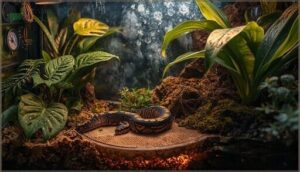
Heating your snake’s enclosure isn’t just about cranking up the temperature—it’s about creating a balanced environment where warmth and moisture work together. Cold climates throw an extra challenge your way, making it harder to maintain the humidity levels your snake needs while keeping temperatures stable.
Here’s how to fine-tune both elements so your snake stays comfortable, healthy, and stress-free all winter long.
Selecting Humidity-Friendly Heating Solutions
When you’re juggling thermoregulation and moisture management, ceramic heat emitters emerge as your reliable reptile heating solutions. These heat source options don’t dry out enclosures like lamps do, supporting humidity control and misting systems without condensation nightmares.
Look for IP-rated thermal safety features and moisture-resistant housings—certifications that protect electrical components while maintaining reptile comfort. Your snake’s health depends on this balance.
Maintaining Proper Enclosure Moisture
Your heat retention strategy means nothing if moisture management derails your snake’s respiratory health. Proper humidity control demands hygrometers placed at snake head height, ventilation systems that prevent stagnant air, and enclosure design balancing misting systems with airflow. Monitor substrate moisture closely—overly damp conditions breed mold and scale rot.
- Position hygrometers near substrate and at mid-enclosure height for accurate readings
- Schedule misting routines to raise humidity temporarily, allowing drying periods between sessions
- Clean water bowls regularly to maintain water quality and prevent bacterial growth affecting ambient moisture
Seasonal Adjustments for Cold Weather
Winter brings thermoregulation challenges that demand seasonal pacing of your heating strategy. You’ll need to maintain temperature gradients by adjusting thermostat setpoints gradually—drop basking zones 3–5°C over 1–2 weeks during fall cooldown to prevent cold stress.
Your heat mats and humidity management systems require recalibration as ambient temperatures shift.
Monitor behavioral cues like feeding response; they’re your clearest indicators that winter care tips are working.
Frequently Asked Questions (FAQs)
Can heating pads be used with glass enclosures?
Yes, heating pads work with glass enclosures when you pair them with thermostats for proper heat transfer and monitor temperatures closely. This setup prevents dangerous hotspots while ensuring your snake’s thermoregulation needs are met safely.
How often should heating pads be replaced?
Like a car tire wearing down mile by mile, snake heating pads degrade with use. Replace them every one to two years under normal conditions, or sooner if you spot frayed cords, temperature inconsistencies, or visible surface damage.
Do heating pads work during power outages?
Standard heating pads won’t function during power outages unless paired with backup power like a UPS or battery system.
Low voltage heat mats connected to emergency heating sources provide thermal backup, maintaining critical thermoregulation when electricity fails.
Are heating pads safe for baby snakes?
Heat mats pose thermal burn risks for hatchlings without proper thermostat regulation.
Baby snakes need gentle, monitored warmth—position heat pads on enclosure sides, never directly underneath, and verify temperatures daily with calibrated thermometers for safe neonate care.
Can multiple heating pads be used together?
You can use multi pad systems to create a broader thermal gradient, but independent thermostats are critical.
Calibrate each heat mat separately to prevent hot spots and maintain proper thermoregulation through careful heat distribution monitoring.
Conclusion
Think of your heating setup as your snake’s winter armor—without it, cold becomes the silent predator. Snake heating pads for cold climates transform survival into stability, letting your reptile thrive when outdoor temperatures turn hostile.
Pairing the right equipment with thermostats and vigilant monitoring creates a microclimate where digestion, immunity, and activity levels remain ideal. Your investment in reliable heating infrastructure doesn’t just prevent emergencies—it ensures your snake stays healthy, active, and resilient through every cold snap.
- https://doi.org/10.3390/ani6100059
- https://www.reptifiles.com/wp-content/uploads/2020/01/Why-Infrared-Matters-by-Roman-Muryn.pdf
- https://reptifiles.com/
- https://academichelpexpress.blog/2024/08/please-use-the-bulleted-points-and-the-rubric-below-to-guide-your-work-your-pa/
- https://x.com/godofprompt/status/1990526288063324577