This site is supported by our readers. We may earn a commission, at no cost to you, if you purchase through links.
desert snakes don’t die from bad feeding schedules or incorrect temperatures—they deteriorate slowly from the ground up, starting with whatever they’re lying on 24 hours a day. The substrate you choose dictates more than aesthetics: it controls humidity buffering, thermal gradient quality, burrowing opportunity, and whether your snake’s ventral scales stay healthy or start showing wear.
Get it wrong, and you’re fighting a losing battle against scale rot, respiratory irritation, and chronic stress.
Choosing the right snake substrate bedding for desert setups means matching your species’ natural microhabitat conditions as closely as captivity allows—and the differences between products matter more than most keepers realize.
Table Of Contents
- Key Takeaways
- Key Factors in Choosing Desert Snake Substrate
- Comparing Popular Desert Substrate Types
- Top 7 Substrate Bedding Products for Desert Setups
- Substrate Maintenance for Healthy Desert Enclosures
- Health, Safety, and Eco-Friendly Considerations
- Frequently Asked Questions (FAQs)
- What substrate for desert kingsnake?
- What is an arid snake substrate?
- What substrate is good for high humidity?
- Can substrate affect a desert snakes feeding response?
- How do escape attempts relate to substrate choice?
- What substrate works best for snake egg incubation?
- Do hatchlings need different substrate than adult snakes?
- How does substrate interact with under-tank heating equipment?
- Conclusion
Key Takeaways
- Substrate depth—at least 4–6 inches for most desert species—isn’t optional; it’s what gives your snake the thermal gradient and burrowing behavior it needs to self‑regulate and stay calm.
- Particle size and shape directly affect how your snake moves and whether its ventral scales stay intact, with intermediate grains (0.5–1 mm) being the sweet spot for efficient locomotion.
- Matching substrate to your specific species matters more than picking a "good general option"—western hognose, Kenyan sand boas, and desert kingsnakes each have non‑negotiable requirements that a one-size-fits-all approach will quietly get wrong.
- Daily spot‑cleaning, biweekly humidity checks, and a full replacement schedule of 1–3 months aren’t busywork—they’re what keep even the best substrate from becoming a health hazard over time.
Key Factors in Choosing Desert Snake Substrate
Picking the right substrate isn’t just about aesthetics — it directly shapes your snake’s health, stress levels, and natural behavior.
Getting this right for your specific species makes all the difference, and snake species habitat design guides can help you match substrate to your snake’s natural environment.
A few key factors determine whether a substrate works or falls short in a desert setup.
Here’s what you need to evaluate before committing to any product.
Importance of Substrate Depth for Burrowing and Thermoregulation
Substrate depth isn’t just cosmetic — it’s the foundation of healthy burrowing behavior and thermoregulation. Hognose snakes need at least 4–6 inches to create stable tunnels and escape surface heat above 95°F.
That vertical thermal gradient, from 75°F at the bottom to 90°F at the top, lets your snake self‑regulate precisely.
- Burrowing Depth Standards: 4–6 inches minimum for most desert species
- Thermal Gradient Benefits: deeper layers buffer temperature swings and reduce hot spots
- Stress Reduction Mechanisms: fully submerging reduces defensive behaviors and facilitates calmer feeding
Implementing an effective heat gradient helps maintain stable temperatures for desert species.
Particle Size and Shape Effects on Snake Movement
grain size directly shapes how your snake moves.
intermediate particles — roughly 0.5–1 mm — provide enough frictional grain size for lateral undulation without resistance. angular grain impact matters too: sharp edges increase ventral scale wear over time, while rounded grains support smoother waveform adaptation.
Research on Eremias arguta shows that intermediate particle sizes boost locomotion efficiency.
| Grain Type | Effect on Snake Behavior |
|---|---|
| Fine sand (0.05–0.2 mm) | Slows movement, increases burrowing traction |
| Intermediate (0.5–1 mm) | Enables efficient lateral undulation |
| Coarse/angular | Causes slipping, raises scale abrasion |
| Packed surface firmness | Improves push‑points, reduces energy loss |
Humidity Control in Arid Enclosures
Once you’ve nailed particle size, humidity control becomes your next balancing act.
Desert snakes like rosy boas thrive at 20–40% ambient humidity — so Microclimate Zoning matters.
Use a humidity hide on the warm side packed with coconut fiber or cypress mulch, monitor with a Digital Hygrometer, and dial in Misting Frequency to short 10–30 second bursts.
Ventilation Strategies and Humidity Hide Placement do the rest.
Impact of Substrate Material on Temperature Gradients
What your snake stands on directly heat moves through the enclosure.
Darker desert substrate absorbs radiant heat more aggressively, creating reliable microclimate zones your snake uses to fine‑tune thermoregulation through burrowing behavior.
Sand’s high thermal conductivity warms quickly under heat mats and holds that warmth for hours — perfect for reinforcing temperature gradients.
Thick coconut fiber, by contrast, insulates against under‑tank heaters, blocking surface warmth.
Species-specific Substrate Needs
Every desert snake has a non-negotiable list — ignore it and you’ll watch them stress in plain sight. Match substrate to species-specific needs using these five rules:
- Fossorial burrowing depth: Western hognose needs 4–5 inches; Kenyan sand boas need 4–6 inches
- Hognose humidity pockets: Use 70% topsoil/30% sand to hold moisture below the surface
- Semi-fossorial microclimates: Mixed dry and damp zones let desert snakes self‑regulate
- Kingsnake surface texture: Dry aspen or soil‑sand blends support active surface roaming
- Exclusion substrate rules: No cedar, pine, gravel, or flat paper — ever
Comparing Popular Desert Substrate Types
Not all substrates are created equal — and for desert snakes, the wrong pick can affect everything from shedding success to stress levels.
Each option below brings a different set of trade-offs in moisture control, safety, and naturalistic appeal. Here’s how the most popular choices stack up.
Reptile-safe Sand for Natural Aesthetics
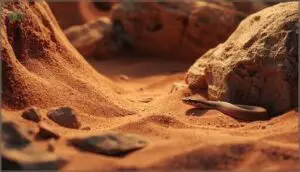
Few substrates nail desert aesthetics like reptile sand — and the visual payoff is real.
Natural Color Palette options in tan, red, or off-white deliver authentic Color Matching against rocks and hides.
Texture Variation between grains affects Lighting Interaction, making Scenic Dunes pop.
| Feature | Detail |
|---|---|
| Color options | Desert white, natural red |
| Grain size | Fine to medium |
| Best use | Desert substrate layouts |
| Depth (non-burrowers) | 3–4 inches |
| Depth (burrowers) | 6+ inches |
Rinse sand substrates before use.
Aspen Shavings for Absorbency and Safety
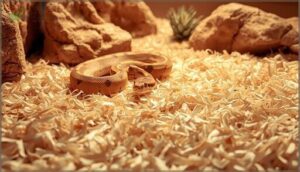
Aspen shavings punch above their weight in desert snake care. Kiln-dried to 10–15% moisture, they deliver reliable absorbency without getting soggy fast.
Low‑Dust Processing removes fine particles that would otherwise irritate airways in dry setups. Heat Treatment kills pathogens before the bag reaches you.
Ammonia Binding keeps Odor Management manageable between spot cleans — and Dust Control stays consistent even in arid enclosures.
Cypress Mulch for Mold Resistance
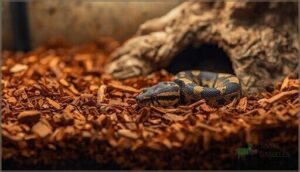
Cypress mulch earns its place in desert substrate shortlists because of its natural antifungal oils — compounds that actively resist mold even when you’re managing a humid hide in an otherwise dry tank.
Its airflow particle structure and chip size benefits keep oxygen moving through the bedding, preventing soggy pockets.
Slow decomposition means less frequent full swaps, and eco‑friendly disposal is straightforward.
Coconut Fiber for Biodegradability and Moisture Control
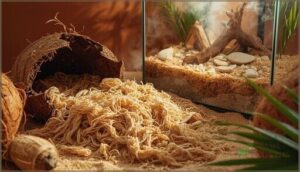
Coconut fiber pulls double duty in desert setups — strong odor absorption and a moisture retention capacity of up to 11 times its dry weight make it surprisingly adaptable when kept mostly dry.
- Expansion Ratio: One compressed brick covers a 55-gallon tank fully hydrated
- Humidity Control: Dry surface layers maintain arid conditions; deeper pockets buffer gently
- Composting Benefits & Carbon Sequestration: Fully biodegradable, compostable post-use, sourced from carbon-sequestering coconut trees
- Sustainable Shipping: Compressed blocks reduce transport emissions considerably
Bioactive Substrate Blends for Ecosystem Replication
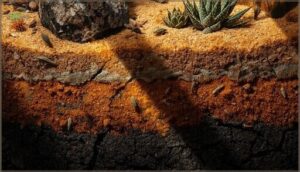
Bioactive substrate blends are the closest thing to bottling the actual desert floor.
Your mix — 60% organic topsoil, 40% play sand, plus 5% charcoal for pH balance — facilitates real nutrient cycling through microfauna selection like powder blue isopods and springtails.
Smart layering strategies with 4‑inch depth, plant integration using aloe or echeveria, and intentional terrarium design make ecosystem replication genuinely achievable in reptile substrate selection.
Top 7 Substrate Bedding Products for Desert Setups
Not every substrate earns a spot in a desert setup — most fall short on dust control, particle size, or moisture management.
These seven products have proven themselves across a range of desert-dwelling species, from sand boas to western hognose snakes.
Here’s what’s worth your money in 2026.
1. Zilla Coconut Husk Brick Reptile Bedding
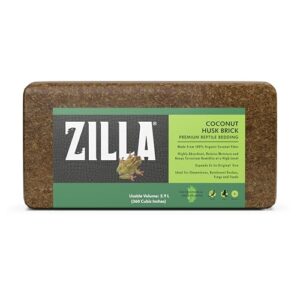
coconut husk brick punches above its weight for a compressed block weighing just 1.3 pounds. Add about a gallon of hot water, wait ten minutes, and you’ve got enough expanded substrate to cover a standard 55‑gallon terrarium floor.
It’s 100% organic coconut fiber — no dyes, no aromatic oils that can irritate airways.
The fibrous, chunky texture resists compaction and facilitates burrowing.
Best suited for humid hides or lay boxes within desert setups, rather than the main arid floor zone.
| Best For | Reptile and amphibian owners who keep tropical species like chameleons, rainforest geckos, frogs, and toads and need a natural substrate that holds humidity well. |
|---|---|
| Material | Coconut Fiber |
| Odor Control | Moderate |
| Humidity Retention | High |
| Organic | Yes |
| Reptile Suitable | Yes |
| Weight | 1.3 lbs |
| Additional Features |
|
- Expands up to 5x its size from a single compact brick — great value for the shelf space it takes up
- 100% organic coconut fiber with no dyes or added oils, so it’s safe for sensitive animals
- Chunky, fibrous texture holds its structure and encourages natural burrowing behavior
- Rehydrating can get messy, and breaking up clumps takes some patience
- Has a noticeable earthy smell right after you add water — it fades, but it’s strong at first
- Not ideal as the main substrate for desert setups; works better in humid hides or lay boxes
2. Zilla Jungle Mix Terrarium Bedding
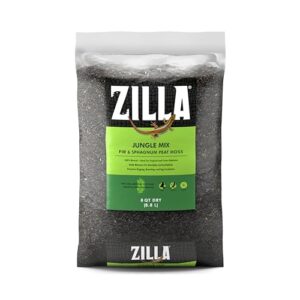
Where coconut husk excels in humid hides, Jungle Mix takes a different angle — it’s built for forest and tropical setups, blending aged Douglas fir bark with sphagnum peat moss into a soft, loamy base.
That peat holds moisture without getting soggy, which makes it genuinely useful for a humid hide or nesting box inside an otherwise arid enclosure.
At 8 quarts per bag, it’s easy to section off a corner without committing your whole desert build to a tropical substrate.
| Best For | Reptile owners setting up tropical or forest terrariums for frogs, geckos, toads, and snakes who want a natural, humidity-friendly substrate. |
|---|---|
| Material | Douglas Fir & Peat Moss |
| Odor Control | Moderate |
| Humidity Retention | High |
| Organic | Yes |
| Reptile Suitable | Yes |
| Weight | 5.8 lbs |
| Additional Features |
|
- Blends aged Douglas fir bark and sphagnum peat moss for a soft, natural feel that mimics forest floor conditions
- Holds moisture well, making it great for humid hides, nesting spots, and egg incubation
- Encourages natural behaviors like digging and burrowing, which keeps reptiles active and comfortable
- Can dry out faster than expected — sometimes within 24 hours — so you may need to mist more often than you’d like
- The larger, sharper bark pieces make it a poor fit for salamanders and could cause splinters if you’re not careful handling it
- May need to be mixed with another substrate to get the moisture balance just right for your setup
3. Riare Coconut Fiber Terrarium Bedding
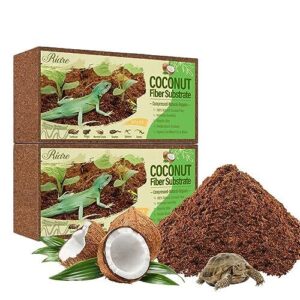
Riare takes a compressed-brick approach — drop it in warm water, and it expands into a loose, crumbly fiber that’s genuinely easy to work with.
At 2.73 pounds per unit, it covers a small to medium enclosure without waste.
The coconut husk material holds localized moisture well, so you can keep one corner slightly damp for shedding support while the main floor stays dry.
It’s low-dust, fully compostable, and soft enough that active ground-dwellers won’t abrade their scales while moving across it.
| Best For | Reptile, amphibian, and invertebrate owners who want a natural, moisture-friendly substrate that supports burrowing and healthy shedding. |
|---|---|
| Material | Coconut Fiber |
| Odor Control | High |
| Humidity Retention | High |
| Organic | Yes |
| Reptile Suitable | Yes |
| Weight | 2.73 lbs |
| Additional Features |
|
- Expands easily from a compressed brick — just add warm water and you’ve got a loose, workable substrate ready to go
- Holds moisture in targeted spots, so you can keep one corner humid for shedding while the rest stays dry
- Fully compostable, low-dust, and soft enough that it won’t rough up your animal’s scales during daily movement
- Dries out fast — you may need to re-moisten every day or two depending on your setup
- Can stick to glass and hands, which makes spot-cleaning and maintenance a little messier than expected
- Tends to attract flies if you’re housing crickets or live feeders alongside it
4. Fluker’s Tropical Cypress Reptile Bedding
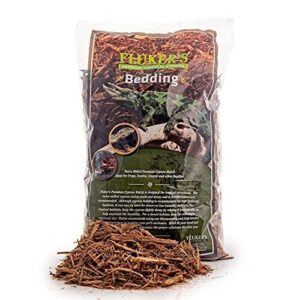
Fluker’s takes a different route — cypress mulch instead of coconut fiber, twice‑milled for uniform, softer pieces that won’t rough up a snake’s belly during routine movement. It’s technically marketed for tropical terrariums, but it works in desert setups as long as you keep it dry and skip heavy misting.
The natural mold resistance means occasional water bowl spills won’t turn your substrate sour overnight.
Available in 5- and 10-quart bags, it’s a practical, low‑maintenance option worth considering.
| Best For | Reptile owners who want a natural, low-maintenance substrate that holds humidity well for tropical setups — or a dry-friendly option for desert tanks. |
|---|---|
| Material | Cypress Mulch |
| Odor Control | Moderate |
| Humidity Retention | Moderate |
| Organic | Yes |
| Reptile Suitable | Yes |
| Weight | 10 lbs |
| Additional Features |
|
- Twice-milled for softer, more uniform pieces that are gentle on snakes and other reptiles
- Naturally resistant to mold, so minor spills won’t ruin the whole substrate
- Works across a wide range of reptiles — frogs, snakes, lizards, tortoises, you name it
- Can dry out fast or get waterlogged if humidity isn’t actively managed
- Has a noticeable hay-and-wood scent that might not work for everyone
- Some buyers have reported receiving product that didn’t match the description — dry sticks instead of actual mulch
5. ReptiChip Coconut Substrate for Reptiles
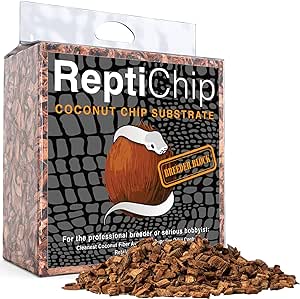
ReptiChip takes the coconut substrate concept further — husk chips rather than fine coir, giving you that chunky, mulch-style texture that desert snakes actually push through without resistance. One compressed 10-pound block hydrates into roughly 72 quarts of bedding, enough to fill multiple enclosures or one deep-layered setup.
The triple-washing process cuts dust and tannin staining, which matters if you’re running glass terrariums.
Run it nearly dry for arid species, or add a humid hide zone — it manages both without breaking down quickly.
| Best For | Reptile owners keeping snakes, turtles, or tortoises who want a natural, odor-controlling substrate that works for both humid and arid setups. |
|---|---|
| Material | Coconut Husk |
| Odor Control | High |
| Humidity Retention | High |
| Organic | Yes |
| Reptile Suitable | Yes |
| Weight | 9.92 lbs |
| Additional Features |
|
- One compressed brick expands into a massive 72 quarts of bedding — great value per use
- Absorbs odors and waste well, keeping enclosures smelling fresh longer
- Flexible moisture control means it works for desert and tropical species alike
- Pricier upfront compared to basic substrate options
- Can kick up dust when you first hydrate it, so handle it somewhere with airflow
- Needs consistent moisture management — let it dry out too much or stay too wet and mold can become an issue
6. Prevue T3 Bird Cage Liner
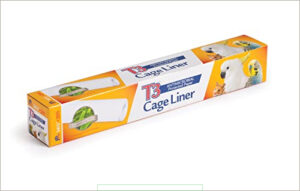
An outlier on this list — the Prevue T3 is a bird cage liner, but it pulls legitimate duty as a disposable desert enclosure floor cover.
Made from all-natural, chemical-free paper with silver ion antimicrobial protection, it catches droppings and spills without harboring bacteria.
It’s compostable, made in the USA, and comes in widths from 9 to 21.5 inches.
Don’t expect burrowing support — it’s purely a hygiene layer for keepers who want fast, no-fuss cleanup between spot cleans.
| Best For | Bird and small animal keepers who want a quick, no-mess liner they can swap out without any fuss. |
|---|---|
| Material | Natural Paper |
| Odor Control | High |
| Humidity Retention | Low |
| Organic | Yes |
| Reptile Suitable | No |
| Weight | Unspecified |
| Additional Features |
|
- All-natural, chemical-free paper means it’s safe around your pets
- Absorbent enough to cut down on odors and keep things tidy between deep cleans
- Works for more than just birds — hedgehogs and other small animals can use it too
- Can curl up and refuse to lie flat, which makes cutting it to size a pain
- Some longtime users say the quality has slipped compared to older versions
- Purely a hygiene layer — don’t expect any burrowing or bedding functionality
7. Zoo Med Aspen Snake Bedding
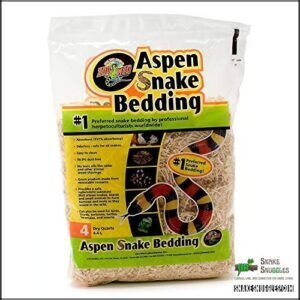
Zoo Med Aspen Snake Bedding earns its spot as a desert staple for good reason. The shavings hit a 191% absorbency rating, lock in liquid waste fast, and stay 99.9% dust free — a real advantage for snakes prone to respiratory irritation.
No toxic oils, no added dyes, just clean renewable aspen.
The pale color makes spot-cleaning straightforward; soiled patches stand out immediately.
Depth is fully adjustable, so you’re in control whether your snake burrows deep or stays surface-level.
| Best For | Snake owners and reptile enthusiasts who want a clean, natural bedding that’s easy to maintain and safe for sensitive animals. |
|---|---|
| Material | Aspen |
| Odor Control | High |
| Humidity Retention | Low |
| Organic | Yes |
| Reptile Suitable | Yes |
| Weight | 9.07 g |
| Additional Features |
|
- Absorbs liquid fast with a 191% absorbency rating, so waste gets locked in before it spreads
- Nearly dust-free, which is a big deal for snakes that are prone to respiratory issues
- The light color makes spot-cleaning easy — soiled areas are obvious at a glance
- Only comes in a 4-quart single count, so if you have a large enclosure or multiple animals, you’ll be reordering often
- Hard to find in physical stores, so you’re basically stuck buying it online
- Can release tannins as it breaks down, which may throw off soil pH if you’re using it in a planted setup
Substrate Maintenance for Healthy Desert Enclosures
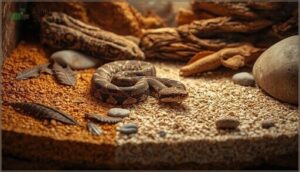
Even the best substrate won’t do its job if you’re not keeping up with it. Maintenance isn’t complicated, but the schedule matters more than most keepers realize.
Here’s what your routine should actually look like.
Daily Spot-cleaning and Odor Prevention
Solid waste starts breaking down fast — feces in a warm desert tank can hit peak odor within 12–24 hours. Daily spot cleaning using a metal sand scoop removes a 5–10 cm radius around each dropping, keeping bacterial buildup minimal.
- Waste removal timing: Pull feces and urates the moment you see them
- Spot cleaning tools: Metal litter scoops sift clean sand back, cutting replacement costs
- Surface disinfection methods: Use chlorhexidine at 1% on soiled glass or decor, then air-dry
- Odor absorbing materials + ventilation strategies: Activated carbon pouches near vents pair well with screen lids to push odor-laden air out
Biweekly Substrate Refresh and Humidity Management
Every two weeks, lift your hides and scoop out buried waste pockets — daily spot‑cleaning misses more than you’d think.
During your substrate refresh, run humidity logging with a digital hygrometer on both tank sides; desert setups should stay between 30–40%. Check the moist hide for mold prevention, replace damp moss, and dial in ventilation adjustment if readings creep above 50%.
Full Substrate Replacement Schedules
Think of full replacement as your reset button — use it when trigger indicators like persistent odor, visible mold, or wet desert substrate appear. For arid snake bedding, a 1–3 month schedule works for most setups; Kenyan sand boas specifically need a swap every 3–4 months.
Bioactive refresh cycles run longer since the cleanup crew manages waste load metrics continuously. Enclosure size impact matters too — smaller tanks soil faster.
Monitoring Depth and Humidity for Optimal Health
Once your replacement schedule is dialed in, don’t let depth and humidity slide between resets. Check substrate depth with a ruler at multiple spots — snakes shift bedding constantly.
For humidity control, place a digital hygrometer at ground level where your snake actually spends time. Log readings in the morning and evening to catch overnight spikes.
Healthy burrowing behavior is your best real-world confirmation that microclimate monitoring is working.
Health, Safety, and Eco-Friendly Considerations
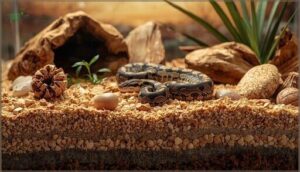
Picking the right substrate isn’t just about looks or burrowing depth — it’s also about keeping your snake safe and your environmental footprint small.
Some materials carry hidden risks, from toxic off-gassing to fine particles that irritate sensitive airways.
Here’s what you need to know before making your final call.
Avoiding Substrate Toxicity and Respiratory Risks
Substrate toxicity is one of those silent threats that can quietly wreck your snake’s health before you spot any symptoms. Cedar and pine release phenols — natural but harmful compounds that damage airways with constant exposure. Stick to untreated materials that pass a simple smell test before going into the enclosure.
Cedar and pine phenols silently damage your snake’s airways long before symptoms ever appear
- Use only chemical‑free bedding — no added fragrances or deodorizers
- Avoid cedar, pine, and any strongly scented woods
- Choose reptile‑labeled brands for safe material testing assurance
- Improve ventilation optimization to prevent fume buildup from waste and cleaners
- Prioritize mold prevention through proper humidity retention management
Effects of Dust and Particle Size on Snake Health
Dust and particle size quietly shape snake behavior and health more than most keepers realize. Fine desert substrate sends particles airborne — respiratory irritation follows fast, with submicrometric grains depositing in tracheal tissue at alarming rates. Sharp edges cause scale abrasion and eye damage during normal movement. Scent obstruction from dust clouds even disrupts chemosensory behavior.
| Health Risk | Dust/Particle Cause |
|---|---|
| Respiratory Irritation | Fine airborne particles inflame lung tissue |
| Eye Damage | Sharp grains scratch corneal spectacles |
| Digestive Impaction | Ingested particles accumulate in gut |
| Scale Abrasion | Coarse edges irritate ventral scales |
Substrate selection and maintenance — including monitoring dust level — directly protects burrowing quality and long‑term health.
Benefits of Biodegradable and Sustainable Substrates
Beyond protecting airways, your substrate choice has a real environmental payoff.
Coconut fiber, cypress mulch, and aspen shavings are renewable, biodegradable materials that support environmental and ecological balance without synthetic fillers. They enable microclimate creation inside the enclosure, assist with waste reduction, and improve long-term cost efficiency — especially in bioactive desert substrate setups where soil enrichment happens naturally through microbial activity.
Composting and Environmental Impact Reduction
Composting used bedding is one of the smartest moves in responsible desert snake care. Materials like coco husk and aspen qualify as compostable bedding — diverting them from landfills cuts methane emission reduction substantially. Here’s what your routine can include:
- Add spent substrate to green cart programs
- Layer with kitchen scraps for carbon footprint lowering
- Reuse finished compost for garden soil reuse
- Remove solid waste first to manage pathogens safely
- Support environmental and ecological balance through reptile substrate selection
reptile conservation and welfare directly to wildlife conservation — one enclosure at a time.
Frequently Asked Questions (FAQs)
What substrate for desert kingsnake?
For a desert kingsnake, aspen shavings or a topsoil-sand blend at 3–4 inches depth works best — supporting natural burrowing behavior while keeping humidity stable around 40–60%.
What is an arid snake substrate?
An arid snake substrate is dry, low-humidity bedding that mimics desert ground conditions — combining sand, soil, and minimal organic material to support dryness balance, heat transfer, burrow stability, and dust minimization throughout your enclosure.
What substrate is good for high humidity?
For high humidity, coconut coir and cypress mulch are your go-to options. Coconut fiber holds moisture for hours, while cypress mulch maintains airflow without getting soggy.
Can substrate affect a desert snakes feeding response?
Yes — substrate hits deeper than aesthetics.
Vibration detection, dust stress, gut blockage risk, and thermal digestion all hinge on what’s underfoot. The wrong bedding can quietly shut down a desert snake’s feeding response entirely.
How do escape attempts relate to substrate choice?
Wrong substrate depth, dusty surfaces, or toxic materials trigger escape attempts — your snake isn’t restless without reason.
Insufficient depth blocks burrowing behavior, and temperature shock from poor gradients keeps them searching for relief.
What substrate works best for snake egg incubation?
For egg incubation, vermiculite mix is your go-to — a 1:1 weight ratio with water nails humidity control without waterlogging.
Perlite ratio adjustments improve gas exchange, while HatchRite convenience skips the guesswork entirely.
Do hatchlings need different substrate than adult snakes?
Hatchlings do. Paper towel safety matters early on — impaction risk is real with loose desert substrate.
Once feeding reliably, move to sand blends for burrowing behavior, temperature stability, and proper humidity control.
How does substrate interact with under-tank heating equipment?
Desert substrate acts as insulation over heat mats — fine sand can be warm at the surface while glass underneath reaches dangerous temperatures.
Keep substrate depth under 4 cm above any under-tank heater, and always run a thermostat.
Conclusion
Your desert snake doesn’t loudly announce when its environment is quietly working against it—it just declines, slowly and silently. The right snake substrate bedding for desert setups is less about aesthetics and more about replicating the microhabitat conditions your animal would self-select in the wild.
Pick the wrong material, and you’re managing symptoms instead of preventing them. Pick the right one, and your enclosure does half the husbandry work for you, every single day.
- https://reptifiles.com/corn-snake-care-guide/corn-snake-substrate/
- https://www.thebiodude.com/blogs/snake-caresheets/care-guidelines-for-corn-snakes
- https://www.furrycritter.com/pages/articles/reptiles/substrate_depth.htm
- https://www.aussiepythons.com/threads/desert-sand-as-substrate.38842/
- https://reptilesmagazine.com/sand-and-scrub-dwelling-snake-species/