This site is supported by our readers. We may earn a commission, at no cost to you, if you purchase through links.
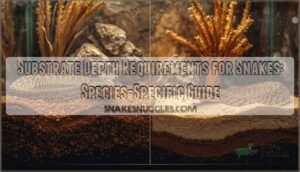
Your snake’s substrate isn’t just bedding—it’s a functional habitat layer that directly influences thermoregulation, humidity retention, and psychological well-being through natural burrowing behaviors. Research on captive reptile stress indicators demonstrates that snakes engaging in partial burrowing show markedly lower cortisol levels compared to those housed on shallow substrate, yet many keepers still provide inadequate depth based on outdated minimum-space guidelines rather than species-specific behavioral needs.
Desert-dwelling species like sand boas and hognose snakes require four to six inches for complete submersion and thermal gradient access, while even mostly arboreal species benefit from sufficient depth to create moisture pockets and occasional exploratory digging. Understanding these depth requirements—and the relationship between substrate composition, layering techniques, and maintenance protocols—transforms enclosure setup from basic containment into an environment that fosters your snake’s natural behavioral repertoire and long-term health outcomes.
Table Of Contents
- Key Takeaways
- Why Substrate Depth Matters for Snakes
- Substrate Depth for Desert-Dwelling Snakes
- Substrate Depth for Terrestrial Snake Species
- Substrate Depth for Arboreal Snake Species
- Choosing The Right Substrate and Depth
- Maintenance and Monitoring of Substrate Depth
- Frequently Asked Questions (FAQs)
- How small a gap can a snake fit through?
- How many inches of substrate do ball pythons need?
- Can a ball python live in a 4x2x2?
- Can substrate depth prevent snake respiratory infections?
- How does substrate depth affect egg-laying snakes?
- Do juvenile snakes need different substrate depths?
- What substrate depth works for semi-aquatic snakes?
- Should substrate depth change seasonally for brumation?
- Conclusion
Key Takeaways
- Substrate depth directly influences your snake’s thermoregulation, humidity control, and stress levels through enabling natural burrowing behaviors, with research showing snakes that can partially burrow exhibit markedly lower cortisol levels than those on shallow substrate.
- Desert-dwelling species like sand boas and hognose snakes require four to six inches of substrate for complete submersion and thermal gradient access, while terrestrial species need two to six inches depending on size, and arboreal species require minimal depth of one to two inches primarily for humidity retention.
- Proper substrate depth creates functional temperature gradients and moisture pockets that allow snakes to self-regulate body temperature and hydration through behavioral choices, with deeper layers providing cooler subsurface zones and buffering against temperature swings that trigger metabolic stress.
- Inadequate substrate depth creates chronic stress manifesting as glass surfing, regurgitation, compromised immune function, and respiratory problems, making species-specific depth requirements non-negotiable for long-term health outcomes rather than simply a matter of enclosure aesthetics.
Why Substrate Depth Matters for Snakes
Substrate depth isn’t just about filling space at the bottom of your snake’s enclosure—it’s a fundamental component of proper husbandry that directly affects your animal’s ability to express natural behaviors, regulate body temperature, and maintain psychological well-being.
Getting the depth wrong can lead to health issues like respiratory problems or stress-related behaviors, so it’s worth knowing how to spot signs of bad substrate choices before they become serious problems.
Understanding why this seemingly simple aspect of care matters so much requires examining how snakes interact with their substrate in the wild and what happens when captive environments fail to meet these species-specific needs. Let’s explore three critical reasons substrate depth deserves your careful attention when designing and maintaining your snake’s habitat.
Natural Behaviors and Burrowing Needs
Understanding burrowing behavior reveals why substrate depth is non-negotiable for your snake’s wellbeing. Fossorial species like hognose snakes and sand boas possess specialized scale structures and muscle adaptations that demand adequate depth for full-body submersion.
Even semi-burrowing terrestrial species rely on this natural behavior for stress relief, predator avoidance, and exploration, making species-specific requirements essential to proper husbandry.
The importance of burrowing fundamentals in soft animals highlights how various substrate properties and strategies influence effective burrowing for both animals and robots.
Thermoregulation and Humidity Control
Substrate depth doesn’t just support burrowing—it creates the temperature gradients and humidity levels your snake needs for thermoregulation. When desert species burrow into deeper substrate (4-6 inches), they’re accessing cooler microhabitats beneath basking zones that may reach 30-35°C, while moisture pockets provide localized humidity control during thermal cycles.
This layered climate control allows snakes to self-regulate body temperature and hydration through behavioral choices rather than relying solely on ambient heat sources.
Impact on Physical and Mental Health
When you deny your snake adequate substrate depth, you’re not just limiting natural behavior—you’re creating chronic stress that manifests as glass surfing, regurgitation, and compromised immune function.
Inadequate substrate depth doesn’t just limit natural behavior—it creates chronic stress that manifests as glass surfing, regurgitation, and compromised immune function
Burrowing Benefits extend beyond enrichment; proper substrate depth fosters thermoregulation effects that prevent respiratory infections and promotes humidity impacts critical for healthy shedding, directly improving Health Outcomes through stress reduction and species-specific requirements fulfillment.
Substrate Depth for Desert-Dwelling Snakes
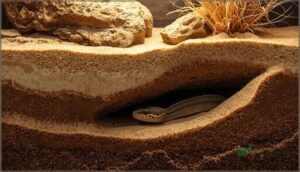
Desert-dwelling snakes have evolved remarkably specialized adaptations for surviving in some of the harshest environments on Earth, and your substrate setup must reflect these critical needs. Species like sand boas, western hognose snakes, and kenyan sand boas aren’t just occasional burrowers—they’re built to spend significant portions of their lives completely submerged beneath the surface, where they regulate body temperature, reduce water loss, and feel secure from predators.
Understanding the specific substrate depth requirements for these arid-adapted species will guarantee you’re providing an environment that promotes both their physical health and natural behavioral repertoire.
Typical Depth Requirements (e.g., Sand Boas, Hognose)
Desert species like sand boas and hognose snakes don’t just prefer deep substrate—they require it for fundamental survival behaviors. Your setup should provide:
If your snake shows constant digging or wall-pacing behavior, it may be experiencing overheating symptoms that require immediate enclosure adjustments.
- Sand boas: 4 to 6 inches of substrate depth, allowing complete submersion when burrowing
- Hognose snakes: Minimum 3 inches for smaller individuals, scaling up to 4-5 inches for large adult females
- Substrate mix: 60-70% topsoil blended with 30-40% play sand for ideal burrow stability
- Aspen alternative: 2-4 inches layered depth for moisture control and easier maintenance
For more details on sand boa care—including —consult reputable species-specific guides.
Importance for Burrowing and Temperature Regulation
Successful tunnel engineering depends on substrate depth that enables full-body coiling and lateral pressure against burrow walls, which your desert species use for tactile sensing and structural reinforcement.
Deeper bedding creates thermal gradients ranging from cool subsurface zones at 10-20 cm depth to warmer upper layers, enabling precise thermoregulation while buffering temperature swings that would otherwise trigger metabolic stress and disrupt essential behavioral cycles.
Creating Humidity Gradients in Arid Setups
Beyond thermal layers, you’ll engineer stable moisture zones within your arid setup through strategic substrate depth and airflow control. Humidity mapping at multiple depths reveals microclimate creation opportunities that support both thermoregulation and hydration needs for desert dwellers.
- Position damp sphagnum moss pockets in sheltered corners away from heat sources to establish localized humidity retention zones
- Maintain gentle top-to-bottom airflow using passive vents to preserve gradient stability without creating stress-inducing drafts
- Mix fine sand with organic material to increase substrate moisture holding capacity in targeted areas
- Monitor weekly with digital hygrometers placed at surface and 8-10 cm depths for accurate humidity control assessment
- Replenish moisture zones after cleaning to restore functional gradients your snake relies upon
Substrate Depth for Terrestrial Snake Species
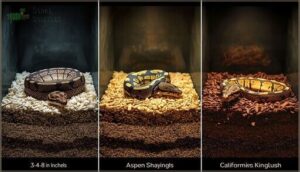
Terrestrial snake species occupy the middle ground between extreme burrowers and purely arboreal species, requiring moderate substrate depths that support partial burrowing behaviors while allowing for proper thermoregulation and stress management.
Species like ball pythons, corn snakes, and kingsnakes fall into this category, each with slightly different needs based on their natural habitat preferences and body size. Understanding the specific requirements for these commonly kept species will help you create an environment that promotes natural behaviors and long-term health.
Recommended Depths for Common Species (e.g., Ball Pythons, Corn Snakes)
You’ll find that ball pythons need 2 to 4 inches of substrate depth as juveniles and 4 to 6 inches as adults, while corn snakes thrive with 3 to 5 inches when young and 4 to 6 inches at maturity.
These measurements aren’t arbitrary—they reflect each species’ adaptations for shallow tunnel creation, thermoregulation through substrate layers, and secure retreat formation that fosters both physical health and behavioral expression.
Partial Burrowing and Stress Reduction
When your snake pushes beneath the substrate with its snout exposed, that partial burrowing behavior delivers measurable stress relief by creating humidity-controlled microclimates and thermal gradients within loosely packed layers.
Snakes engaging in this instinctive digging show lower cortisol indicators, more consistent appetite, and calmer behavioral patterns than those housed on shallow substrate—demonstrating how species-specific requirements for adequate substrate depth directly support both physical comfort and psychological well-being in reptile care.
Adjusting Depth Based on Enclosure Size
Scaling your enclosure upward doesn’t mean you’ll just add another inch of substrate depth everywhere—proper depth proportion adjusts both to footprint and your snake’s burrowing needs.
In larger terrariums, increase substrate depth by 1 to 2 inches beyond baseline recommendations to support full-body burrow space and improved thermal mass, while maintaining uneven substrate gradient zones that let your terrestrial snake self-regulate thermoregulation and humidity control across varied microclimates.
Substrate Depth for Arboreal Snake Species
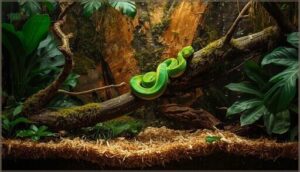
Arboreal snake species spend most of their time traversing vertical spaces rather than living on the ground, which fundamentally changes their substrate requirements compared to terrestrial or desert-dwelling species.
While these snakes don’t need deep substrate for burrowing, you still need to provide enough depth to maintain appropriate humidity levels and give them a safe landing surface if they fall from climbing structures.
The following sections explain how to determine the right substrate depth for your arboreal species while balancing their need for vertical climbing space.
Minimal Depths for Humidity Retention
Arboreal species don’t need thick bedding, but you can’t skip it entirely—a depth of 1 to 2 inches creates essential microclimate management for humidity retention and thermoregulation.
Here’s what minimal substrate depth accomplishes:
- Moisture control through slow vapor release from fine-grained substrate materials
- Humidity levels maintained around 60 to 75 percent in shallow layers
- Burrow dynamics supporting brief retreat behaviors
- Species-specific requirements met without sacrificing vertical space
- Humidity control buffering rapid environmental swings
Occasional Burrowing and Exploration
Even canopy dwellers drop down to probe the substrate—burrowing behavior isn’t exclusive to fossorial species. Your arboreal snake will periodically tunnel 5 to 15 cm through the substrate, investigating microclimate cues like temperature shifts and moisture pockets. These behavioral triggers, including post-feeding security checks, guide species-specific requirements.
Substrate depth of 1 to 2 inches allows for this exploration without compromising vertical space.
| Tunneling Patterns | Duration | Trigger |
|---|---|---|
| Shallow probing | 2-5 minutes | Temperature fluctuation |
| Conical entrance digging | 5-10 minutes | Post-feeding retreat |
| Irregular short burrows | 10-20 minutes | Environmental change |
| Surface substrate shifting | 1-3 minutes | Humidity assessment |
Balancing Substrate With Climbing Structures
When your arboreal species explores the ground layer, climbing structures need thoughtful placement. You’ll want to maximize vertical space without sacrificing substrate depth—position branches and perches to leave enough floor area for those 1 to 2 inches of loose material.
Climbing Structure Design Principles:
- Anchor branches at varied angles to guide snake exploration patterns without compressing substrate beneath
- Select substrate texture variation that provides burrow stability near base foundations
- Space vertical elements to prevent overcrowding while maintaining species-specific requirements
- Adjust enclosure design quarterly based on your snake’s usage patterns and seasonal behavior shifts
Choosing The Right Substrate and Depth
Selecting the right substrate isn’t just about depth—the material itself directly impacts your snake’s respiratory health, thermoregulation capacity, and overall wellbeing.
Different species require specific substrate compositions that mirror their natural environments, while certain materials pose serious health risks that you must avoid entirely. Understanding the distinctions between safe options, toxic alternatives, and bioactive versus traditional setups will help you create an appropriate environment suited to your snake’s physiological needs.
Safe Substrate Materials for Different Species
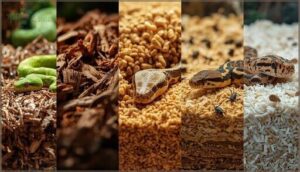
Your substrate selection determines both snake safety and the practical depth you’ll maintain. Coconut coir holds moisture well, making it suitable for tropical species requiring higher humidity control, while cypress mulch provides natural burrowing materials for desert and semi-arid setups.
Reptile-safe sand works for desert-dwelling snakes but demands careful feeding monitoring, and bioactive substrate options support decomposer life for certain terrestrial species. Paper-based substrate alternatives reduce impaction risk for arboreal snakes.
Toxic Substrates to Avoid
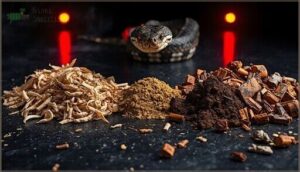
While safe substrate types support your snake’s health, certain materials pose serious risks you can’t overlook. Cedar and pine shavings release phenolic compounds that damage respiratory tissues, and fertilized soils foster mold growth that irritates nasal passages.
Contaminated outdoor topsoil containing pesticides exposes your snake to chronic toxins through skin contact, while copper bedding corrodes probes and causes gastrointestinal irritation if ingested.
Bioactive Vs. Traditional Substrate Setups
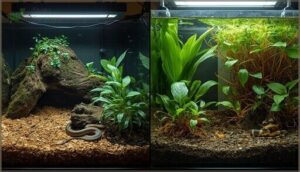
Traditional substrate setups rely on manual waste removal and frequent replacements, offering straightforward maintenance but requiring consistent labor.
Bioactive systems, by contrast, use springtails and isopods to process waste naturally, reducing cleaning demands while creating self-sustaining substrate layers that support microbe balance and humidity gradients. However, bioactive benefits come with ecological risks—mold outbreaks and establishment delays—plus higher initial maintenance costs, making species-specific requirements and substrate depth vital considerations before committing to either approach.
Maintenance and Monitoring of Substrate Depth
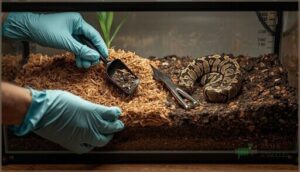
Maintaining proper substrate depth requires consistent monitoring and a structured cleaning routine that balances hygiene with your snake’s need for environmental stability.
You’ll need to establish both daily spot-cleaning protocols and periodic full substrate replacement schedules that vary based on whether you’re using traditional or bioactive setups. Understanding the difference between these maintenance approaches, along with recognizing behavioral signs of substrate problems, will help you provide ideal conditions throughout your snake’s life.
Cleaning and Replacement Schedules
Your cleaning schedule should align with your snake’s species-specific requirements and substrate depth to maintain reptile health and wellness. Weekly substrate rotation removes waste, while monthly replacement intervals refresh one-third of the material.
Most enclosures need complete sanitation protocols every three to six months, though high-humidity setups and deeper substrate layers demand more frequent maintenance routines to prevent bacterial growth, compaction, and odor buildup.
Spot Cleaning Vs. Full Substrate Change
You’ll balance daily maintenance with periodic sanitization to preserve bioactive balance and reptile health throughout the year. Spot cleaning removes waste immediately—targeting feces and urates within minutes each day—while preserving beneficial microbial communities that support substrate depth stability.
Full substrate changes, scheduled every one to three months based on snake species and substrate selection and depth, eliminate deeper contaminants and reset your reptile enclosure setup according to species-specific requirements.
Signs of Inadequate Substrate Depth
Your snake’s frantic glass surfing or repeated corner pacing reveals substrate depth failing to support burrowing issues and natural behaviors—key stress signals that escalate into health decline when ignored.
Behavioral changes like reduced feeding, poor shedding cycles, and defensive strikes indicate your substrate selection and depth don’t meet species-specific requirements, while rapid substrate compaction confirms your reptile enclosure setup needs immediate depth adjustment.
Frequently Asked Questions (FAQs)
How small a gap can a snake fit through?
Think of your snake species as liquid in a flexible bottle—most species can slip through gaps roughly half the width of their body, though smaller juveniles often squeeze through quarter-inch openings with alarming ease.
How many inches of substrate do ball pythons need?
You’ll want to provide ball pythons with a substrate depth of about 3 to 4 inches in standard enclosures, allowing them to express natural burrowing needs while maintaining proper humidity control and thermoregulation.
Can a ball python live in a 4x2x2?
Yes, a 4x2x2 foot enclosure works well for most adult ball pythons, offering adequate space for thermal gradients, hides, and burrowing needs.
Though larger females may benefit from additional room for enrichment and movement.
Can substrate depth prevent snake respiratory infections?
Proper substrate depth aids respiratory health by reducing airborne dust, maintaining stable humidity for mucous membrane hydration, and enabling burrowing behaviors that help snakes avoid dry microclimates which can irritate airways.
How does substrate depth affect egg-laying snakes?
Adequate substrate depth facilitates successful egg incubation by enabling natural nesting behaviors, maintaining stable humidity gradients around clutches, and providing thermal microhabitats that promote healthy embryo development while preventing desiccation.
Do juvenile snakes need different substrate depths?
Like tailoring a suit for a growing child, juvenile burrowing snakes need shallower substrate depths—usually 2 to 3 inches—until gradual increases support burrow complexity and snake development without overwhelming their smaller frames.
What substrate depth works for semi-aquatic snakes?
Semi-aquatic species need substrate depth to support tunnel systems, maintain humidity levels near the water table, and allow proper thermoregulation through species-specific burrow depth preferences that accommodate their unique habitat requirements.
Should substrate depth change seasonally for brumation?
Yes, substrate depth should increase seasonally for brumation cues—deeper layers create temperature stratification and humidity gradients that support burrowing behavior, allowing snakes to access cooler microclimates essential for thermoregulation during dormancy preparation.
Conclusion
The devil’s in the details, and substrate depth requirements for snakes represent one detail that fundamentally separates adequate husbandry from ideal care. By matching substrate depth to your snake’s evolutionary adaptations—whether that’s six inches for burrowing hognoses or two inches for green tree pythons—you’re providing functional environmental complexity rather than decorative bedding.
This substrate foundation directly aids thermoregulation, humidity management, and stress reduction, transforming your enclosure into a space where natural behaviors aren’t just permitted but actively encouraged through thoughtful design.