This site is supported by our readers. We may earn a commission, at no cost to you, if you purchase through links.
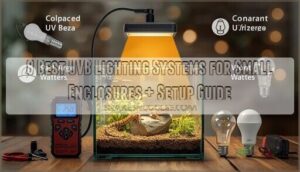
Most reptile keepers with compact terrariums face a frustrating dilemma: their gecko, chameleon, or bearded dragon needs adequate UVB exposure to prevent metabolic bone disease and calcium deficiency, but standard fluorescent tubes are too large for 10-20 gallon setups, and dome fixtures often create dangerous hot spots in confined spaces.
UVB lighting systems for small enclosures require careful selection because improper intensity can lead to eye damage or insufficient vitamin D3 synthesis, both of which compromise your reptile’s long-term health and skeletal development. The right compact fixture delivers species-appropriate UVB output at safe distances, usually 6-8 inches from basking areas, while maintaining proper heat gradients and energy efficiency.
Understanding bulb strength ratings, coverage zones, and mounting techniques ensures your small-scale habitat provides the same metabolic benefits as larger professional setups without the risk of overexposure or thermal stress.
Table Of Contents
- Key Takeaways
- Best UVB Lighting Systems for Small Enclosures
- Choosing The Right UVB Strength and Size
- Key Features of Compact UVB Lighting
- Installation and Maintenance Tips
- Troubleshooting Common UVB Lighting Issues
- Frequently Asked Questions (FAQs)
- What size UVB bulb for a 20 gallon tank?
- Is a basking light the same as an UVB light?
- How much of an enclosure should UVB cover?
- Is UV light the same as UVB light?
- Can I use UVB lighting for nocturnal reptiles?
- How do I measure UVB output accurately?
- Are mercury vapor bulbs suitable for small enclosures?
- Whats the difference between UVA and UVB?
- Do LED UVB bulbs work as well as fluorescent?
- Conclusion
Key Takeaways
- Most small reptile enclosures (10-20 gallons) need compact UVB fixtures that deliver species-appropriate output at 6-8 inches from basking areas without creating dangerous hot spots, with T5 tubes or compact fluorescents offering better control than mercury vapor bulbs in confined spaces.
- UVB bulb strength must match your reptile’s Ferguson Zone classification—Zone 1 crepuscular species like crested geckos need minimal exposure while Zone 4 desert baskers like bearded dragons require 10% UVB output, and mismatched lighting leads directly to metabolic bone disease and calcium deficiency.
- Replace compact fluorescent and T8 UVB bulbs every 6-8 months and T5 tubes annually regardless of visible brightness, because invisible UV output degrades 30-40% before the bulb burns out, and dust accumulation on reflectors can cut UVB delivery by over 30%.
- Proper UVB coverage should span 60-70% of your enclosure floor to create lighting gradients that let your reptile self-regulate exposure between full-intensity basking zones and shaded retreats, preventing both overexposure burns and insufficient vitamin D3 synthesis.
Best UVB Lighting Systems for Small Enclosures
Choosing the right UVB lighting system for your small enclosure can feel overwhelming, especially when your reptile’s health depends on getting it right. You need a fixture that delivers adequate UVB output without overheating a compact space, and it should fit your budget without sacrificing quality or safety.
For ball pythons and similar species, understanding how different UVB lighting systems compare helps you balance effectiveness, heat output, and enclosure size.
Below, you’ll find eight proven UVB lighting systems that combine clinical effectiveness with practical design for small habitats.
1. Exo Terra Reptile Terrarium Light Bulb
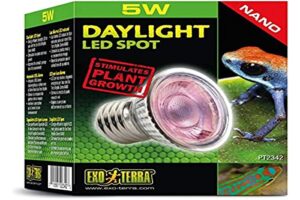
The Exo Terra Reptile Terrarium Light Bulb delivers UVA and UVB output in a compact fluorescent design, making it ideal for small enclosures where space is limited. This bulb fits standard dome fixtures and uses phosphor blends to penetrate dense foliage, ensuring your reptiles receive adequate UV exposure even in planted terrariums.
You’ll find it available in multiple wattages to match your enclosure size and basking requirements. The sunlike spectrum promotes vitamin D3 synthesis and calcium metabolism, fostering healthy bone development in small reptiles and hatchlings.
For boa constrictors specifically, pair this UVA output with a quality heat source—explore heating options for boa constrictors to create an optimal basking zone.
| Best For | Small reptile, amphibian, or invertebrate keepers who need a compact, energy-efficient light to support live plants and enhance their pet’s coloration in nano or mini terrariums. |
|---|---|
| Brand | Exo Terra |
| Weight | 2.11 ounces |
| Material | Plastic |
| Power | 5 Watts |
| Color | N/A |
| UVB Output | N/A |
| Additional Features |
|
- Energy-efficient 5W LED design provides bright daylight spectrum that stimulates plant and moss growth while keeping electricity costs low
- Enhances the vivid colors of both animals and plants, making your terrarium more visually appealing
- Compatible with Exo Terra’s compact Reptile Dome NANO, making it perfect for space-constrained setups
- Only works with Exo Terra NANO and MINI terrariums, limiting your flexibility if you upgrade or change enclosures
- At least one user reported the bulb stopped working after less than a month, raising durability concerns
- Doesn’t provide UVB output despite being marketed for reptiles, so you’ll need a separate UVB source for species that require it
2. Zoo Med Reptisun Led Terrarium Hood
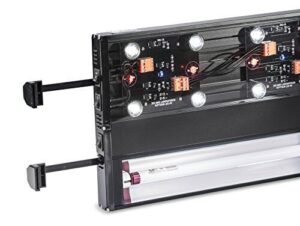
If you’re looking for an LED solution that complements your UVB setup, the Zoo Med Reptisun LED Terrarium Hood brings energy efficiency and adaptable lighting modes to small enclosures. This low-profile fixture includes 6500K daylight white LEDs for natural color rendering, red LEDs at 620 nm to stimulate live plant growth, and blue LEDs at 465 nm for gentle nighttime viewing.
The fixture has independent switches that let you control each spectrum separately, while removable LED modules with quick-connect plugs simplify replacement when needed. Sliding rails adjust to fit terrariums from 9 to 60 inches wide, and the included suspension kit allows safe overhead mounting.
| Best For | Reptile keepers who want a versatile lighting system that supports both live plants and healthy reptile development in small to medium terrariums. |
|---|---|
| Brand | Zoo Med |
| Weight | 6.9 pounds |
| Material | Stainless Steel |
| Power | N/A |
| Color | Red |
| UVB Output | 5.0 HO |
| Additional Features |
|
- Three independent light modes (daylight, plant growth, and nighttime) let you customize the environment throughout the day
- Adjustable sliding rails fit a wide range of terrarium sizes from 9 to 60 inches
- Energy-efficient LED modules with replaceable components reduce long-term costs
- Some customers received incomplete units or missing parts upon delivery
- The included UVB bulb may need replacement sooner than expected
- Takes up significant space on smaller cages, which can block airflow and affect ventilation
3. Exo Terra Reptile Dome Light Fixture
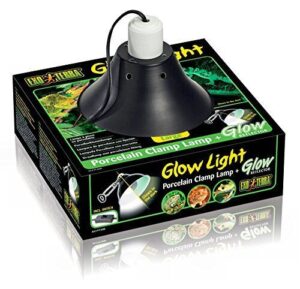
The Exo Terra Reptile Dome delivers focused UVB and basking light through an extra-deep aluminum reflector that concentrates the beam into a defined zone.
Pairing it with the right bulb and replacement schedule for UVB lighting systems ensures your reptile receives consistent UV exposure year-round.
You’ll find two main sizes—the small dome at 6 inches diameter accommodates up to 75 watts for nano tanks, while the 8-inch large dome accommodates 160-watt bulbs for broader coverage.
A heat-resistant ceramic socket accepts compact fluorescent or incandescent bulbs, and the 6-foot cord includes an inline switch for quick manual control without unplugging.
| Best For | Reptile owners who need reliable, concentrated heat and UVB lighting for small to medium terrariums with bulbs up to 160 watts. |
|---|---|
| Brand | Exo Terra |
| Weight | 1.22 pounds |
| Material | Porcelain |
| Power | Up to 250 watts |
| Color | Blacks & Grays |
| UVB Output | Compatible |
| Additional Features |
|
- Deep aluminum reflector focuses light and heat exactly where your reptile needs it, maximizing bulb efficiency
- Ceramic socket handles high temperatures safely and works with incandescent, halogen, and compact fluorescent bulbs
- Inline switch on the 6-foot cord lets you control the light without crawling behind the tank to unplug it
- Gets extremely hot during use, so you need to be careful when adjusting or moving it
- Clamp design can be tricky to position and secure properly on some tank edges
- Costs more than basic dome fixtures, though the quality materials justify the price for serious keepers
4. Reptisun Compact Fluorescent Uvb Light
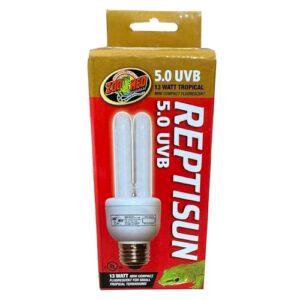
Zoo Med’s Reptisun compact fluorescent line brings integrated-ballast convenience to tight spaces, with 5.0 and 10.0 versions delivering 5 percent or 10 percent UVB output respectively. The 13-watt mini compact fits standard E26 sockets and works vertically or horizontally in clamp lamps or naturalistic hoods.
You’ll get UVI readings around 2.6 to 3.5 at four inches with the 5.0 version, though mesh screens can reduce those levels by 30 to 40 percent. Replace bulbs every six to twelve months to maintain effective calcium metabolism support.
| Best For | Owners of tropical reptiles and amphibians in small to medium enclosures who need reliable UVB without added heat. |
|---|---|
| Brand | Zoo Med |
| Weight | N/A |
| Material | Glass |
| Power | 13 watts |
| Color | N/A |
| UVB Output | 5% UVB |
| Additional Features |
|
- Fits standard sockets and works in any orientation, making it easy to install in various setups
- Provides solid UVB output (5% or 10%) for proper calcium metabolism and preventing metabolic bone disease
- Doesn’t produce excessive heat, so it’s safe for species that don’t need extra warmth
- Needs replacement every 6-8 months to stay effective, which adds to long-term costs
- UVB output drops significantly through mesh screens, reducing effectiveness in some enclosures
- Some users report quality control issues like bulbs failing early or not lighting up consistently
5. Reptile UVB Light Fixture
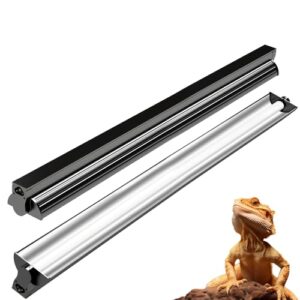
REPTIDLDB’s T5 fixture pairs a high-output electronic ballast with a 10.0 UVB bulb, delivering 10 percent UVB and 30 percent UVA through an alloy reflector that maximizes output across your enclosure.
This setup works especially well for species with moderate to high UVB needs, though ball python morph lighting needs vary significantly and some morphs require more careful UV exposure management.
You’ll find four size options—12, 22, 34, and 46 inches—each rated at 8, 24, 39, or 54 watts, so you can match wattage to tank dimensions without overloading small habitats.
The detachable cable and integrated on/off switch simplify daily photoperiod control, while minimal heat emission keeps temperature gradients stable in desert and tropical setups alike.
| Best For | Reptile keepers who need reliable UVB coverage for desert or tropical species like bearded dragons, tortoises, and lizards in medium to large enclosures. |
|---|---|
| Brand | N/A |
| Weight | 7 ounces |
| Material | Iron |
| Power | N/A |
| Color | Black |
| UVB Output | N/A |
| Additional Features |
|
- Four fixture sizes (12–46 inches) let you match the light output to your tank’s footprint without wasting energy or creating hot spots.
- The alloy reflector bounces UVB downward efficiently, ensuring your reptile gets consistent exposure for vitamin D3 synthesis and healthy bone development.
- Built-in on/off switch and detachable cable make it easy to control daily light cycles without unplugging or using external timers.
- Some buyers report receiving broken fixtures or bulbs that failed shortly after arrival, suggesting inconsistent quality control.
- The UVB bulb requires periodic replacement—usually every 6–12 months—which adds ongoing maintenance costs.
- While marketed as low-heat, the 39W and 54W models can still raise enclosure temperatures slightly, requiring careful placement in heat-sensitive setups.
6. Reptile UVB Light Fixture Combo Kit
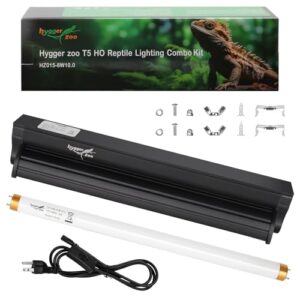
Combo kits bundle a UVB tube, reflector, mounting hardware, and power cord in one package, eliminating guesswork for your first small enclosure. Many pair T5 high-output bars with polished curved reflectors that enhance UVB and visible light, while dome models house mercury vapor or basking bulbs to deliver heat and UVB from a single screw-in source.
Built-in or inline timers automate day-night cycles, and you’ll find multiple lengths or dome diameters to fit nano, mini, or standard terrariums without buying separate controllers.
| Best For | Beginners setting up their first desert reptile enclosure who want a complete UVB lighting solution without piecing together separate components. |
|---|---|
| Brand | KSIPZE |
| Weight | 9.9 ounces |
| Material | Brass |
| Power | N/A |
| Color | Multicolor |
| UVB Output | N/A |
| Additional Features |
|
- Curved reflector design amplifies UVB output and brightness, helping smaller desert reptiles like bearded dragons and turtles synthesize vitamin D3 more effectively
- Dual mounting options let you place it on mesh tops or inside the tank, giving you flexibility as your setup evolves
- Aluminum construction dissipates heat better than plastic alternatives, which should extend the fixture’s lifespan
- Several users mentioned durability concerns and quality control issues that may require returns or replacements
- Doesn’t scale well for larger tanks—owners of 120-gallon enclosures will need a different solution
- Fixture sometimes needs extra clips or adjustments to stay securely positioned, especially when placed on mesh covers
7. Reptile UVB Light Fixture Kit
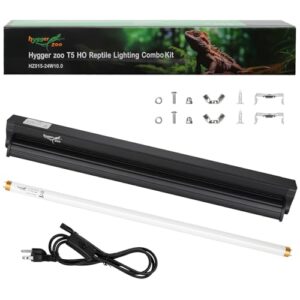
Full kits include a preinstalled T5 UVB tube, low-profile housing, removable reflector, mounting clips, and power cord, so you’re ready to plug in and light up within minutes.
The Hygger zoo fixture delivers 24 watts through a polished aluminum reflector—23.4 inches long, 1.45 pounds—that fits bearded dragons, turtles, and chameleons in vivariums or mesh-top tanks. You can rest the black bar on your screen lid, hang it from brackets, or screw it inside, giving your setup adaptable installation without purchasing separate hardware or guessing bulb compatibility.
| Best For | Keepers of desert reptiles like bearded dragons, turtles, or chameleons who want a plug-and-play UVB solution that mounts flexibly on or inside standard mesh-top enclosures. |
|---|---|
| Brand | REPTIDLDB |
| Weight | N/A |
| Material | Aluminum |
| Power | 39 watts |
| Color | N/A |
| UVB Output | 10% UVB |
| Additional Features |
|
- Complete kit ships with a 24 W T5 UVB tube, reflector, clips, and cord—no hunting for compatible bulbs or extra hardware
- Polished aluminum reflector amplifies UVB rays and light output while dissipating heat for longer bulb life
- Versatile mounting lets you rest it on mesh, hang it from brackets, or screw it inside the tank
- 23.4-inch length may fall short for larger tanks (120 gallons), leaving dim corners
- Some buyers flag durability concerns—wobbly clips, loose reflectors, or early bulb failures
- Assembly and positioning take trial and error if your enclosure has unusual dimensions or thick screen lids
8. Reptispa T5 UVB Lighting Kit
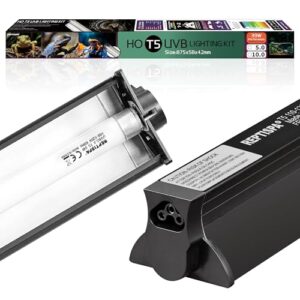
The Reptispa T5 UVB Lighting Kit delivers 10% UVB and 30% UVA through a 39-watt high-output tube—35 inches long, 1.85 pounds—that matches desert-dwelling bearded dragons, tortoises, and chameleons in 24-inch tanks.
You’ll mount the aluminum bar on mesh tops or inside wooden vivariums using the included clips, then plug the detachable cord into a household outlet and flip the switch. The curved reflector focuses ultraviolet rays downward for stronger calcium absorption, though you’ll replace the tube every 6 to 12 months as output declines.
| Best For | Keepers of desert reptiles like bearded dragons and uromastyx who need a reliable all-in-one UVB solution for standard-sized terrariums without managing separate bulbs and fixtures. |
|---|---|
| Brand | Hygger zoo |
| Weight | 1.06 pounds |
| Material | Aluminum |
| Power | 8W |
| Color | Black |
| UVB Output | Higher UVB |
| Additional Features |
|
- Ships as a complete kit with fixture, bulb, reflector, and mounting hardware so you can set up UVB lighting in minutes
- 10% UVB output paired with a curved reflector pushes more ultraviolet rays toward basking zones for stronger vitamin D3 synthesis
- Detachable power cord and built-in switch let you replace components or turn off lighting without unplugging at the wall
- Bulb replacement every 6–12 months adds recurring costs and some users report the integrated design makes swapping tubes awkward
- Aluminum housing gets hot during extended use, so you’ll need to position it carefully around curious pets or flammable decorations
- May not produce enough UVB for larger enclosures over 48 inches or species with higher ultraviolet demands
Choosing The Right UVB Strength and Size
Choosing the correct UVB strength and bulb size isn’t guesswork—it’s a calculated decision based on your enclosure’s dimensions, your species’ physiological needs, and the coverage area required for safe exposure. You can’t simply grab any UVB bulb and hope it works, because mismatched lighting leads to metabolic bone disease, behavioral changes, and long-term health complications.
Choosing the right UVB bulb isn’t guesswork—it’s a calculated decision that prevents metabolic bone disease and long-term health complications
Here’s how to match UVB output to your small enclosure and your reptile’s specific requirements.
Matching UVB Bulb Output to Enclosure Dimensions
Pairing UVB output with tank dimensions prevents dangerous overexposure in small reptile enclosures. UVB intensity drops sharply with distance, so match bulb sizing to your tank dimensions for safe lighting gradients.
A 24-inch bulb usually suits a 36-inch tank, covering the basking zones while leaving shaded retreats. For enclosure lighting in 10 to 20-gallon setups, you’ll want compact or short linear UVB bulbs rather than high-output tubes.
Proper reptile care relies on choosing the right UVB bulb output level for your specific enclosure.
Species-specific UVB Requirements
Each species metabolizes UVB differently, so you’ll need to tailor your reptile lighting setup to individual needs.
Ferguson Zones classify UVB requirements—Zone 1 crepuscular animals like crested geckos thrive with minimal UVB spectrum exposure, while Zone 4 desert baskers such as bearded dragons demand intense UVB dosage and specific lighting cycles.
Species sensitivity varies even within families, affecting UVB output and intensity choices for your reptile’s metabolism and long-term health. To better understand these distinctions, check out this guide on UVB requirements by Ferguson Zone.
Recommended UVB Coverage Area for Small Tanks
Once you’ve matched UVB output to your species, you need to map lighting gradients across your tank dimensions. In a 10-gallon enclosure measuring 20 by 10 inches, aim for 60 to 70 percent floor coverage ratios so your reptile can choose between basking zones with full UVB intensity and shaded retreats with near-zero UVB lighting—this coverage balance fosters natural thermoregulation in small animal enclosures.
Key Features of Compact UVB Lighting
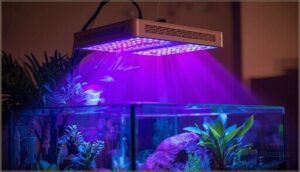
When you’re shopping for UVB lighting for a small enclosure, you need to focus on more than just the bulb’s UVB output. The fixture itself plays a critical role in your pet’s health, from how efficiently it uses energy to how safely it controls heat in a confined space.
Let’s look at the three most important features that separate excellent compact UVB systems from ones that fall short.
Energy Efficiency and Bulb Lifespan
LED lights deliver outstanding energy efficiency for small enclosures, using up to 80 percent less electricity than incandescent UVB bulbs while lasting approximately 25,000 hours.
You’ll reduce replacement costs by 60 to 90 percent annually, and the lower heat output cuts cooling demands by up to 20 percent. This bulb durability and energy savings make LED UVB lighting a smart investment with payback periods under two years.
Adjustable Fixtures for Precise Placement
Beyond low operating costs, adjustable fixtures give you surgical control over UVB delivery in small reptile enclosures. Fine-tuning beam angles, mounting height, and horizontal reach lets you dial in target UVI readings at your animal’s favorite basking spot without guesswork. These fixture adjustments matter because UVB output drops sharply with distance.
The adjustments include the following features:
- Height-adjustable mounts telescope from 8 to 15 inches, letting you raise or lower compact lights and LED UVB fixtures for precise distance control.
- Swing-arm brackets pivot horizontally, centering the UVB beam over basking platforms instead of leaving hot spots at tank edges.
- Tiltable dome sockets angle UVB reptile lighting onto raised shelves, overlapping warmth with UV exposure where your pet naturally sits.
- Clamp-style mounting options secure fixtures to screen tops, preventing shifts that throw off carefully measured UVI zones.
- Offset arms extend the lamp past tank rims and misting nozzles, eliminating shadows that block life-sustaining radiation.
Position your UVB lighting system 10 to 12 inches above basking sites for mid-level species, then measure UVI with a meter to confirm safe ranges before introducing your reptile.
Heat Management and Safety in Small Spaces
Small animal enclosures trap radiant heat fast, turning UVB lighting into a thermal hazard without proper heat management. Install ventilation systems near the fixture to prevent hot pockets, pair bulbs with thermostats to stop overheating spikes, and add heat shields or guards for burn prevention.
Thermal monitoring with dual thermometers—one at basking height, one on the cool side—ensures your safety protocols support healthy thermoregulation instead of creating dangerous hot spots.
Installation and Maintenance Tips
Proper installation and ongoing maintenance are the cornerstones of safe, effective UVB lighting in small enclosures.
You’ll need to understand correct mounting techniques, routine cleaning protocols, and replacement schedules to maintain ideal output and protect your reptile’s health.
The following tips will guide you through each critical step, ensuring your UVB system delivers consistent, safe exposure for your pet.
Safe Mounting and Positioning of UVB Fixtures
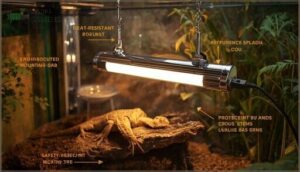
Getting your UVB lighting fixtures properly mounted isn’t just about screwing in a bulb—it’s about creating a safe environment. Position your reptile lighting fixtures 6 to 12 inches above the basking area, adjusting mounting heights based on bulb type and UVB output requirements.
Consider these critical factors:
- Align UVB angles parallel to basking surfaces for uniform coverage
- Use heat-resistant mounting hardware with secondary safety features
- Route cords away from your reptile’s reach
- Install splash guards near water sources for electrical protection
Cleaning and Maintaining Reflectors and Housings
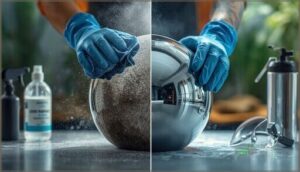
A clean reflector can mean the difference between thriving scales and hidden deficiencies—dust alone cuts UVB output by over 30 percent. Wipe your reflectors with a soft microfiber cloth every 1 to 2 weeks, removing loose debris from mounting points before it scatters light unevenly.
| Maintenance Task | Frequency |
|---|---|
| Dust removal from reflectors | Every 1–2 weeks |
| Housing inspection for corrosion | Monthly |
| Clean ventilation slots with compressed air | As needed |
Use reptile-safe terrarium cleaners or 3 percent hydrogen peroxide on metal housings, avoiding ammonia-based products that corrode finishes and irritate lungs. Always unplug fixtures before cleaning, then air-dry completely outside the enclosure to prevent electrical arcing and chemical residue. Check screw heads and socket contacts monthly for green or white corrosion—if you spot damage at connection points, replace the fixture immediately rather than risking sudden failure or overheating.
UVB Bulb Replacement Schedules for Optimal Output
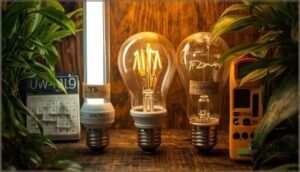
Even bright UVB bulbs lose their invisible UV output long before they burn out, making strict replacement schedules essential for your reptile’s bone health.
Replace compact fluorescent and T8 UVB bulbs every 6 to 8 months, T5 tubes annually, and mercury vapor lamps every 8 to 10 months—writing installation dates directly on fixtures prevents dangerous guesswork and ensures consistent UVB intensity despite normal lighting cycles.
Troubleshooting Common UVB Lighting Issues
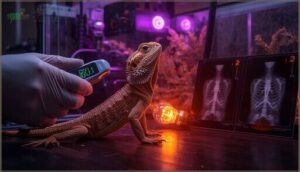
Even with proper installation and maintenance, you’ll occasionally encounter issues with your UVB lighting system that require quick attention.
Recognizing the warning signs early can prevent serious health problems for your reptile, from metabolic bone disease to thermal burns. Let’s walk through the most common UVB lighting problems you might face and how to address them effectively.
Detecting and Addressing Bulb Dimming or Malfunction
When your reptile’s UVB lighting loses its punch, you’ll notice dimming signs within days—brightness drops, flickering at startup, or uneven light across the tank.
Use a lux meter to confirm UVB output matches manufacturer specs, inspect bulbs for discoloration or cracks, and check fixture connections for corrosion.
Replace T5 UVB bulbs every 6 to 12 months to prevent bulb failure and maintain consistent UVB intensity for your pet’s health.
Preventing Overexposure and Burns
Too much UVB intensity can trigger burn risk factors when your fixture sits too close to basking behavior zones—maintain manufacturer-recommended distances, use UVB meters to verify safe UVB output, and provide shaded retreats for skin protection.
Monitor for reddened scales or eye irritation, adjust UVB bulbs‘ placement for heat management, and implement consistent photoperiods to support UVB safety through overexposure prevention in your UVB lighting setup.
Ensuring Consistent UVB Levels for Reptile Health
Consistent UVB output fuels Vitamin D3 production that powers Calcium Metabolism, so you’ll need UVB Metering every three months to track UVB Intensity as bulbs age—replace Reptile UVB Bulbs on schedule, monitor Reptile Behavior for lethargy or appetite shifts, and maintain stable Lighting Cycles to support Reptile Health through predictable UVB Lighting routines that safeguard your animal’s skeletal strength.
- Monthly UVB meter readings at basking zones confirm adequate irradiance
- Appetite changes or lethargy signal potential UVB deficiency
- Six-to-twelve-month bulb rotation prevents invisible output decline
- Consistent twelve-hour photoperiods synchronize natural metabolic rhythms
- Behavioral cues like increased basking indicate insufficient UVB exposure
Frequently Asked Questions (FAQs)
What size UVB bulb for a 20 gallon tank?
Most 20 gallon tanks perform best with a 12-inch UVB tube covering two-thirds of the enclosure, though your species dictates whether you’ll need a 0 or 0 bulb strength for proper calcium absorption.
Is a basking light the same as an UVB light?
No, basking lights primarily generate heat for thermoregulation, while UVB bulbs emit ultraviolet radiation essential for vitamin D3 synthesis.
Most reptile setups require both heat sources and dedicated UVB lighting to meet complete metabolic needs.
How much of an enclosure should UVB cover?
Think of UVB coverage like sunshine through tree branches—your reptile needs options, not a floodlight.
Aim for half to two-thirds of the enclosure floor, creating a gradient that lets your pet choose exposure levels near the basking spot.
Is UV light the same as UVB light?
UV light isn’t the same as UVB light—the UV spectrum includes UVA, UVB, and UVC wavelengths with different radiation effects.
While UVB fluorescent lamps emit specific 280–315 nanometer wavelengths essential for reptile health and UVB safety considerations.
Can I use UVB lighting for nocturnal reptiles?
Most nocturnal reptiles don’t require UVB lighting since they naturally avoid daytime sun exposure.
However, some crepuscular species benefit from low-intensity UVB during brief active periods, supporting vitamin D3 synthesis and calcium metabolism without disrupting their natural circadian rhythms.
How do I measure UVB output accurately?
You’ll need a dedicated UV meter that reads microwatts per square centimeter or UVI measurements to capture irradiance mapping at your reptile’s basking distance, ensuring accurate spectral analysis and proper UVB output monitoring.
Are mercury vapor bulbs suitable for small enclosures?
Mercury vapor bulbs aren’t ideal for compact habitats—their combined heat and UVB can cause dangerous overheating and burns.
You’ll achieve safer, more controllable UVB levels with compact fluorescent tubes or adjustable LED lighting solutions designed for small enclosure safety.
Whats the difference between UVA and UVB?
UVA penetrates deeper into the skin and causes photoaging, while UVB triggers sunburn and vitamin D synthesis.
Your reptile needs UVB for calcium metabolism—that’s why proper UVB lighting matters for their bone health.
Do LED UVB bulbs work as well as fluorescent?
LED UVB bulbs rival fluorescent tubes in spectrum quality and durability, lasting up to 50,000 hours with cooler heat management—but many produce lower UVB output per watt, requiring closer positioning for effective reptile lighting in compact enclosures.
Conclusion
Your reptile’s skeletal integrity depends entirely on what happens in the next six months—whether calcium absorbs properly or bone density quietly deteriorates beneath healthy-looking scales.
The UVB lighting systems for small enclosures you’ve examined here eliminate guesswork from compact habitat management, translating technical specifications into measurable metabolic protection. Mount your chosen fixture at the recommended distance, mark your calendar for bulb replacement in six months, and monitor basking behavior weekly. Precision now prevents irreversible damage later.
- https://www.magazoo.com/us/reptisun-led-terrarium-hood.html
- https://zoomed.com/t5-reptisun-led-uvb-terrarium-hood/
- https://kensfish.com/products/zoo-med-reptisun-led-fixture-with-sunrise-sunset-timer
- https://reptilianarts.com/products/zoo-med-reptisun-led-terrarium-hood-18-26
- https://exo-terra.com/products/lighting/dome-fixtures/reptile-dome-large/