This site is supported by our readers. We may earn a commission, at no cost to you, if you purchase through links.

Most snakes don’t die from neglect—they die from subtle miscalculations. A basking spot that runs five degrees too cool, a hide on the wrong side of the enclosure, substrate that can’t hold moisture. These aren’t dramatic failures; they’re the kind of quiet, compounding mistakes that erode a snake’s health over months.
Understanding what snakes need in their habitat means thinking the way a snake does—tracking warmth, seeking cover, regulating every function through environmental cues. Get these fundamentals right, and you’ll have a thriving animal. Miss them, and even a "healthy" snake is quietly struggling.
Table Of Contents
- Key Takeaways
- Essential Temperature and Heating Needs
- Humidity and Moisture Requirements
- Safe and Comfortable Hiding Places
- Substrate and Environmental Enrichment
- Water and Hydration Essentials
- Frequently Asked Questions (FAQs)
- How do snakes survive?
- Do snakes need a habitat?
- How have snakes adapted to their habitat?
- Do snakes live in urban environments?
- What does a snake’s habitat need?
- How much space does a pet snake need?
- What lighting schedule do snakes require daily?
- Can snakes live together in the same enclosure?
- How often should you feed a pet snake?
- Do snakes need UVB lighting to stay healthy?
- Conclusion
Key Takeaways
- Your snake’s enclosure must have a warm zone around 32°C and a cool side between 24–27°C, because without that thermal gradient, digestion, immunity, and basic body function all quietly break down.
- Humidity isn’t optional — match it precisely to your species (ball pythons need 60–80%, kingsnakes prefer 40–60%), or you’ll face stuck sheds, respiratory issues, and scale rot.
- Every snake needs at least two hides — one on the warm side, one on the cool — because a snake without a secure retreat lives in chronic stress, which shows up as refused meals, poor sheds, and defensive behavior.
- Substrate, hydration, and enrichment work together as a system: the right floor material holds moisture and supports burrowing, a properly placed water bowl stabilizes humidity, and climbing or digging features keep your snake behaviorally healthy long-term.
Essential Temperature and Heating Needs
Temperature is the single biggest factor in keeping your snake healthy — get it wrong, and everything else falls apart. Snakes can’t generate their own body heat, so your enclosure has to do that work for them. Here’s what you need to get the thermal setup right.
For a deeper look at exactly how to dial in your setup, this guide on snake enclosure heating and temperature gradients covers everything from heat mats to thermostat settings.
Warm and Cool Zones
Temperature regulation isn’t optional for snakes — it’s survival. Your snake’s enclosure needs a warm zone hitting around 32°C and a cool side staying between 24–27°C. That thermal gradient gives them full control over their own body temperature, letting them shift between zones as needed.
Get this ecosystem balance right, and your snake’s digestion, activity, and overall health will show it. Creating a proper basking area setup is essential for maintaining the ideal temperature range.
Proper Heat Sources
Once you’ve got those zones mapped out, you need the right tools to actually hold them steady. Your snake is ectothermic — it relies entirely on you to provide warmth.
Here are five heat sources worth knowing:
- Heat Lamps – Great for basking spots
- Ceramic Emitters – 24-hour infrared heat, no light disruption
- Radiant Panels – Even, roof-mounted warmth for larger enclosures
- Heat Mats – Mimic ground warmth naturally
- Thermostat Controls – Non-negotiable for preventing dangerous overheating.
For ideal snake care, consider using safe heat sources to guarantee the well-being of your pet.
Thermal Gradients for Health
Having the right heat sources matters, but it’s the gradient system that ties everything together. Your snake shuttles between warm and cool zones multiple times a day — that’s thermoregulation in action.
Without a proper 10 to 20°F spread, digestion rates slow, heat stress builds, and ectothermic environmental adaptation breaks down. Think of temperature control as the invisible architecture your snake lives inside.
Humidity and Moisture Requirements

Humidity is just as important as heat regarding keeping your snake healthy. Get it wrong, and you’ll start seeing stuck sheds, labored breathing, and a snake that’s clearly not thriving.
Getting the balance right matters more than most new keepers realize — snake breeding humidity requirements break down exactly what levels to target and why they’re non-negotiable for healthy sheds and successful breeding.
Here’s what you need to know about species-specific humidity needs, how to maintain them, and what happens when levels go off track.
Ideal Humidity Levels by Species
Every snake species carries its own moisture blueprint. Ball pythons, native to West Africa, need 60–80% humidity daily, spiking to 80–100% overnight. Corn snakes thrive at 65–75%, while kingsnakes prefer a drier 40–60%. Boa constrictors sit comfortably at 55–75%.
Matching these moisture levels to each species’ environmental needs isn’t optional — it’s how healthy shedding and temperature regulation actually happen.
Methods to Maintain Humidity
Keeping humidity steady in your snake habitat comes down to layering smart strategies together. Here’s what actually works:
- Use Humid Hideouts lined with sphagnum moss for localized moisture pockets.
- Install Misting Systems like MistKing for consistent, automated coverage.
- Size Water Bowls generously — evaporation naturally raises ambient levels.
- Apply Ventilation Control by partially covering mesh tops with plastic wrap.
Add Moisture Sensors to track everything precisely.
Effects of Improper Humidity
Humidity levels that drift too far in either direction spell trouble fast. Too dry — below 50% — and you’ll notice shedding problems first: patchy, retained skin and stuck eye caps that signal real distress. Drop further, and dehydration symptoms like sunken eyes and lethargy follow.
Swing too high, and scale rot and respiratory issues take hold, threatening your snake’s life within days.
Safe and Comfortable Hiding Places
A snake without a hide isn’t just uncomfortable — it’s genuinely stressed, and that stress shows up in skipped meals, defensive biting, and poor overall health. Think of hides as your snake’s version of a locked bedroom door: private, secure, and non-negotiable.
A hideless snake isn’t uncomfortable — it’s living in chronic stress, and its health pays the price
Here’s what you need to know about the types available and where to place them.
Importance of Hides for Stress Reduction
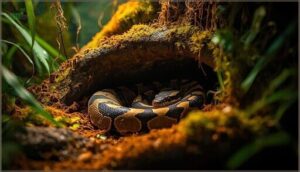
A snake without a hide isn’t just uncomfortable — it’s basically living in a state of chronic alarm. Snake security depends on shelter that mimics tight natural burrows, directly bolstering stress reduction and healthy snake behavior. Without it, snakes often refuse food, shed poorly, and develop weakened immunity over time.
- Lowers baseline stress hormones
- Improves feeding confidence
- Bolsters complete, healthy sheds
- Encourages natural exploration behaviors
Types of Hides and Placement
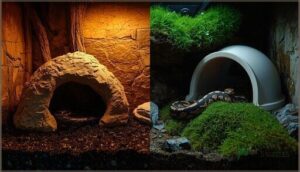
Your snake needs at least two hides — one on the warm side (around 88°F) for digestion, one on the cool side (near 75°F) for retreat. Ceramic hides handle thermal hide placement best on the heat end, while lightweight plastic suits the cool zone. Add a humid moss-filled hide during shedding.
Smart enclosure layout tips like these directly support natural snake behavior and reduce stress.
Natural Vs. Artificial Hiding Spots
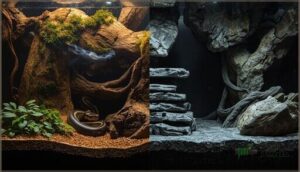
Natural materials genuinely outperform plastic regarding snake shelter preferences and overall wellbeing. Here’s what the data tells us:
- Cork bark holds surface moisture, creating humid microclimates that plastic simply can’t match
- Driftwood crevices support shedding by giving snakes friction points for targeted skin removal
- Stacked slate mimics naturalistic environments, satisfying hognose and ground-dwelling species instinctively
- Artificial cave systems work fine but dry out faster, sometimes causing incomplete sheds
Substrate and Environmental Enrichment

The substrate lining your snake’s enclosure does more than just look good — it shapes how your snake moves, burrows, and behaves day to day. Getting it right also makes cleaning easier and keeps the whole habitat healthier long-term.
Here’s what you need to know about choosing the best substrate and adding the right environmental features to keep your snake genuinely thriving.
Best Substrate Types for Snakes
The floor of your snake’s enclosure isn’t just filler — it’s a foundation for health. Choosing the right substrate options shapes humidity control, burrowing behavior, and overall comfort across a snake’s ecological niche.
| Snake Bedding | Best For |
|---|---|
| Aspen Shavings | Corn snakes, low humidity |
| Coconut Husk | Ball pythons, tropical species |
| Cypress Mulch | Rainbow boas, humid setups |
Match substrate safety to your species’ habitat.
Cleaning and Maintenance Tips
Great substrate choices keep things clean — but they also demand upkeep. Waste removal should happen daily using reliable maintenance tools like a litter scoop or tongs.
Consistent cleaning schedules protect your snake’s health long-term.
- Spot-clean feces every day
- Refresh water bowls every 48 hours
- Stir substrate weekly
- Use F10SC or chlorhexidine as disinfectant options
- Deep-clean enclosure design monthly
Environmental Features for Stimulation
Clean enclosures set the foundation — but enrichment brings your snake’s habitat to life. Think beyond the basics. Climbing Structures, Burrowing Options, and Exploration Areas tap into deep-rooted environmental adaptation behaviors.
| Feature | Example | Benefit |
|---|---|---|
| Climbing Structures | Sturdy branches | Muscle development |
| Burrowing Options | Coconut husk substrate | Natural digging instinct |
| Sensory Stimulation | Herb scents on hides | Vomeronasal engagement |
Visual Barriers and varied textures round out a thriving snake habitat.
Water and Hydration Essentials
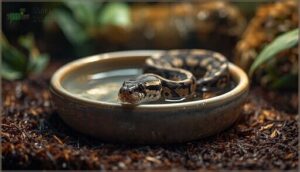
Water might seem simple, but it’s one of the most overlooked parts of a snake’s care. Getting it right means more than just dropping a bowl in the corner and calling it done.
Here’s what actually matters regarding keeping your snake properly hydrated.
Water Bowl Size and Placement
For proper Snake Hydration, bowl size and Bowl Placement genuinely matter. Adults like ball pythons need bowls at least 10 inches long — deep enough for soaking, but not so deep they panic.
Set it on the cool side to keep Water Quality stable and slow evaporation. Avoid warm-side positioning; it spikes Substrate Moisture unpredictably and disrupts your snake’s natural behavior.
Misting and Shedding Support
Once your water bowl is dialed in, misting becomes your next lever for Snake Hydration and Shed Support. Proper Misting Tools and Mist Timing make all the difference — morning or early evening sprays let your snake’s habitat dry before nighttime temperature regulation kicks in. Target Humidity Levels by species:
- Ball pythons need 60–75% daily
- Corn snakes thrive at 40–60%
- Pre-shed? Bump humidity briefly higher
- Humid hides locally reach 70–90%
Signs of Dehydration in Snakes
Dehydration sneaks up quietly — and your snake’s body tells the story before behavior does. Watch for wrinkled, accordion-like Snake Skin along the sides, sunken eyes that lose their bright fullness, and dry chalky urates.
A simple Hydration Test confirms it: pinch the skin gently — if it stays tented instead of snapping back, that’s a serious Reptile Health warning.
Frequently Asked Questions (FAQs)
How do snakes survive?
Snakes survive through exceptional evolutionary traits — temperature regulation, camouflage, and sharp predator avoidance instincts.
These snake adaptations keep ecosystem balance intact, making their survival tactics a masterclass in millions of years of fine-tuned evolution.
Do snakes need a habitat?
Absolutely. A snake’s habitat isn’t just a home — it shapes its behavior, metabolism, and survival. Without the right environmental needs, even a healthy snake quickly declines. Habitat diversity is everything to reptile ecology.
How have snakes adapted to their habitat?
Millions of years of environmental adaptation have shaped snakes into masters of survival. From desert snake camouflage to rainforest hunting tactics, habitat diversity drives every behavioral and physical trait they carry.
Do snakes live in urban environments?
Yes, they absolutely do. Many species thrive in cities, exploiting rodent-rich zones, drainage systems, and green corridors.
This proves that urban snake adaptation is real, and urban ecosystem balance depends on their presence.
What does a snake’s habitat need?
Your snake’s habitat needs proper heat gradients, humidity, clean water, secure hides, and the right substrate — all working together to support natural snake behavior, environmental factors, and overall health.
How much space does a pet snake need?
Space depends on species, but a general rule: the enclosure size should match your snake’s length combined across floor area. A 4-foot snake needs at least 4 feet of combined length and width.
What lighting schedule do snakes require daily?
Most pet snakes thrive on a 12-hour light, 12-hour dark cycle. This Light Cycle Management mimics natural Day Night Transitions, supporting Circadian Rhythm Maintenance and healthy snake behavior without stress.
Can snakes live together in the same enclosure?
Most snakes are solitary by nature, making Snake Socialization rare and Cohabitation Risks real.
Species Compatibility matters — mixing species courts disaster.
For Multi Snake Care, prioritize Enclosure Size and individual resources.
How often should you feed a pet snake?
Think snakes eat like teenagers raiding the fridge? Not quite. Feeding schedules depend on age and species — young snakes eat every 5–7 days, adults every 7–14 days.
Do snakes need UVB lighting to stay healthy?
Yes — UVB lighting genuinely benefits snakes. It triggers Vitamin D3 synthesis in their skin, boosts immunity, and aids calcium metabolism. Ferguson Zones help you dial in the right exposure level for your specific species.
Conclusion
Getting what do snakes need in their habitat right isn’t just good husbandry—it’s the whole ball of wax. Every degree on that thermal gradient, every hide placed with intention, every humid microclimate you maintain adds up to something profound: a snake that isn’t just surviving but genuinely thriving.
These animals read their environment like a map. Build the right one, and you’re not just keeping a snake—you’re earning its trust, one warm basking spot at a time.
- https://cyfairanimalhospital.com/snakes/snake-owning-101-heat-humidity-habitat/
- https://vcahospitals.com/know-your-pet/snakes---housing
- https://iere.org/what-is-the-habitat-of-a-snake/
- https://reptifiles.com/corn-snake-care-guide/corn-snake-temperatures-humidity/
- https://apexreptile.com/blogs/apex-reptile-blog/complete-guide-to-heating-and-lighting-your-pvc-reptile-enclosure