This site is supported by our readers. We may earn a commission, at no cost to you, if you purchase through links.
A snake doesn’t decide to strike—its nervous system does it first. Long before conscious processing kicks in, a snake’s threat-detection wiring has already assessed your distance, your movement, and whether you qualify as a predator worth responding to.
Most bites happen not because a snake is aggressive, but because it felt cornered with nowhere to go. Understanding what pushes a snake into defensive mode—instinctual triggers, environmental stress, sudden disturbances—changes how you read their behavior entirely.
When snakes feel threatened, their responses follow a predictable escalation, and recognizing where you are in that sequence keeps both you and the animal safe.
Table Of Contents
- Key Takeaways
- What Causes Snakes to Feel Threatened?
- Common Defensive Behaviors in Snakes
- Recognizing Warning Signs in Snake Body Language
- Differences Between Venomous and Non-Venomous Defenses
- How to Respond Safely to Threatened Snakes
- Frequently Asked Questions (FAQs)
- What do snakes do when threatened?
- What repels snakes immediately?
- How to tell if a snake feels threatened?
- How to not make a snake feel threatened?
- Can snakes recognize the same threat twice?
- Do snakes feel threatened by other snake species?
- How does temperature affect a snakes threat response?
- Are young snakes more defensive than adult snakes?
- Can snakes become desensitized to human presence over time?
- Conclusion
Key Takeaways
- Snake defensive behavior is instinct-driven, not aggression — your movement, proximity, and body position trigger a hardwired threat response before the snake even “decides” anything.
- Defensive displays follow a predictable escalation — freezing, hissing, body flattening, and bluff strikes — giving you clear warning signals well before an actual bite occurs.
- Environmental stressors like habitat disruption, sudden noise, and temperature shifts can push even a calm snake into defensive mode, so context matters as much as the snake’s temperament.
- Your best response to a threatened snake is simple: stop moving toward it, give it a clear escape route, and back away slowly — most snakes want to flee, not fight.
What Causes Snakes to Feel Threatened?
Snakes don’t get aggressive out of nowhere — there’s almost always a reason behind the behavior. Understanding what triggers that defensive response can make your interactions with them a lot safer and less stressful for everyone involved.
Once you know the warning signs, you’ll be surprised how avoidable most bites are — understanding ball python bite triggers and handling techniques goes a long way toward building real trust with your snake.
Here are the main factors that push a snake into threat mode.
Instinctual Triggers and Perceived Danger
Instinct, not intention, drives almost every defensive response you’ll see in a snake. When you come within one to two body lengths — or move directly toward its head — threat detection kicks in fast.
These aren’t choices; they’re hardwired survival strategies. Fear responses trigger defensive displays before the snake even “decides” anything.
Understanding that predator avoidance is purely instinctual helps you interpret snake body language without taking it personally. Research highlights how snake threat detection mechanisms are grounded in evolutionary survival, affecting both snake and human behavior.
Environmental Stressors and Sudden Changes
Beyond instinct, environmental factors push snakes toward stress responses just as quickly. Habitat Disruption from construction or flooding removes familiar shelter, forcing snakes into exposed spaces. Climate Shifts throw off basking schedules.
Noise Pollution — vibrations from machinery or traffic — triggers defensive postures almost immediately. Sudden Light Exposure or Enclosure Changes can activate full threat displays, turning an otherwise calm snake into a defensive one.
Recent research shows that a companion’s calming presence can help reduce stress responses in rattlesnakes.
Prior Experiences and Habituation
A snake’s past shapes how it reacts today. One raised with consistent, calm handling and Environmental Enrichment — hides, climbing options, stable routines — generally shows far fewer defensive postures when you approach.
Snake Socialization early in life, through gentle Handling Strategies and Stress Reduction Methods like gradual exposure, builds familiarity.
Habituation Techniques fundamentally teach snake behavior to shift: threat responses quiet down when nothing harmful follows.
Common Defensive Behaviors in Snakes
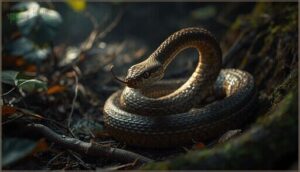
When a snake feels cornered or scared, it doesn’t just sit there and hope for the best — it has a whole toolkit of responses designed to keep it alive. These behaviors follow a kind of escalating logic, starting subtle and ramping up only when necessary.
Here’s what that actually looks like in practice.
Freezing and Camouflaging
One of the quietest animal defense mechanisms is also one of the most effective. When a snake senses danger, its first move is often to simply stop moving. This freezing behavior, combined with visual crypsis and background matching, makes detection surprisingly difficult.
Even a snake’s body posture can mislead you, since many harmless species mimic dangerous ones by flattening their heads — a good reason to learn safe snake handling techniques before getting hands-on.
Here’s what that looks like in practice:
- Patterned scales blend into leaf litter, bark, or sand
- Camouflage techniques improve when snakes choose resting spots matching their own coloration
- Motion camouflage blurs bold markings during rapid movement
- Freezing reduces both sound and visual cues simultaneously
Understanding snake body language starts here — stillness isn’t inactivity, it’s strategy.
A snake’s stillness is not inactivity — it is strategy
Defensive Postures and Body Flattening
When a snake feels cornered, its body becomes the message. Defensive postures like Lateral Flattening, Coiling Behavior, and the iconic Cobra Hood Display are all part of a complex threat display system — no venom required.
| Behavior | What It Looks Like | Why It Works |
|---|---|---|
| Cobra Hood Display | Wide, flattened neck spread | Appears larger, more dangerous |
| Lateral Flattening | Body pressed wide and flat | Expands visible silhouette |
| Neck Flattening | Triangular hood shape | Mimics venomous species |
| Head Shaping | Broad, viper-like head | Bluffs predators into retreating |
These animal defense mechanisms are mostly bluff — snake body language designed to buy time.
Hissing, Musk Release, and Tail Vibrations
When a snake feels pressured, its next line of defense goes beyond body language — it gets loud, smelly, and noisy. These Defensive Signals form a layered Threat Response system:
- Hissing Mechanics – Air forced through the glottis creates a sharp warning display
- Musk Composition – Foul chemicals released near the cloaca repel predators
- Tail Vibration – Rapid shaking mimics rattlesnake warning displays
- Combined Signals – Hissing pairs with defensive postures for stronger effect
- Escape Priority – These warning displays buy time to flee, not fight
Striking and Bluffing
When a snake runs out of softer options, striking becomes the last card it plays. A defensive strike usually covers one-third to one-half of the snake’s body length — fast, precise, and usually followed by an immediate retreat.
Many of these are bluff attacks: closed-mouth lunges designed as warning displays, not real bites. Understanding these strike mechanics can help you read threat responses accurately and stay safe.
Recognizing Warning Signs in Snake Body Language
Snakes can’t tell you when they’re uncomfortable — but their bodies sure can. Before a snake ever strikes, it usually sends out a series of clear signals that something’s wrong.
Here are the key warning signs worth knowing.
S-Shaped Coiling and Head Flattening
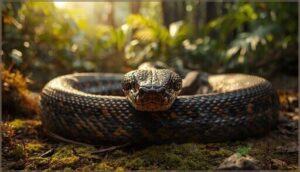
Two of the clearest Snake Threat Displays you’ll encounter are S-shaped coiling and head flattening — and knowing what they mean can keep you safe.
- The S-curve loads muscles like a spring, signaling Strike Preparation
- Head flattening makes the snake appear wider and more threatening
- These Coiling Mechanisms reflect Defensive Posturing, not aggression
- Warning Signals often layer hissing alongside these visual cues
- Recognizing these defensive mechanisms helps you respond calmly and correctly
Rapid Movements and Escape Attempts
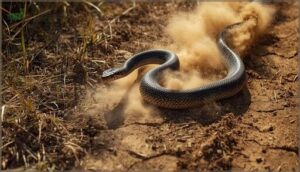
Catch a snake sprinting for cover and you’re watching Flight Initiation in real time—its first line of defense relies on sudden, rapid movement. Most will weave away in unpredictable, zigzag patterns, making pursuit harder.
This stress response includes bursts of speed, sharp turns, even panic reversals, all displaying classic escape strategies in snake body language long before striking or coiling.
Tongue Flicking and Unusual Stillness
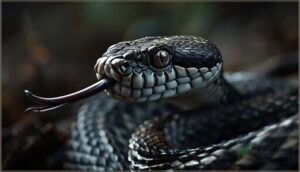
Tongue flick speed is one of the clearest windows into a snake’s threat detection process. When your snake shifts from slow, casual flicks to rapid, near-continuous sampling, it’s picking up chemical cues that signal danger.
Defensive stillness, where movement stops entirely and muscles go rigid, signals the opposite extreme — a shutdown response.
Together, these reptile behavior patterns reveal snake stress before a strike ever comes.
Differences Between Venomous and Non-Venomous Defenses
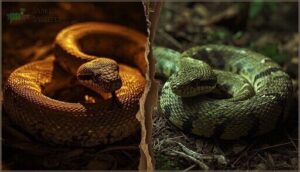
Not all snakes play defense the same way — and a big part of that comes down to whether they’re venomous or not. Each type has its own toolkit for handling threats, from subtle bluffs to outright bites.
Here’s a closer look at how those strategies actually differ.
Use of Venom and Dry Bites
Not every venomous bite delivers venom — and that’s intentional. Through venom metering, snakes consciously control venom delivery, sometimes issuing a dry bite as a warning. Dry bite rates vary widely by species, reaching up to 80% in eastern brown snakes. Understanding defensive envenomation helps you respond smarter:
- Venom production costs energy, so snakes conserve it
- Cornered snakes are most likely to deliver full defensive envenomation
- Dry bites still require immediate medical observation
- Venom metering reflects calculated snake body language
- Defensive striking doesn’t always mean envenomation occurred
Warning Signals and Bluff Strikes
Before a snake commits to a real bite, it almost always warns you first. Snake threat displays — hissing, defensive coiling, body inflation, and warning vibrations — are meant to buy the snake space, not trigger a fight. Bluff attacks and mock strikes, like those hognose snakes perform, keep the mouth closed entirely.
| Signal | What It Looks Like | What It Means |
|---|---|---|
| Defensive Coiling | S-shaped body, raised head | Strike preparation is active |
| Warning Vibrations | Rapid tail buzzing | Escalating stress level |
| Mock Strikes | Fast lunge, closed mouth | Bluffing, not biting |
| Hissing | Loud air expulsion | Back away now |
| Body inflation | Puffed, wider posture | Snake threat displays intensifying |
Backing away slowly usually de-escalates defensive striking quickly.
Camouflage, Hiding, and Playing Dead
Not every defense involves posturing or sound. Many snakes rely on Color Pattern Adaptation and camouflage techniques long before any threat gets close. Copperheads, for example, vanish against leaf litter using Defensive Mimicry — their banded pattern genuinely resembles dead leaves. Thanatosis Behavior takes this further, with hognose snakes playing dead convincingly.
- Freezing instead of fleeing when cover is nearby
- Hiding under debris, rocks, or dense vegetation
- Matching body color to surrounding habitat
- Playing dead combined with foul odor mimicry
How to Respond Safely to Threatened Snakes

Knowing how a snake behaves when it feels cornered is only half the equation — the other half is knowing what to do about it. Your response in those moments can either calm the situation or make it worse.
Here’s what actually works, whether you’re a snake owner or just someone who crossed paths with one outdoors.
Safe Distance and Allowing Retreat
Most snake encounter safety comes down to one rule: give them room to leave. Stay at least 6 to 8 feet away — well beyond typical strike range — and take slow, steady steps backward.
Defensive snakes rarely pursue; they just want a retreat strategy. Once you open a clear escape route and stop advancing, most will disappear into cover within minutes.
Best Practices for Snake Owners and Wildlife Encounters
Whether you’re a keeper or hiker, these snake handling tips apply across situations:
- Support the snake’s full body — never grab from above.
- Know your enclosure design: secure lids, feeding tongs, and hides reduce stress.
- With venomous species outdoors, don’t improvise — follow emergency protocols and call professionals.
Reading defensive snake body language early keeps wildlife encounters and safety outcomes on your side.
Frequently Asked Questions (FAQs)
What do snakes do when threatened?
When threatened, snakes rely on a layered set of snake defense mechanisms — from freezing and snake camouflage to defensive coiling, warning displays, and, as a last resort, venom delivery.
What repels snakes immediately?
Strong ground vibrations, sharp odor repellents like clove or cinnamon oil, and visual barriers such as fine-mesh fencing work as immediate vibrational deterrents and habitat modification tools that prompt snakes to evacuate quickly.
How to tell if a snake feels threatened?
Watch for tight S-curves, flattened bodies, and rapid tail vibrations — these warning signals reveal snake anxiety fast.
Defensive postures, hissing, and frantic escape attempts are your clearest stress indicators that defensive mechanisms have kicked in.
How to not make a snake feel threatened?
Give snakes room to breathe — stay calm, move quietly, and keep a safe distance. Gentle handling and respectful space prevent stress responses and defensive postures before they ever start.
Can snakes recognize the same threat twice?
Yes — snakes can. Through reptile behavior research, we find they link specific scent, heat, and movement patterns to past outcomes. That’s Defensive Recall in action: same threat, faster response.
Do snakes feel threatened by other snake species?
Snakes absolutely feel threatened by other snake species. Chemical threat detection, visual threat cues, and interspecific competition all drive these defensive snake responses — shaping reptile behavior in ways that reveal complex snake species interactions rooted in survival instinct.
How does temperature affect a snakes threat response?
Temperature shapes a snake’s energy levels, reaction speed, and strategy shifts. Warmer snakes flee or strike faster, cooler ones freeze. Body heat isn’t just comfort; it dictates every defensive snake response.
Are young snakes more defensive than adult snakes?
Generally, yes. Juvenile vulnerability makes young snakes more reactive — their small size drives intense defensive snake behavior.
With maturation changes and habituation effects, adults tend to rely on retreat over striking.
Can snakes become desensitized to human presence over time?
Over time, reptile behavior and psychology shows that captivity habituation is real — many pet snakes calm down with gentle, predictable handling and care.
Wild tolerance exists too, though desensitization limits mean instinct never fully disappears.
Conclusion
When snakes feel threatened, they’re not acting out of malice—they’re running a survival program older than memory itself. Every hiss, every flattened hood, every bluff strike is a negotiation, not an attack.
Read those signals clearly, give them space to exit, and most encounters end without incident. The snake doesn’t want conflict; it wants an escape route. Your awareness is what creates one. Respect that instinct, and you’ll rarely find yourself on the wrong end of it.
- https://www.britannica.com/animal/reptile/Striking-and-biting
- https://californiaherps.com/behavior/snakelifehistorydefense.html
- https://asknature.org/strategy/defense-mechanism-deters-predators/
- https://news.mongabay.com/2024/08/as-climate-change-shakes-up-global-map-of-venomous-snakes-health-risks-abound/
- https://academic.oup.com/cz/advance-article/doi/10.1093/cz/zoaf070/8315358