This site is supported by our readers. We may earn a commission, at no cost to you, if you purchase through links.
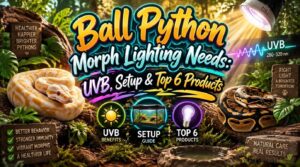
An albino ball python and a wild-type share the same species name and almost nothing else regarding light. Melanin-deficient morphs absorb UV differently, and a fixture safe for one snake can accelerate retinal damage in another. That’s not a minor calibration issue; it’s the difference between a thriving animal and a stressed one.
Ball python morph lighting needs vary enough that a single setup rarely covers every genetic line in your collection. Albinos, leucistics, scaleless, and hypomelanistics each respond to UVB intensity, photoperiod, and spectrum in distinct ways. Getting this right means understanding the biology behind the pigment, not copying a generic care sheet.
Table Of Contents
- Key Takeaways
- Do Ball Python Morphs Have Different Lighting Needs?
- Daylight Spectrum and Photoperiod for Ball Python Morphs
- Safe UVB Levels for Ball Python Morphs
- Ball Python Lighting Setup, Placement, and Monitoring
- Top 6 Lighting and Care Products for Ball Python Morphs
- Frequently Asked Questions (FAQs)
- What lighting do ball pythons need?
- What is the most sought after ball python morph?
- Is 70 degrees too cold for a ball python at night?
- How many lights do I need for my ball python?
- Can morphs share the same enclosure lighting?
- Do darker morphs need stronger heat sources?
- How often should UVB bulbs be replaced?
- What wattage works best for small enclosures?
- Are LED lights safe for all morphs?
- How does lighting affect ball python feeding behavior?
- Conclusion
Key Takeaways
- Albino, leucistic, and scaleless ball python morphs absorb significantly more UV light than standard morphs due to reduced melanin, making diffused, low-intensity lighting setups essential to prevent retinal damage and chronic stress.
- Even snakes of the same morph can respond differently to identical UVB exposure, so track each animal’s basking behavior and feeding cycles individually rather than relying solely on morph-wide guidelines.
- UVB bulbs lose meaningful output well before they visibly burn out, so test with a calibrated meter every few weeks and replace bulbs every 6–12 months to maintain safe, effective levels.
- A consistent 12–14 hour photoperiod using 5500–6500K full-spectrum lighting, ramped on and off gradually over 15–30 minutes, directly stabilizes feeding behavior and circadian rhythms across all morphs.
Do Ball Python Morphs Have Different Lighting Needs?
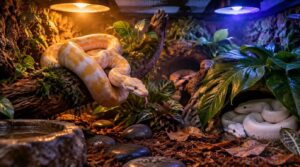
Yes, ball python morphs have different lighting needs, and getting this wrong puts your animal at risk. Whether you keep an albino, leucistic, hypomelanistic, or scaleless morph, each comes with specific sensitivities that standard setups don’t account for. Here’s what you need to know about each morph before adjusting your lighting.
For a deeper look at how these sensitivities vary across popular picks like albinos and leucistics, beginner-friendly ball python morphs and their care needs break down exactly what new keepers should prepare for before choosing a morph.
Albino Morph Light Sensitivity
Most keepers underestimate how severely reduced melanincreased melanin affects an albino morph’s light sensitivity. Without melanin to filter incoming wavelengths, your snake’s eyes and skin absorb far more raw light energy, triggering photophobia and visible stress behaviors like head-bobbing. Bright UVB exposure compounds this, so keep fixtures diffused, maintain a 30 cm minimum distance, and cap the photoperiod at 12 hours.
Leucistic Morph Lighting
Leucistic morphs mirror the Albino Morph’s vulnerability: reduced melanin leaves the retina almost unshielded. That absence accelerates retinal damage and triggers photophobia faster than you’d expect. Even moderate light sensitivity becomes a serious problem without the right setup.
- Use diffused broad-spectrum bulbs (CRI 80+)
- Limit UVB to 3-6% output
- Set a 12:12 photoperiod
- Keep all fixtures 20-30 cm above substrate
Hypomelanistic and Scaleless Morphs
Hypomelanistic scales intensify light sensitivity by reflecting UV rather than fully absorbing it. Reduced melanin requires 30-40% shaded coverage. Scaleless morphs face even more direct UV contact on skin, and retinal damage escalates fast. Follow a separate UVB Setup Care Guide from general Ball Python Morph Lighting Needs.
| Morph | UVI | Shade |
|---|---|---|
| Hypomelanistic | 1-2 | 30-40% |
| Scaleless | 0.5-1 | 40-50% |
| Standard | 2-3 | 20-30% |
Genetic and Individual Variation
Even within the same morph, Genetic Makeup creates real individual differences. Two Albino morphs can respond differently to identical UVB. Light Sensitivity is personal, not morph-wide.
Use Genotype Specific Care:
- Track basking duration per snake
- Adjust UVI individually, not just by morph
- Watch Hypomelanistic Morphs for UVB light aversion
- Log photoperiod response weekly
- Note feeding cycle shifts after light changes
Daylight Spectrum and Photoperiod for Ball Python Morphs
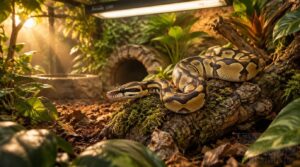
Because your ball python’s behavior tracks light as much as temperature, getting the Daylight Spectrum right is non-negotiable. Aim for a 5500–6500 K balanced white output during daylight hours. This directly helps normal feeding cues and activity windows without stressing more light-sensitive morphs like albinos.
Keeping your lighting on a consistent timer matters just as much as the spectrum itself, so if you’re starting from scratch, this guide on creating a comfortable day-night environment for snakes walks you through building a stable routine your ball python can actually rely on.
Nail the daylight spectrum or watch feeding cues collapse and light-sensitive morphs suffer
Photoperiod for Ball Python Morphs should run 12–14 hours daily. Consistent 12-Hour Photoperiods work well year-round, but during breeding or pre-shed phases, extending to 14–16 hours can meaningfully stimulate increased activity. Revert once the phase ends. A programmable reptile light timer outlet takes the guesswork out of those seasonal adjustments, handling the shift from 12 to 14+ hours automatically.
Full Spectrum Lighting drives Circadian Rhythm Stability, so use a timer and ramp light on and off over 15–30 minutes to simulate sunrise and sunset. Abrupt switches stress your snake. Keep night periods completely dark for 10–12 hours minimum.
Safe UVB Levels for Ball Python Morphs
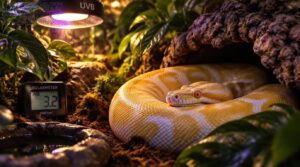
Your morph places you on a specific UVB intensity spectrum. For standard wild-type ball pythons, target UVB output measurement readings between 0.1 and 0.5 W/m² at the UVB safe distance from the lamp, which is usually your basking zone. Albinos and scaleless lines belong at the lower end, and don’t let any basking surface top 0.75 W/m², regardless of morph. Morph-specific intensity targets—and the reasoning behind them—are covered thoroughly in this guide on whether ball pythons need UVB light for optimal health, which is worth reading before you finalize your setup.
UVB degradation matters more than most keepers realize. Bulbs lose meaningful output well before visually burning out, so confirm readings with a calibrated handheld meter every few weeks.
Limit peak UVB for ball pythons to 30-60 minutes daily for standard morphs, then reduce to just a few sessions per week for sensitive lines to prevent cumulative skin and ocular damage.
Ball Python Lighting Setup, Placement, and Monitoring
Picture your enclosure as a staged environment where every lamp position either builds or breaks your snake’s health. A solid ball python habitat lighting guide starts with basking spot temperature: keep the surface between 90 and 110°F using a digital probe placed at substrate level.
- Position fluorescent tubes 12 to 18 inches from the basking area for safe UVB output measurement
- Never place bright fixtures over water bowls; humidity swings breed mold fast
- Use a thermostat-controlled heat source to create reliable day-to-night gradients without thermal shock
A proper UV gradient matters most for sensitive morphs. Lighter enclosure walls boost ambient brightness, so factor reflectivity into your setup. Red or blue night-scene lighting lets you observe activity without disrupting circadian rhythms.
A quality UVB linear tube light spanning the basking zone makes building that gradient far easier.
Top 6 Lighting and Care Products for Ball Python Morphs
Getting the lighting right means nothing without the right gear to back it up.
The six products below cover every essential need—enclosure, sanitation, heat, UVB, and automation—so you’re not piecing together a setup that falls short.
Each one is chosen with morph-specific sensitivities in mind.
1. Repti Zoo Large Reptile Terrarium
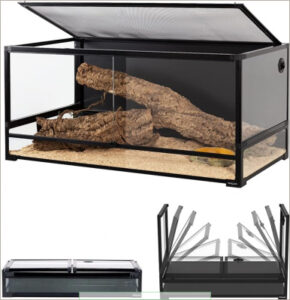
Your lighting and thermal setup starts with the enclosure itself. The Repti Zoo Large Reptile Terrarium’s 48×24×24-inch frame and 120-gallon interior give your ball python genuine room to thermoregulate across a proper gradient. The aluminum alloy frame holds structural integrity under heat lamp loads, and the screen top’s four wire inlets keep your UVB and heating cables organized without improvised gaps or tape fixes.
The black-out PVC back panel reduces visual stress while front ventilation strips manage airflow and humidity, keeping conditions stable between your basking and cool zones. The raised 0.5-inch waterproof bottom grips substrate heaters without complications. Inspect the door latches routinely, as some users have reported durability problems with the glass doors over time.
| Best For | Reptile keepers setting up desert or rainforest habitats for ball pythons, bearded dragons, lizards, snakes, tortoises, or turtles who need a spacious, well-ventilated enclosure with flexible heating and lighting options. |
|---|---|
| Build Material | Aluminum alloy & glass |
| Max Wattage | N/A |
| Safety Rating | N/A |
| Dilution Required | N/A |
| Size / Capacity | 48×24×24 in, 120 gal |
| Compatibility | Multiple reptile species |
| Additional Features |
|
- The 48×24×24-inch, 120-gallon interior provides genuine space for thermoregulation gradients, and the aluminum alloy frame handles heat lamp loads without warping.
- Four wire inlets in the screen top keep UVB and heating cables tidy, while the black-out PVC back panel reduces animal stress and front ventilation strips stabilize airflow and humidity.
- The raised 0.5-inch waterproof bottom accommodates substrate heaters cleanly, and the tempered glass base is easy to clean and maintains heat effectively.
- Customer feedback includes durability concerns, with some users reporting glass doors falling out over time, suggesting the build quality may not hold up under regular use.
- Door operation is polarizing, with a portion of users finding the latches or hinges difficult to work with day to day.
- At 120 gallons, the enclosure meets only minimum space requirements for larger species, which may require an upgrade sooner than expected as animals grow.
2. Veterinary Grade Disinfectant Cleaner Solution
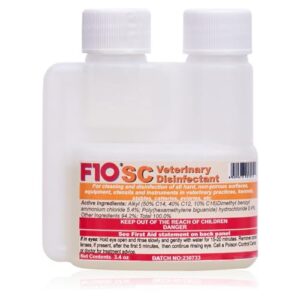
Your enclosure is only as safe as your cleaning routine. F10 SC is an EPA-registered, broad-spectrum disinfectant that targets bacteria, viruses, fungi, and spores, making it one of the most reliable options for reptile enclosures. Its odorless, non-corrosive, biodegradable formula won’t stress your snake during or after cleaning.
Dilute it at 1:250, meaning 4 mL per liter of water. That ratio matters. Too weak and you’re barely cleaning; use it concentrated and it’s harmful to your animal. On hard, non-porous surfaces like glass and ceramic, no rinse is needed. Porous materials require thorough rinsing before your python re-enters. The 4.66-ounce bottle is compact, so keep backup stock on hand for high-frequency use.
| Best For | Reptile keepers, veterinary clinics, kennels, and animal shelters that need a hospital-grade disinfectant safe enough for routine enclosure cleaning. |
|---|---|
| Build Material | N/A |
| Max Wattage | N/A |
| Safety Rating | EPA-registered |
| Dilution Required | 1:250 (4 mL/L) |
| Size / Capacity | 4.66 oz bottle |
| Compatibility | Hard non-porous surfaces |
| Additional Features |
|
- Broad-spectrum formula kills bacteria, viruses, fungi, and spores, giving you thorough protection with a single product.
- Odorless and non-corrosive, so it won’t stress your animals or damage enclosure surfaces.
- No-rinse required on hard, non-porous surfaces like glass and ceramic, making cleaning faster and easier.
- Must be diluted precisely at 1:250 — concentrated solution is harmful to animals, leaving no margin for guesswork.
- Not suitable for porous materials without thorough rinsing, which adds steps for enclosures with mixed surfaces.
- The 4.66-ounce bottle is small, so high-volume facilities or frequent cleaners will need to reorder regularly.
3. Pet Friendly Disinfectant Cleaner Solution
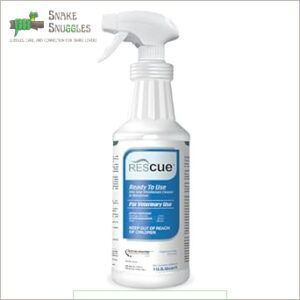
Your ball python’s health depends on a consistently clean habitat, and Rescue One Step Disinfectant makes that standard absolutely non-negotiable. Its accelerated hydrogen peroxide formula neutralizes broad-spectrum pathogens, including canine parvovirus, in just 60 seconds flat. You apply it straight from the bottle to hard surfaces with no dilution required, then wipe everything clean.
One practical detail to know upfront: the bottle doesn’t include a spray nozzle, so pick one up before cleaning day. It leaves no visible residue on most solid surfaces, though clear plastic panels may develop a light film. The chemical odor is strong, so ventilate your room well and let every surface dry completely before returning your snake.
| Best For | Pet owners and veterinary professionals who need a fast-acting, no-fuss disinfectant that’s safe to use around animals. |
|---|---|
| Build Material | N/A |
| Max Wattage | N/A |
| Safety Rating | N/A |
| Dilution Required | None, ready-to-use |
| Size / Capacity | N/A |
| Compatibility | Hard surfaces only |
| Additional Features |
|
- Kills a broad range of pathogens, including canine parvovirus, in just 60 seconds
- Ready to use straight from the bottle — no mixing or diluting needed
- Leaves no visible residue on most solid surfaces, so habitats look clean after wiping down
- Bottle doesn’t include a spray nozzle, so you’ll need to buy one separately
- Produces a strong chemical odor that requires good ventilation during and after use
- May leave a visible film on clear plastic surfaces, which can be an issue for enclosures with transparent panels
4. Reptile Clamp Lamp Fixture
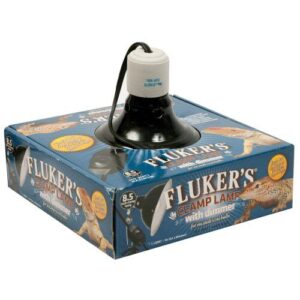
Once your habitat’s clean and dry, you need reliable heat delivery.
Fluker’s ReptaClamp Lamp features a swivel head design that directs heat precisely where your morph needs it, letting you fine-tune a basking zone or correct a cold corner without repositioning the whole setup.
The fixture is UL/CUL approved and rated for up to 150 watts, compatible with both incandescent bulbs and ceramic heat emitters. Its heavy gauge aluminum construction and ceramic socket handle continuous operation, and a polarized plug adds built-in electrical safety.
Know the limits: the integrated dimmer switch won’t work with mercury vapor bulbs, and LED bulbs often flicker even at full output. Stick to incandescent or ceramic emitters for consistent results.
| Best For | Reptile and amphibian keepers who need precise, adjustable heat delivery for a basking zone or cold-spot correction in their habitat setup. |
|---|---|
| Build Material | Heavy gauge aluminum |
| Max Wattage | 150W |
| Safety Rating | UL/CUL approved |
| Dilution Required | N/A |
| Size / Capacity | N/A |
| Compatibility | Incandescent & ceramic |
| Additional Features |
|
- Swivel head lets you aim heat exactly where it’s needed without moving the whole fixture
- UL/CUL approved with a ceramic socket and heavy gauge aluminum built for continuous use
- Works with both incandescent bulbs and ceramic heat emitters, giving you heat-only or light-and-heat options
- Dimmer switch is incompatible with mercury vapor bulbs, limiting your lighting choices
- LED bulbs flicker even at full output, so you’re locked into incandescent or ceramic emitters
- The clamp can be tricky to attach securely and may need an alternative mounting solution
5. Reptile Premium Heat Lamp Fixture
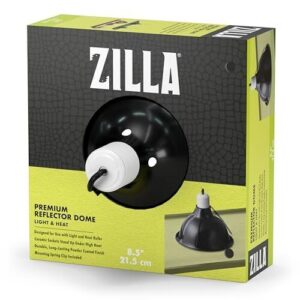
Zilla’s Premium Reflector Dome improves on basic fixtures with a reflective white interior that pushes infrared heat downward rather than dispersing it sideways. The 8.5-inch ceramic socket takes up to 150 watts continuously, making it compatible with halogen floods or ceramic heat emitters for your thermal gradient.
The powder-coated black exterior stays cool to the touch while the spring clip mount secures it directly to your screen lid. A 6-foot cord with an in-line switch keeps your hands clear during adjustments.
One honest caveat: some users report durability issues and clamp fit problems, so handle it carefully during setup. Bulbs aren’t included, so pair it with your preferred heat source right from the start.
| Best For | Reptile keepers who need a reliable, high-wattage dome fixture for maintaining consistent heat gradients in medium to large terrariums. |
|---|---|
| Build Material | Powder-coated exterior |
| Max Wattage | 150W |
| Safety Rating | N/A |
| Dilution Required | N/A |
| Size / Capacity | 8.5-in dome |
| Compatibility | Halogen & ceramic |
| Additional Features |
|
- Reflective white interior directs heat downward for more efficient and even warmth distribution
- Ceramic socket handles up to 150 watts, supporting a wide range of heating bulbs including halogen floods and ceramic heat emitters
- Spring clip mount and 6-foot cord with in-line switch make positioning and adjustments easy and hands-free
- Bulbs are not included, requiring an additional purchase before use
- Some users report durability concerns, with units breaking under normal handling
- The clamp mechanism has mixed reviews, with fit issues reported on certain screen lid sizes
6. Indoor Heavy Duty Timer Switch
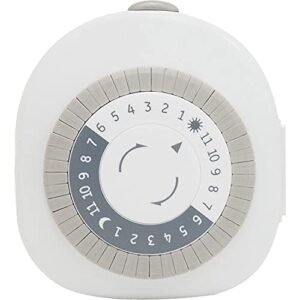
Once that dome is mounted, you need something to run it on a reliable schedule. GE’s Heavy Duty Timer Switch (model 15153) puts your 12:12 lighting cycle on autopilot using 30-minute interval precision across a full 24-hour daily cycle. No more manual switching, no forgotten lights, no disrupted circadian rhythms.
The single grounded 3-prong outlet grips LED, CFL, and incandescent loads alike, while the override switch lets you pause your schedule during maintenance without losing your program. At just 4 ounces, it’s compact enough to tuck near any outlet.
One honest caveat: it’s mechanical, so expect some audible ticking and schedule drift of ±2-5 minutes each month. Check it weekly.
| Best For | Anyone who wants to automate lamps, holiday lighting, or small appliances on a consistent daily schedule without any smart home setup. |
|---|---|
| Build Material | Heavy-duty mechanical |
| Max Wattage | N/A |
| Safety Rating | Grounded outlet |
| Dilution Required | N/A |
| Size / Capacity | 3×5×6 in, 4 oz |
| Compatibility | LED, CFL, incandescent |
| Additional Features |
|
- Sets a reliable 24-hour schedule on 30-minute intervals, perfect for maintaining a consistent lighting cycle
- Works with LED, CFL, and incandescent bulbs, so it fits whatever setup you already have
- The override switch lets you pause the schedule for maintenance without wiping your program
- The mechanical ticking can be disruptive in or near sleeping areas
- Printed setup instructions are small and hard to follow, especially for first-time tab configuration
- Physical tabs can stick or need manual nudging to stay in the correct position
Frequently Asked Questions (FAQs)
What lighting do ball pythons need?
You need a consistent day/night cycle of 12–14 hours light, low-intensity ambient illumination, and optional low-level UVB for ball pythons. Prioritize heat gradients over bright lighting; your snake thrives with shaded, diffused setups.
What is the most sought after ball python morph?
Ball python lighting aside, the most sought after morph is probably the Ball Python morph known as the Banana. Rare clutches once sold for thousands; prices have dropped, but demand stays high.
Is 70 degrees too cold for a ball python at night?
Short answer: borderline, not ideal. Your ambient temperature dipping to 70°F is acceptable only briefly. Sustained nights that cold slow digestion, so add a thermostat-controlled heat source for proper nocturnal snake care.
How many lights do I need for my ball python?
You’ll need two light sources usually: a T5 HO UVB lighting fixture and a basking lamp, both on a 12-hour light, 12-hour dark cycle. That covers UVB exposure and heat for thriving, not surviving.
Can morphs share the same enclosure lighting?
Yes, all morphs thrive under one shared lighting plan: a 12:12 photoperiod, broad-spectrum daylight, and proper basking zones. Just watch albino individuals closely, since reduced pigment can make them shun bright spots.
Do darker morphs need stronger heat sources?
You might assume darker morphs demand stronger heat, but that’s a myth. Thermal gradients, not pigment, drive basking behavior. Hypomelanistic morphs and albinos alike thrive when your basking temperature hits 32–34°C. Prioritize thermoregulation over genotype-tailored care extremes.
How often should UVB bulbs be replaced?
Still assuming your UVB bulb is fine because it lights up? UVB output decline sets in well before burnout, so schedule UVB bulb replacement every 6–12 months to keep your python’s vitamin D3 synthesis working.
What wattage works best for small enclosures?
Treat wattage like a precision tool, not a blunt one. For small enclosures under 20 gallons, 25-40 watts creates the right thermal gradient without overheating. A Temperature Control thermostat keeps your basking zone at 30-32°C.
Are LED lights safe for all morphs?
Like sunlight filtered through a dense forest canopy, LEDs work safely across every morph. Full-spectrum 5000–6500K fixtures cause no documented harm when paired with a consistent 12-hour photoperiod that maintains your snake’s natural circadian rhythms.
How does lighting affect ball python feeding behavior?
Darkness is a predator’s most reliable ally. Ball python lighting directly shapes feeding response by triggering or suppressing prey-tracking instincts. Bright or misaligned day-night cycles push your morph to hesitate, stress, and outright refuse meals.
Conclusion
A keeper with three albino hatchlings and one normal morph quickly learns that one fixture doesn’t fit all. Ball python morph lighting needs are real, measurable, and worth solving before symptoms appear. Your leucistic doesn’t squint for drama; it squints because the UVB index is wrong.
Dial in spectrum, intensity, and photoperiod for each genetic line. Your animals won’t thank you out loud, but consistent behavior, steady feeding, and bright, calm eyes will.