This site is supported by our readers. We may earn a commission, at no cost to you, if you purchase through links.
Crack open a corn snake egg, and you’re likely to find a genetic tug-of-war unfolding right on the scales. Co-dominant genes don’t pick sides—they let both parental traits parade across the hatchling’s skin, no one fading into the background.
Suddenly, a single clutch bursts with unexpected variety, every morph a visible snapshot of its genetic roots. In the hands of breeders, these corn snake co-dominant genes transform the rules of inheritance, trading secrets of color and pattern in real time.
Grasping this force not only shapes every breeding project but redefines what’s possible with each new generation.
Table Of Contents
Key Takeaways
- Co-dominant genes in corn snakes allow both parental traits to appear distinctly in offspring, leading to visible genetic diversity within a single clutch.
- Recognizing co-dominant morphs relies on clear visual markers like unique patterns and color contrasts, often identifiable in hatchlings soon after birth.
- Breeding with co-dominant genes offers predictable inheritance patterns, accelerates morph variety, and makes genotype tracking essential for responsible record-keeping.
- Maintaining genetic diversity and prioritizing animal welfare are crucial ethical considerations for breeders working with co-dominant traits.
What Are Co-Dominant Genes in Corn Snakes?
If you want to understand corn snake genetics, co-dominant genes are where the story gets interesting. These genes show their influence in a way that’s easy to spot—even in just one snake. Let’s break down exactly what makes these traits stand out.
Definition of Co-Dominance
Imagine blending two powerful colors—neither outshining the other. That’s the heart of co-dominance theory.
In corn snakes, codominant genes at a single locus guarantee both alleles show up in the phenotype. You see distinct traits from each parent, not a muted blend, turning inheritance patterns into a lesson in Mendelian inheritance and revealing true allele expression.
Difference Between Co-Dominant and Other Inheritance Patterns
Unlike simple dominant or recessive patterns—where trait expression feels like an on-off switch—codominant genes in corn snakes flex their muscle by letting both alleles stand in the spotlight. Here, genotype isn’t masked; phenotype diversity leaps out.
Traditional Punnett squares predict these inheritance types, but only codominant genes showcase such bold genetic variation and clear gene interaction patterns.
Understanding complex genetic concepts, such as those found in AP Biology courses, can help explain the intricacies of codominant genes.
Importance in Corn Snake Genetics
Understanding codominant genes in corn snake genetics puts the power of Morph Diversity right in your hands. These genes reveal new trait expression—revealing unique color inheritance patterns and expanding genetic variation within breeding outcomes.
Codominant genes reshape genotype-phenotype relationships, offering breeders real-time feedback on genetic mutations and morphs, making Mendelian inheritance personal, practical, and anything but predictable.
By exploring the intricacies of genetic engineering and human genetic issues, breeders can better understand the implications of their work.
Identifying Co-Dominant Traits in Corn Snake Morphs
Spotting co-dominant traits in corn snake morphs isn’t as mysterious as it seems. If you know what to look for, certain features stand out right away. Let’s walk through the most telling signs you’ll find in these snakes.
Common Co-Dominant Morphs and Their Features
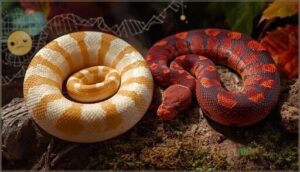
No two corn snake morphs tell the same genetic story—just look at Axanthic Pied with its patchwork of glassy white, or the Countershaded Red’s smoldering bands.
Co-dominant gene interaction drives this morph classification, where color genetics and pattern expression shift with every genetic mutation, and trait inheritance creates new chapters in the saga of snake morphology.
Phenotypic Expression in Heterozygotes
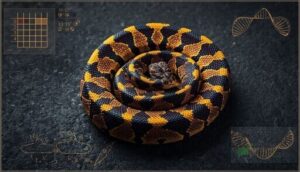
Heterozygote traits in corn snakes reveal the power of genetic variation—what you see isn’t a copy of either parent, but a striking blend. Phenotype expression at co-dominant loci produces unique patterns that defy standard dominant-recessive expectations.
Phenotype mapping and Punnett squares bring genotype-phenotype relationships to life, letting you track co-dominant effects through each twist of trait expression.
Visual Markers of Co-Dominant Genes
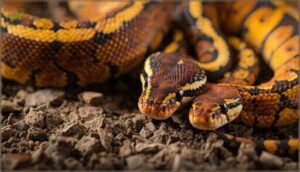
Tell a corn snake story with your eyes: Dorsal Patterns often flag co-dominant genes at a glance, while Scale Edge contrasts and Eye Stripes can whisper heterozygote status to an attentive keeper.
Look closer—ventral colors and brightness levels shift subtly with genetic mutations, making Punnett Squares and real-world observation the paramount tag team for decoding morphs.
Genetic Mechanisms Behind Co-Dominance
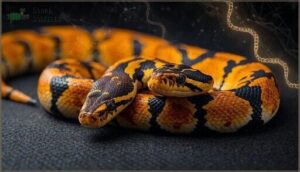
Understanding how co-dominance works starts with looking at the alleles involved and where they act.
The way a corn snake’s genes translate to its appearance depends on these basics.
Let’s break down the key parts you should know.
Alleles and Locus Involvement
Ever wonder how a single gene can paint such a bold difference on your corn snakes? At the core, alleles at one chromosomal locus juggle control over visible morphs, with neither blinking out the other—classic co-dominance.
Watch for these three technical clues:
- Chromosomal analysis pinpoints the locus.
- Allele interactions drive intermediate patterns.
- Locus effects reshape gene expression, breaking Mendelian inheritance rules.
Genotype-to-Phenotype Relationships
Genetic expression in corn snakes is anything but subtle—your snake’s outward appearance, or phenotype, is a direct map of its genotype.
Thanks to gene interaction at co-dominant loci, Punnett squares become vivid predictors of phenotype variation. Each pairing becomes a living experiment that breaks old Mendelian inheritance assumptions, embodying the true complexity of trait inheritance and molecular genetics.
Comparison With Dominant and Recessive Inheritance
Tired of black-and-white genetics? Inheritance patterns aren’t simple switch-flips; they’re a tug-of-war between dominant genes, recessive genes, and co-dominant interactions shaping phenotype variations. Watch how:
- Dominant genes blur subtlety—one allele rules.
- Recessive genes lurk, waiting for a match.
- Co-dominant genes reveal both sides.
- Trait expression isn’t binary.
- Punnett squares animate genotype-phenotype complexity.
Breeding Strategies Using Co-Dominant Genes
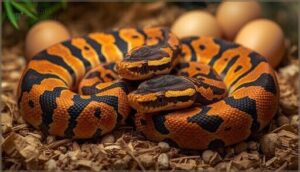
When you work with co-dominant genes in your breeding program, predicting results gets much more straightforward. These genes make it easier to plan for specific morphs and add diversity to your collection.
Here’s what you should keep in mind as you choose your approach.
Predicting Offspring Morphs
Imagine this: you shape a clutch’s future with nothing but Morph Analysis and solid Genetic Prediction. By weaving Punnett Squares, Dihybrid Crosses, and a grasp of Genotype Phenotype Relationships, you unlock Breeding Outcomes.
Careful tracking of trait inheritance transforms random hatchlings into predictable Offspring Patterns—Morph Genetics meets Molecular Biology, turning chance into mastery.
Advantages of Co-Dominant Genes in Breeding
You want more control over Breeding Outcomes? Co-Dominant Genes hand it to you. They boost Morph Diversity by revealing new Trait Expression every generation. Here’s how you benefit:
- Accelerated Genetic Variation
- Predictable Inheritance Patterns
- Faster recognition of novel morphs
- Breeding Techniques that double your options
- Consistent expansion of Genetic Diversity in your collection
Record-Keeping for Genotype Tracking
Having diverse morphs at your fingertips means data management is your silent partner. Careful genotype tracking—through breeding records, Punnett squares, and detailed morph documentation—not just sharpens your pedigree analysis but also clarifies genotype-phenotype links.
The benchmark? Logging each pairing, predicted genotype, and observed phenotype. That habit alone forges reliable records, driving precision and responsible breeding.
Practical Implications for Corn Snake Keepers

When you’re working with co-dominant genes in your corn snakes, the choices you make every step of the way shape what your reptiles become. Breeders and keepers alike have some practical considerations to keep in mind before starting any new project.
Here’s what you’ll need to think about as you plan your next pairing and set up your snakes’ space.
Selecting Breeding Pairs for Desired Traits
Every Breeding Plan is a calculated gamble, but solid Genetic Testing sharpens your odds. If you’re truly after reliable Morph Prediction and bold Trait Selection, start pairing using genotyped adults. Embrace these practices:
- Consult Punnett Squares before any union
- Record genotypes, not just colors
- Make ethics the backbone of each selection
- Commit to proven Breeding Techniques and Strategies
Maintaining Genetic Diversity
Maximizing genetic diversity isn’t just responsible herpetoculture—it’s the backbone of long-term Population Dynamics and Diversity Conservation. Rely on Breeding Programs that foster gene flow; when you introduce unrelated stock, you boost Genetic Variation and reduce the bottlenecks.
Careful record-keeping and screening spot unwanted Genetic Mutations, keeping your Snake Breeding efforts vibrant, resilient, and true to solid Genetic Principles.
Ethical Considerations in Morph Breeding
Integrity matters—especially when you shape a living animal’s destiny through morph breeding. True Breeder Ethics mean prioritizing Welfare Standards and Genetic Transparency above novelty. Don’t let Morph Regulation or market trends squeeze out Conservation Efforts and core Genetic Principles.
Uphold breeder ethics by putting animal welfare and genetic transparency ahead of novelty or shifting market trends
Responsible Pet Ownership drives Species Conservation, so focus on:
- Health-first selection
- Transparent records
- Ongoing Genetic Diversity safeguards
Frequently Asked Questions (FAQs)
How does environment affect co-dominant gene expression?
Imagine you’re painting with shifting light—environmental factors like temperature, humidity, and early nutrition alter gene expression, revealing or masking traits.
In molecular biology, even slight environmental nudges can tweak dominant gene outcomes, showcasing intricate genetics at work.
Are there health issues linked to co-dominant morphs?
Health concerns tied to co-dominant morphs remain minor—think subtle pattern irregularities or slightly higher scale asymmetry—yet studies show no increased disease risk, lifespan reduction, or systemic issues.
Genetic stability and disease resistance largely mirror other morphs and breeding outcomes.
How early can co-dominant traits be identified?
Hatchling identification of co-dominant traits is often possible within days, thanks to early marker detection and clear phenotype expression.
Still, for nuanced morph genetics, genetic verification strengthens breeding strategies and clarifies genotype-phenotype relationships beyond dominant-recessive expectations.
Conclusion
You might think corn snake co-dominant genes are a tangled web best left to experts, but the logic behind their patterns is accessible with careful study. Each clutch you produce is a fresh experiment, a living chart of inheritance that rewards your curiosity and diligence.
Embrace the unpredictability—this is where true mastery begins. By understanding these genetic mechanics, you’re not just breeding snakes; you’re decoding nature’s playbook, one scale at a time. The possibilities, quite literally, show themselves.