This site is supported by our readers. We may earn a commission, at no cost to you, if you purchase through links.

A hatchling ball python that misses two weekly meals might be signaling a husbandry problem, not a personality quirk. Baby snakes operate on tight metabolic margins—their growth rate, immune function, and long-term health all hinge on consistent nutrition during those critical first months.
But “consistent” doesn’t mean universal. A corn snake thrives on prey every five days, while a garter snake demands smaller meals twice as often, and a king snake hatchling might refuse rodents entirely until you offer lizards. Feeding frequency isn’t a one-size answer; it’s a species-specific calculation shaped by age, enclosure temperature, and individual metabolism.
Get the schedule wrong and you risk stunted growth or regurgitation. Nail the timing and prey size, and you’ll watch your snake double its weight in weeks.
Table Of Contents
Key Takeaways
- Baby snakes need species-specific feeding schedules—ball pythons and corn snakes eat every 5–7 days as hatchlings, while garter snakes require smaller prey more frequently, and king snakes may start on lizards before switching to rodents.
- Enclosure temperature directly controls digestion speed and appetite, so you must maintain 86–90°F in warm zones and monitor humidity between 40–60% to prevent feeding refusals and health problems.
- Track your snake’s weight weekly and match prey size to body width at the thickest point (around 4–6% of body weight), using feeding tongs to present pre-killed rodents warmed to 98–100°F to avoid regurgitation and injury.
- Three consecutive meal refusals signal serious trouble—check temperatures first, then consult a reptile vet if your snake refuses food for two weeks, regurgitates repeatedly, or shows sudden weight loss.
Key Factors Affecting Baby Snake Feeding
You can’t feed every baby snake the same way and expect good results. Different species have different needs, and factors like age, size, and even the temperature in their enclosure all play a role in how often they should eat.
Understanding these key influences helps you create a feeding schedule that promotes healthy growth without overfeeding or starving your snake.
Species-Specific Dietary Needs
Each species has distinct dietary restrictions and prey selection needs that directly shape your snake nutrition approach. Young ball pythons usually feed weekly on appropriately sized rodents during their rapid growth phase. Corn snakes show similar feeding schedules at 5–7 days between meals as hatchlings.
Garter snakes need smaller prey more frequently than larger constrictors. King snake hatchlings may start on lizards before shifting to mammals, depending on their population’s natural prey availability.
Age and Growth Stage Considerations
Your baby snakes need smaller prey and tighter feeding schedules during their early hatchling stage. As they hit growth spurts, their metabolic rate climbs and feeding frequency must increase to match.
Watch for molting cycles—appetite drops temporarily before and during sheds. Track these developmental milestones carefully.
Each stage demands adjusted prey sizes and intervals to support healthy growth rates without overfeeding. Understanding the importance of methodological rigor is vital for making informed decisions about their care.
Size, Metabolism, and Activity Level
As your hatchling grows, body size directly determines prey size requirements. Metabolic rates scale with mass—larger babies digest faster and signal hunger sooner. Watch activity levels closely. A restless snake constantly exploring means high metabolism and more frequent feeding needs. Growth patterns accelerate when you match meal intervals to digestion speed. Track these three markers weekly:
As your hatchling grows, its size and activity dictate prey portions and feeding frequency for healthy, accelerated development
- Body weight changes
- Movement frequency between feedings
- Time between meal and next hunger cue
Environmental Influences (Temperature, Humidity)
Your enclosure temperature directly drives metabolic rate and digestion speed. Maintain 28–32°C (86–90°F) in warm zones for peak feeding responses.
Humidity levels between 40–60% support hydration and appetite—too low causes dehydration, too high promotes respiratory issues.
Use calibrated thermometers and hygrometers for environmental monitoring. Proper climate management and thermoregulation strategies guarantee consistent nutrition uptake in your reptile care routine.
Recommended Feeding Frequency by Species

Not all baby snakes eat on the same schedule. Species-specific metabolic rates and growth patterns determine how often your snake needs a meal. Below, you’ll find feeding guidelines for four common pet snake species to help you establish a safe routine.
Ball Pythons
You’ll feed your ball python hatchling every 5 to 7 days to support rapid growth patterns and meet critical nutrition needs. This feeding frequency supplies the fuel baby snakes require during their most vulnerable stage.
As your python matures toward juvenile size, you can gradually extend the interval to every 7 to 10 days, matching ball python diet adjustments to observed weight gain and activity in the snake habitat.
Corn Snakes
Young corn snakes thrive when you provide meals every 5 to 7 days during early life, matching their rapid growth patterns and high metabolic demands. This feeding frequency promotes healthy snake behavior and ideal development in your corn snake habitat.
As your snake matures toward subadult size, you’ll adjust the schedule to every 7 to 10 days, guided by:
- Consistent weight gain tracking
- Visual body condition assessment
- Detailed feeding charts monitoring prey size and response
Garter Snakes
Generally, garter snakes require meals every 5 to 7 days as youngsters, matching their rapid snake growth rates and varied prey preferences in a suitable garter snake habitat. You’ll adjust this feeding frequency based on body condition, activity patterns, and seasonal temperature shifts.
Monitor weight biweekly, offer appropriately sized prey, and record each feeding session to guarantee your garter care tips and secure balanced snake nutrition facts throughout early development.
King Snakes
King snakes thrive when you offer meals every 5 to 7 days during early life, then shift to 7 to 10-day intervals as growth patterns stabilize. Track weight monthly, adjust prey size to match body width, and maintain feeding charts to guarantee proper snake nutrition.
Your King Snake Habitat temperature directly influences digestion speed, so monitor environmental conditions alongside baby snakes’ feeding frequency for ideal breeding tips and development.
How to Feed Baby Snakes Safely
Feeding baby snakes isn’t difficult, but doing it wrong can stress your snake or cause serious health problems. You need to know the right prey size, proper tools, and how to read your snake’s behavior before each meal.
Let’s walk through the essential techniques that keep feeding time safe and successful.
Selecting Appropriate Prey Size
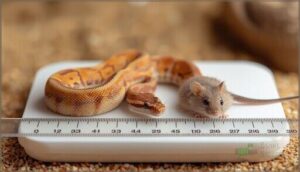
Selecting the right prey size shields baby snakes from regurgitation and stunted growth. Match prey to your snake’s girth at its widest point—hatchlings need items around 4–6% of body weight.
Use a scale to weigh both snake and prey for accuracy. If regurgitation occurs, drop prey size one step for the next two feedings to stabilize digestion rates.
Feeding Tools and Techniques

To present prey safely, you’ll need feeding tongs or forceps at least 10 inches long, avoiding direct snake handling. Pre-killed rodents reduce the risk of injury during meals. Thaw frozen prey to 98–100°F in warm water before offering.
Set up a distraction-free feeding environment with stable lighting and minimal noise.
Store frozen food at 0°F or below, rotating stock monthly to maintain nutritional quality.
Monitoring Hunger Cues and Behavior

Once you’ve set up safely, watch for genuine hunger signs in your baby snakes. Feeding frequency depends on reading appetite indicators correctly.
Pay attention to three key snake behavior patterns:
- Purposeful movement toward prey with sustained focus and minimal retreat signals true hunger-driven feeding triggers
- Rapid tongue flicking combined with eye tracking indicates readiness to strike
- Calm emergence from hiding without defensive displays confirms appetite rather than stress
Creating a Stress-Free Feeding Environment

Beyond reading your snake’s hunger signals, feeding ambience shapes feeding success. Lower noise around the snake enclosure and avoid sudden movements that trigger defensive responses.
Maintain stable temperature and humidity within species-specific ranges to support digestion. Use tongs for calm presentation of warmed prey, minimizing human contact.
Environmental stability reduces stress during feeding frequency windows, helping baby snakes accept meals consistently.
Monitoring Health and Adjusting Schedules

You can’t set a feeding schedule and forget about it. Your baby snake’s health depends on regular monitoring and your willingness to adjust as it grows.
Below are the essential tracking methods that will help you recognize when your snake needs more food, less food, or a completely different feeding approach.
Tracking Weight and Growth Patterns
Regularly weighing your baby snakes reveals their true growth rate and helps you fine-tune the feeding schedule. Track these key metrics each week:
- Weight trends over six months to spot nutritional deficiencies early
- Monthly percent change in mass to confirm steady snake development
- Length measurements paired with weight for complete nutrition planning
- Feeding charts documenting prey type, size, and date
- Body condition scores assessed through gentle midbody palpation
Compare your data against species-specific growth curves when available.
Recognizing Signs of Over- or Underfeeding
Once you’ve tracked weight and growth, watch for feeding imbalance signs. Sudden weight spikes, visible bloating, or frequent regurgitation signal overfeeding. Conversely, skeletal prominence, dull eyes, or persistent hunger cues indicate underfeeding. Health monitoring through body condition scoring helps you distinguish proper snake nutrition from potential health issues.
| Indicator | Overfeeding Signs | Underfeeding Signs |
|---|---|---|
| Body Shape | Distended abdomen, rapid girth increase | Visible spine, skeletal prominence |
| Behavior | Lethargy after meals, reduced activity | Aggressive feeding posture, constant hunting |
| Physical Health | Frequent regurgitation, bloating | Dull eyes, poor shed quality |
Adjusting Meal Size and Frequency
Once you’ve spotted signs of imbalance, adjust your feeding schedule and prey size immediately. Increase meal sizing gradually—only after consistent weight gain—keeping prey under 10% of your baby snakes’ girth.
If growth rates slow, maintain current frequency while checking digestion speed weekly. Use feeding charts to track nutrition patterns, then modify intervals based on body condition rather than arbitrary schedules.
Maintaining Detailed Feeding Records
Keep a feeding chart from day one to recognize patterns in your baby snakes’ nutrition and growth. Accurate record keeping transforms feeding schedules from guesswork into data analysis.
- Record date, prey type, and size relative to snake girth at each feeding
- Log your snake’s weight before and after meals biweekly
- Track enclosure temperature and humidity during feeding events
- Note feeding habits like refusals or aggressive strikes
- Archive schedule changes with brief rationale for future reference
Top 3 Tools for Baby Snake Feeding
You don’t need fancy equipment to feed a baby snake safely. A few basic tools will help you maintain accurate feeding schedules, handle prey properly, and monitor your snake’s health.
Here are the three essentials every new snake owner should have on hand.
1. Amazon Basics Digital Kitchen Scale

Precision matters when you’re feeding baby snakes, and the Amazon Basics Digital Kitchen Scale delivers exactly that. This tool weighs prey items up to 11 pounds with 1-gram accuracy, ensuring proper portion control for your snake’s growth stage.
Use the tare function to subtract container weight and measure net food weight precisely. The scale converts between grams, ounces, and pounds, letting you track feeding habits and maintain an accurate feeding schedule.
Its stainless steel platform cleans easily between uses, maintaining hygiene standards essential for snake nutrition.
| Best For | Snake owners who need precise measurements for portioning prey items and tracking feeding schedules across different growth stages. |
|---|---|
| Price Range | Under $50 |
| Primary Use | Measuring portions |
| Target User | Home cooks |
| Ease of Use | Simple operation |
| Material Quality | BPA-free plastic |
| Maintenance | Battery replacement |
| Additional Features |
|
- Measures up to 11 pounds with 1-gram accuracy, perfect for weighing everything from pinky mice to larger prey items
- Tare function lets you subtract container weight so you get exact prey measurements every time
- Easy-to-clean stainless steel platform maintains hygiene between feedings
- Auto-shutoff feature can interrupt multi-step feeding prep sessions
- Display might get blocked by larger feeding containers or bowls
- Gram setting doesn’t show decimal places, limiting precision for very small hatchling portions
2. Poison Frogs Biology Guide

Understanding toxin transfer and venom dynamics in poison frogs sharpens your grasp of prey selection principles that apply directly to baby snakes. This 668-page herpetology reference covers frog diet variations, captive care protocols, and feeding schedule fundamentals across species.
You’ll find detailed insights on how prey size, environmental factors, and nutritional balance affect growing reptiles. The guide’s treatment of feeding behavior and metabolic demands translates well to snake nutrition planning.
While focused on amphibians, its biological frameworks strengthen your approach to safe, effective baby snake feeding practices.
| Best For | Serious poison frog keepers and breeders who want a comprehensive reference on captive husbandry, feeding strategies, and disease management. |
|---|---|
| Price Range | $185.00 |
| Primary Use | Frog care reference |
| Target User | Reptile enthusiasts |
| Ease of Use | Comprehensive guide |
| Material Quality | High-quality printing |
| Maintenance | Reference only |
| Additional Features |
|
- Over 1000 full-color photos and illustrations make complex biological concepts easy to understand
- Covers practical care details like housing setup, breeding techniques, and common health issues with treatments
- Extensive 668-page format provides in-depth explanations you can reference again and again
- High price point at $185 may put it out of reach for casual hobbyists
- Some classification systems and information may be outdated since the 2007 publication date
- Online communities like Dendroboard might offer more current advice and user experiences for less money
3. Similac Infant Formula With Prebiotics

Raising hatchlings demands careful attention to nutrition. Yet this 36-ounce infant formula caters to human babies, not baby snakes. The prebiotic blend promotes immune and brain development in infants, delivering essential vitamins and minerals through a non-GMO powder formula at $175.22 for three containers.
While pediatric guidance emphasizes infant nutrition and formula safety, snake feeding schedules require rodent prey matched to body width. You need species-appropriate feeding protocols for hatchlings, not dietary supplements designed for human consumption. Keep your focus on proper reptile nutrition instead.
| Best For | Parents looking for a formula with prebiotics to support their infant’s immune system, brain development, and digestive health when breastfeeding isn’t an option. |
|---|---|
| Price Range | $175.22 |
| Primary Use | Infant nutrition |
| Target User | Parents |
| Ease of Use | Easy to prepare |
| Material Quality | Non-GMO ingredients |
| Maintenance | Regular feeding |
| Additional Features |
|
- Contains 5 HMO prebiotics that mirror those found in breast milk, supporting gut health and immune development
- Non-GMO formula with no artificial growth hormones, giving parents peace of mind about ingredient quality
- Easy to mix powder form that dissolves well and may reduce fussiness and gas in babies
- Not suitable for infants with galactosemia or certain metabolic conditions
- Premium price point at $175.22 for a 3-pack may be cost-prohibitive for some families
- Despite prebiotic benefits, it’s still a formula substitute and not equivalent to breast milk’s complete nutritional profile
Frequently Asked Questions (FAQs)
What to do if a baby snake refuses food?
First, rule out shedding or stress—baby snakes often pause during molts.
Check enclosure temperatures hover near 88–92°F, confirm prey size matches body width, and document refusals.
If hatchlings refuse beyond ten days, consult a herp-certified veterinarian.
How to safely introduce new prey types?
Start with non-moving prey that’s 0–5x your snake’s gape size. Offer it once during active hours, then wait 24–48 hours. Remove uneaten prey to prevent injury and stress.
What risks are associated with power feeding?
Power feeding accelerates growth unnaturally, causing regurgitation risks, digestive issues, and obesity factors. You’ll see feeding stress, metabolic strain, and higher mortality rates.
Overfeeding creates health issues, including fatty liver disease and malnutrition from imbalanced nutrition.
When should I seek veterinary help for feeding issues?
Contact your reptile vet if your snake refuses food for two consecutive weeks, regurgitates repeatedly, shows dehydration signs like sunken eyes, or exhibits sudden weight loss—these veterinary red flags indicate serious feeding emergencies requiring professional intervention.
Conclusion
A single missed meal won’t doom your hatchling, but three consecutive refusals demand immediate troubleshooting. Baby snake feeding frequency separates thriving juveniles from stunted adults.
Check your temperatures first—cold enclosures kill appetites faster than any husbandry mistake. Weigh your snake weekly, adjust prey size by girth, and document every feeding. Your records become diagnostic tools when growth plateaus.
Master the variables now, and you’ll raise a snake that doubles its birthweight on schedule.