This site is supported by our readers. We may earn a commission, at no cost to you, if you purchase through links.

Kingsnakes have been killing rattlesnakes since long before anyone thought to keep them as pets. That’s not a metaphor — they’re genuinely immune to pit viper venom, and they’ll constrict a rattler with the same indifference they show a mouse. For a snake that fits in a 48-inch enclosure, that’s an impressive biological résumé.
What surprises most first-time keepers isn’t the feeding schedule or the temperature gradients — it’s how much the details matter. A humidity level 10% too low during a shed, a hide on the wrong thermal end, a prey item slightly too wide: these aren’t minor oversights, they’re the difference between a thriving snake and a stressed one. Kingsnake husbandry rewards precision.
This king snake care sheet covers everything — enclosure sizing, thermal gradients, feeding schedules, health red flags, and the specific equipment worth investing in.
Table Of Contents
- Key Takeaways
- Kingsnake Species Overview, Size, and Lifespan
- Kingsnake Enclosure Setup and Habitat Needs
- Kingsnake Temperature, Lighting, and Humidity
- Kingsnake Diet, Feeding, Health, and Handling
- Top 10 Essential Products for Kingsnake Care
- 1. Carolina Custom Large Glass Terrarium
- 2. Zoo Med ReptiSun UVB Lamp
- 3. Arcadia Reptile UVB Lamp
- 4. Arcadia Jungle Dawn LED Light Bar
- 5. Bio Dude Glow and Grow LED Bulb
- 6. Etekcity Infrared Thermometer Gun
- 7. Zoo Med Reptile Soil
- 8. Zoo Med Coconut Fiber Substrate
- 9. Exo Terra Plantation Soil
- 10. Bio Dude Terra Firma Reptile Substrate
- Frequently Asked Questions (FAQs)
- Can kingsnakes be housed together safely?
- What are kingsnake breeding requirements and seasons?
- How much do kingsnakes typically cost?
- Are kingsnakes legal in all states?
- What quarantine procedures for new kingsnakes?
- Do kingsnakes need UVB lighting?
- How do you breed kingsnakes in captivity?
- What are signs of a gravid female kingsnake?
- Can kingsnakes eat frozen prey exclusively?
- Can kingsnakes coexist safely with other reptiles?
- Conclusion
Key Takeaways
- Kingsnake husbandry is precision-driven — a 10% humidity variance, a misplaced hide, or an oversized prey item aren’t minor slip-ups; they’re direct causes of stress, failed sheds, and shortened lifespan.
- A proper thermal gradient running from 85–95°F on the warm end to 70–80°F on the cool end is non-negotiable, giving your snake the autonomy to self-regulate digestion and metabolism without relying on you to guess its needs.
- Because kingsnakes are natural snake-eaters, cohabitation is never a calculated risk — solo housing is the only responsible standard, regardless of enclosure size or species pairing.
- With consistent temperature control, parasite management, and properly sized frozen-thawed prey, kingsnakes routinely live 15 to 25 years, meaning your setup decisions today compound — for better or worse — across decades.
Kingsnake Species Overview, Size, and Lifespan
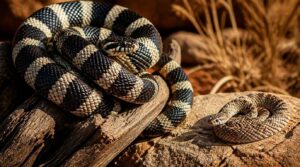
Kingsnakes are one of the most diverse snake genera you can keep in captivity, and choosing the right subspecies shapes every care decision that follows.
From classic California kingsnakes to the dazzling variety unlocked by captive breeding, small snake species that thrive in captivity can help you narrow down which kingsnake subspecies fits your space and experience level.
Before you set up an enclosure or plan a feeding schedule, it helps to understand what you’re actually working with — size, lifespan, and natural behavior all vary more than most beginners expect. Here’s what you need to know about the most popular subspecies and their key physical traits.
Popular Kingsnake Subspecies
Five subspecies dominate the pet trade, each with its own personality and range. The California kingsnake (Lampropeltis californiae) is the most widely kept, prized for its docile temperament and bold banding. The Eastern kingsnake spans Florida to Missouri, while the speckled variety favors open grasslands.
Where ranges overlap, hybridization occurs naturally — worth knowing when identifying wild-caught specimens. You can explore different kingsnake types to learn more about their unique characteristics.
Size and Growth Rate
Adult kingsnakes usually reach 3 to 5 feet, though some subspecies push past 6 feet. Hatchlings start at just 8–12 inches — small, fast-growing, and hungry.
Several growth determinants shape how quickly yours matures:
- Prey sizing ratios and dietary needs met consistently
- Basking temperatures driving metabolic rate
- Enclosure space reducing chronic stress
- Clean sheds reflecting hydration and skin health
- Parasite-free status protecting body condition
Most reach sexual maturity by years two or three.
Lifespan in Captivity
Growth rate tells you how fast your kingsnake matures — lifespan tells you how long you’ll share that journey.
With consistent husbandry, most kingsnakes reach 15 to 25 years in captivity. That’s not accidental. Stable temperatures, parasite control, and regular veterinary checks quietly accumulate into decades. Stress, inadequate hides, or dietary gaps chip years away. Genetics matter too, but environment is the variable you control.
Environment is the variable you control — and it quietly decides whether your kingsnake lives 15 years or 25
Colors and Pattern Variations
Kingsnake coloration is genuinely one of the genus’s most striking features. The Eastern kingsnake wears glossy black with white chain-like crossbands; the Mexican Black kingsnake goes nearly uniform dark with a faint iridescent sheen. Juveniles often start paler, darkening with age.
High-contrast banding isn’t just beautiful — it’s functional, disrupting silhouette among leaf litter and serving as Batesian mimicry against predators.
Solo Housing Requirements
Because kingsnakes are ophiophagous by nature, housing even two together isn’t a calculated risk — it’s a guaranteed one. That predatory instinct doesn’t switch off in captivity.
Your escape-proof enclosure becomes the entire habitat, so floor plan efficiency matters: prioritize usable floor space over height, and keep the layout simple, secure, and species-appropriate from day one.
Kingsnake Enclosure Setup and Habitat Needs
Getting your kingsnake’s enclosure right from the start sets the foundation for everything else in its care.
There are a few key factors you’ll need to nail — tank sizing, security, substrate, hides, and enrichment — and each one plays a direct role in keeping your snake healthy and stress-free. Here’s what you need to know about each.
Tank Size by Age
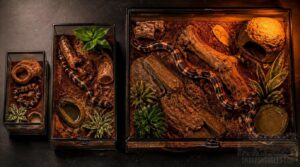
Sizing the enclosure correctly from day one sets the pace for healthy growth.
- Hatchlings under 6 weeks: 10–20 gallon container
- Juveniles at 6–12 months: 40–55 gallon terrarium
- Adults at 3–4 feet: minimum 48"L × 18"W footprint
Upgrade roughly every 6–12 months, scaling substrate depth and thermal gradients as the space expands to maintain effective basking and cooling zones.
Escape-Proof Enclosure Security
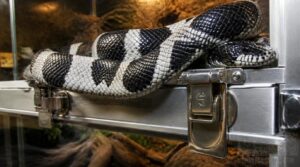
Escape artists by nature, kingsnakes will test every seam, lid, and vent in your enclosure. I recommend a dual locking system — a top latch paired with a side bolt — to resist the prying force these constrictors apply.
Micro-mesh venting prevents gaps without sacrificing airflow, while gasket seal maintenance eliminates flex along lid perimeters. Inspect tamper-resistant hardware monthly; a loose screw is all it takes.
Best Kingsnake Substrates
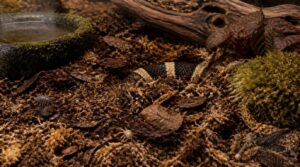
Substrate choice quietly determines whether your enclosure stays healthy or becomes a maintenance headache. I recommend aspen shavings, cypress mulch, or coconut fiber layered 2–3 inches deep — each allows for natural burrowing without compaction. Avoid pine or cedar entirely; their aromatic oils cause respiratory damage.
Bioactive mixes with microfauna actively break down waste, cutting odor and reducing how often you’ll need full cleanouts.
Hides and Burrowing Space
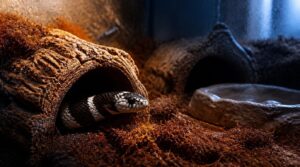
A hide isn’t just shelter — it’s your snake’s anchor point for feeling safe. Place hides at both thermal ends, and position one near the water dish to reduce defensive behavior during cleaning.
Burrow openings should sit off the substrate surface, limiting front-panel visibility. Pack substrate firmly around entrances to prevent collapse, and keep interior surfaces smooth to avoid scale abrasion.
Climbing and Enrichment
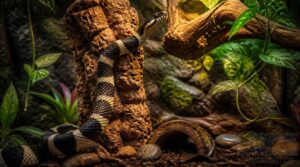
Kingsnakes are far more active than most owners anticipate. Vertical movement and texture variation drive real cognitive stimulation:
- Cork bark tubes for climbing and retreating
- Rotating obstacles monthly to prevent habituation
- Rough and smooth surfaces for grip contrast
- Foraging enrichment through buried or hidden prey
Swap elements every few weeks to sustain curiosity in your naturalistic habitat.
Kingsnake Temperature, Lighting, and Humidity
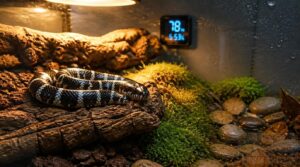
Getting the temperature, lighting, and humidity right is where kingsnake care gets precise — and where cutting corners actually costs you.
Your snake’s ability to digest food, shed cleanly, and stay healthy depends almost entirely on how well you dial in these three variables. Here’s exactly what you need to maintain across each one.
Ideal Temperature Gradient
Getting thermal regulation right separates thriving kingsnakes from chronically stressed ones. A proper temperature gradient runs linearly from one end of the enclosure to the other, giving your snake autonomy to self-regulate metabolism throughout the day.
| Thermal Zone | Target Range |
|---|---|
| Warm Zone | 85–95°F |
| Mid-Zone | 78–84°F |
| Cool Zone | 70–80°F |
| Nighttime Drop | 72–75°F |
| Humidity Overlap | 40–60% |
Use multiple probe thermometers — never guesswork — to map each zone accurately and prevent dangerous hot spots.
Basking and Cool Zones
Once the gradient is mapped, each zone has a distinct job. The basking spot targets 85–95°F on a dry, non-slip surface; the cool zone holds 70–80°F. Your snake moves between them freely, self-regulating metabolism on its own terms.
Keep these details in check:
- Non-slip, heat-conductive basking surfaces
- Clear paths between thermal zones
- Thermostat-controlled heat sources
- Digital thermometers at both ends
Nighttime Temperature Drops
Once the lights go out, nocturnal cooling patterns take over. I recommend letting temperatures drop to 72–75°F overnight — this mimics natural atmospheric stability effects and helps healthy thermoregulation without stressing your snake.
| Condition | Daytime Temp | Nighttime Temp |
|---|---|---|
| Basking Zone | 85–95°F | 72–75°F |
| Cool Zone | 70–80°F | 70–72°F |
| Ambient Room | 75–80°F | 68–72°F |
| Urban Environment | Higher baseline | Delayed drop |
| Rural/Natural | Variable | Sharper drop |
Thermal setback strategies — modest, controlled drops — replicate what radiative heat loss does in the wild each evening.
Humidity and Shedding Support
Skin molting demands humidity control. Aim for 40–60%, rising to 60–70% during shedding.
A humid hide lined with damp sphagnum moss lets your snake self-regulate moisture without saturating the whole enclosure.
To prevent retained shed:
- Monitor with a calibrated hygrometer
- Place the hide on the warm side
- Keep substrate damp, not soggy
- Check eyes and tail tips after shed
UVB and Daylight Cycles
Kingsnakes aren’t strict UVB dependents, but a T5 5.0 or 6% UVB bulb still helps with vitamin D3 synthesis and immune function — especially when dietary supplementation is inconsistent. Mount it within 12–18 inches, replace every 6–12 months as output degrades invisibly.
Pair it with a 12-hour photoperiod on a timer. Consistent daylight cycles regulate circadian rhythm and feeding behavior, keeping your snake settled and predictable.
Kingsnake Diet, Feeding, Health, and Handling
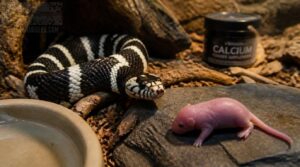
Getting your kingsnake’s diet and health routine right is where good care becomes great care. From choosing the right prey size to recognizing early warning signs of illness, every detail in this section directly affects how long and well your snake thrives.
Here’s what you need to know about feeding, supplements, health monitoring, and safe handling.
Prey Types and Sizing
Prey sizing is where most beginners go wrong. I recommend selecting frozen-thawed prey no wider than 1.5 times your snake’s thickest girth point — larger items trigger regurgitation, which stresses the animal and disrupts digestion.
Mice and rats cover most dietary needs, but dietary diversity using small birds or hamsters occasionally keeps feeding responses sharp and nutrition balanced.
Feeding Schedule by Age
Hatchlings demand the most consistent rhythm — feed every 5 to 7 days, sizing prey carefully to match their still-developing girth.
As your kingsnake grows, shift to every 7 to 14 days. Watch hunger cues: an alert, actively hunting posture signals readiness. During growth spurts, minor prey size increases help, but never rush the schedule — overfeeding strains digestion more than it accelerates growth.
Supplements and Hydration
Whole prey covers most nutritional needs, but juveniles benefit from calcium and vitamin D3 dusted every third feeding to support rapid bone development. Skip electrolyte supplements entirely — dosing is impossible to control, and human-formulated products may contain harmful additives.
For hydration, fresh dechlorinated water in a stable dish works best, supplemented by light misting and brief soaks during suspected dehydration episodes.
Common Health Warning Signs
A healthy kingsnake is alert, responsive, and feeding predictably — so any deviation from baseline deserves immediate attention.
Appetite loss lasting two or more missed meals, open-mouth breathing, wheezing, or mucus near the nares all signal something is wrong. Watch for patchy, incomplete sheds, cloudy eyes, or vent swelling too. Neurological symptoms — spasms, falling, inability to right itself — require emergency veterinary care without delay.
Safe Handling and Taming
Kingsnakes have a docile nature once trust is built, but rushing that process backfires.
Start with non-contact acclimation, then progress gradually:
- Support the full body when lifting — never grab
- Watch for hissing or tail coiling as stress signal recognition
- Track each session’s length and behavior for taming progress
- Never handle post-feeding
Wash hands before every session.
Top 10 Essential Products for Kingsnake Care
Getting your kingsnake’s setup right starts with having the right gear in your corner. I’ve put together a focused list of ten products that cover the essentials — from lighting and substrate to temperature monitoring — so you’re not guessing when it counts. Here’s what I recommend for building a setup your snake can actually thrive in.
1. Carolina Custom Large Glass Terrarium
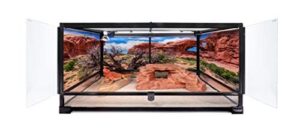
For a species that treats every lid gap as an invitation, the Carolina Custom Large Glass Terrarium earns its place at the top of this list. At 36"L x 18"W x 18"H, it meets the minimum footprint a juvenile kingsnake needs — and its hinged, key-lock doors close the escape-artist debate entirely.
The all-tempered-glass construction gives you unobstructed sightlines for daily behavioral checks, while the four-inch waterproof base tray keeps substrate where it belongs. That depth matters when you’re layering aspen or cypress mulch 2–3 inches thick for burrowing.
The full steel mesh top holds standard clamp lamps and promotes airflow without sacrificing humidity control — a balance kingsnakes genuinely need. Weighing just over 60 pounds, it’s substantial enough to stay put, but assemble it on location; you won’t want to move it fully loaded.
| Best For | Reptile and amphibian keepers who want a secure, high-visibility enclosure that supports bioactive setups and stops escape attempts cold. |
|---|---|
| Brand | Carolina Custom |
| Product Type | Enclosure |
| Kingsnake Suitable | Yes |
| Bioactive Friendly | Yes |
| Ease of Setup | Moderate |
| Maintenance Level | High |
| Additional Features |
|
- Hinged, key-lock doors eliminate lid gaps that curious kingsnakes (and other escape artists) love to exploit
- Four-inch waterproof base tray keeps substrate contained and makes cleanup far less messy
- All-tempered-glass construction gives you clear sightlines from every angle for easy daily monitoring
- At over 60 pounds, it’s heavy enough that you’ll want to assemble it in its final spot rather than move it later
- The large footprint (nearly 3 feet long) demands dedicated floor space that not every room can spare
- Monthly deep cleaning is a must to keep things hygienic, which adds to the ongoing time commitment
2. Zoo Med ReptiSun UVB Lamp
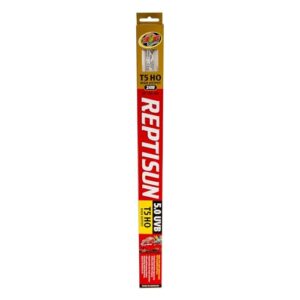
The Carolina Custom’s steel mesh top sets you up perfectly for what comes next: lighting. Kingsnakes aren’t UV-dependent the way chameleons or tortoises are, but supplemental UVB does support vitamin D3 synthesis and calcium metabolism — and that’s worth having on your side.
I recommend the Zoo Med ReptiSun T5 HO 5.0, a 24-watt, 22-inch lamp that delivers reliable UVB output without overshooting what a crepuscular species actually needs. Position it 12 to 18 inches above the basking zone for effective exposure. The high-output T5 format emits UVA wavelengths as well, which can sharpen foraging responses and activity levels in ways you’ll notice over time.
Pairing this lamp with a curved reflector keeps that UVB precisely targeted, and you can explore additional reptile UVB lighting options for multi-tank setups if you’re managing more than one enclosure.
One practical heads-up: the bulb requires a compatible T5 HO hood — it won’t operate standalone, so factor that into your setup budget.
| Best For | Tropical reptile owners — including chameleon, gecko, and tortoise keepers — who want a professional-grade UVB bulb that supports vitamin D3 production and natural behavior without overwhelming lower-UV species. |
|---|---|
| Brand | Zoo Med |
| Product Type | UVB Lighting |
| Kingsnake Suitable | Yes |
| Bioactive Friendly | Partial |
| Ease of Setup | Easy |
| Maintenance Level | Low |
| Additional Features |
|
- High-output T5 HO design delivers strong, reliable UVB and UVA light that supports calcium absorption and stimulates natural activity
- Veterinarian and zoo recommended, so you’re getting a trusted, professional-grade product
- Emits a broad light spectrum that mirrors natural sunlight, encouraging healthier foraging, appetite, and reproductive behavior
- Requires a compatible Zoo Med T5 HO Terrarium Hood to operate — it can’t run on its own, adding to your upfront cost
- Not a great fit for reptiles that need high-intensity UVB levels beyond the 5.0 range
- Lifespan can vary depending on how heavily it’s used, so replacement costs may add up over time
3. Arcadia Reptile UVB Lamp
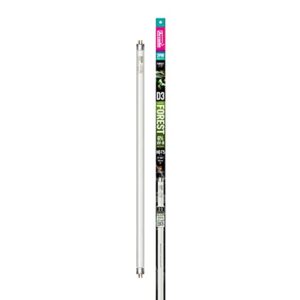
If you want a UVB lamp that doesn’t need replacing every few months, the Arcadia Reptile T5 HO 6% is worth the extra spend. Built with German-sourced phosphors, it maintains consistent UVB output for a full 12-month lifespan — longer than most competitors at this price tier.
The 6% UVB rating sits squarely in the range kingsnakes need, and the 30% UVA output helps intensify natural coloration and sharpen activity responses over time. Pair it with a compatible T5 HO fixture and position it above the basking zone at Arcadia’s recommended distance for effective exposure.
One honest caveat: the glass construction is fragile, and some users report inconsistent longevity. Handle it carefully during installation. Even so, when it performs as intended, Arcadia’s output consistency is hard to beat at this UVB level.
| Best For | Reptile keepers housing forest or shade-dwelling species like chameleons, day geckos, or iguanas who want a reliable, long-lasting UVB solution without frequent bulb replacements. |
|---|---|
| Brand | Arcadia |
| Product Type | UVB Lighting |
| Kingsnake Suitable | Yes |
| Bioactive Friendly | Partial |
| Ease of Setup | Easy |
| Maintenance Level | Low |
| Additional Features |
|
- Maintains consistent UVB output for a full 12 months, outlasting many competitors at a similar price
- 30% UVA output enhances natural coloration and supports healthy animal behavior
- Flicker-free operation and 6,500K daylight simulation create a low-stress, naturalistic environment
- Glass construction is fragile and may be vulnerable to damage during shipping or handling
- Some users report inconsistent longevity, meaning results can vary between units
- Requires precise setup — correct fixture type and positioning are essential to hit the full 12-month lifespan
4. Arcadia Jungle Dawn LED Light Bar
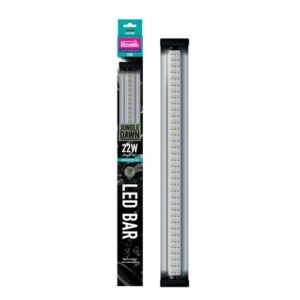
UVB does the biological heavy lifting, but light quality shapes how your enclosure actually looks and functions day-to-day. That’s where the Arcadia Jungle Dawn LED Bar earns its place.
Running at 22 watts with a 6200K full-spectrum output, it mimics natural daylight without the purple cast you get from standard grow lights. At 141 lumens per watt, the efficiency is genuinely impressive — bright illumination without the heat penalty of traditional lamps.
The triple-track LED configuration matters more than it sounds. Light distributes evenly across the enclosure floor, which eliminates the shadowed corners that can make captive snakes uneasy and live plants struggle.
At 18.5 inches long, it fits standard mesh-topped terrariums cleanly, and units can be daisy-chained for larger builds. If you’re running a bioactive setup, this fixture pulls real weight.
| Best For | Bioactive setups with live plants and daylight cycling |
| Wattage | 22W |
| Color Temp | 6200K |
| Length | 18.5" |
| Brand | Arcadia |
Best For: Reptile and amphibian keepers running bioactive terrariums or vivaria who want high-quality, natural-looking daylight without sacrificing energy efficiency.
| Brand | Arcadia |
|---|---|
| Product Type | LED Lighting |
| Kingsnake Suitable | Yes |
| Bioactive Friendly | Yes |
| Ease of Setup | Easy |
| Maintenance Level | Low |
| Additional Features |
|
- Full-spectrum 6200K output closely mimics natural sunlight, making colors look vivid and supporting healthy plant growth without the purple tint of typical grow lights
- Exceptional efficiency at 141 lumens per watt means bright, even coverage across the enclosure floor with minimal heat output
- Versatile mounting design fits standard mesh-topped enclosures and can be daisy-chained for larger setups
- No specified waterproof or humidity resistance rating, so it may not be ideal for high-moisture tropical builds without extra precautions
- At 18.5 inches, it may not be the right fit for smaller or non-standard enclosures without careful planning
- Doesn’t emit UVB, so a separate UVB source is still required for species that need it
5. Bio Dude Glow and Grow LED Bulb
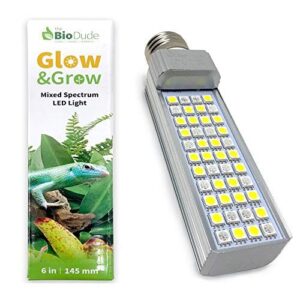
For bioactive setups that don’t demand a full lighting rig, the Bio Dude Glow and Grow LED Bulb punches well above its price point. Running at 60 watts with a 6500K daylight spectrum, it integrates red and blue diodes that actively drive photosynthesis in mosses, tropical ferns, and low-light plants — the exact species that thrive inside a naturalistic kingsnake build.
The 180-degree rotational mount is a genuine practical advantage. You can angle it directly over a moss mat or shaded plant corner without repositioning the entire fixture.
It emits no heat and no UVB, so it won’t interfere with your thermal gradient or disrupt your UVB lamp’s role. Think of it as a dedicated plant-support layer — not a replacement for your primary lighting, but a reliable complement to it. The aluminum housing keeps it durable across long photoperiod cycles.
| Best For | Bioactive vivarium and terrarium keepers who want to boost plant growth in low-light setups without adding extra heat or UVB to their enclosure. |
|---|---|
| Brand | Bio Dude |
| Product Type | LED Lighting |
| Kingsnake Suitable | Yes |
| Bioactive Friendly | Yes |
| Ease of Setup | Easy |
| Maintenance Level | Low |
| Additional Features |
|
- Mixed red and blue diodes actively drive photosynthesis, making it genuinely effective for mosses, tropical plants, and other vivarium-friendly species
- The 180-degree rotational mount gives you real flexibility to direct light exactly where plants need it
- Energy-efficient at 60W with durable aluminum housing, built to handle long daily photoperiod cycles
- Emits no UVB, so it can’t replace a dedicated UVB lamp for reptiles that require it
- Produces no heat, meaning it won’t contribute to your enclosure’s thermal gradient
- Only a one-year warranty for a fixture expected to run daily long-term
6. Etekcity Infrared Thermometer Gun
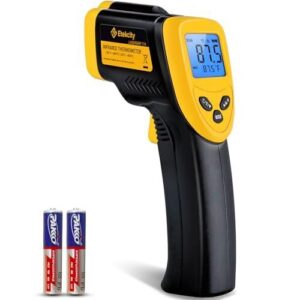
Temperature guesswork is how husbandry mistakes happen. I recommend the Etekcity Infrared Thermometer Gun as your go-to tool for non-contact surface readings across every zone of your kingsnake’s enclosure — basking spot, cool hide, and substrate included.
The 12:1 distance-to-spot ratio lets you pull accurate readings from roughly 14 inches away, so you’re not hovering over your animal mid-check. That matters more than keepers expect. The 0.5-second response time covers a -58°F to 716°F range, and the backlit LCD stays legible in a dimmed reptile room without strain.
One limitation worth knowing: the emissivity is fixed at 0.95, so you can’t adjust for highly reflective surfaces. For wood, ceramic, and standard reptile substrates, though, that setting performs reliably. Pair it with a calibrated digital thermostat and you’ve got your thermal gradient fully covered.
| Best For | Reptile keepers, home cooks, and hobbyists who need quick, accurate, non-contact surface temperature readings across a wide range of environments. |
|---|---|
| Brand | Etekcity |
| Product Type | Temperature Tool |
| Kingsnake Suitable | Yes |
| Bioactive Friendly | No |
| Ease of Setup | Easy |
| Maintenance Level | Low |
| Additional Features |
|
- Lightning-fast 0.5-second response time with a wide -58°F to 716°F range makes it versatile across kitchen, reptile, and home maintenance tasks
- The 12:1 distance-to-spot ratio lets you take readings from about 14 inches away, keeping you at a safe distance from hot surfaces or live animals
- Backlit LCD screen and low battery indicator make it practical to use in dim reptile rooms or tight spaces without fumbling
- Fixed emissivity at 0.95 means you can’t adjust for shiny or highly reflective surfaces, which can throw off accuracy
- Measures surface temperature only, so it won’t tell you the internal temperature of food or deep substrate layers
- No maximum temperature recording feature, so you’ll need to manually note peak readings during monitoring sessions
7. Zoo Med Reptile Soil
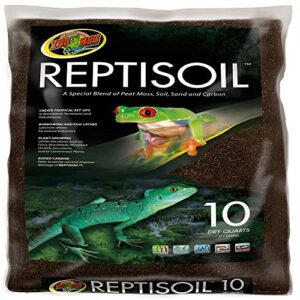
Substrate choice shapes how comfortably your kingsnake lives day to day. Zoo Med ReptiSoil earns its place here because it meets two demands at once — stable humidity retention and a loose, diggable texture that invites natural burrowing without compacting under your snake’s weight.
The mix of peat moss, organic topsoil, sand, and coconut carbon does real work. Peat holds moisture evenly, while the carbon aerates the mix, controls odors, and creates a porous surface where beneficial bacteria can establish. That’s why this substrate translates well into bioactive enclosure setups with live plants and microfauna.
One honest caveat: dust can be an issue straight out of the bag. Lightly misting before use solves that. Layer it 2 to 3 inches deep and you’ve got a functional, naturalistic base your kingsnake will actually use.
| Best For | Kingsnake and reptile keepers who want a naturalistic, bioactive-friendly substrate that holds humidity and supports burrowing behaviors. |
|---|---|
| Brand | Zoo Med |
| Product Type | Substrate |
| Kingsnake Suitable | Yes |
| Bioactive Friendly | Yes |
| Ease of Setup | Moderate |
| Maintenance Level | Moderate |
| Additional Features |
|
- Blends peat moss, sand, and coconut carbon to retain moisture evenly while staying loose and diggable
- Coconut carbon controls odors and supports beneficial bacteria, making it a strong choice for bioactive setups with live plants
- Versatile enough for a wide range of tropical and humidity-loving species beyond just kingsnakes
- Can produce noticeable dust straight out of the bag — a light misting before use is pretty much necessary
- May carry a slight odor when first opened
- Best suited for humid environments; not ideal for arid or desert-style enclosures
8. Zoo Med Coconut Fiber Substrate
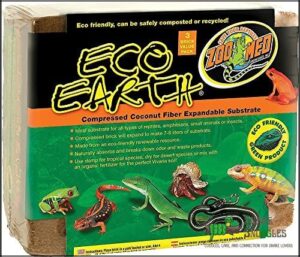
Coconut fiber might seem like a modest choice until you watch your kingsnake burrow into it like it owns the place. Zoo Med’s Eco Earth Compressed Coconut Fiber comes in a 3-brick pack, each expanding to 7–8 liters once moistened — enough bedding to layer 2 to 3 inches deep with material to spare.
It’s a budget-friendly substrate too — see how it fits into the full pet snake ownership costs from setup to ongoing care if you’re still planning your budget.
What makes it earn its spot is the balance it strikes. The fiber absorbs waste and odors naturally through microbial activity in the damp substrate, keeping the enclosure cleaner between spot cleans. Humidity holds steady in that 50–60% range without turning the enclosure into a swamp.
Hydrate it gradually, though. Over-saturating the brick during prep invites mold and gnat problems. Stir it occasionally and you’ll get long, reliable performance from every brick.
| Best For | Kingsnake owners wanting eco-friendly, humidity-stable bedding that encourages burrowing |
| Primary Use | Substrate/bedding |
| Expands To | 7–8 liters per brick |
| Pack Size | 3 compressed bricks |
| Material | Natural coconut fiber |
| Additional Features | Odor-absorbing, compostable, chemical-free |
Best For: Reptile and amphibian owners — especially those with burrowing species like kingsnakes — who want a natural, humidity-friendly substrate that keeps enclosures fresh between cleanings.
| Brand | Zoo Med |
|---|---|
| Product Type | Substrate |
| Kingsnake Suitable | Yes |
| Bioactive Friendly | Yes |
| Ease of Setup | Moderate |
| Maintenance Level | Moderate |
| Additional Features |
|
- Expands to 7–8 liters per brick, so three bricks give you a generous supply of bedding with room to spare
- Naturally absorbs odors and waste through microbial activity, cutting down on how often you need to deep clean
- Eco-friendly and chemical-free, making it safe for sensitive reptiles and compostable when spent
- Prep can get messy, and it’s easy to over-saturate the brick if you’re not careful with how much water you add
- Too much moisture during or after setup can attract gnats and flies
- Requires hands-on hydration and breaking apart before use, which adds a step compared to ready-to-use substrates
9. Exo Terra Plantation Soil
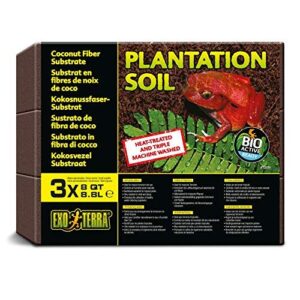
Exo Terra’s Plantation Soil punches above its weight class for a coconut-fiber substrate. Each compressed brick is triple-washed and heat-treated, which strips residual salts and keeps bacterial odor under control from the start — something you’ll appreciate during routine maintenance.
Soak the brick fully, then break apart any remaining clumps by hand until you’ve got a fine, workable texture. Layer it 2 to 4 inches deep and your kingsnake will burrow naturally without the substrate compacting beneath it. That open grain structure also drains efficiently, preventing the anaerobic pockets that accelerate bacterial growth.
Humidity control is where it genuinely earns its spot. The hygroscopic coir material holds moisture steadily in that 50–70% range, supporting clean sheds without constant misting.
| Best For | Natural humidity-retaining substrate for kingsnakes that burrow |
| Primary Use | Substrate/bedding |
| Weight | 3.9 pounds |
| Pack Size | 3 compressed bricks |
| Material | Coconut husk fiber |
| Additional Features | Triple-washed, heat-treated, 100% natural, hygroscopic |
Best For: Reptile and amphibian owners who need a natural, humidity-regulating substrate that supports burrowing behaviors in tropical terrariums.
| Brand | Exo Terra |
|---|---|
| Product Type | Substrate |
| Kingsnake Suitable | Yes |
| Bioactive Friendly | Yes |
| Ease of Setup | Moderate |
| Maintenance Level | Moderate |
| Additional Features |
|
- Triple-sterilized and heat-treated, so it arrives clean and ready to use with minimal odor right out of the box
- Holds moisture consistently in the 50–70% humidity range, reducing how often you need to mist the enclosure
- Compressed brick format means compact storage, and one pack expands into a surprisingly large amount of usable substrate
- Rehydrating the bricks takes manual effort — you’ll need to soak and break them apart by hand before use
- Occasional batches may contain debris or unwanted insects, so inspect before adding it to your vivarium
- If used dry, expect a lengthy drying time of up to 12 hours before it reaches the right consistency
10. Bio Dude Terra Firma Reptile Substrate
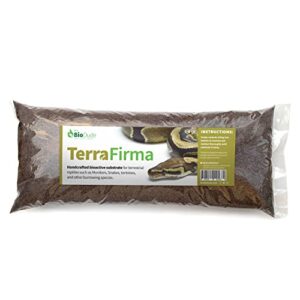
Bio Dude’s Terra Firma is the substrate choice when you’re ready to take your kingsnake’s enclosure from functional to a genuinely living environment. At $24.95 for a 6-quart bag, this handcrafted mix nurtures a self-sustaining microfauna colony — springtails and isopods break down waste, cycle nutrients, and keep the enclosure cleaner between maintenance sessions.
The composition works remarkably well for burrowing. Terra Firma holds tunnel structure without collapsing, which matters for a kingsnake that actively digs and retreats. Spread it 2–4 inches deep and you’ll see natural digging behavior almost immediately.
Humidity compatibility sits between 50–75%, which aligns well with standard kingsnake husbandry requirements. No separate drainage layer is needed, which simplifies the build considerably.
| Best For | Bioactive kingsnake terrariums requiring stable humidity and burrowing support |
| Price | $24.95 |
| Size | 6 quarts |
| Brand | Bio Dude |
| Humidity Range | 50–75% |
| Key Feature | Aids microfauna; no drainage layer required |
Best For: Reptile keepers who want to build a fully bioactive kingsnake enclosure with live plants, microfauna, and a self-sustaining ecosystem.
| Brand | BioDude |
|---|---|
| Product Type | Substrate |
| Kingsnake Suitable | Yes |
| Bioactive Friendly | Yes |
| Ease of Setup | Easy |
| Maintenance Level | Moderate |
| Additional Features |
|
- Holds burrow and tunnel structures well, supporting natural digging behavior
- No separate drainage layer needed, making setup simpler and more straightforward
- Includes mycorrhizae and supports microfauna colonies that help break down waste naturally
- Only works well within a specific humidity range (50–75%), so it’s not ideal for all species
- Needs live plants and clean-up crews (springtails/isopods) to reach its full bioactive potential
- A 6-quart bag may not go far in larger enclosures, adding to the overall cost
Frequently Asked Questions (FAQs)
Can kingsnakes be housed together safely?
No — kingsnakes are ophiophagous, meaning they eat other snakes, including their own kind. Cohabitation risks cannibalism, territorial aggression, and disease transmission. House them individually; it’s the only reliably safe option.
What are kingsnake breeding requirements and seasons?
Breeding kingsnakes requires a deliberate cooling period of 6 to 12 weeks at 55–65°F, initiated in late fall. Gradually raise temperatures to 78–82°F in spring to trigger natural mating behavior.
How much do kingsnakes typically cost?
Expect to spend $60–$150 for common kingsnakes, with rare morphs like albinos pushing toward $ Budget another $150–$500 for initial setup costs — enclosure, heating, and substrate included.
Are kingsnakes legal in all states?
No, kingsnakes aren’t legal everywhere. Ownership laws vary by state — some require permits for specific subspecies or hybrids, and others restrict interstate transport. Always check your state wildlife agency before acquiring one.
What quarantine procedures for new kingsnakes?
Isolate your new kingsnake for three to six months before any contact with existing reptiles. Schedule a vet exam immediately to screen for parasites, and monitor daily for appetite loss, abnormal stools, or wheezing.
Do kingsnakes need UVB lighting?
Ironically, the snake that can survive without UVB often thrives most with it. A low-output UVB bulb — targeting 0–0 UVI, placed 12 to 18 inches above the basking zone — sharpens activity, helps with calcium metabolism, and reinforces natural daily rhythms.
How do you breed kingsnakes in captivity?
Captive breeding starts with a brumation period of 6–12 weeks at 40–50°F, which gets ready both sexes reproductively. After warming them back up, introduce the male and monitor for courtship over 1–3 weeks. Females usually lay 2–6 eggs, incubated at 80–82°F on moist vermiculite for 60–90 days.
What are signs of a gravid female kingsnake?
A gravid female develops noticeable abdominal swelling, with the midsection feeling firmer as eggs progress through the oviducts. Watch for nesting behavior — digging, basking more frequently, and reduced food interest as gestation advances.
Can kingsnakes eat frozen prey exclusively?
Straight from the freezer to the tongs — yes, kingsnakes thrive on exclusively frozen prey. I transitioned a stubborn California kingsnake in two weeks by warming thawed mice to near body temperature and tong-feeding consistently.
Can kingsnakes coexist safely with other reptiles?
No — kingsnakes are natural predators of other reptiles and must be housed alone. Even large enclosures can’t eliminate the predation risk. Solo housing isn’t optional; it’s the standard for responsible kingsnake care.
Conclusion
Picture a kingsnake coiled inside a perfectly calibrated enclosure — warm side steady, substrate deep enough to burrow, a prey item sized just right. That image isn’t luck. It’s the result of every decision outlined in this king snake care sheet detailed enough to eliminate guesswork.
Precision is the real skill here. Get the fundamentals right, and you’ll have a snake that sheds cleanly, feeds reliably, and thrives for decades under your care.
If you’re ever unsure about prey size or feeding frequency, our guide to snake feeding and health walks through the details.