This site is supported by our readers. We may earn a commission, at no cost to you, if you purchase through links.
When a green tree python coils around a branch three feet above the substrate and refuses to descend for days, it’s not being difficult—it’s showing you exactly what millions of years of evolution hardwired into its nervous system. Arboreal snakes don’t just prefer height; they require it for psychological security, thermoregulation, and even successful digestion.
This means the flat rock cave that works for a ball python becomes a stress trigger for species like emerald tree boas, rough green snakes, and Amazon tree boas. The challenge isn’t simply adding vertical space—it’s engineering snake hides for arboreal snakes that replicate the branch forks, hollow limbs, and canopy crevices these animals instinctively seek while maintaining structural integrity six inches, twelve inches, or even eighteen inches off the ground.
Table Of Contents
Key Features of Arboreal Snake Hides
Arboreal snakes don’t just need a place to hide—they need refuge that honors their instinct to climb, coil, and disappear into elevated spaces where they feel genuinely secure. The right hide replicates the tree hollows, branch forks, and canopy crevices these species seek in the wild, supporting their natural behavior while reducing stress in captivity.
Positioning these hides near climbing branches and thermal gradients ensures your snake can thermoregulate effectively without sacrificing the security of elevation.
Arboreal snakes need elevated hides that let them climb and coil, mirroring their wild instincts and easing captivity stress
Understanding the core features that make a hide effective for vertical dwellers will help you create an environment where your snake thrives, not just survives.
Ground-level hides remain essential for daily comfort, and learning how to make your snake comfortable ensures both vertical and horizontal spaces meet their instinctive needs.
Elevated Design for Vertical Climbing
Unlike ground-dwelling species, arboreal snakes demand vertical space that lets them climb, explore, and rest at multiple heights. Your elevated perches and climbing structures must mimic the layered branches of an arboreal habitat, giving your snake the freedom to exercise natural agility and movement patterns.
A well-planned snake enclosure for arboreal snakes incorporates sturdy horizontal branches at varying levels, allowing your snake to thermoregulate by moving between cooler and warmer zones.
Consider these design priorities:
- Staggered height placement creates a climbing ladder effect
- Vertical entry angles enhance grip during ascent
- Integrated perches provide progressive challenge points
This vertical enrichment transforms reptile habitats into vibrant snake enclosures.
Sturdy branches and ledges give snakes room to explore upward, creating a ball python climbing branches setup that mimics their natural behavior.
Secure Attachment to Branches or Walls
Once you’ve built your vertical space with branches and climbing structures, you need attachment methods that won’t fail. Secure fastening through corrosion-resistant hardware—think stainless-steel bolts or heavy-duty cable ties—keeps branch mounting rock-solid in humid reptile habitat conditions.
For corn snakes specifically, proper climbing branch selection and placement ensures both safety and enrichment in their arboreal setup.
Wall anchors must grip firmly without shifting, because arboreal snakes exert surprising force during exploration. Your snake enclosures demand hardware selection that matches the moisture, weight, and constant movement these climbers generate daily.
Proper Ventilation and Airflow
Airflow management in your snake’s hide prevents respiratory health disasters that stem from stagnant, moist air. Arboreal snakes climbing through vertical space need gentle circulation around every branch and platform.
Ventilation systems with small perforations maintain air exchange rates near 50–70% humidity without creating drafts, while directional pathways guide moisture away from climbing structures, keeping temperature gradients stable and your snake’s lungs clear.
Non-Toxic and Humidity-Resistant Materials
You can’t compromise on what touches your snake’s skin, especially when tropical humidity intensifies chemical leaching from substandard materials.
Safe materials like non-toxic woods with low resin content—cork, manzanita, or untreated hardwoods—paired with toxic-free coatings and humidity-resistant finishes prevent warping, mold colonization, and off-gassing that threaten your arboreal snakes during shedding cycles and extended contact within climbing structures and vertical space.
Multiple Entry and Exit Points
When your snake senses danger or simply wants privacy, a well-designed exit strategy means the difference between confident exploration and chronic stress in arboreal hides.
- Position at least two distinct entry points along natural climbing pathways that mimic tree crevices your arboreal snakes would encounter in canopy habitats
- Size openings to accommodate both juvenile and adult specimens without creating structural weak points in snake enclosures
- Align hide accessibility with existing climbing structures to encourage fluid vertical movement and rapid snake retreat
- Maintain airflow around each entry point to prevent condensation buildup that compromises reptile care standards
- Inspect materials surrounding openings regularly to verify structural integrity under repeated contact and vibration
Choosing The Right Size and Placement
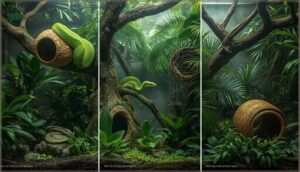
Choosing the right hide size and placement isn’t about guessing—it’s about understanding how your snake actually moves through vertical space and where it feels most secure. You’ll need to factor in your snake’s body length, climbing habits, and whether it prefers tight retreats near the canopy or more spacious options at mid-level branches.
The decisions you make here directly affect your snake’s stress levels, feeding response, and overall willingness to explore its environment.
Sizing Hides for Juvenile Vs. Adult Snakes
Matching your snake’s growth rate to the right hide size isn’t guesswork—it’s a cornerstone of arboreal behavior support and reptile care.
Juveniles thrive in snug hides, approximately 1.5 to 2 times their girth, preventing stress while encouraging natural retreat instincts.
Adults demand interior diameters of 2.5 to 3.5 inches with multi-chamber designs that respect species-specific needs and accommodate full coiling without compression.
Hide Placement at Varying Heights
Vertical hide placement transforms your enclosure into a true canopy replica, where thermal gradients and spatial distribution mirror natural arboreal habitats.
Position hides across a 30–150 cm range to match climbing behavior:
- Lower placements (30–60 cm) suit juveniles and cautious feeders
- Mid-level locations (60–100 cm) enhance patrol routes and ambush zones
- Upper hides (100–150 cm) satisfy adult height preferences
- Multiple levels reduce territorial friction in shared spaces
Integrating Hides With Climbing Structures
Think of your climbing structures and hides as interconnected highways—branches become anchor points when you bolt hides to support frameworks capable of holding five times your snake’s body weight, ensuring structural integrity testing prevents mid-climb failures.
Space vertical access points to allow fluid snake movement patterns between levels, ventilating each climbing hide design without drafts while using mold-resistant, non-toxic materials that thrive in humid reptile habitat conditions, optimizing vertical space for authentic arboreal habitat creation.
Ensuring Accessibility and Security
Your snake’s life depends on accessibility paired with unwavering hide stability—secure entry points must accommodate head dimensions without forcing unnatural movements, while dual-attachment mounting systems prevent detachment during vigorous climbing, prioritizing snake safety through accessible design that enables stress-free health checks.
- Attachment hardware rated for five times body weight distributes load across branch surfaces
- Ventilation systems positioned to avoid drafts while maintaining airflow throughout each hide
- Smooth, inspectable surfaces prevent scale damage during routine arboreal snake care sessions
- Easy access door configurations with secure locking systems support animal welfare and conservation protocols
Types of Arboreal Snake Hides
Arboreal snakes thrive when you provide hides that reflect the structural diversity they’d encounter in forest canopies, from hollow logs wedged between branches to suspended refuges that sway with subtle movement.
Your choice of hide material—whether natural, synthetic, or custom-built—will influence durability, humidity retention, and how convincingly the setup mimics your snake’s native microhabitat.
Let’s examine four distinct categories of arboreal hides, each offering unique advantages for security, ventilation, and integration with your vertical climbing structures.
Cork Bark Tubes and Natural Wood Hides
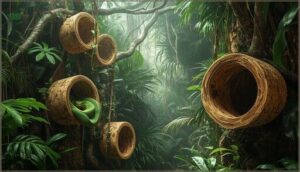
When designing a habitat that mimics the forest canopy, cork bark tubes and natural wood hides offer both authenticity and functionality. Cork bark provides several benefits, including lightweight construction, natural porosity for ventilation, and irregular internal dimensions that accommodate juvenile arboreal snakes from 12 to 20 inches, remaining serviceable as they mature, depending on species-specific growth patterns.
| Feature | Cork Bark Tubes | Natural Wood Hides |
|---|---|---|
| Weight & Mounting | Lightweight, easy attachment to climbing structures | Heavier, requires secure fastening hardware |
| Ventilation | Inherent porosity plus small openings | Intentional gaps or drilled ventilation holes |
| Durability | Resists warping, minimal gnaw damage | Moisture-resistant when untreated, non-toxic wood used |
Natural wood hides should be crafted from untreated, non-toxic wood species with inherent moisture resistance to prevent mold growth and structural degradation in the tropical humidity ranges typical of arboreal snake enclosures. Both cork and wood options provide smooth interior surfaces that prevent skin irritation or scale snags, critical for maintaining healthy integument during shedding cycles and daily movement. Proper ventilation, achieved through cork’s natural texture or strategically placed openings in wood, prevents overheating while sustaining humidity within the 60–80% range preferred by most canopy-dwelling species.
Secure attachment to branches or vertical structures ensures the snake shelter remains stable during active exploration, reducing stress and promoting natural behaviors like static posture within hides—a camouflage strategy observed in wild populations. These naturalistic environments, when thoughtfully integrated with climbing structures and arboreal decor, transform standard reptile care into a vibrant, species-appropriate habitat that fosters both physical health and psychological well-being.
Plastic and Acrylic Elevated Hides
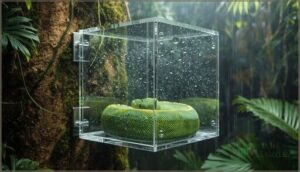
While bark and wood deliver that forest-floor authenticity, plastic and acrylic elevated hides bring clarity and control to your arboreal setup. Non-porous polymers resist humidity without warping, and clear designs let you monitor your snake’s behavior without disturbing its refuge—a win for both observation and welfare. Ventilation systems built into these hides balance airflow with security, preventing mold while maintaining the 60–80% humidity range canopy species need.
Key advantages of elevated hide materials:
- Smooth interiors prevent shedding obstructions and scale irritation during skin cycles
- Lightweight construction simplifies repositioning during routine maintenance without stressing your animal
- Uniform temperature distribution pairs seamlessly with heat sources for consistent thermal gradients
- Built-in clamps or adhesive-compatible fasteners guarantee stable vertical mounting on smooth enclosure walls
You’ll find acrylic more impact-resistant than standard PET plastic, though it scratches more easily—regular cleaning with reptile-safe disinfectants keeps transparency intact.
Size your hide to accommodate at least 1.5 body lengths for juveniles, with clearance around the widest girth for adults, and place it at mid- to upper-vertical tiers where arboreal snakes naturally patrol. Proximity to climbing structures reduces travel distance, supporting instinctive ambulation patterns while minimizing the energy your snake expends moving between refuge and exploration zones.
Suspended and Hanging Hide Boxes
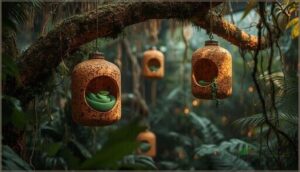
When your snake repeatedly bypasses floor-level refuges, suspended and hanging hide boxes deliver the vertical enrichment arboreal species instinctively seek.
Attach zip-tied cork rounds or screw-mounted PVC chambers to climbing structures using corrosion-resistant hardware, positioning them at multiple heights to mimic canopy layers where green tree pythons and emerald tree boas naturally coil—naturalistic design that transforms unused airspace into functional reptile habitat.
This approach to creating arboreal habitats requires understanding of vertical space needs to guarantee the well-being of the snakes.
Custom DIY Arboreal Hide Solutions
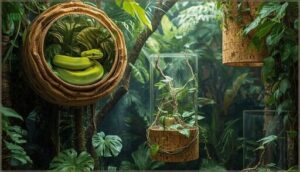
When commercial options fall short of your vision, custom DIY arboreal hide designs let you tailor vertical space utilization to your snake’s exact climbing structures and arboreal snake behavior patterns—crafting reptile habitat from cork bark, PVC, or acrylic sheets bonded with aquarium-safe adhesives.
- Install modular units with removable panels for trouble-free cleaning cycles
- Blend artificial vines into hide material options to improve grip and camouflage
- Position hides at staggered heights, replicating the layered canopy strata arboreal snakes navigate
- Use corrosion-resistant fasteners and breathable finishes to maintain structural integrity under tropical humidity
Top 7 Arboreal Snake Hides and Enclosures
You’ll find a range of enclosures designed to meet the vertical and environmental demands of arboreal snakes, each offering distinct advantages in construction, ventilation, and spatial configuration.
These seven options vary in materials—from tempered glass to UV-stable acrylic—and in their capacity to support climbing structures, humidity control, and multi-level habitat design.
Selecting the right enclosure depends on your snake’s species-specific needs, adult size, and the level of customization you’re prepared to integrate into their arboreal environment.
1. Reptizoo Large Reptile Tank Enclosure
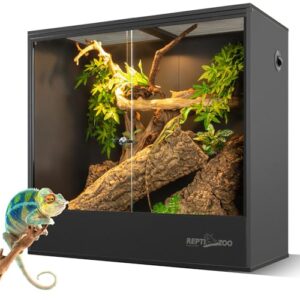
When you’re ready to enhance your arboreal snake habitat beyond improvised solutions, the Reptizoo Large Reptile Tank Enclosure delivers the structural integrity and vertical space that climbing species demand.
This 36 x 18 x 36-inch PVC enclosure weighs approximately 65.9 pounds and provides 100 gallons of climbing territory, featuring removable glass sliding doors with safety locks, detachable mesh screens that improve ventilation systems, and non-absorbent surfaces that simplify tank assembly and maintenance.
The black polyvinyl chloride construction excels at temperature regulation, making it ideal for recreating humid canopy conditions where reptile behavior flourishes.
| Best For | Reptile owners housing arboreal snakes, chameleons, or tree-dwelling lizards who need a tall enclosure with solid insulation and easy maintenance. |
|---|---|
| Material | PVC |
| Dimensions | 36×18×36 inches |
| Weight | 65.9 pounds |
| Color | Black |
| Ventilation | Mesh screen |
| Door Access | Sliding glass door |
| Additional Features |
|
- Excellent temperature and humidity control thanks to non-absorbent PVC construction that holds heat better than glass terrariums
- Generous 36-inch height provides ample vertical climbing space for arboreal species to exhibit natural behaviors
- Easy to clean and maintain with removable sliding doors and smooth surfaces that don’t absorb moisture or odors
- Small door openings can make it challenging to reach into corners or rearrange decorations inside the enclosure
- Mesh screen may block some UVB output, requiring you to adjust lighting placement or use higher-output bulbs
- Lock mechanism and suction cups can be finicky, with some users reporting difficulty getting them to work reliably
2. Waazoorep Reptile Enclosure Tank
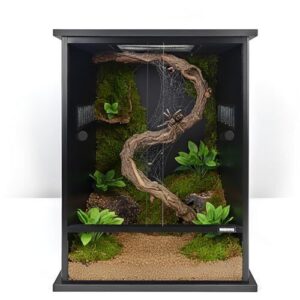
You’ll appreciate how the Waazoorep Reptile Enclosure Tank balances affordability with functional vertical design, offering arboreal snakes an 18 x 18 x 24-inch PVC habitat that weighs just 25 pounds yet maintains structural integrity for climbing setups.
The tempered glass sliding doors simplify reptile care and tank assembly, while the metal top screen ensures proper humidity control and ventilation that prevents respiratory complications.
Though front panel clearance occasionally limits access during feeding, this reptile enclosure provides adequate height for natural snake behavior, and its non-absorbent surfaces resist mold accumulation in humid arboreal hide design configurations.
| Best For | Reptile owners seeking an affordable, lightweight enclosure for arboreal snakes like ball pythons or chameleons who need vertical climbing space without heavy glass construction. |
|---|---|
| Material | PVC and Glass |
| Dimensions | 18×18×24 inches |
| Weight | 25 pounds |
| Color | Black |
| Ventilation | Metal top screen |
| Door Access | Tempered glass sliding |
| Additional Features |
|
- The PVC construction keeps humidity stable while staying easy to clean and mold-resistant, unlike wood alternatives that absorb moisture
- Metal top screen provides consistent airflow and UVB light penetration without sacrificing heat retention in the main habitat
- At 25 pounds, it’s light enough to move or reposition without help, yet sturdy enough for climbing branches and decorations
- Front panels can hit knobs when opening, making it awkward to reach your pet without removing hardware or adding suction cups
- No leak testing mentioned for misting systems, so you might deal with water seepage if you keep high-humidity species
- Limited interior width means bulky decorations or thick branches won’t fit as easily as in wider enclosures
3. Repwild Reptile Terrarium Tank Enclosure
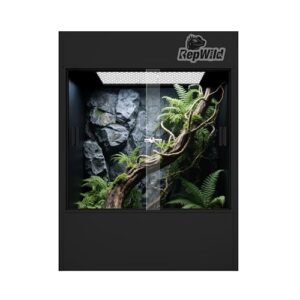
With PVC composite walls and a 17.7 x 17.7 x 23.6-inch vertical design, this terrarium delivers the climbing structures and elevation arboreal snakes require for species-typical behavior. However, you’ll need to apply additional sealant to eliminate minor gaps that compromise humidity retention in tropical reptile habitat configurations.
The scratch-resistant glass panels and ventilated mesh balance visibility with airflow, preventing respiratory infections while supporting natural snake behavior. The beginner-friendly assembly accommodates bioactive substrates that replicate forest canopy conditions, making this reptile enclosure functionally adequate despite its waterproofing limitations.
| Best For | Owners of arboreal snakes like green tree pythons or emerald tree boas who need a tall enclosure with climbing space and don’t mind sealing a few gaps during setup. |
|---|---|
| Material | PVC |
| Dimensions | 17.7×17.7×23.6 inches |
| Weight | 13.52 kg |
| Color | Black |
| Ventilation | Ventilated mesh |
| Door Access | Scratch-resistant glass |
| Additional Features |
|
- Vertical 23.6-inch height gives climbing snakes the elevation they need, with enough room for branches and mid-level hides.
- Scratch-resistant glass and ventilated mesh let you watch your snake without fogging issues while keeping airflow steady.
- PVC walls hold humidity better than screen cages, and the design works for bioactive setups if you’re into naturalistic habitats.
- You’ll have to buy sealant separately and patch minor gaps yourself before it holds humidity properly.
- Assembly instructions can be confusing in spots, so first-timers might need to troubleshoot a few steps.
- It’s not watertight out of the box, so forget using it for anything that needs standing water or heavy misting without prep work.
4. OrayuPro Reptile Terrarium Tank
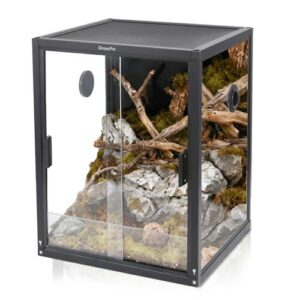
Precision meets practicality in the OrayuPro Reptile Terrarium Tank—a 24-inch tall habitat crafted for arboreal snakes craving vertical space and climbing structures. You get a blend of acrylic, glass, and aluminum, ensuring durable enclosure materials, excellent insulation, and crystal-clear visibility.
Tank assembly is straightforward, though some users note minor challenges. Vertical lighting encourages natural reptile behavior, while mesh tops enhance airflow for humidity control.
This terrarium design lets you build an authentic reptile habitat, balancing accessibility and security for your climbing species.
| Best For | Hobbyists keeping small arboreal snakes or tree-dwelling reptiles who need a tall, vertical enclosure with clear viewing and solid build quality. |
|---|---|
| Material | PVC and Glass |
| Dimensions | 18×18×24 inches |
| Weight | 22.2 pounds |
| Color | Multi-material |
| Ventilation | Well-ventilated design |
| Door Access | Escape-proof design |
| Additional Features |
|
- 24-inch height gives climbing species the vertical space they need, with room for branches and elevated hides
- Mixed-material construction (PVC, glass, acrylic, aluminum) balances durability, insulation, and clear visibility
- Front-opening design and mesh top make feeding and maintenance easier while supporting proper ventilation
- Some users report assembly can be tricky or time-consuming
- Not ideal for reptiles that need more floor space instead of height
- Requires regular monitoring to prevent humidity buildup, especially with the screen top
5. Toxirium Reptile Terrarium Cage
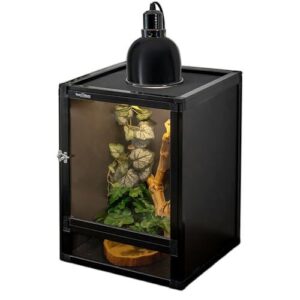
When your arboreal snakes demand both refuge and elevation, the Toxirium Reptile Terrarium Cage transforms vertical space into functional security. This compact 12″x12″x18″ unit features durable cage materials—sturdy aluminum frames paired with insulated PVC panels—that lock in humidity control while promoting ventilation systems through interchangeable dual doors, one acrylic and one screen.
You’ll appreciate how climbing structures integrate seamlessly with reinforced mounting points, enabling secure attachment to branches and walls. This directly influences reptile behavior by mimicking natural canopy retreats and supports bioactive setup flexibility in your terrarium design for proper reptile care.
| Best For | Reptile keepers who need a compact, stackable enclosure for small arboreal species like crested geckos, day geckos, or tree frogs that require stable humidity and vertical climbing space. |
|---|---|
| Material | PVC and Aluminum |
| Dimensions | 12×12×18 inches |
| Weight | 7.2 pounds |
| Color | Black |
| Ventilation | Screen door option |
| Door Access | Dual doors |
| Additional Features |
|
- Dual door system (acrylic and screen) lets you switch between maximum humidity retention and increased airflow depending on your species’ needs
- Lightweight and stackable design makes it easy to expand your collection or rearrange setups without heavy lifting
- Insulated PVC panels with aluminum frame maintain consistent warmth and humidity for tropical species
- Build quality issues reported including doors that don’t close flush, leaving gaps that small prey or hatchlings might escape through
- Assembly instructions are unclear and frustrating, making setup more difficult than it should be
- Not waterproof and may arrive with scratches or damage, limiting its use for high-moisture bioactive setups
6. Reptile Glass Terrarium Enclosure
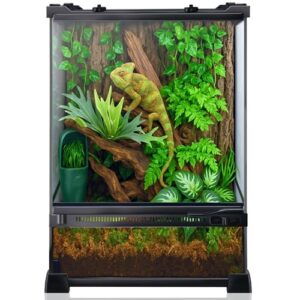
Ever wondered why Glass Terrariums remain a staple in vivarium setups for arboreal snakes? Their vertical lighting options, high visibility, and humidity control let you monitor every scale and shed.
With sturdy enclosure materials and a front-access design, you get seamless reptile care and maintenance. These tall terrariums excel at creating stable thermal gradients, and when paired with climbing branches, they transform into multi-level bioactive setups.
For rainforest species, a glass enclosure means reliable warmth, moisture, and a panoramic view of natural behavior.
| Best For | Keepers of small arboreal reptiles, tree frogs, or invertebrates who want a compact, visually clear enclosure that supports climbing behavior and maintains stable humidity for rainforest species. |
|---|---|
| Material | Glass |
| Dimensions | 14×10×10 inches |
| Weight | 9 pounds |
| Color | White |
| Ventilation | Top ventilation |
| Door Access | Top and front access |
| Additional Features |
|
- Full-glass design gives you unobstructed views from all angles, making it easy to monitor your pet’s health, behavior, and environmental conditions without disturbing them.
- Vertical layout with front-access doors works perfectly for climbing species and reduces stress during feeding or maintenance compared to reaching in from above.
- Compact 14×10×10-inch footprint fits on desks or shelves while still providing enough height for branches, plants, and a layered bioactive setup.
- Humidity can be tricky to maintain long-term since glass enclosures with screen tops tend to dry out faster, often requiring foggers, misters, or partial top coverage to hit target levels.
- Actual size may run smaller than expected, and the latch mechanism can be finicky to operate, with bottom door vents potentially allowing tiny insects to slip out.
- Glass loses heat faster than insulated materials like PVC, so you’ll likely need to invest more in heating devices and monitor temperatures closely to maintain proper gradients.
7. Reptile Acrylic Terrarium Enclosure Tank
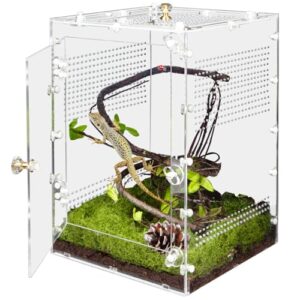
When you need lightweight portability paired with crystal-clear reptile visibility, an acrylic tank design delivers both without shattering risk—these 10-gallon units from brands like TCooSo weigh roughly 5 pounds yet maintain stable humidity control through precise vent hole arrays that balance airflow with moisture retention.
Their front and top opening doors simplify tank maintenance, letting you access climbing branches and arboreal hides without disturbing your snake’s canopy refuge, while transparent walls showcase every detail of your terrarium setup and transform routine reptile enclosure design into a living display of arboreal snake behavior.
| Best For | Reptile keepers who want a lightweight, shatter-resistant enclosure with excellent visibility for arboreal species like crested geckos or small snakes that need stable humidity and easy front-access maintenance. |
|---|---|
| Material | Acrylic |
| Dimensions | 18×12×12 inches |
| Weight | 5 pounds |
| Color | Clear |
| Ventilation | Vent holes |
| Door Access | Front and top opening |
| Additional Features |
|
- Weighs only 5 pounds and won’t shatter on impact, making it safer and easier to move than glass tanks of the same size
- Retains heat and humidity better than glass due to tight seals and controlled ventilation, which helps maintain stable conditions for reptiles without constant misting
- Front and top opening doors let you access your pet and clean the enclosure without reaching in from above, reducing stress for climbing species
- Ventilation holes may be large enough for very small juveniles or invertebrates to escape, requiring careful monitoring or modifications
- Some buyers reported receiving cracked or damaged units, suggesting inconsistent quality control from the manufacturer
- Acrylic scratches more easily than glass when cleaning, so you’ll need to use soft cloths and avoid abrasive scrubbers to keep it clear
Safety and Maintenance Tips for Arboreal Hides
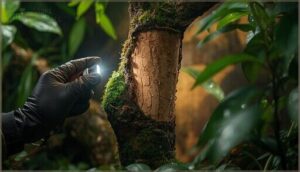
Your arboreal snake’s hides require consistent checks and upkeep to prevent injuries, infections, and structural failures that can compromise your animal’s health. Regular inspections catch problems before they escalate, while proper cleaning routines stop mold growth and bacterial buildup in the humid conditions these species require.
Here’s what you need to monitor and maintain to keep your snake’s elevated retreats safe, sanitary, and fully functional.
Inspecting for Sharp Edges and Stability
Your snake’s safety hinges on methodical edge inspection and stability tests—trauma from unsecured or splintered hides ranks among the most common yet preventable injuries in captive boas and pythons. Run your fingers along every surface, checking for sharp protrusions, unstable anchoring, or entrapment gaps that compromise both material safety and perch security, then test load-bearing capacity by applying firm pressure to each mounting point before introducing your animal.
To ensure the well-being of your pet, it’s vital to follow proper snake care guidelines to prevent injuries and promote a healthy environment.
| Inspection Focus | Method | Risk if Neglected |
|---|---|---|
| Sharp edges on wood/plastic | Visual scan + tactile sweep | Abrasions, eye injury, scale damage |
| Anchor point integrity | Pressure test all fasteners | Falls, crush injuries, perch collapse |
| Entrapment gaps | Measure openings as snake grows | Limb trapping, circulation loss |
| Hardware corrosion | Check brackets, screws monthly | Sudden detachment, laceration from exposed metal |
Injury prevention in arboreal snakes demands that you prioritize reptile enclosure design with animal welfare as its foundation. Reinspect hides after every deep clean, since moisture exposure degrades wood and loosens adhesive mounts. Remember that arboreal hide design flaws reveal themselves only when your snake’s full weight tests a weak branch fork or corroded suction cup at three a.m.
Cleaning and Mold Prevention
Once you’ve ruled out sharp edges, keeping hides free from mold becomes your daily ritual. Spot cleaning, paired with weekly wipe-downs using chlorhexidine or F10 disinfectant options, protects Reptile Health and Wellness.
Swap damp substrate, monitor humidity control, and rotate décor—these steps anchor your Cleaning Schedules and Mold Control, supporting vibrant Arboreal Snake Care in naturalistic environments.
Monitoring Humidity and Air Circulation
After preventing mold, your next battleground is balancing humidity control with airflow management. Position at least one hygrometer in the middle vertical space where your arboreal snakes actually perch, not buried in substrate.
Screen tops paired with low cool-side vents drive flow-through ventilation systems that maintain 50 to 70 percent humidity without trapping stagnant air, safeguarding respiratory health while your temperature gradients remain stable throughout terrarium design.
Replacing Damaged or Worn Hides
Once airflow and humidity stay dialed in, worn cork bark, cracked acrylic, or splintered branches demand immediate replacement before sharp edges injure delicate ventral scales or unstable platforms collapse mid-climb. Conduct damage inspection monthly, checking:
- Attachment integrity where hides mount to enclosure walls
- Surface degradation from humidity exposure
- Structural weakening that threatens arboreal snakes mid-perch
- Entry points narrowed by swelling or warping
Prioritize hide replacement over refurbishment when material selection originally favored aesthetics instead of wear prevention.
Frequently Asked Questions (FAQs)
Do arboreal snakes actually use hides regularly?
Like a watchful sentinel retreating to a canopy fortress, your arboreal snakes won’t ignore well-placed hides.
Captive observations confirm they regularly seek elevated shelters during rest, with environmental factors and hide placement strongly influencing their climbing habits and usage patterns.
Can multiple snakes share one arboreal hide?
Shared arboreal hides generally trigger territorial behavior and mounting attempts in most species, compromising snake stress management and individual thermoregulation.
You’ll achieve better reptile husbandry outcomes through dedicated hide size allocation supporting natural coexistence strategies.
How do hides affect feeding behavior patterns?
Arboreal hides compress feeding windows toward crepuscular periods, shorten time-to-first-attack after prey introduction, and increase successful capture frequency by offering consistent ambush points.
These features reduce perceived risk and support natural hunting rhythms in captive snake behavior.
Should hides mimic specific natural tree features?
Yes, hides that replicate tree bark texture, branch geometry, and wood grain patterns strengthen natural camouflage, reduce stress, and encourage species-typical behaviors in arboreal snakes.
Mimicry techniques greatly improve bioactive and naturalistic environments for ideal arboreal snake care.
What temperatures work best inside arboreal hides?
You’ll want to keep hide interiors 2–6 °C warmer than ambient air, matching your species’ basking needs while maintaining 50–70% humidity.
Temperature gradients and thermal monitoring prevent stratification, supporting microclimate management and species-specific thermoregulation throughout the enclosure.
Conclusion
A single miscalculated hide placement can unravel weeks of careful husbandry, transforming a thriving green tree python into a stress-curled recluse that refuses food and develops respiratory complications.
The snake hides for arboreal snakes you select aren’t decorative afterthoughts—they’re architectural commitments to replicating canopy microhabitats where your animal’s neurological wiring expects concealment at height.
Measure twice, mount securely, and watch your arboreal species finally exhale into the vertical sanctuary evolution promised them.