This site is supported by our readers. We may earn a commission, at no cost to you, if you purchase through links.

Your ball python’s enclosure might look cozy to you, but without proper heating, it’s basically a cold prison for a creature designed to bask under the West African sun. Unlike mammals, ball pythons can’t generate their own body heat—they rely entirely on external warmth to digest meals, fight off infections, and maintain the metabolic processes that keep them alive.
A heating pad isn’t just a luxury accessory; it’s the cornerstone of responsible ball python care. The question isn’t whether your snake needs supplemental heat, but rather how to deliver that warmth safely and effectively. Getting the setup right means understanding thermal gradients, choosing the right equipment, and avoiding the burns and temperature swings that send too many pythons to the vet clinic.
Table Of Contents
- Key Takeaways
- Do Ball Pythons Need Heating Pads?
- Heating Pad Options for Ball Pythons
- Safe Setup and Temperature Control Tips
- Top Heating Products for Ball Python Enclosures
- Frequently Asked Questions (FAQs)
- How much heat do ball pythons need?
- What is the best heating method for a ball python?
- Can ball pythons survive without any heat source?
- How often should heating equipment be replaced?
- Do baby ball pythons need different temperatures?
- Whats the ideal nighttime temperature for ball pythons?
- Can multiple heating sources be used together safely?
- Conclusion
Key Takeaways
- Ball pythons can’t generate their own body heat, so they need external heating sources to maintain the 88-92°F warm zone required for digestion, immune function, and survival.
- A proper thermal gradient—with warm and cool zones—lets your snake thermoregulate naturally, while a thermostat prevents dangerous burns and overheating that send pythons to the vet.
- Under-tank heaters work well when paired with thermostats and proper substrate depth, but you can also use ceramic emitters, heat cables, or radiant panels depending on your setup needs.
- Check temperatures daily with digital sensors on both sides of the enclosure, maintain 50-60% humidity, and replace heating equipment every 3-5 years to prevent metabolic failure and equipment malfunctions.
Do Ball Pythons Need Heating Pads?
Ball pythons absolutely need a heat source to stay healthy, and heating pads are one of the most reliable ways to create the warm zone they depend on. Without consistent belly heat in the 88-92°F range, your snake can’t digest food properly or fight off infections.
For owners in colder regions, investing in a high-quality heating pad designed for reptiles in cold climates ensures your ball python maintains that critical warm zone even when room temperatures drop.
Let’s look at why temperature control matters so much, what happens when heating goes wrong, and how a proper thermal gradient keeps your ball python thriving.
Ball Python Temperature Requirements
Your ball python needs specific temperature ranges to thrive. The warm side should hit 88 to 92°F, while the cool side stays around 78 to 82°F. At night, temperatures can safely drop to 72 to 78°F.
To give your ball python the best of both worlds, using a heating mat safely for snakes means covering no more than a third of the floor so your snake always has a cool retreat.
During these cooler nighttime hours, your snake may still shift positions or explore quietly, so it helps to recognize signs of stress in ball pythons versus normal restful behavior.
You’ll need reliable heat sources and careful temperature regulation to create this thermal gradient. It’s also vital to maintain proper ball python humidity levels to support healthy shedding and overall wellbeing.
Without proper reptile heating and enclosure design, your snake can’t regulate its body temperature effectively.
Importance of a Thermal Gradient
That warm-to-cool range isn’t just a recommendation—it’s how your snake survives. A thermal gradient lets your ball python shuttle between heat zones to digest food, rest comfortably, or cool down when needed. Without proper gradient creation and heat distribution across temperature zones, your pet can’t thermoregulate effectively.
A thermal gradient is vital for ball pythons, allowing them to move between warm and cool zones so they can survive and thrive
- Thermal balance promotes natural metabolic cycles throughout the day
- Heat mats positioned correctly establish defined warm patches without overheating everything
- Temperature regulation prevents stress from sudden swings between extremes
- Humidity control works alongside heat sources to maintain respiratory health
- Reptile heating zones mimic natural environments where pythons move freely to self-regulate
Risks of Improper Heating
Get the temperature wrong and you’re opening the door to fire hazards, electric shock, and even carbon monoxide buildup in poorly ventilated setups. Overheating causes heat stress and thermal burns, while inadequate heating pad control disrupts thermoregulation entirely.
Without proper temperature control, your thermal gradient collapses—and so does your snake’s ability to stay healthy in basic reptile care. Neglecting regular maintenance can expose pets and people alike to serious heating system risks.
Heating Pad Options for Ball Pythons
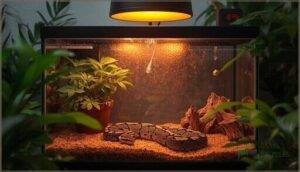
You’ve got more heating options than you might think in terms of keeping your ball python warm and comfortable. Each type works a little differently, and understanding the basics will help you pick what fits your setup best.
Let’s break down the main choices you’ll see recommended by reptile vets and experienced keepers.
Under Tank Heaters (UTH) and Heat Pads
Under tank heaters, or UTHs, deliver heat directly through your enclosure’s floor—think of them as a gentle heating blanket for your snake’s belly.
A high-quality heating pad designed for glass tanks creates this warm zone while staying safe and energy-efficient.
These reptile heating pads cover about one-third of the base, creating the warm zone your ball python needs while the opposite side stays cooler.
Proper pad materials and thermostat settings prevent dangerous hot spots, and regular UTH maintenance keeps temperature control reliable and your pet safe.
Heat Cables, Mats, and Tapes
Beyond traditional heat pads, you can use heat cables, mats, or tape to shape the thermal gradients your ball python needs.
Heat cables deliver precise spot heating along irregular layouts, while reptile heating mats spread warmth evenly across larger floor areas.
Heat tape boosts both temperature and humidity when paired with proper substrate. All heat sources require thermostat control and careful cable installation to prevent dangerous overheating.
Ceramic Heat Emitters and Radiant Panels
Ceramic heat emitters and radiant panels deliver infrared heat benefits without light, letting your Ball Python rest undisturbed while you maintain thermal gradient control across the enclosure.
- Ceramic element types reach full temperature in 5 to 8 minutes, faster than heat mats.
- Radiant panel design spreads warmth evenly, reducing burn risk.
- Heat emitter safety requires thermostat pairing for reptile heating.
- Always verify temperature control with a digital thermometer.
Safe Setup and Temperature Control Tips
Setting up a heating pad the right way can mean the difference between a thriving snake and a medical emergency. You need to think about more than just plugging in a heat source—size, placement, and failsafes all matter.
Let’s walk through the essentials that’ll keep your ball python safe and comfortable.
Choosing The Right Pad Size and Wattage
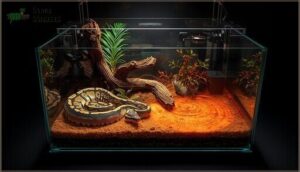
You’ll want your heating pad to cover about 60 to 70 percent of the enclosure floor—think of it as creating a warm zone, not a hot tub.
For a standard 20-gallon long tank, a 9 by 12 inch heat mat works well. Start with lower wattage, usually 4 to 10 watts for smaller setups, to build a safe thermal gradient your ball python can navigate comfortably.
Using Thermostats for Heat Regulation
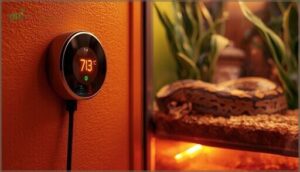
A thermostat isn’t optional—it’s your safety net. Install it with the heat sensor placed directly on the warm side, not buried under substrate, so temperature regulation stays accurate.
Look for models with overheat protection and temperature alarms that cut power if things spike beyond 95°F. Proper thermostat wiring ensures your heating pad cycles smoothly, preventing burns and giving you real control over your snake’s environment.
Monitoring Enclosure Temperature and Humidity
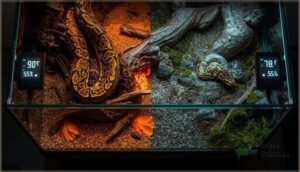
You can’t set the thermostat once and walk away—real temperature control means checking both ends of your temperature gradient daily.
Use digital temperature sensors on the warm side and cool side to verify your heat mat or undertank heater is delivering 88-92°F where it counts.
Pair that thermal monitoring with a hygrometer for humidity control, keeping levels at 50-60 percent for healthy shedding and climate management.
Substrate Considerations and Placement
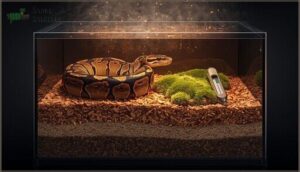
Substrate depth acts as your heat buffer—go too thin and you risk burns, too thick and the heating pad can’t reach your ball python’s belly.
Match your substrate choice to both burrowing needs and temperature control:
- Use 2-4 inches of coco fiber or cypress mulch for ideal moisture management and surface texture
- Avoid cedar or pine—those aromatic oils irritate respiratory systems
- Keep humidity levels at 50-60 percent to balance heat transfer with skin health
- Check substrate surface temps daily where the heating pad sits underneath
- Spot-clean waste immediately to prevent bacterial hot spots in warm zones
Top Heating Products for Ball Python Enclosures
You’ve learned the principles—now let’s talk about the actual gear that gets the job done. I’ve worked with plenty of ball python setups over the years, and certain products consistently prove themselves reliable, safe, and worth the investment.
Here are five heating options that meet the temperature control and safety standards your snake needs.
1. iPower Reptile Heat Pad
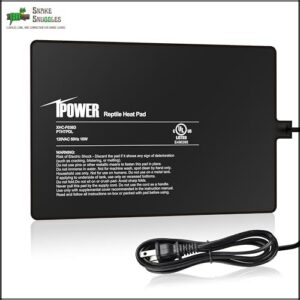
The iPower Reptile Heat Pad brings steady, low-wattage warmth to your ball python’s enclosure without the fire-and-forget risk. Available in sizes like 8×12 inches for 30-40 gallon tanks, it uses a strong 3M adhesive to stick securely under glass or along the side.
You’ll get quick heat-up and moisture resistance, but here’s the catch: there’s no built-in temperature control. That means you absolutely need a thermostat to prevent overheating and keep your snake safe.
| Best For | Ball python owners who want an affordable under-tank heater and already own a thermostat to regulate temperature safely. |
|---|---|
| Power | 16 watts |
| Material | PTC heating material |
| Intended Use | Terrariums, germination |
| Temperature Control | Requires thermostat |
| Safety Features | UL listed, waterproof |
| Cord Length | 6 feet |
| Additional Features |
|
- Heats up quickly and uses only 16 watts, keeping energy costs low
- Strong 3M adhesive keeps the pad firmly attached to glass or terrarium sides
- Waterproof design protects against moisture and makes cleaning easier
- No built-in temperature control means you must buy a separate thermostat
- Risk of overheating or fire if used without proper monitoring
- Not suitable for underwater use or full submersion in water
2. Inkbird Digital Temperature Controller Thermostat
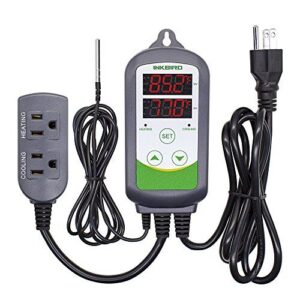
Once your heat pad is running, you’ll need a reliable partner to keep things in the safe zone. The Inkbird Digital Temperature Controller is that partner. It plugs directly into your outlet, then your heat source plugs into it—think of it as a safety middleman.
You can set precise temps in small increments, and it’ll cut power if things climb too high or drop too low. The backlit display makes nighttime checks easy, and its 1100 W capacity accommodates most reptile heating setups without breaking a sweat.
| Best For | Reptile owners who need precise, automated temperature control for heat mats, ceramic heaters, or other heating/cooling equipment without constant manual monitoring. |
|---|---|
| Power | 1100W max output |
| Material | Plastic |
| Intended Use | Fermenters, terrariums, greenhouses |
| Temperature Control | Built-in dual relay |
| Safety Features | Alarm, load protection |
| Cord Length | Not specified |
| Additional Features |
|
- Dual relay system lets you control both heating and cooling devices simultaneously, perfect for maintaining narrow temperature ranges
- Clear dual display shows current and target temps at a glance, plus alarm alerts if things drift out of your safe zone
- Handles up to 1100W, which covers most reptile heating setups, and the compressor delay feature protects your equipment from short-cycling damage
- 10A maximum current means it won’t handle larger heating systems or multiple high-wattage devices at once
- Temperature can swing by about 0.5°F minimum, which might be too loose for extremely sensitive species
- Relays may wear out faster if you’re maxing out the load and cycling constantly, especially in heavy-duty applications
3. Zoo Med Reptile Heat Cable
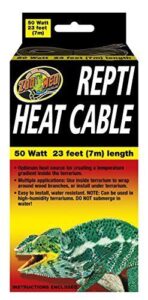
For more creative heat placement, the Zoo Med Repti Heat Cable gives you flexibility that flat pads can’t match. You can wrap this 23-foot cable around branches or weave it beneath substrate to build a custom warm zone.
It’s water-resistant and runs on just 50 watts, making it energy-smart for secondary heat. Just remember the first 6.5 feet don’t heat—that’s the cold lead keeping your outlet connection safe. Pair it with a thermostat, and you’ve got targeted warmth exactly where your python needs it.
| Best For | Reptile owners who need flexible heating options for custom enclosure setups or want to create specific warm zones around branches and decorations. |
|---|---|
| Power | 50 watts |
| Material | Plastic |
| Intended Use | Reptile tanks, breeding |
| Temperature Control | Requires thermostat |
| Safety Features | Water-resistant |
| Cord Length | 6.5 feet cold lead |
| Additional Features |
|
- Flexible 23-foot cable lets you create custom heating layouts by wrapping around branches or weaving through substrate
- Energy-efficient at only 50 watts and water-resistant for safe use in humid environments
- Long reach allows coverage in larger enclosures or multiple smaller setups
- First 6.5 feet is a non-heating cold lead, so actual heated length is only about 16.5 feet
- Requires a separate thermostat purchase for safe temperature control
- May not provide enough heat as a primary source for larger enclosures
4. Fluker’s Ceramic Heat Emitter
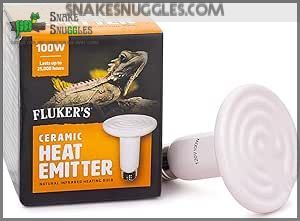
When you need nighttime heat without disturbing your python’s sleep schedule, Fluker’s 100-watt ceramic heat emitter becomes your best friend. It radiates infrared warmth straight down into the basking zone—no bright light to stress your snake during those dark hours.
You’ll screw it into any ceramic socket fixture, position it at one end of the enclosure, and watch it maintain steady temps around the clock. Just pair it with a thermostat to dial in that 88-92°F sweet spot safely.
| Best For | Ball python owners who need reliable 24/7 heat without light disruption, especially for maintaining nighttime temperatures or supplementing daytime heating systems. |
|---|---|
| Power | 100 watts |
| Material | Ceramic |
| Intended Use | Reptile heat source |
| Temperature Control | Requires thermostat |
| Safety Features | High heat ceramic |
| Cord Length | Not specified |
| Additional Features |
|
- Produces consistent infrared heat around the clock without any visible light that could disrupt your snake’s natural day-night cycle
- Large 100-watt emitter creates a wider basking area compared to smaller heat sources, giving your python more space to thermoregulate
- Works seamlessly with thermostats for precise temperature control, preventing overheating and creating safe thermal gradients
- Requires a separate ceramic socket fixture like the Repta-Clamp Lamp, adding to your initial setup cost
- Surface gets extremely hot during operation, so you’ll need to position it carefully with a protective guard to prevent burns
- May emit a noticeable smell during the first few hours of use as the ceramic element cures
5. Zilla Reflector Dome Light Fixture
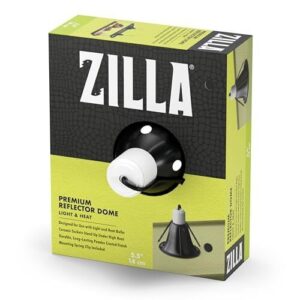
You’ll mount the Zilla Reflector Dome right on top of your screen lid using its spring clips—no wobbling, no slipping.
The 5.5-inch model holds bulbs up to 60 watts, whether you’re running a basking lamp or pairing it with that ceramic heat emitter we just discussed.
Its white interior bounces light and warmth exactly where your python needs it, while the powder-coated black exterior stays cool to the touch. The 6-foot cord with an inline switch lets you control power without reaching into the habitat.
| Best For | Snake owners who need a secure, easy-to-mount heat or light source that clips directly onto screen enclosures without taking up floor space. |
|---|---|
| Power | 60W max capacity |
| Material | Metal |
| Intended Use | Reptile terrariums |
| Temperature Control | On/off switch only |
| Safety Features | Spring clip attachment |
| Cord Length | 6 feet |
| Additional Features |
|
- Spring clip design attaches firmly to screen tops, so you don’t need stands or worry about it shifting around
- Reflective white interior maximizes heat and light output, directing warmth straight down into your python’s basking zone
- 6-foot cord with inline switch gives you flexible placement and quick on/off control without disturbing your snake
- 60-watt limit means you’ll need multiple fixtures if your enclosure requires higher heat output
- Ceramic socket can crack during shipping or rough handling, so check it carefully when it arrives
- Bulbs may burn out every few months depending on how many hours you run them daily
Frequently Asked Questions (FAQs)
How much heat do ball pythons need?
Your ball python thrives when its warm basking zone stays between 90 and 95 degrees Fahrenheit, while the cool side drops to 75 to 80 degrees to support healthy thermoregulation.
What is the best heating method for a ball python?
There isn’t one “best” method—success comes from pairing overhead heat like a ceramic emitter with an under-tank pad, creating the gradient your python needs while a reliable thermostat keeps everything safe.
Can ball pythons survive without any heat source?
Your python can endure brief periods without heat, but prolonged exposure to room temperature compromises digestion, immune function, and overall health.
A regulated heat source isn’t optional—it’s essential for survival.
How often should heating equipment be replaced?
Check your heating pad every three months for damage, and plan to replace it every three to five years. Replace thermostats immediately if they drift more than two degrees.
Do baby ball pythons need different temperatures?
Yes, hatchlings need warmer basking spots—around 88 to 92°F on the warm side—to digest properly.
Their cool side should stay between 78 and 82°F, creating a safe gradient for healthy growth.
Whats the ideal nighttime temperature for ball pythons?
Your ball python’s enclosure should stay between 75 and 80°F at night.
This gentle drop from daytime temps—about six to ten degrees—mimics their natural cycle and keeps digestion humming along smoothly.
Can multiple heating sources be used together safely?
Think of a heating system like a symphony—every instrument needs coordination.
You can combine sources, but only with a single thermostat regulating both and careful spacing to prevent dangerous hot spots or overlap.
Conclusion
Your ball python won’t survive a week without the right warmth, that’s how critical proper heating is. Now you know that ball pythons need heating pads (or equivalent heat sources) paired with thermostats to create safe thermal gradients.
Burns happen when you skip controllers, and metabolic failure follows cold enclosures. Install your equipment correctly, monitor those temperatures religiously, and your snake will thrive for decades instead of becoming another preventable casualty.