This site is supported by our readers. We may earn a commission, at no cost to you, if you purchase through links.
Your snake just stopped eating. You check the temperature—perfect. Humidity levels look fine. Then you notice the UVB bulb you installed six months ago, still glowing but biologically useless. Most reptile keepers don’t realize that UVB output drops by 30-50% within the first year, long before the bulb burns out.
Your snake’s refusal to feed, lethargy, or odd shelter-seeking behavior might not be temperament—it’s often a lighting problem masquerading as mystery.
Getting your snake terrarium lighting guide right isn’t about mimicking sunlight for aesthetics. It’s about triggering vitamin D3 synthesis, regulating circadian rhythms, and preventing metabolic bone disease before skeletal deformities become irreversible.
Different species demand vastly different setups: what works for a diurnal corn snake will stress a nocturnal ball python.
Table Of Contents
- Key Takeaways
- Why Proper Lighting Matters for Snakes
- Choosing The Right Lighting Types
- UVB and UVA: What Snakes Need
- Species-Specific Lighting Requirements
- Setting Up Your Snake Terrarium Lighting
- Maintaining a Healthy Light Cycle
- Enhancing The Terrarium Environment With Lighting
- Frequently Asked Questions (FAQs)
- What lights do I need for a snake enclosure?
- How many hours of light do snakes need?
- Should I turn my snakes heat mat off at night?
- What wattage should my snake light be?
- Can colored lights harm my snakes vision?
- Do snakes need moonlight simulation at night?
- How does seasonal lighting affect breeding cycles?
- What light intensity prevents glass surfing behavior?
- Should quarantined snakes receive different lighting schedules?
- Conclusion
Key Takeaways
- UVB bulbs lose 30-50% of their output within the first year even while still glowing, so replace them every 6-12 months to prevent metabolic bone disease and maintain vitamin D3 synthesis in your snake.
- Diurnal snakes like corn snakes need 12-14 hours of full-spectrum UVB daily, while nocturnal species like ball pythons thrive with ceramic heat emitters and minimal lighting to match their natural activity patterns.
- Your snake’s refusal to feed, lethargy, or unusual shelter-seeking often signals lighting problems rather than temperament issues—proper UVB and consistent day-night cycles regulate circadian rhythms and feeding behavior.
- Position heat lamps 25-40 cm above basking zones to create temperature gradients of 90-110°F at the hot end and 70-85°F at the cool end, allowing your snake to thermoregulate naturally throughout the day.
Why Proper Lighting Matters for Snakes
Your snake’s lighting setup isn’t just about seeing into the tank—it’s the foundation of their physical health and natural behavior. Without the right light, even a well-fed snake can develop serious health problems or fall into irregular patterns that stress their system.
Different species have unique lighting needs, so understanding rare snake species care helps you tailor the setup to your snake’s natural habitat.
Here’s what proper lighting actually does for your snake.
The Role of Lighting in Snake Health
Light therapy isn’t optional—it’s the backbone of snake enclosure lighting. UVB lighting drives vitamin D3 synthesis, enabling calcium uptake for strong bones and preventing metabolic bone disease. UVB bulbs paired with proper basking behavior support reptile health at the cellular level.
Snake vision relies on spectrum cues that regulate photoperiodism and circadian health. Without reptile lighting, your snake can’t process minerals or maintain normal physiology.
For a detailed overview of, proper species-specific lighting choices are vital to ensuring your snake’s health.
Impacts on Behavior and Circadian Rhythm
Your snake’s circadian rhythm depends on consistent light cues to regulate activity patterns and thermoregulation. Disrupted photoperiod triggers behavioral shifts—nocturnal species become restless during the day, while diurnal snakes retreat into hides.
You’ll notice stress signals like excessive basking or erratic feeding when reptile lighting fails. UVB lighting and predictable cycles keep circadian rhythms stable, supporting natural hunting and rest behaviors.
Preventing Metabolic Bone Disease
Without adequate UVB radiation, your snake can’t synthesize vitamin D3—the catalyst for calcium absorption and bone health. Metabolic bone disease develops when reptile nutrition lacks proper UVB exposure, causing skeletal deformities and organ failure.
Without UVB radiation, your snake can’t produce vitamin D3, leading to metabolic bone disease and skeletal failure
UVB bulbs prevent these metabolic disorders by mimicking natural sunlight, eliminating the need for calcium supplements. Install full-spectrum UVB lighting to safeguard your reptile’s skeletal integrity.
Choosing The Right Lighting Types
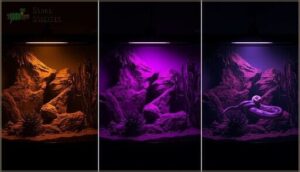
Your snake’s lighting setup depends on the bulb type you choose, and each option brings different benefits to the table. Some bulbs deliver heat and light together, while others focus on one job at a time.
Let’s break down the main lighting types so you can pick what works best for your specific setup.
Incandescent Vs. Fluorescent Vs. LED
You’ll find three main bulb types in reptile lighting, and each delivers different trade-offs for your setup.
- Incandescent bulbs provide excellent heat output and warm color rendering but consume the most energy—only 10% efficiency—and die within 750–1,000 hours.
- Fluorescent lights deliver solid UVB lighting at 20–30% efficiency, lasting 7,000–15,000 hours.
- LED lights dominate energy efficiency at 80–90%, slashing lighting costs with 25,000+ hour bulb longevity, though upfront prices run higher. For a full breakdown of energy efficiency comparison between bulb types, check the linked guide.
Pros and Cons of Mercury Vapor Bulbs
Mercury vapor bulbs pack both heat output and UVB lighting into one fixture, simplifying your snake enclosure lighting setup. These heat lamps deliver strong basking zones for reptile lighting, though you’ll replace UVB bulbs every few thousand hours as brightness fades.
A thoughtful snake enclosure balances these mercury vapor benefits with your corn snake’s moderate UVB needs and consistent day-night cycles.
You’ll pay higher lighting costs upfront and face steeper energy consumption than LEDs, but bulb efficiency beats incandescent options.
Understanding Ceramic Heat Emitters
Ceramic heat emitters deliver infrared heating without visible light, letting nocturnal snakes stay warm while you maintain a proper day-night cycle. These radiant heat lamps use a ceramic substrate to distribute steady warmth across your temperature gradient, though heat emitter safety demands vigilant thermal regulation—pair them with thermostats and fire-rated fixtures.
- Zero light emission preserves natural darkness for nocturnal activity patterns
- Long service life means fewer replacements than standard reptile lighting bulbs
- High operating temperatures require careful emitter maintenance and clearance from flammable materials
UVB and UVA: What Snakes Need
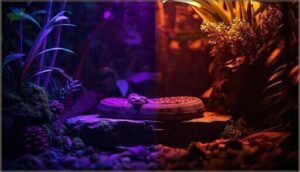
Not all light is created equal regarding your snake’s health. UVB and UVA wavelengths serve very different purposes in your terrarium, and understanding what your snake actually needs will save you money and improve their long-term wellbeing.
Here’s what each type of UV light does—and what you can skip entirely.
Importance of UVB for Vitamin D3 Synthesis
UVB radiation is the trigger your snake’s body uses to manufacture vitamin D3 through skin synthesis. When UVB wavelengths (290-315 nm) hit your snake’s skin, they convert a molecule called 7-dehydrocholesterol into previtamin D3, which becomes vitamin D3 through heat. This vitamin D3 production facilitates calcium absorption and bone growth—absolutely essential for metabolic health. Without proper UVB lighting, you’re inviting metabolic bone disease.
| UVB Component | Function | Impact Without UVB |
|---|---|---|
| UVB wavelengths (290-315 nm) | Convert 7-dehydrocholesterol to previtamin D3 | No vitamin D3 synthesis in skin |
| Vitamin D3 production | Facilitates calcium and phosphorus metabolism | Weak bones and mineral deficiency |
| UVB fluorescent lamps | Provide controlled reptile lighting exposure | Metabolic bone disease risk increases |
Replace your UVB bulbs every 6-12 months—they lose effectiveness even when they still look bright.
UVA’s Effect on Snake Behavior
UVA light influences your snake’s daily rhythm and activity patterns in ways you mightn’t expect. While snakes don’t rely on UVA for vitamin D3 synthesis like they do with UVB lighting, UVA sensitivity shapes how they interact with their light environments and respond to behavioral cues.
How UVA affects reptile behavior and physiology:
- Basking behavior: Diurnal species increase basking duration under UVA-rich photoperiod effects, synchronizing thermal needs with visible light cues for warmth seeking.
- Activity timing: UVA presence aligns daily activity peaks with sunlit periods, reinforcing natural wake-sleep cycles in your snake enclosure lighting setup.
- Exploration patterns: Juvenile snakes show more aggressive movement toward UVA-rich zones, suggesting UVA photic input helps juvenile foraging or exploration.
- Predator avoidance: Snakes exhibit faster retreat responses when UVA cues are paired with shadowed refuges, aiding predator avoidance during dawn and dusk.
- Species variation: Corn snakes display pronounced UVA-influenced exploration, while ball pythons show moderate UVA responses—use appropriate reptile lighting for each species.
Install UVA-capable bulbs alongside your UVB lighting to support natural behavioral cues and activity patterns. Your snake vision system relies on UV light exposure to regulate movement, feeding times, and shelter-seeking behavior throughout the day.
Why UVC is Unnecessary for Snakes
You don’t need UVC in your snake enclosure lighting—it’s actively harmful to reptile health. UVC radiation damages snake vision, burns skin, and offers zero metabolic benefits unlike UVB lighting.
The UV light spectrum your snake requires stops at UVA and UVB radiation. UVC safety means keeping it out entirely.
Stick with proven UV alternatives like UVB lighting for vitamin D3 synthesis instead.
Species-Specific Lighting Requirements
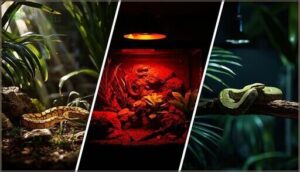
Not all snakes need the same lighting setup—your species’ natural habitat determines whether it requires full UVB, minimal light, or something in between. Diurnal snakes rely on UV exposure for essential metabolic functions, while nocturnal species thrive with heat-focused solutions that skip the bright basking lights.
Let’s break down the specific requirements for popular pet snakes so you can match your setup to your animal’s biology.
Diurnal Vs. Nocturnal Species Needs
Your snake’s natural schedule drives everything about its lighting setup. Diurnal species hunt during daylight and demand bright, full-spectrum UVB lighting to match their circadian rhythms. Nocturnal species thrive in dimmer conditions and rely on thermal gradients rather than intense photoperiods.
Match lighting to activity patterns:
- Diurnal snakes need 12-14 hours of UVB exposure daily to support vitamin D3 synthesis and natural behavioral cues
- Nocturnal species perform best with subdued reptile lighting and 10-12 hour dark periods
- Temperature gradients should align with your snake’s peak activity window—warm zones during daylight for diurnal hunters
- Photoperiod needs differ drastically; abrupt transitions stress both types, so use gradual dawn-dusk shifts
- Behavioral cues like feeding and exploration depend on proper light-dark cycles matching natural habitat patterns
Ball Pythons, Boa Constrictors, and Corn Snakes
Ball pythons tolerate low-level UVB but don’t require it—ceramic heat emitters maintain your temperature gradient without photoperiod stress.
Boa constrictors benefit from moderate UVB in larger terrarium design setups, supporting vigorous animal behavior and feeding responses.
Corn snakes, being diurnal, thrive with full-spectrum reptile lighting for 12-14 hours daily.
Species research drives your snake habitat choices—match UVB intensity to natural activity patterns for ideal reptile care.
Adjusting Lighting for Spotted and Children’s Pythons
Spotted and children’s pythons share crepuscular snake behavior, so your terrarium design needs a 12:12 photoperiod with moderate UVB dosage. Position reptile lighting to create defined basking zones at 88–92°F while maintaining a temperature gradient across your snake habitat. Here’s how to dial in their python lighting needs:
- Install a full-spectrum UVB lighting fixture overhead to support vitamin D3 synthesis and natural activity patterns.
- Test UV output every 6–12 months with a meter at basking-zone height to maintain consistent UVB dosage.
- Shield all fixtures to prevent direct contact and avoid overheating hides or substrate in your setup.
Setting Up Your Snake Terrarium Lighting
You’ve chosen the right bulbs for your snake’s species. Now it’s time to position them correctly and create the temperature zones your snake needs to thrive.
Let’s walk through the practical steps of installing your lighting system, from setting up basking spots to automating your light schedule.
Creating Basking Zones and Temperature Gradients
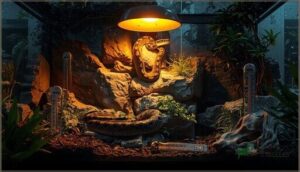
Gradient design starts with a radiant heating source positioned over the basking zone—your snake’s thermal command center. You’ll want that basking spot hitting 90 to 110°F while the cool end drops to 70 to 85°F. Thermometer placement matters: measure at the surface, not the air.
This temperature gradient lets your snake practice thermoregulation, moving between zones as needed for digestion and rest.
Placement of Lamps and Fixtures
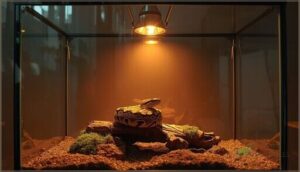
Once you’ve defined your temperature gradient, fixture mounting becomes the next practical task. Position your heat lamps 25 to 40 centimeters above the basking zone—this height delivers 40 to 60 watts equivalent intensity without overheating scales.
UVB lighting and ambient fixtures sit higher at 40 to 60 centimeters for gentle overhead coverage. Proper lighting angles focus rays downward onto the basking area while minimizing glare and stress.
Using Timers for Consistent Light Cycles
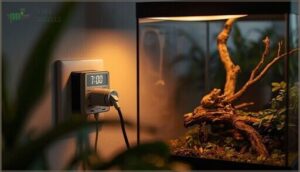
Plug-in timers keep snake terrarium lights on a fixed schedule without manual switching. Most keepers set a photoperiod of 10 to 12 hours—lights on at 7 a.m., off at 7 p.m.—to support stable circadian rhythms and reduce stress.
Timer settings enable cycle automation for consistent day/night cycles, while electrical safety requires grounded outlets rated for your total lamp wattage to prevent overheating.
Maintaining a Healthy Light Cycle
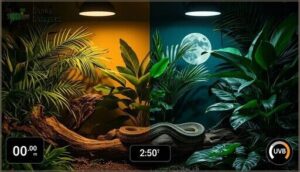
Getting the lighting right is only half the battle—you also need to maintain it. Your snake depends on consistent light cycles to stay healthy, but bulbs degrade and nighttime temps can drop fast.
Let’s break down the day-to-day schedules, heating tricks, and maintenance habits that keep your terrarium running smoothly.
Day/night Schedules for Snakes
Most snake keepers aim for 11 to 13 hours of light each day to support healthy circadian rhythms and stable snake activity patterns. Use a timer for consistent light cycles—automated photoperiod management reduces stress and aids digestion.
In winter, drop to 10–11 hours to slow metabolism; in summer, extend to 12–14 hours for ideal temperature control and feeding behavior. Monitor your snake’s reptile lighting schedule and adjust photoperiod by small increments.
Nighttime Heating Solutions
After lights-out, ceramic heat emitters deliver steady radiant warmth without disrupting your snake’s dark period. Heat mats under substrates create nighttime gradients, while radiant panels spread heat evenly across the ceiling.
Pair any heating source with thermostat control for precise temperature control—you’ll maintain stable temperature gradients and avoid dangerous hot spots that stress nocturnal species.
Replacing Bulbs and Monitoring UV Output
Your UVB bulbs lose roughly 40 percent of their output within six months, even when they still glow brightly.
To track UV lighting performance, follow these steps:
- Measure UVI at snake eye level using a UV meter in the basking zone weekly.
- Replace UVB lighting every nine to twelve months to maintain vitamin D3 synthesis.
- Power off circuits before bulb replacement to guarantee lamp safety and prevent burns.
Enhancing The Terrarium Environment With Lighting
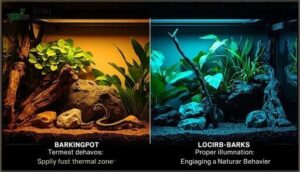
Lighting isn’t just about keeping your snake warm—it’s a tool that shapes the entire terrarium environment. When you integrate your heat and UVB sources with hides, plants, and climbing structures, you create zones that encourage natural exploration and reduce stress.
The right lighting strategy transforms a basic enclosure into a functional habitat that meets your snake’s physical and behavioral needs.
Integrating Lighting With Hides and Décor
Your decor doubles as a lighting management system—place fixtures above or beside hides to create soft edge shading, not harsh direct beams. Use matte-surfaced rocks and visual barriers to diffuse UVB lighting across microclimates without overexposure.
Mount ambient lighting at least six inches from glass, and run cables behind decorative accents to maintain clean reptile enclosure design while supporting natural temperature control in your terrarium.
Live Plants and Humidity Regulation
Bromeliads, pothos, and ferns thrive under reptile lighting while boosting humidity control through transpiration—creating a microclimate that stabilizes moisture at 60 to 75 percent in well-sealed terrarium design.
Position UVB lighting above plant canopies to drive photosynthesis without drying out substrate.
Adjust airflow management and misting schedules based on your plant species’ needs, ensuring reptile care and maintenance routines support both flora and lighting and temperature control simultaneously.
Supporting Natural Behaviors Through Lighting
Once your plants stabilize moisture, you can shape how your snake explores its world. Strategically placed lighting gradients paired with visual barriers trigger environmental cues that drive behavioral enrichment—encouraging climbing, scent tracking, and shelter seeking.
Pair UVB lighting with a consistent photoperiod to anchor circadian rhythm, supporting thermoregulation and natural activity cycles through precise lighting and temperature control in your reptile care and lighting approach.
Frequently Asked Questions (FAQs)
What lights do I need for a snake enclosure?
You need a dedicated heat source for basking, a UVB bulb for vitamin D3 synthesis, and a secondary light for day/night cycles.
Ceramic heat emitters handle nighttime warmth without disrupting sleep.
How many hours of light do snakes need?
Most snakes thrive on a 12-hour light, 12-hour dark photoperiod. Diurnal species benefit from longer daylight exposure, while nocturnal snakes prefer extended dark periods.
Consistent day/night cycles regulate circadian rhythm, basking time requirements, and snake activity patterns.
Should I turn my snakes heat mat off at night?
Think of your heat mat as a midnight furnace—you can turn it off if your room stays above 70°F, but leave it on with a thermostat to support belly heat, snake digestion, and nocturnal comfort when temperatures dip.
What wattage should my snake light be?
For most small to medium enclosures, a 40 to 75 watt bulb delivers proper heat output.
Always pair your bulb wattage with a thermostat and measure actual temperatures to maintain safe basking zones.
Can colored lights harm my snakes vision?
While colored LEDs won’t blind your snake, they can muddy color perception and disrupt circadian rhythms. Red light intensity may reduce hunting accuracy; blue wavelengths risk overstimulation.
Prioritize full-spectrum UVB lighting and proper photoperiod for vision health and natural snake behavior.
Do snakes need moonlight simulation at night?
Most keepers don’t simulate moonlight—your snake’s circadian impact depends on complete darkness during night hours.
Nighttime behavior thrives without continuous reptile lighting, preserving natural photoperiod rhythms better than dim moonlight effects on snake vision.
How does seasonal lighting affect breeding cycles?
Seasonal changes in photoperiod trigger hormone regulation that drives breeding cycles. Gradually extending light cycles simulates spring, stimulating gonadal growth and mating readiness.
Pair photoperiod effects with proper temperature gradient and UVB lighting for maximum reproductive success.
What light intensity prevents glass surfing behavior?
Light intensity between 20 and 40 lux around the glass reduces surfing by minimizing reflections.
Pair this with a dedicated basking zone at 70 to 90 lux to encourage proper thermoregulation without triggering glass-chasing behavior.
Should quarantined snakes receive different lighting schedules?
Your quarantined snake thrives on a rock-solid 12-hour light, 12-hour dark schedule. Consistent lighting cycles slash stress hormones, stabilize feeding times, and prevent circadian disruption—critical factors when your animal’s immune system needs every advantage to recover safely.
Conclusion
Like a dimming bulb that still looks fine but no longer fulfills its purpose, outdated UVB lamps silently undermine your snake’s health. This snake terrarium lighting guide gives you the species-specific knowledge to prevent metabolic disasters before they start.
Replace bulbs on schedule, match lighting to your snake’s natural activity pattern, and monitor basking behavior weekly. Your snake won’t thank you verbally—but consistent feeding, normal shedding, and skeletal strength speak volumes.