This site is supported by our readers. We may earn a commission, at no cost to you, if you purchase through links.

A snake that can’t digest its meal properly isn’t just uncomfortable—it’s burning through immune reserves trying to compensate for inadequate warmth. Temperature regulation sits at the core of every metabolic function in a snake’s body, from enzyme activity during digestion to immune cell production after a shed.
Get the heat wrong, and even a well-fed, stress-free snake starts declining in ways that look mysterious until you pull out a temperature gun. The gap between a thriving ball python and a chronically ill one often traces back to a single overlooked decision: which heating setup actually matches your enclosure material, your species, and your room conditions.
Table Of Contents
- Key Takeaways
- Snake Heating Methods Compared
- Heat Pads, Mats, and Tape
- Overhead Heat Source Comparison
- Thermostats, Safety, and Running Costs
- Top 7 Heating Products Compared
- Frequently Asked Questions (FAQs)
- What are the different types of heating for snakes?
- Is a ceramic heat emitter better than a lamp?
- What’s better than heat tape?
- What is the best heating system for a snake enclosure?
- What is the best heat source for snakes?
- How to keep a snake enclosure warm?
- Can I use human heating pads for snakes?
- How long do heating elements typically last?
- Whats the ideal nighttime temperature for snakes?
- Do all snake species need belly heat?
- Conclusion
Key Takeaways
- Temperature regulation isn’t optional—without a proper thermal gradient, your snake can’t digest food, shed cleanly, or fight off illness.
- Enclosure material (glass, PVC, or wood) directly affects which heat source works, so match your heater to the tank, not just the species.
- Every heating element needs a thermostat; without one, surface temps can spike past 120°F and silently cause burns or equipment failure.
- Belly heat with an overhead source gives most snakes the best of both worlds, especially for species like ball pythons that need tight, consistent temperature zones.
Snake Heating Methods Compared

Not all heat sources work the same way, and the one you choose can make or break your snake’s comfort. A few key factors — enclosure type, species, and room temp — will steer you toward the right setup.
A solid starting point is this snake heating pad buyer’s guide, which breaks down the options by enclosure type and species needs.
Here’s how the main heating methods stack up.
Belly Heat Vs Overhead Heat
Choosing between belly heat and overhead heat comes down to your snake’s species and how your enclosure is built. Each method delivers warmth differently, affecting heat transfer efficiency and daily safety.
- Belly Heat Safety: Under tank heaters warm substrate directly, ideal for digestion.
- Overhead Heat Uniformity: Ceramic heat emitters spread radiant warmth from above.
- Species Preference: Arboreal snakes favor heat lamps; terrestrials need floor-level warmth.
- Installation Complexity: A thermostat is non‑negotiable for controlling any temperature gradient.
For prolonged steady warmth, consider electric belts with multi‑sensor control.
How Thermal Gradients Affect Snake Health
A solid thermal gradient does more than keep your snake comfortable — it drives digestion efficiency, enhances immune function, and keeps stress hormone levels in check.
Without a true temperature gradient, snake thermoregulation breaks down fast. Your snake can’t regulate its metabolic rate, shedding success drops, and reptile health suffers.
Good heat distribution gives your snake real choices.
Matching Heat Sources to Glass, PVC, and Wood Enclosures
Your enclosure material changes everything about heat source selection. Glass tanks have low thermal conductivity, so under‑tank heaters need higher wattage or a supplementary source to build a reliable warm zone.
PVC insulation works against belly heat mats but pairs well with radiant panels. Wood retains heat nicely but warps under intense surface temps — so distribute warmth evenly and keep direct contact minimal.
Choosing by Tank Size, Species, and Room Temperature
Tank size, species, and ambient temperature all shape your heater choice. A 40-gallon enclosure holds warmth more steadily than a 10-gallon, so heater power matching matters — bigger tanks need proportionally stronger elements.
Ball pythons demand tighter thermal gradients than corn snakes, so species-specific heating isn’t optional.
Factor in seasonal temperature shifts too; a thermostat keeps your ambient room influence from throwing off the whole setup.
Heat Pads, Mats, and Tape

Regarding belly heat, not all options work the same way or fit every setup.
Heat pads, mats, and tape each have their own strengths depending on your enclosure type, snake species, and how many tanks you’re running.
Here’s a closer look at how they compare.
How Under-tank Heaters Work
undertank heater works by sitting flush against the exterior glass, relying on adhesive bonding to maintain full contact and steady heat distribution. heat transfer mechanics push warmth up through the floor and into the substrate above. substrate conductivity does the rest.
- Mounting orientation options include bottom or side placement.
- Power consumption metrics generally run 5–24 watts.
- digital thermostat locks in your thermal gradient safely.
Pros and Cons of Heat Mats and Pads
Heat mats and pads score high on cost effectiveness and energy consumption, usually drawing just 5–24 watts.
Temperature precision depends heavily on pairing them with a reliable thermostat — without one, surface temps can spike past 120°F.
Surface compatibility matters too: glass tanks lose heat faster than PVC.
Check adhesive condition regularly, since maintenance frequency directly affects hot spot risk.
Heat Tape for Rack Systems and Larger Setups
When you’re running a rack system with multiple tubs, heat tape becomes your most practical tool. It cuts to any shelf width, runs in a serpentine layout design across drawers, and pairs with a digital thermostat for precise temperature regulation per zone.
- Insulation backing options direct warmth inward, improving thermal gradient consistency.
- Power distribution scaling lets one thermostat supervise multiple zones.
- Cable management practices keep wiring safe and organized across shelves.
Best Use Cases for Localized Belly Heat
Belly heat shines in specific scenarios.
After feeding, it aids digestion by maintaining substrate temps around 88–92 °F, giving your snake a reliable warm patch for feeding digestion support.
During shedding cycle assistance, consistent bottom warmth keeps thermoregulation stable.
In rack systems, under tank heaters for bottom heat provide rack unit isolation, and heat mats and pads for localized warmth act as a nighttime temperature buffer across substrate‑compatible enclosures.
Hot Spots, Adhesive Issues, and Substrate Limits
Even the best heat mat can work against you if the setup has weak points.
- Hot Spot Gradient Control — hot spots can run 6–12 °F above ambient, so surface temperature mapping with an IR gun catches these before your snake does.
- Adhesive Delamination Risks — thermal cycling degrades bonding over time; quality 3M adhesive manages humidity and cleaning agents far better.
- Substrate Heat Conductivity — moisture-induced hotspots shift with substrate type, disrupting your thermal gradient across the temperature range.
Overhead Heat Source Comparison
Not all snakes get their heat from the ground up — and that’s where overhead sources change the game. Whether you’re keeping arboreal species or just want more even warmth throughout the enclosure, the options here go well beyond a basic bulb.
Here’s how the most effective overhead heating methods stack up.
Ceramic Heat Emitters Vs Deep-heat Projectors

Both types screw into standard fixtures, but they work differently. Ceramic heat emitters (50–150W) warm ambient air steadily, while deep heat projectors use reflector design to focus a radiant beam with targeted wattage scaling.
| Feature | CHE | DHP |
|---|---|---|
| Visible Light Output | None | Low red glow |
| Service Life Longevity | Moderate | Longer |
| Installation Clearance | Standard | Wider, recommended |
For precise thermal gradient control and heat source selection, DHPs edge ahead in larger setups.
Radiant Heat Panels for Even Enclosure Warmth

Radiant heat panels take even heat distribution to the next level compared to targeted projectors. Mounted 12–24 inches above substrate with proper Mounting Gap Guidelines, they bathe your snake terrarium in consistent infrared warmth.
Reflective Backing Benefits include fewer cold spots and reduced temperature stratification.
| Feature | Detail |
|---|---|
| Panel Power Selection | 300–800W range |
| Infrared Spectrum Choice | IR-A and IR-B |
| Quiet Operation | No fan or noise |
| Energy Efficiency | Low-wattage solid-state control |
| Temperature Regulation | ±1°F with proportional thermostat |
Air Heating Compared With Surface Heating
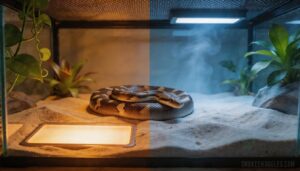
Surface heating and air heating solve the same problem in different ways. A radiant heat panel or under tank heater warms substrate directly, giving you strong surface heat retention and substrate temperature uniformity.
Air heating moves warmth faster but creates vertical stratification and introduces airflow noise from fans.
| Factor | Surface Heat (Heat Pad/Panel) | Air Heating |
|---|---|---|
| Heat Retention | High via substrate | Low, escapes quickly |
| Ventilation Requirements | Minimal | High |
| Fan Energy Consumption | None | Moderate–High |
Best Overhead Options for Arboreal Snakes

Arboreal snakes live vertically, so overhead heat is non‑negotiable. A ceramic heat emitter or radiant heat panel creates the basking spot and temperature gradient that your tree‑dwelling snake depends on.
| Factor | Recommendation |
|---|---|
| Wattage Selection | 50–75 W for most arboreals |
| Mounting Height | 6–12 in above top perch |
| Branch Placement | Position under warm zone |
| Shielding Materials | Mesh guard required |
| Power Supply Compatibility | Match fixture rating |
When Combined Heating Setups Work Better

Sometimes heat source just doesn’t cut it. Combining belly heat with overhead warmth gives you Synergistic Temperature Control — a true Combined Heat Balance that facilitates thermal gradient management in mixed heating setups.
| Setup Type | Species Specific Pairing | Benefit |
|---|---|---|
| UTH + Radiant Panel | Ball python, boa | Hot Spot Reduction |
| Heat tape + CHE | Corn snake rack | Energy Savings Strategy |
| Mat + Deep-heat projector | Rainbow boa | Even heat distribution |
Thermostats, Safety, and Running Costs

Getting the heat right is only half the job — keeping it safe and consistent is where thermostats earn their place.
The details below cover everything from probe placement to long‑term running costs, so you can build a setup that protects your snake and your wallet.
Here’s what you need to know before choosing your heating controls.
Why Every Snake Heater Needs a Thermostat
Running a heat mat without a thermostat is a genuine fire hazard — surface temps can spike past 120°F with no automatic power cutoff to stop it. A digital thermostat manages temperature regulation automatically, protecting your snake and your equipment.
- Prevents overheating through automatic power cutoff
- Delivers consistent temperature stability across daily cycles
- Reduces snake stress from sudden thermal swings
- Extends heater lifespan by preventing constant full-power cycling
- Ensures heat source safety with continuous temperature monitoring
Proportional Vs On/off Thermostat Performance
proportional thermostat uses control loop dynamics and heat output modulation to deliver partial power as temperatures near your setpoint — unlike an on/off thermostat, which swings fully on or off.
sawtooth cycling causes temperature overshoot and stresses your heater.
duty cycle modulation and feedback gain tuning keep thermal gradient management tight, holding temps within roughly 1–2°F for more reliable temperature regulation.
Probe Placement, Thermometers, and Temp Guns
Where you place your probe makes or breaks temperature monitoring protocols. Keep it at the warm end, near the substrate surface, and away from the heating element itself to avoid hotspot interference, avoidance issues.
- Use an infrared temperature gun with correct infrared emissivity settings for accurate surface readings
- Mount your digital thermometer at thermometer mounting height above substrate, not buried in it
- Apply multiple sensor averaging and regular probe calibration for reliable temperature verification
Preventing Burns, Overheating, and Equipment Failure
Burns don’t announce themselves — they happen when your setup fails silently. Keep insulation barriers between heat mats and substrate, and stick to a wiring inspection schedule every three months.
Silent failures cause burns — inspect wiring quarterly and keep insulation barriers between heat mats and substrate
Redundant power supplies and spare thermostats cut downtime after failures.
| Risk | Prevention |
|---|---|
| Hot spots | Thermostat calibration + barriers |
| Overheating | Temperature monitoring protocol |
| Equipment failure | Redundant power supplies |
Energy Efficiency and Long-term Cost Comparison
Spending 15–35% more upfront on energy efficient heating solutions for terrariums isn’t a luxury — it’s a smart cost analysis of reptile heating equipment over time.
The Initial Investment Premium pays off through Operating Cost Savings of 20–50% annually.
Proportional thermostats reduce energy consumption by 5–15%, while insulation cuts heat loss 20–40%.
Factor in Lifecycle Replacement Frequency and Smart Control Payback, and cost-effective setups often break even within 3–7 years.
Top 7 Heating Products Compared
Now it’s time to put all that theory into practice with some real product picks. The seven options below cover a range of wattages, mounting styles, and tank sizes, so there’s likely a solid match for your setup.
Here’s how they stack up.
1. Acrylic Reptile Feeding Box with Heating Pad
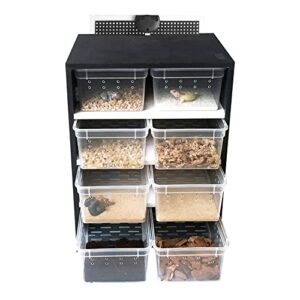
The SNKOURIN HG-HJWJL-1080 is a compact acrylic cabinet designed for feeding and short-term housing of small reptiles.
It measures roughly 26.9 × 20.5 × 36.3 cm and includes eight clear feeding boxes, each about 7.3 × 4.8 × 3 inches.
The built-in 13 W, 220 V heating pad provides basic belly heat, though it may struggle to hold temps above 85°F for heat-demanding species.
You’ll likely need an external thermostat for reliable temperature control.
| Best For | Hobbyists who keep multiple small reptiles, amphibians, or invertebrates and need a clean, space-efficient setup for feeding or housing hatchlings and breeding stock. |
|---|---|
| Power Rating | 13W |
| Voltage | 220V |
| Thermostat Required | Yes |
| Mounting Style | Pad under tank |
| Target Species | Snakes, reptiles |
| Fire Risk Warning | Yes |
| Additional Features |
|
- Eight separate clear feeding boxes make it easy to house and manage multiple small animals at once
- Built-in temperature and humidity gauge means one less thing to buy for basic monitoring
- 360° transparent design lets you keep an eye on your animals without opening the enclosure and stressing them out
- The 13W heating pad often can’t push temps past 85°F, so species that need more heat will require additional equipment
- The feeding boxes have no handles or edges, which makes pulling them out a bit awkward
- The hygrometer only reads in Celsius, so Fahrenheit users will need a separate monitor
2. BN-LINK Reptile Heating Pad
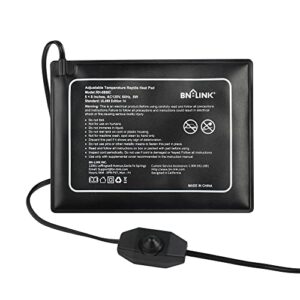
If you need something more straightforward for a single glass tank, the BN-LINK Reptile Heating Pad is worth a look. The 6 × 8 in, 8 W pad sticks directly to the outside of glass enclosures using 3M adhesive and delivers steady belly heat in the 104–122 °F range.
It fits 10–20 gallon setups well.
The dial lacks clear markings, so pair it with a separate thermostat—there’s no built-in over-temperature protection, and you don’t want to risk a hot spot.
| Best For | Reptile and amphibian owners with a single 10–20 gallon glass tank who want a simple, low-cost heating solution. |
|---|---|
| Power Rating | 8W |
| Voltage | 120V |
| Thermostat Required | Yes |
| Mounting Style | 3M adhesive |
| Target Species | Reptiles, amphibians |
| Fire Risk Warning | Yes |
| Additional Features |
|
- Sticks right to the outside of the tank—no brackets, no fuss, just peel and press
- Energy-efficient 8 W draw keeps electricity costs low while delivering steady belly heat
- Flexible silicone construction holds up over time and works on curved surfaces
- Dial has no clear temperature markings, so you’ll need an external thermostat to dial things in safely
- Adhesive can lose grip over time, especially on textured or uneven surfaces
- Heating output is limited—may only raise temps a few degrees in larger or colder setups
3. Pawfly Reptile Heat Pad
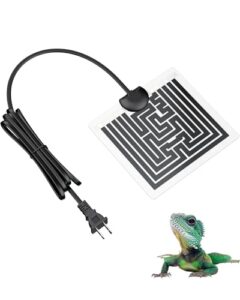
The Pawfly Reptile Heat Pad steps things down a notch from the BN-LINK—literally. At just 5 W and $7.99, it’s one of the most budget-friendly options on this list.
The 6 × 5.5 in graphene pad reaches up to 122 °F and works well under small glass tanks for corn snakes or juvenile ball pythons. It’s non-adhesive, so you’ll need to secure it yourself. Always pair it with a thermostat—some users have reported temperatures exceeding the stated limit.
| Best For | Budget-conscious reptile keepers with small enclosures who need a simple, low-cost heat source for corn snakes, small geckos, or juvenile snakes. |
|---|---|
| Power Rating | 5W |
| Voltage | DC |
| Thermostat Required | Yes |
| Mounting Style | Non-adhesive |
| Target Species | Reptiles, amphibians |
| Fire Risk Warning | Yes |
| Additional Features |
|
- At $7.99 and only 5 W, it’s easy on both your wallet and your electric bill
- The thin, non-adhesive design slides right under most small tanks without taking up interior space
- Graphene heating element spreads warmth evenly across the pad surface
- No built-in thermostat and some units run hotter than the stated 122 °F limit, so external monitoring is a must
- Heat output is modest—it won’t cut it as a primary source for larger or heavily insulated tanks
- A few users have reported warping or failure after a few months, raising some durability concerns
4. Kabasi Reptile Heating Pad
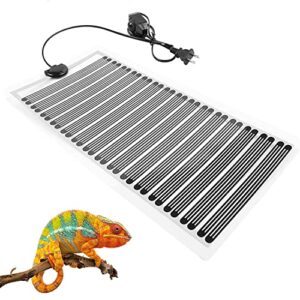
If budget matters but you still want reliable belly heat, the Kabasi Reptile Heating Pad is worth a look.
Available in 7W and 20W versions, it fits smaller and mid-size tanks with sizes ranging from 11×5.9 in up to 16.5×11 in.
The waterproof, moisture-resistant surface manages humid setups without issue, and the non-adhesive design makes repositioning easy.
Even heat distribution helps reduce hot spots. Like any mat, pair it with an external thermostat for safe, consistent temperature control.
| Best For | Budget-conscious hobbyists and small-scale breeders who need simple, affordable belly heat for reptiles, amphibians, or invertebrates in small to mid-size enclosures. |
|---|---|
| Power Rating | 25W |
| Voltage | 120V |
| Thermostat Required | Yes |
| Mounting Style | Non-adhesive |
| Target Species | Reptiles, invertebrates |
| Fire Risk Warning | Yes |
| Additional Features |
|
- At $19.99, it’s one of the more wallet-friendly heating mats out there — easy to justify for beginners or multi-tank setups.
- The non-adhesive, removable design means you can reuse it when you swap tanks or rearrange your setup.
- Thin 0.2 in profile slides under glass enclosures without lifting the tank or getting in the way.
- No built-in thermostat or temperature display — you’ll need an external controller, or you’re risking overheating.
- Can’t be buried under wood chips or dense substrate without creating dangerous hot spots.
- Some buyers have reported units arriving bent or showing durability issues that you wouldn’t see with pricier alternatives.
5. iPower Reptile Heat Pad Thermometer
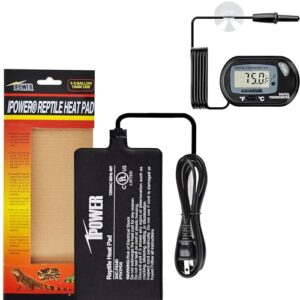
iPower Reptile Heat Pad Thermometer bundles belly heat and temperature monitoring into one package — a genuine plus if you’d rather skip the extra gadgetry.
The 8×12 inch mat runs on just 4W, making it easy on your electricity bill. A built-in LCD thermometer keeps you informed at a glance, while the 3M adhesive holds the pad firmly against the tank floor. Rubber feet lift the enclosure to prevent heat buildup underneath. Pair it with an external thermostat for tighter temperature control.
| Best For | Reptile and small animal owners who want basic belly heat and temperature monitoring without buying separate gear. |
|---|---|
| Power Rating | 4W |
| Voltage | 120V |
| Thermostat Required | Yes |
| Mounting Style | 3M adhesive |
| Target Species | Reptiles, amphibians |
| Fire Risk Warning | Yes |
| Additional Features |
|
- Comes with a built-in LCD thermometer, so you’re not hunting for a separate one
- Only draws 4W, which keeps your electricity costs low over time
- Includes rubber feet to lift the tank and cut down on heat buildup underneath
- The temperature dial has no precise readout, so finding the right setting takes some guessing
- The adhesive can start peeling after extended use, which means the mat may shift around
- Some users find the heating inconsistent and have to crank the dial higher than expected to hit their target temp
6. iPower Reptile Heat Mat
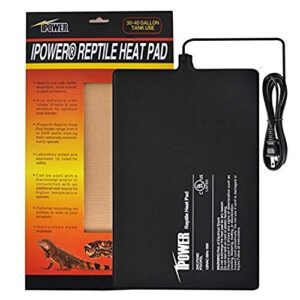
The 16W PTC element in this 8×12 inch mat heats up quickly and distributes warmth evenly across the enclosure floor. Strong 3M adhesive backing keeps it firmly attached to glass, PVC, or wood, and the 6-foot cord gives you flexible placement options.
It’s a solid choice for corn snakes, king snakes, or ball pythons in standard 10–20 gallon tanks. Just don’t skip the external thermostat — without one, surface temps can climb beyond safe limits fast.
| Best For | Reptile keepers housing corn snakes, king snakes, or ball pythons in 10–20 gallon tanks who want reliable, low-profile under-tank heat. |
|---|---|
| Power Rating | 16W |
| Voltage | 120V |
| Thermostat Required | Yes |
| Mounting Style | 3M adhesive |
| Target Species | Reptiles, amphibians |
| Fire Risk Warning | Yes |
| Additional Features |
|
- PTC element heats up fast and spreads warmth evenly across the enclosure floor
- Strong 3M adhesive sticks well to glass, PVC, or wood — no fuss installation
- 6-foot cord gives you real flexibility on where you set things up
- You’ll need a separate thermostat — without one, temps can get dangerously high
- The adhesive can weaken over time, especially with heat cycling
- No clear temperature markings on the control switch, so you’re guessing a bit
7. Fipasen Reptile Heating Mat
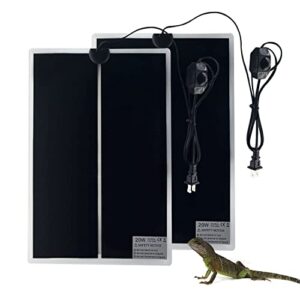
The Fipasen mat comes in a generous 17 × 12 inch size and runs at 20 watts, making it a better fit for larger enclosures than most entry-level pads.
It mounts on the side wall rather than the bottom, which works well for species that need lateral warmth.
The removable, non-adhesive backing lets you reposition it without residue.
You’ll still need an external thermostat — the built-in dial has no numeric markings, so precise control depends on a separate probe.
| Best For | Reptile and insect keepers who need reliable side-wall heating for larger enclosures, especially in cold rooms or during winter months. |
|---|---|
| Power Rating | 20W |
| Voltage | 120V |
| Thermostat Required | Yes |
| Mounting Style | Non-adhesive |
| Target Species | Reptiles, insects |
| Fire Risk Warning | Yes |
| Additional Features |
|
- Comes in a generous 17×12 inch size with 20W of power — solid coverage for bigger terrariums
- Side-wall mounting works great for species that need lateral warmth rather than belly heat
- Non-adhesive backing means easy repositioning without leaving a sticky mess
- No numeric markings on the dial, so you really do need a separate thermostat for accurate temperature control
- Can’t be folded or buried under substrate — improper use creates a real overheating risk
- Only splash-resistant, not waterproof, so high-humidity setups need extra caution
Frequently Asked Questions (FAQs)
What are the different types of heating for snakes?
Snakes rely on three main heat sources: under-tank mats, overhead emitters, and radiant panels. Each delivers warmth differently, so matching the method to your species and enclosure type matters most.
Is a ceramic heat emitter better than a lamp?
A ceramic heat emitter wins for nighttime use — it delivers steady infrared warmth without any light to disrupt your snake’s cycle.
For daytime basking spots, a lamp still has its place.
What’s better than heat tape?
Radiant heat panels beat heat tape for most setups — they spread warmth evenly, last longer, and pair cleanly with a thermostat.
For rack systems, heat tape still wins on cost and flexibility.
What is the best heating system for a snake enclosure?
The best heating system combines a thermostat-controlled under-tank pad for belly heat with a secondary overhead source, maintaining an 88–92 °F warm zone and a 75–80 °F cool side.
What is the best heat source for snakes?
Think of heating like a thermos — the right tool keeps warmth where it’s needed.
For most snakes, thermostat-controlled under-tank heater or radiant panel delivers the safest, most consistent belly and ambient heat.
How to keep a snake enclosure warm?
Keep your snake’s enclosure warm by combining an under-tank heater covering one-third of the floor with a thermostat, maintaining an 88–92 °F warm zone and a cooler 76–80 °F side.
Can I use human heating pads for snakes?
Human heating pads aren’t designed with temperature limits safe for snakes — they can exceed 120 °F and lack thermostat control, making burns almost inevitable. Stick with reptile-specific under-tank heaters instead.
How long do heating elements typically last?
Most heating elements last 2 to 5 years, depending on wattage, thermostat use, and maintenance.
Quality mats with integrated thermostats can reach 6 years, while cheaper pads may fail sooner under continuous high heat.
Whats the ideal nighttime temperature for snakes?
Most snakes do well with nighttime temperatures between 70 and 80°F on the warm side. Ball pythons prefer closer to 75–80°F, while corn snakes tolerate a slight dip toward 70°F.
Do all snake species need belly heat?
Not every snake needs belly heat — but most ground-dwelling species do. Arboreal snakes rely on overhead warmth instead.
Matching your heat source to your species’ natural behavior keeps digestion, shedding, and health on track.
Conclusion
Cutting to the chase, your snake’s health hinges on proper temperature control, making a well-informed decision on snake terrarium heating options comparison essential.
You can’t put a price on peace of mind, so consider the top heating methods, including heat pads and overhead heat sources, to create a thriving environment for your pet, ensuring its well-being and your confidence in its care.