This site is supported by our readers. We may earn a commission, at no cost to you, if you purchase through links.
A reptile that can’t regulate its body temperature is a reptile in danger. Unlike mammals, snakes, lizards, and tortoises depend entirely on their environment to stay warm—and the heating setup you choose directly controls whether they thrive or merely survive.
Under tank heaters are often the backbone of that setup, but a poorly sized pad, wrong voltage, or skipped safety step can turn a simple tool into a fire hazard or a health risk for your animal. Getting the installation right isn’t complicated, but it does require attention to a few non‑negotiable details that most guides gloss over.
Table Of Contents
- Key Takeaways
- Choosing The Right Under Tank Heater
- Preparing for Installation
- Installing The Under Tank Heater
- Safety Practices for Heater Installation
- Maintenance and Temperature Monitoring
- Frequently Asked Questions (FAQs)
- Where to put under a tank heater?
- How well do under tank heaters work?
- Can an aquarium heater touch the gravel?
- Do under tank heaters work?
- How submerged should my aquarium heater be?
- Can I use multiple heating pads together?
- How do I remove an old heating pad?
- What temperature range is safe for reptiles?
- Do heating pads work with screen bottoms?
- How long do heating pads typically last?
- Conclusion
Key Takeaways
- Match heater pad size and wattage to your enclosure—covering more than one‑third of the floor collapses the thermal gradient that your reptile needs to self‑regulate.
- Always plug your under‑tank heater directly into a GFCI outlet, use heat‑resistant silicone wiring, and keep flammable substrates well clear of the heat source.
- Clean glass with isopropyl alcohol before applying the pad, roll it on edge‑to‑edge to eliminate air pockets, and let it cure undisturbed for 24 hours for a reliable bond.
- Check pad adhesion weekly, monitor warm and cool zone temperatures daily with a calibrated digital thermometer, and replace pads every two to three years before failure shows up as a cold spot.
Choosing The Right Under Tank Heater
Picking the right under tank heater isn’t complicated, but a few key factors can make or break your setup.
Size matters most—small enclosures can overheat fast, so brush up on how long a snake can safely go without heat before dialing in your setup.
Get these wrong and you risk an uncomfortable — or unsafe — environment for your reptile.
Here’s what to look at before you buy.
Heater Pad Sizes and Types
Pad size is your starting point — get it wrong and your reptile loses that critical thermal gradient. Under tank heaters range from small 4×7‑inch pads for nano setups up to 8×18‑inch extra‑large options for 50–60 gallon enclosures. Pad construction matters too: most use PTC heating technology for even heat spread, with adhesive backing only a few millimeters thick.
- Small pads (4×7 in): Best for 1–5 gallon tanks
- Medium pads (6×8 in): Designed for 10–20 gallon enclosures
- Large pads (8×12 in): Covers 30–40 gallon setups effectively
- Extra large (8×18 in): Built for 50–60 gallon terrariums
- Voltage types: Choose 110–120V AC for standard outlets or 12V DC for off‑grid builds
Consider the ULC‑approved safety certification for reliable operation.
Matching Wattage to Enclosure Size
Once you’ve nailed pad size, wattage becomes your next decision. Match it wrong, and your Ambient Room Impact works against you — a cool basement demands more power than a warm living room. For precise sizing, consult the Aquarium heater size calculator.
| Enclosure Size | Recommended Wattage |
|---|---|
| 10–20 gallon | 6–16 watts |
| 30–40 gallon | 16–24 watts |
| 55–75 gallon | 24–32 watts |
| 100+ gallon | 30–40 watts |
Always check your Thermostat Capacity before finalizing wattage, and cross‑reference Species Temperature Needs with your Heat Distribution Ratio for safe, even warmth.
Voltage and Compatibility Considerations
Wattage sorted — now check your voltage. Mains Voltage Match isn’t optional; plug a 120V Under Tank Heater into a 230V outlet and you’re risking fire.
North American electrical systems run 110–120V, while European power supply standards sit at 220–240V. If you travel or relocate enclosures, Dual Voltage Options exist. Always confirm Thermostat Load limits, Circuit Amperage ratings, and Regional Plug Types before powering up.
Before powering up any enclosure, do a quick electrical cord inspection for reptile heat mats to catch fraying or kinks that voltage differences can make far more dangerous.
Preparing for Installation
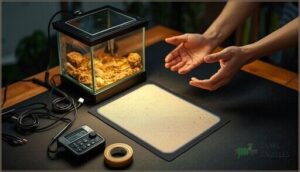
little prep work goes a long way. Getting the setup right from the start means fewer headaches and a safer environment for your reptile.
Here’s what to sort out before the heater ever touches the glass.
Selecting The Ideal Terrarium Location
Where you place your terrarium matters more than most people realize. The right spot protects your heating system installation from day one.
- Light Exposure – Keep the tank away from direct sunlight to maintain temperature stability.
- Ventilation Placement – Make sure surface stability on a sturdy shelf, with clearance underneath for airflow.
- Draft Avoidance – Distance the substrate environment from vents, doors, and air conditioners.
Cleaning and Drying Glass Surfaces
Getting the glass truly clean is the foundation of a solid installation process.
Start with dust removal using a dry microfiber cloth, then follow with alcohol degreasing — a light wipe of 70% isopropyl deals with oils fast.
Use streak‑free techniques by buffing with a second dry cloth.
Safe cleaning products matter here.
Complete drying before applying the pad is non‑negotiable.
Safety Checks Before Installation
Before you plug anything in, run through these quick checks — they take five minutes and save a lot of headaches.
Start with a Cord Damage Inspection: look for frays, cracks, or discoloration.
Next, do your Glass Surface Confirmation and Outlet Grounding Check — UTH only works on glass, and your outlet must be GFCI‑protected.
Installing The Under Tank Heater
Now comes the part where everything clicks into place.
Getting the heater pad positioned and secured correctly is what separates a safe setup from a risky one. Here’s what you need to know to do it right.
Before placing the pad, give the enclosure a proper once-over with this guide to cleaning a substrate liner, since heat can bake residue right into the material.
Positioning The Heating Pad Correctly

Where you put the pad matters more than most people realize. Warm side placement should cover only one-third of the enclosure floor — never the whole base. This preserves the cool side gap your animal needs for thermoregulation.
- Position the pad under the main hide on the warm side
- Keep substrate thickness to 1 cm or less above the heat source
- Use side-mount orientation for deep-substrate setups
- Place your thermostat probe directly above the pad’s center for accurate temperature control
- Never center the pad — it collapses the thermal gradient your animal depends on
Applying The Adhesive Pad Securely
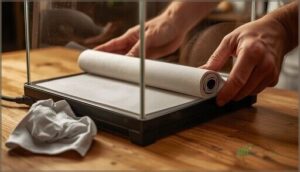
Clean glass bonds better than dirty glass — always.
Before mounting the water heater, wipe the surface with isopropyl alcohol and let it dry completely (under 60 seconds).
Peel the backing, then roll the pad on using firm, even pressure — roughly 10 to 20 pounds of hand force.
| Step | Method | Why It Matters |
|---|---|---|
| Surface Prep | Isopropyl alcohol wipe | Removes oils for stronger bond |
| Pressure Technique | Roll edge-to-edge | Eliminates air pockets |
| Curing Time | 24 hours undisturbed | Reaches full adhesive strength |
Bond Inspection after curing — Temperature Control depends on full contact.
Avoiding Bends and Creases During Setup

A single crease can create a hotspot that harms your reptile. During the installation process, use the Gentle Rolling Method — peel the backing from one short edge, then roll forward with minimal pressure. This Air Pocket Prevention approach keeps the pad flat against the glass.
Apply Edge Alignment Tips near water lines and electrical wiring, and use your Rib Navigation Strategy with firm downward pressure for the Pad Flattening Technique.
Safety Practices for Heater Installation
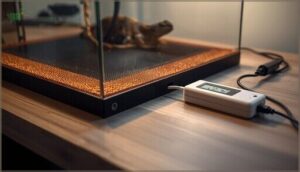
Getting the electrical side right isn’t just a technicality — it’s what keeps you and your animals safe.
A few key practices make all the difference between a setup that runs reliably for years and one that becomes a hazard. Here’s what you need to know before you plug anything in.
Pairing that probe with a quality under tank heater for hatchlings lets you fine-tune warmth precisely instead of guessing based on the device’s factory settings.
Electrical Outlet and GFCI Protection
Your electrical setup can make or break your reptile’s safety. Always plug your under tank heater directly into a moisture-resistant GFCI outlet — never rely on an extension cord. A dedicated electrical circuit keeps power stable and prevents tripped breakers.
Plug your under tank heater directly into a GFCI outlet — your reptile’s safety depends on it
- Run GFCI testing monthly by pressing the reset button
- Match the ampere rating: outlets should exceed your heater’s wattage draw
- Prioritize Extension Cord Avoidance — plug straight into the wall
- Use a dedicated circuit for consistent, safe electrical wiring
Using Heat-resistant Wiring
Wiring matters just as much as the outlet itself.
For the installation process, use silicone‑insulated wires — they manage temperatures up to 200°C and deliver real silicone insulation benefits in humid setups.
Match your wire gauge selection carefully: 14 AWG manages 15 amps for standard heaters.
Seal every connection with heat‑shrink sealing tubing, and follow smart cable routing strategies to keep wires untangled and overheating prevention top of mind.
Keeping Heaters Away From Flammable Materials
Beyond wiring, physical placement calls for equal attention. Keep your heater away from newspapers, pine shavings, or paper towels — these ignite faster than you’d expect.
Use Non-Combustible Substrates like Repti Sand or Repti Bark, and always maintain Elevation Gaps with four rubber feet for Ventilation Clearance. Heat-Resistant Barriers and Protective Pad Placement aren’t optional — they’re your reptile’s first line of defense.
Maintenance and Temperature Monitoring
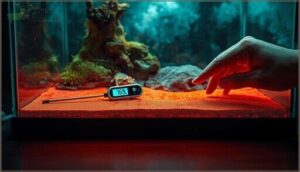
Once your under tank heater is installed, the real work begins — keeping it running safely and consistently. A quick routine check goes a long way toward catching problems before they turn into bigger headaches.
Here’s what to stay on top of.
Regularly Checking Pad Adhesion and Wear
Check pad adhesion every week during spot-cleaning — it takes seconds and catches problems early. Look for lifting edges, bubbles, or any adhesive degradation signs along the glass.
Moisture impact assessment matters too, since humid enclosures accelerate breakdown faster.
Wear pattern identification, like discoloration or hard creases, signals replacement time.
Don’t wait for failure; pad replacement indicators protect your animal and your setup.
Monitoring Enclosure Temperature
Good adhesion keeps the pad working — but knowing your temperatures keeps your animal safe.
Use these monitoring habits consistently:
- Place a digital sensor on the warm side; thermometer placement at substrate level gives accurate basking readings.
- Log daily temps for temperature log analysis — spot trends before they become problems.
- Run gradient consistency checks across both warm and cool zones.
- Set alarm threshold settings on your thermostat for overnight drops below 24 °C.
- Calibrate monthly for reliable digital sensor calibration.
Troubleshooting Common Heating Issues
Even the best setup hits a snag sometimes. Here’s how to diagnose fast:
| Issue | Likely Cause | Fix |
|---|---|---|
| No heat | Power Supply Issues | Run a GFCI Reset Procedure |
| Overheating Symptoms | Thermostat Calibration drift | Adjust probe; replace faulty thermostat |
| Edges lifting | Adhesive failure | Follow Pad Replacement Timing — swap after 2 years |
Unplug immediately if you smell burning.
Frequently Asked Questions (FAQs)
Where to put under a tank heater?
Place your tank heater under the warm end — bottom placement covers one-third of the base.
Use bumper elevation for airflow, make sure sunlight avoidance, and maintain water bowl clearance above the heated zone.
How well do under tank heaters work?
Under tank heaters work well for heat distribution across smaller enclosures, but substrate penetration and temperature rise depend heavily on thermostat control.
leopard geckos thrive on belly heat, while basking lizards need supplemental overhead lighting.
Can an aquarium heater touch the gravel?
No, an aquarium heater shouldn’t touch the gravel. Gravel Heat Transfer blocks heat, causing Hotspot Formation that cracks glass and shortens Heater Lifespan. Keep it elevated for safe Thermal Regulation.
Do under tank heaters work?
Yes, they work well for the right species.
Under tank heaters deliver reliable belly heat, strong temperature stability, and low energy consumption — especially for nocturnal reptiles needing gentle, consistent nighttime heating without disruptive light.
How submerged should my aquarium heater be?
Keep your heater fully submerged, above the minimum immersion depth mark.
Horizontal placement near the bottom ensures evaporation safety, substrate clearance, and temperature sensor accuracy — giving you reliable, even heat throughout your aquatic tank setup.
Can I use multiple heating pads together?
You can use multiple heating pads together, but overlap hazards are real. Proper thermostat synchronization and power budgeting keep heat distribution safe. Without controls, substrate drying and overheating happen fast.
How do I remove an old heating pad?
Start with power unplugging, then allow a cooling period of 15–30 minutes.
Use a hair dryer for adhesive softening, a plastic scraper for residue removal, and finish with a glass inspection before installing the new pad.
What temperature range is safe for reptiles?
Safe reptile care means maintaining basking temperature zones around 90–107°F and cool zones near 72–80°F.
Species-specific ranges, gradient zones, and a nighttime drop of 2–4°C keep your reptile comfortable and healthy.
Do heating pads work with screen bottoms?
Heating pads and screen bottoms are a poor match — like trying to warm a room through a window.
Mesh conductivity loss blocks over 80% of heat transfer, gutting temperature gradient impact.
Alternative heat sources work far better here.
How long do heating pads typically last?
Most pads last 2 to 3 years with daily use. Watch for failure signs like cold spots or scorched patches. A thermostat extends pad lifespan by preventing material degradation from overheating.
Conclusion
Nail these under tank heater installation tips, and you’ve done more than just plug in a heating pad—you’ve built a foundation your reptile can literally live on.
Right sizing, clean surfaces, a thermostat, and GFCI protection aren’t optional extras; they’re the difference between a thriving animal and a preventable tragedy.
Check adhesion monthly, keep your thermometer honest, and trust the setup you’ve built.
A warm enclosure done right stays that way.