This site is supported by our readers. We may earn a commission, at no cost to you, if you purchase through links.

That bowl sitting in the corner of your enclosure does more than hold water. Its placement controls local humidity, affects how fast bacteria multiply, and determines whether your snake is drinking fresh water or something closer to a warm petri dish.
Most keepers drop the bowl wherever it fits. But warm-side placement can turn a clean bowl cloudy within 48 hours, while the wrong humidity shift saturates your substrate and stresses a species that never wanted the moisture in the first place.
Knowing where to put it, and why, is basic care that most guides gloss over.
Table Of Contents
- Key Takeaways
- Should a Snake’s Water Bowl Be on The Warm or Cool Side?
- How Does Water Bowl Placement Affect Humidity and Water Quality?
- When Should Species or Enclosure Size Change Bowl Placement?
- What Makes a Snake Water Bowl Safe and Stable?
- How Should You Clean The Bowl and Monitor Hydration?
- Frequently Asked Questions (FAQs)
- Can snakes drink water while fully submerged?
- How deep should a snakes water bowl be?
- Should hatchlings have a different bowl setup?
- Can tap water harm snakes over time?
- How often should the bowl itself be replaced?
- Does shedding change where to place the water bowl?
- Should hatchlings have their bowl placed differently than adults?
- How does substrate type affect water bowl positioning?
- Can a water bowl double as a humidity hide?
- Does feeding schedule affect where to place the bowl?
- Conclusion
Key Takeaways
- Keep your snake’s water bowl on the cool side by default, since warm-side placement turns clean water bacterial within 48 hours and spikes humidity fast.
- Water bowl placement isn’t just about drinking—it directly shapes your enclosure’s humidity gradient and can saturate substrate before you notice the problem.
- Match your bowl material and shape to function: heavy, non-porous ceramic with a wide, shallow profile resists tipping, slows biofilm growth, and makes cleaning easier.
- Tap water, cracked bowls, and lingering odors are slow, silent threats—use dechlorinated water, clean with a dedicated brush, and replace the bowl the moment it stops coming fully clean.
Should a Snake’s Water Bowl Be on The Warm or Cool Side?
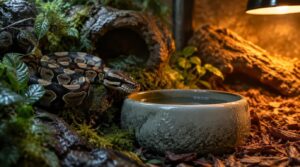
Where you place the water bowl matters more than most keepers realize. Cool side is almost always the right call, but a few specific situations call for a different approach. Here’s what determines which side your snake’s bowl belongs on.
Lighting choices also play a subtle role, so if you’re fine-tuning your setup, brushing up on reptile UV lamp options for ball pythons helps you see the full picture.
Cool-Side Default
Usually, your snake’s water bowl belongs on the cool side. Cool-side placement keeps water below peak basking temps, slowing evaporation and limiting bacterial growth. It also aligns with your snake’s thermal drinking preference, since snakes naturally seek cooler zones after digestion.
Water bowl placement directly shapes the thermal gradient. It doesn’t disrupt heat cycling, and it helps consistent snake thermoregulation.
Warm-Side Exceptions
That default has real exceptions. When ambient humidity runs consistently low, warm-side bowl placement helps your snake’s postbask hydration needs, using evaporation to raise local moisture without disrupting the thermal gradient.
Some species also prefer warmer water during shedding, where zone-based placement aligns with their thermal drinking preference and avoids thermal shock.
Keep bowls shallow, non-porous, and check water daily.
Stainless steel or ceramic options tend to stay cleanest longest, and you’ll find more guidance on maintaining optimal snake health at snake hydration and nutritional care tips.
How Does Water Bowl Placement Affect Humidity and Water Quality?
Bowl position directly shapes humidity levels and water quality in ways that compound fast. Warm-side water bowl placement drives faster evaporation, pushing local humidity above your target range. That moisture clings to nearby surfaces and can saturate substrate before you notice.
Here’s what changes based on where the bowl sits:
- Warm-side evaporation lifts enclosure humidity within hours
- Bacterial growth in warm water fouls it within 24-48 hours
- Cool-side bowls slow microbial activity, extending water clarity to 3-5 days
- Humidity spikes cluster near basking spots, creating localized moisture surges
- Condensation forms on enclosure walls when warm bowls rest close to heat
Water quality breaks down faster on the warm side. Plan on daily changes there to keep bacterial growth in check.
When Should Species or Enclosure Size Change Bowl Placement?
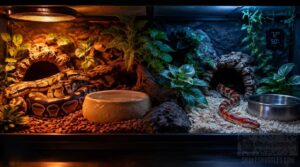
Cool-side placement works as a default, but species and enclosure size can change that calculus fast.
A larger enclosure especially demands that you track gradients across multiple zones, since species with wider thermal ranges can exploit temperature differences you might otherwise overlook.
A corn snake’s needs look nothing like a ball python’s, and a 6-foot enclosure demands a different strategy than a 20-gallon tank.
Here’s how to adjust bowl placement based on what you’re actually keeping.
Corn Snakes and Kingsnakes
Both corn snakes and kingsnakes are forgiving species, but poor water bowl placement still drives dehydration and serious bacterial growth in your enclosure. Put the bowl on the cool side of the enclosure. Your snake doesn’t need high ambient moisture, and a warm-side position triggers humidity spikes that saturate the substrate fast.
Prioritize bowl stability with a wide, low-profile dish.
Ball Pythons and Boas
Because ball pythons and boas overheat easily, water bowl placement on the cool side of the enclosure isn’t optional. Heat degrades water quality fast and triggers humidity spikes that stress your snake. Keep the bowl clear of basking zones.
Water bowl stability matters too since boas tip bowls during movement. Use a weighted, smooth-rimmed bowl to keep hydration consistently accessible.
Something like a tip-proof weighted reptile bowl can save you from constant refills and soggy substrate when your boa decides to redecorate at 2 a.m.
Multiple-Bowl Setups
In a larger enclosure, multizone water stations cover every activity cycle your snake runs. Stagger water bowl placement across the temperature gradient: Pairing a reptile water dish set designed for multi-zone setups makes it easy to maintain consistent hydration across both thermal gradients.
- Cool side: primary bowl, steady humidity control
- Warm side: secondary bowl for active drinking
- Cool bowl: slower evaporation between refills
- Warm bowl: check daily for biofilm
- Both: stable bases for water bowl stability
What Makes a Snake Water Bowl Safe and Stable?
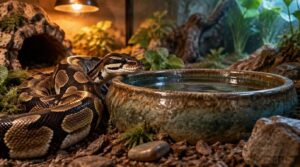
Imagine your snake nudges its bowl mid-drink and flips it, soaking the substrate. That one accident spikes humidity and breeds mold fast. Bowl weight and shape are your first line of defense.
A heavy ceramic bowl resists tipping far better than lightweight plastic. Go for a wide, shallow design with at least a 4 to 6 inch diameter so your snake can dip its head without knocking it sideways. Water bowl size should match your snake’s girth, not just its length. Rubberized feet add grip on smooth substrates.
Water bowl placement matters too. Press the bowl slightly into the substrate so snout nudges don’t send it sliding. A nonporous material resists biofilm and makes water bowl maintenance easier between changes.
A ceramic reptile water dish stays naturally smooth inside, so biofilm has nowhere to cling between your weekly rinses.
How Should You Clean The Bowl and Monitor Hydration?
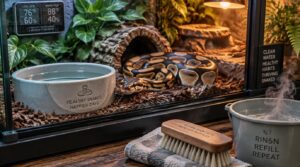
A film of slime coating the bowl’s interior is bacteria announcing itself. That’s not safe drinking water, and your snake’s paying the price.
Slime in your snake’s water bowl isn’t residue—it’s bacteria, and your snake drinks the consequence
Snake hydration depends entirely on what you offer. Bacterial growth accelerates in warm enclosures, which is why water bowl cleaning can’t be an afterthought. Cloudy water or any odor means discard and disinfect immediately. A reptile-safe disinfectant cleaner cuts through bacterial buildup without leaving residues that could harm your snake.
Follow this sequence every time:
- Empty the bowl before scrubbing.
- Scrub with hot water and a dedicated enclosure brush.
- Rinse until zero soap residue remains.
- Perform daily water changes if the bowl sits warm-side.
- Monitor water quality by checking for cloudiness or smell at each feeding.
If your snake’s drinking less, check when it last shed or fed. Activity shifts explain a lot.
Frequently Asked Questions (FAQs)
Can snakes drink water while fully submerged?
Picture it nose-down, fully submerged in the bowl. A snake can still drink using a buccal pump, creating rapid pressure changes inside its mouth to pull water in. Surface access isn’t required for snake hydration.
How deep should a snakes water bowl be?
Keep water bowl depth at 1 to 2 inches. That helps your snake’s hydration without drowning risk. Juveniles need a shallower bowl, around 1 inch. Adults can handle slightly more based on their body size.
Should hatchlings have a different bowl setup?
Hatchlings drown faster than you’d expect. Use a shallow bowl on the cool side, no deeper than an inch, to keep juvenile snakes hydrated safely without triggering thermal shock or raising enclosure humidity too fast.
Can tap water harm snakes over time?
Tap water can harm your snake over time, and the damage is gradual. Chlorine and chloramine irritate soft tissues, heavy metals accumulate, and mineral buildup stresses kidneys. A reptile-safe dechlorinator takes care of water quality problems fast.
How often should the bowl itself be replaced?
You don’t need a fixed replacement calendar. Replace the bowl the moment cracks appear, odors linger after weekly cleaning, or biofilm returns within a day of water disinfection. Trust your eyes over any set schedule.
Does shedding change where to place the water bowl?
During a shedding cycle, you don’t need to move the bowl at all. Cool side placement already keeps steady humidity pockets. Only high-humidity species occasionally benefit from a temporary warm-side relocation to ease the shed.
Should hatchlings have their bowl placed differently than adults?
Your hatchling is a fragile vessel. Keep its water bowl on the cool side of the enclosure at all times. Adults can tolerate modest warm-side adjustments, but young hatchlings dehydrate fast. Don’t gamble with placement.
How does substrate type affect water bowl positioning?
Your substrate changes everything. Loose substrates like sand create heating variability, pushing your bowl toward the cool side. Absorbent options like cypress mulch stabilize humidity, slow evaporation, and reduce substrate contamination risks near the bowl.
Can a water bowl double as a humidity hide?
Only if it creates a humid microclimate beneath or inside it. Ambient moisture alone doesn’t qualify. A large, lidded bowl placed directly over damp substrate can actually work, but a standard open bowl simply won’t.
Does feeding schedule affect where to place the bowl?
Think of your snake, motionless and digesting on the warm side after a feeding. That feeding routine shifts drinking behavior, not bowl placement. The temperature gradient decides where the bowl goes, not the meal schedule.
Conclusion
Yes, it takes one extra step to think about placement. That step matters. Answering should snake water bowl be in warm or cool side isn’t just trivia, it’s the difference between clean hydration and a bacteria-friendly puddle baking under your heat source.
Cool side is your default. Adjust only when your species, enclosure size, or humidity targets demand it. Get the placement right, and the bowl does its job quietly, every single day.