This site is supported by our readers. We may earn a commission, at no cost to you, if you purchase through links.
A bearded dragon can go from thriving to dangerously cold within a few hours if a heat bulb fails overnight, and by morning, the damage is often done. Most owners set up their thermal gradient once and assume it holds steady, but enclosures shift with room drafts, bulb degradation, and seasonal temperature swings outside. That assumption costs reptiles more than any other husbandry mistake I see in practice.
So how often should you check reptile temperatures? The honest answer depends on your setup’s age, your reptile’s health status, and whether you’re using a reliable monitor or eyeballing a stick-on gauge. Here’s the schedule that actually keeps your gradient safe, from daily baseline checks to the critical windows after a power outage or new enclosure setup.
Table Of Contents
- Key Takeaways
- Check Reptile Temperatures at Least Twice Daily
- When More Frequent Checks Are Needed
- Best Times to Check Temperatures
- Where to Measure Enclosure Temperatures
- Tools for Reliable Temperature Checks
- Frequently Asked Questions (FAQs)
- What temperature is too cold for reptiles?
- How often should you check the vivarium temperature?
- What temperature do lizards prefer?
- At what temperature do lizards stop moving?
- How hot is too hot for lizards?
- What happens if reptile temperatures fluctuate too drastically?
- Can reptiles overheat from prolonged basking spot exposure?
- How do temperature checks differ for nocturnal reptiles?
- Should temperatures be adjusted during reptile breeding season?
- How does feeding schedule affect reptile temperature needs?
- Conclusion
Key Takeaways
- Check your reptile’s basking spot and cool side at least twice a day, once in the morning and once at night, so you catch drift before it becomes dangerous.
- Ramp up to hourly checks during the first 48 hours in a new enclosure, after installing new heating equipment, or anytime a power outage disrupts your setup.
- Sick or young reptiles need much closer attention, with checks every 1-2 hours for sick animals and every 2-3 hours for juveniles under six months old.
- Always measure at the right spot, dead-center on the basking surface, six inches into the warm-side air, and at head height on the cool side, since placement errors can make accurate thermometers give misleading readings.
Check Reptile Temperatures at Least Twice Daily
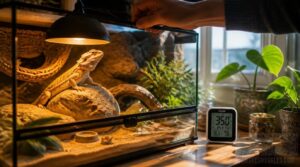
Twice-daily checks give you the consistency needed to catch problems before they affect your reptile’s health, but the timing and method behind each check matter just as much as doing it.
Morning checks work best paired with evening ones so subtle shifts in behavior or appearance don’t slip past you, and this step-by-step reptile health check guide walks through exactly what to look for during each session.
You’ll want a morning routine, an evening routine, and a few quick glances at your monitor in between to round things out.
Here’s how those three checkpoints work together to keep your enclosure on track.
Morning Temperature Check
Every reptile keeper should hit the enclosure within 30 minutes of Morning Light Activation. Check Basking Surface Temp with a calibrated probe, then confirm Cool Side Air for a proper Thermal Gradient Check. Compare readings against species-specific ranges. Any temperature deviations warrant immediate heating adjustments, not a "wait and see" approach.
Proper measurement technique is essential, as factors like probe placement and surface moisture can affect accuracy, similar to guidelines for taking a temperature in humans. how to take a temperature
Evening Temperature Check
Once lights shut off, give the enclosure 30 to 60 minutes to settle before checking. Compare warm and cool sides against species targets, using the same spot nightly for temperature baseline stability. Variation should stay under 1-2°C. Sudden drops signal thermostat drift or drafts; rising trends suggest overheating. Track two weeks of readings to catch gradual enclosure microclimate shifts early.
Continuous Monitor Glances
Two checks a day catch trends, but they miss what happens in between. That’s where a reptile thermostat with continuous monitor glances earns its keep, tracking ambient air temperature and humidity in real time.
- Glance frequency optimization every 5-15 minutes
- Glance sensor placement at basking and hides
- Glance data logging with trend analysis
- Customizable alerts for hazardous conditions
- Immediate glance alert response
When More Frequent Checks Are Needed
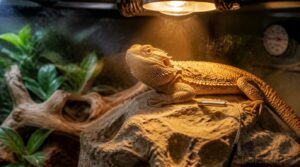
Twice-daily checks work fine for a stable, established setup, but certain situations call for closer attention no matter how busy your schedule gets.
Your reptile’s health and safety depend on catching temperature swings before they cause real harm, and some circumstances raise that risk considerably.
Here’s when you’ll want to check in more often, and why each situation demands it.
New Enclosure Setup
A fresh setup lies to you. Check hourly for the first 48 hours—thermostats drift as materials off-gas and airflow settles.
A fresh enclosure lies to you—check hourly for the first 48 hours while thermostats drift and airflow settles
| Species | Basking Target | Check Frequency |
|---|---|---|
| Ball Python | 88-96°F | Hourly, Day 1-2 |
| Bearded Dragon | 90-115°F | Hourly, Day 1-2 |
| Leopard Gecko | 90-115°F | Hourly, Day 1-2 |
| Iguana | Up to 120°F | Hourly, Day 1-2 |
Heating Equipment Changes
Swapping in new equipment resets your baseline. Check every hour for 24 hours after installing electric heat pumps, updated thermostats, or insulation upgrades—thermostat setup needs recalibration against actual enclosure conditions, not factory settings.
This step-by-step reptile thermostat setup and calibration guide walks you through adjusting probe placement and target ranges so your new equipment reads actual enclosure conditions accurately.
Confirm safety device function immediately; high-limit switches should trip before basking areas exceed species maximums. Data logging helps you catch drift patterns your eyes might miss during ambient air tracking.
Sick or Young Reptiles
When your reptile is sick or still a juvenile, twice-daily checks aren’t enough. Check sick reptiles every 1-2 hours for the first 24 hours; watch for lethargy or labored breathing.
Juveniles need checks every 2-3 hours until 6 months old.
- Cold, sluggish limbs
- Refusing food
- Gaping or wheezing
- Faded, dull coloring
Adjust basking to 88-92°F for recovery.
Seasonal Room Changes
When furnaces and AC units cycle on, your enclosure feels it. Indoor temperatures can swing 3-6°C between seasons, so weekly thermostat rechecks matter during transitions.
| Season | Key Adjustment |
|---|---|
| Winter | Raise basking 2-5°F, block drafts |
| Summer | Reduce heating hours, monitor humidity |
Track ambient air near windows—drafts and floor insulation both skew readings your basking thermostat won’t catch.
Brumation and Breeding
Preparing reptiles for breeding demands the tightest temperature discipline you’ll practice all year. A gradual temperature drop over several weeks, checked daily, prevents the stress that ruins successful brumation cycles. Rushing the cooling period, or rewarming too fast afterward, can derail ovulation and mating readiness entirely—so daily monitoring during brumation and the post-brumation warming phase isn’t optional, it’s essential for breeding trigger timing.
Best Times to Check Temperatures
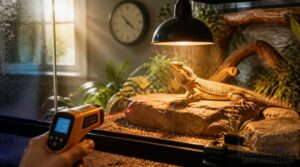
Timing matters just as much as frequency when you’re checking temperatures, since readings taken at the wrong moment can mislead you about how well your setup actually performs.
Certain windows throughout the day reveal problems that would otherwise stay hidden until they became serious.
Here’s when you should be paying closest attention.
After Morning Lights Activate
The first fifteen minutes after lights-on trigger the fastest thermal shift your reptile experiences all day. Basking surface rise outpaces ambient air by 5-10°F, while thermostat response time holds the warm side steady. Check within:
- 15 minutes: rapid warming begins
- 30-60 minutes: goldilocks zone achieved
- Hour one: activity levels climb
- Ambient tracking confirms gradient
- Stabilization window closes daily
During Peak Daytime Heating
Mid-to-late afternoon, roughly 2 PM to 5 PM, brings your enclosure’s hottest stretch as household temperatures climb. Check basking zones every 30-60 minutes for overshoot risk, since thermostats with proportional control should taper heat as targets near. Verify thermal gradients hold across warm and cool sides.
Confirm alarms and power stability, whether you’re maintaining Safe Bearded Dragon Care or Safe Ball Python Care standards.
Two Hours After Lights-Out
Two hours post-lights-out, run a quiet nocturnal temperature check. Confirm nighttime heat sources hold species-specific lows, substrate near hides stays stable, and overnight humidity helps shedding without inviting mold. Track ambient air temperature at the cool end, too.
Set alarms on the display to alert you of hazardous conditions—this single habit anchors safe conditions for reptiles and amphibians, including Safe Ball Python Care standards.
Following Power Outages
Power loss demands its own protocol. A 20-gallon enclosure can lose 5°F hourly; a 30-minute outage drops basking surfaces to 88°F. After restoration, expect rebound within 10 minutes, but cap rises at 2°F/minute using ramp-up mode. Recalibrate probes afterward.
- Check every 30 minutes if outages exceed 4 hours
- Verify backup heating duration matches outage length
- Confirm spot-check sensors read accurately
- Watch home display systems for alerts
- Recheck all zones 24 hours later
Where to Measure Enclosure Temperatures
Knowing when to check isn’t much use if you’re checking the wrong spot. Every enclosure has distinct zones, and each one tells you something different about your reptile’s environment. Here’s where you need to be placing your thermometers, and why each location matters.
Basking Surface
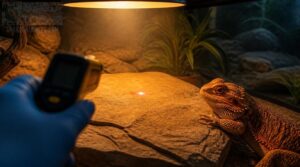
Rarely does a thermometer lie, but placement does — always measure dead-center on the basking surface, not the air above it. Target 88-96°F depending on species. Check gradient edges too, since uneven heating signals a repositioned lamp or warping material needing replacement.
Weekly cleaning and monthly crack inspections keep this zone safe, functional, and accurately regulating your reptile’s metabolism.
Warm-Side Air
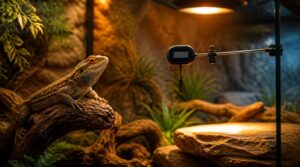
Once basking surface readings check out, move your probe six inches back into the warm-side air itself, ideally shoulder-height to your reptile. This zone should hold 86-92°F by day, dropping to 70-78°F overnight.
Watch for stagnant airflow creating heat pockets — that skews your gradient and confuses thermoregulation.
Twice-daily checks confirm ambient stability, not just surface temperature.
Cool-Side Air
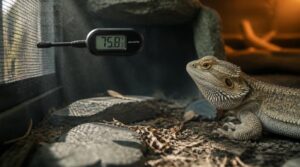
Rarely does the cool side get enough attention, yet it’s what lets your reptile cool down on demand. Keep readings at 20-26°C, measured at head height in open air, never buried near substrate.
Gentle cross-ventilation prevents stagnant pockets without drafting directly on your animal. Skip vents near intake points — they’ll fake a cooler reading than what’s actually there.
Hides and Substrate
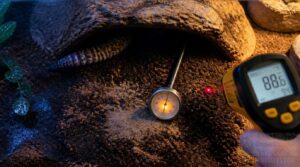
Don’t overlook what’s hiding beneath the hide itself. Substrate depth influences heat exchange, so check surface temps where your reptile actually rests, not just ambient air nearby.
Damp substrates trap humidity microclimates affecting shedding; dry ones suit arid species. Weekly, inspect for mold or clumping. Elevating hides slightly curbs moisture pooling, keeping that gradient stable and accessible without disturbing your reptile’s routine.
Aquatic Habitat Water
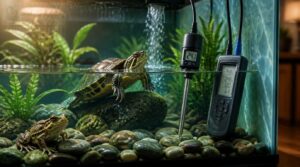
Turtles and aquatic frogs need water checked daily, not just air temperature. Keep it between 22-28°C, with stability within ±1°C to avoid immune stress.
Check pH weekly (6.5-7.5), confirm filtration hits 4-8 turnovers hourly, and verify dissolved oxygen stays above 6 mg/L using a calibrated meter—low oxygen turns dangerous within 24 hours.
If your setup also includes misting for humidity-loving species, this reptile fogger setup guide can help you dial in safe, well-ventilated conditions alongside your water testing routine.
Tools for Reliable Temperature Checks
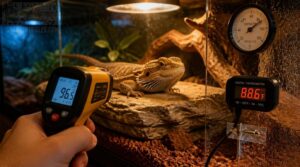
Knowing when to check temperatures only matters if your equipment gives you accurate numbers to trust. The right tools, placed and calibrated correctly, take the guesswork out of your daily routine. Here’s what you need to keep those readings reliable.
Digital Probe Thermometers
A digital probe thermometer stays your most reliable temperature control device for direct enclosure readings.
- Thermistor sensors offer strong accuracy for daily use
- Quick response times, often 2-3 seconds, catch changes fast
- Waterproof probes simplify cleaning between placements
Calibrate every six months using ice water, verifying 32°F accuracy, and store probes capped and dry to prevent drift.
Infrared Temperature Guns
Point, shoot, done—except accuracy hinges on emissivity settings near 0.95 for skin and rock surfaces. Keep spot ratio and distance consistent for reliable surface measurement technique.
| Setting | Target | Why It Matters |
|---|---|---|
| Emissivity | 0.95 | Prevents false-low readings |
| Distance | Few cm | Maintains spot ratio accuracy |
| Calibration | Monthly | Confirms probe agreement |
Verify monthly against a probe thermometer for context.
Thermostats and Safety Alarms
A thermostat is your fail-safe, not just a dial. Look for thermostat cutoff safety, redundant sensor validation, and auto reset function after faults clear. Confirm UL or CE approvals before trusting any unit.
- Alarm output alerts for hazard conditions
- Remote monitoring and control access
- Customizable alerts for drift thresholds
- Auto reset after transient faults
- UL/CE-verified electrical safety
Proper Sensor Placement
Even a certified alarm is only as good as what it’s reading.
Sensor height placement matters most: mount probes near the reptile’s eye level, never buried in substrate or crammed against basking rocks. Use wired spot check sensors on-surface and separate ambient units. Use wired spot check sensors on-surface and separate ambient units for cool and warm zones. For aquatics, submerge the probe mid-water, clear of filters and current.
Regular Equipment Calibration
Placement means nothing if the sensor itself is lying to you. Calibrate quarterly, checking drift against a traceable ice-water or dry-well standard, within ±0.5°C tolerance.
- Log date, instrument ID, pass/fail
- Recalibrate after heater or thermostat swaps
- Verify infrared guns monthly against probes
- File nonconformance reports for failed units
This protects iguanas, geckos, turtles, and tortoises alike—accuracy isn’t optional.
Frequently Asked Questions (FAQs)
What temperature is too cold for reptiles?
Below 50°F (10°C), you’re risking cold shock and impaired immune function. Below 60-70°F, metabolism slows, appetite drops, and growth stalls—especially dangerous for turtles, iguanas, and geckos needing consistent warmth for safe reptile care.
How often should you check the vivarium temperature?
Give your vivarium a quick once-over morning and night, no exceptions. Temperature gradient verification each check confirms ambient air tracking and thermal stability, catching equipment drift before it disrupts your reptile’s ideal range.
What temperature do lizards prefer?
Preferences vary by species, but most lizards want a preferred basking range of 27-35°C (80-95°F), a cooler retreat near 21-24°C (70-75°F), and a thermal gradient supporting proper temperature regulation for coldblooded animals.
At what temperature do lizards stop moving?
Cold turns a lizard’s body into a stalled engine.
Thermal immobilization thresholds hit around 45°F (7°C), where lizard temperature regulation fails, metabolic rate drops sharply, and movement resumes only once ambient air temperature climbs back above roughly 60°F (15°C).
How hot is too hot for lizards?
Sustained heat above 35°C (95°F) pushes lizards past their thermal safety margin, triggering dehydration and stress; body temperatures nearing 45°C (113°F) become lethal for many species without shade or cooler refuge access.
What happens if reptile temperatures fluctuate too drastically?
Drastic swings push your reptile outside its ideal temperature range, slowing metabolism, weakening immune defenses, and impairing digestion.
You’ll often see reduced appetite, sluggish locomotion, growth setbacks, and higher disease susceptibility, all signs that temperature stability in the enclosure needs immediate attention.
Can reptiles overheat from prolonged basking spot exposure?
Yes, it’s not just a myth. Without a cooling refuge, prolonged basking causes real heat stress, gaping, lethargy, sunken eyes, especially if your thermal gradient lacks a reachable shaded retreat within the enclosure.
How do temperature checks differ for nocturnal reptiles?
Nocturnal reptiles need refuge microclimate tracking, not open-air readings. Place sensors inside hides for hidden surface temps, since shelter thermal mapping and nighttime gradient checks reveal actual body-temperature exposure better than simple ambient air temperature tracking across the enclosure’s temperature gradient.
Should temperatures be adjusted during reptile breeding season?
Picture a warm nudge, not a heat wave: gradual basking increases stimulate hormones for mating readiness, while nest incubation specifics affect sex determination. Adjust gently, monitor daily, and let seasonal ramps guide the shift.
How does feeding schedule affect reptile temperature needs?
Feed earlier in the day so digestion coincides with peak basking access. Heat-dependent metabolism breaks down meals efficiently only when post-feeding temperatures stay warm; cooling too soon risks regurgitation.
Adjust feeding schedule seasonally, since slower metabolism in cooler months demands earlier, warmer feeding windows.
Conclusion
A dead bulb takes minutes to cool an enclosure; it takes hours to warm a sick dragon back up. That asymmetry is why how often should you check reptile temperatures isn’t a rhetorical question, it’s a daily obligation with real consequences.
Twice-daily checks, sharper vigilance during transitions, and reliable probes aren’t excessive caution. They’re the baseline. Your dragon can’t tell you it’s too cold until damage is already done, so the thermometer becomes its voice.
- https://docs.google.com/forms/d/1GAQr3Kn1cURCVHUA82hAga1Wv8DCH0IuqDLRUrOpN7M/viewform?ts=63f4f653&entry.1515682415=https://www.merriam-webster.com/thesaurus%2Foften
- https://unabridged.merriam-webster.com/check-redirect-premium?utm_source=mw&utm_medium=inline-def&utm_campaign=evergreen&headword=often
- http://www.petco.com/content/petco/PetcoStore/en_US/pet-services/resource-center/home-habitat.html