This site is supported by our readers. We may earn a commission, at no cost to you, if you purchase through links.

Most keepers outgrow their first rack within two years—not because they bought wrong, but because they bought for where they were, not where they were heading.
At 10 boas, improvised setups still work. At 30, a miscalculated shelf height or undersized tub creates daily friction that compounds fast.
Boa constrictor racks for experienced keepers aren’t about aesthetics; they’re about infrastructure that scales without breaking down around you.
Boaphile, Freedom Breeder, and Vivarium Electronics each solve that problem differently—in materials, heating architecture, and price—and the right choice depends on your collection size, room conditions, and tolerance for long-term maintenance.
Table Of Contents
Key Takeaways
- Buying a rack for your current collection size—not where it’s headed—is the most common mistake experienced keepers make, and it costs you daily friction within two years.
- Boaphile, Freedom Breeder, and Vivarium Electronics each solve the scaling problem differently—ABS plastic modularity, welded steel load capacity, and humidity-resistant PVC—so match the material to your room conditions, not your budget.
- Thermostats aren’t optional: stacks taller than five levels need dual-zone wiring with independent sensors inside the tubs, not on the shelves, or your top animals will overheat while the bottom ones stay cold.
- Total cost means freight, assembly time, replacement parts, and lifecycle maintenance—not just the unit price—so a $1,200 Freedom Breeder ProLine can easily beat a $400 rack that needs replacing in two years.
Best Boa Rack Systems Compared

Not all boa racks are built the same, and at this level the differences matter.
Pairing your setup with reptile thermostats built for experienced hobbyists can make a real difference in how consistently your boas thrive.
Three manufacturers consistently lead the field — Boaphile Plastics, Freedom Breeder, and Vivarium Electronics — each with distinct engineering priorities.
Here’s how they stack up.
Boaphile Plastics Rack Strengths
Boaphile Plastics earns its reputation through engineering, not marketing.
Impact-resistant ABS panels handle repeated humidity cycles without warping, while corrosion-resistant stainless fasteners keep frames solid long-term.
Snap-Fit Assembly means no tools, no wobble.
Studded Load Distribution prevents shelf sag under full tubs.
Rounded Edge Safety protects both snake and tub.
Modular Reconfiguration lets you swap dividers in seconds—Non-Porous Surfaces keep cleaning fast and bacterial buildup slower.
Freedom Breeder ProLine Rack Strengths
Boaphile leans on plastic engineering, Freedom Breeder ProLine bets on metal.
Welded J4 Steel frames deliver a rust-resistant frame that holds up in high-humidity snake rooms without compromising structural integrity. Heavy load capacity stays consistent across every level—no flex, no sag.
modular expansion design lets your custom caging system grow with your collection, and easy reassembly after freight shipping means less downtime.
Vivarium Electronics Rack Strengths
Vivarium Electronics takes a different approach—PVC Construction throughout, purpose-built for snake rooms where humidity swings are constant.
Belly Heat Channels run shelf-to-shelf across the Vivarium Electronics VE2 Rack and VE6 Rack, delivering consistent floor temps without hot spots.
Modular Shelf Design and Airflow Integration keep stacks like the Super70 5 Tub Rack expandable and breathable.
UV Resistance means the PVC Reptile Rack Systems won’t yellow or warp over years of use.
The rack also features an RL Heat Belly for uniform temperature distribution.
Key Design Differences Between Major Brands
Each brand commits to a different philosophy.
Boaphile leans on lightweight Modular Tub Design with adjustable divided cages and frequent accessory options.
Freedom Breeder prioritizes Frame Material Choice—corrosion-resistant steel, magnetic door seals, and an Expansion Mechanism that scales laterally without replacing hardware.
Vivarium Electronics VE2 Rack, VE6 Rack, and Super70 5 Tub Rack rely on PVC Reptile Rack Systems with solid Locking Mechanisms and Corrosion Resistance built for perpetually humid rooms.
Which Rack Style Suits Advanced Keepers
Experienced keepers running high-throughput operations need more than a basic reptile rack system. Expandable modular design, sophisticated climate automation, and adjustable divided cages aren’t extras—they’re operational necessities.
- Modular and stackable vivarium designs support growing breeding collections without replacing hardware
- Integrated data logging and heat gradient management keep each level dialed in precisely
- Customizable reptile enclosure solutions adapt to different boa sizes and life stages
- High throughput maintenance stays manageable when tub access, spill control, and cable routing are built into the frame
Choosing The Right Rack Size
Rack size isn’t one-size-fits-all—a hatchling tub that works perfectly at six months becomes a liability by year two. Getting this right means matching dimensions to the snake’s current size, not where you hope it’ll end up.
Here’s what to keep in mind at each stage.
Hatchling and Juvenile Tub Sizing

Start hatchlings in 6–8 quart tubs—the I80 Hatchling Tub and 8 Quart Tub for VE2 and VE6 Racks both fit this capacity guideline. Dimension ranges of 9–12 inches long keep newborns secure.
Hit growth milestones around 150–200 grams, then step up to the 11 Quart or 23 Quart Tub for VE2 and VE6 Racks, or the I160 Hatchling Tub. Always confirm hide clearance and enrichment options before upgrading.
Adult Boa Rack Dimensions
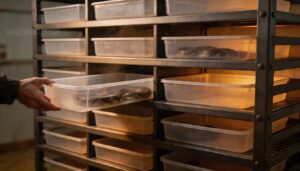
Once boas push past 1,000 grams, tub length, rack width, and shelf height all need a hard reset. Target tubs are 32–40 inches long, shelves spaced 6–8 inches apart, and an overall footprint between 42–60 inches wide. Level count tops out at 8 before thermostat zoning becomes a headache.
- Shelf height: 6–8 inches minimum for adult girth and a proper hide
- Rack width: 42–60 inches to distribute weight and allow clean tub pulls
- Reptile enclosure dimensions like the 48x24x48 240 Gallon Red Tail Boa Enclosure V3 set the baseline when racks won’t cut it
Breeding Female Space Requirements
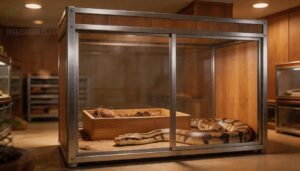
Breeding females need 20–40% more floor space than non-breeders—minimum 15–20 square feet once a litter arrives.
Your nesting box dimensions should hit 5–8 square feet with 2–4 inches of nesting material depth underneath.
vertical clearance above the nest runs 18–24 inches for pup movement.
Keep access panel width at 12–14 inches, and leave 6–8 inches of clear litter escape route around the box.
Floor Space Versus Tub Height

Floor space and tub height aren’t competing priorities—they’re a trade-off you manage deliberately. Taller tubs improve ergonomic tub access and retain humidity better, but clearance requirements demand at least 24 inches of aisle width planning in front of each stack. Weight distribution concerns increase with height, so non-slip flooring isn’t optional.
Vivarium tub selection and sizing, modular PVC rack components for hobbyists, and expandable and stackable configurations give you layout flexibility strategies without sacrificing size options for vivarium efficiency.
When a Full Enclosure Beats a Rack
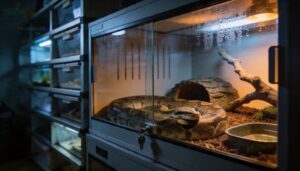
Racks dominate high-volume collections but full enclosures earn their place in specific situations.
Enhanced humidity retention cuts daily top-ups by up to 40 percent, while solid panels deliver temperature stability within 2–3°F of your set point.
Contaminant reduction, ease of cleaning, and built-in security measures make them the smarter pick for breeding pairs or medical holds where humidity management and thermal gradient consistency aren’t negotiable.
Heat and Humidity Control
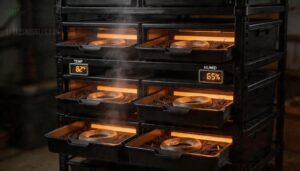
Getting heat and humidity right isn’t optional — it’s the difference between a thriving collection and a vet bill.
Every rack system manages thermal management differently, and knowing those differences saves you real headaches down the line.
Here’s what you need to understand about the key heating and humidity factors before committing to a setup.
Why Every Boa Rack Needs a Thermostat
Without a thermostat, your heat tape is just a burn waiting to happen.
A proportional thermostat delivers set point accuracy that manual checks never will—maintaining thermal uniformity across every tub, catching temperature spikes before they stress or injure your animals, and triggering alarm notifications the moment something drifts. It also cuts energy savings by delivering power only on demand.
Digital thermometers and digital hygrometers confirm the thermal regulation your thermostat maintains.
Dual-zone Heating for Tall Rack Stacks
Tall stacks above five levels can’t run on a single thermostat—heat stratifies, and your top tubs will cook while the bottom ones stay cool. Run Independent Thermostat Wiring with Heat Zone Sensors at representative tubs in each zone. Use Zone Isolation Barriers between tiers and Zoned Airflow Dampers to stop warm air migration. Install Safety Overheat Cutoffs on every circuit.
- Split stacks at level five or above into two controlled zones
- Wire each zone to its own thermostat and heating element
- Place thermal sensors inside representative tubs—not on shelves
- Use insulated partitions as Zone Isolation Barriers between zones
- Install Safety Overheat Cutoffs independently per zone
Heat Tape Versus Integrated Heat Panels
Once your zones are dialed in, heat source selection determines how reliably you hold them.
Heat tape for racks delivers targeted belly heat element contact at 90–110°F, but installation complexity is low—tape, thermostat, done.
Integrated panels win on temperature uniformity and energy efficiency across wider surfaces.
Both demand consistent safety controls and maintenance frequency. Neither forgives a skipped thermostat check.
Humidity Targets for Daily Care
Temperature locked in, humidity is next. Keep daily levels between 55% and 75%—mid-rack humidity monitoring with a digital hygrometer placed inside the tub, not the room, gives you accurate readings.
water bowl on the cool side controls water bowl influence and moisture balance without soaking substrate. dry surface, not wet bedding—mold prevention depends on it.
Seasonal humidity tweaks matter most in winter, when room heating drops relative humidity fast.
Shedding-season Humidity Adjustments
When the skin turns dull and opaque, bump humidity to 75–85% for the pre-shed window only—not the full cycle. Place a moist hide on the warm-cool boundary to create a skin hydration zone without soaking the substrate.
Your misting schedule should target air and hides, not the floor layer. Monitor dry-down carefully; stagnant moisture wrecks microclimates fast.
Build Quality and Custom Features

Build quality separates a rack you’ll use for five years from one you’ll replace in two. Each major brand takes a different approach to materials, heat integration, and layout flexibility — and those differences matter at scale.
Here’s how they stack up across the features that actually count.
Plastic, ABS, and Stainless-steel Construction
Material choice isn’t cosmetic—it determines how your rack performs five years from now.
- Weight Savings — ABS and HDPE material panels cut total rack weight substantially versus all-steel builds.
- Corrosion Resistance — Stainless-steel hardware shrugs off humidity that destroys untreated metal.
- Impact Resistance — ABS absorbs daily tub impacts without cracking.
- Thermal Insulation — Plastic reptile enclosures reduce thermal bridging, keeping heat management in terrariums precise.
- Modular Replacement — Individual tubs in a modular vivarium swap out without replacing the whole frame.
Durability for High-volume Snake Rooms
High-volume rooms expose every weakness a rack has—daily tub pulls, chemical cleaners, constant humidity, and sheer weight add up fast.
Boaphile’s background spans over two decades and tens of thousands of cages in plastic reptile and amphibian enclosure manufacturing, which shows in their frame reinforcement and HDPE material choices.
Corrosion resistance, wear-resistant coatings, load capacity, and modular replacement parts aren’t extras—they’re what keeps a collection running.
Recessed Belly Heat Technology
Recessed belly heat routes the heat strip into a channeled groove cut into the rack shelf—channel placement keeps the strip flush, so heat transfers directly to the tub floor.
Heat strip routing eliminates exposed tape that shifts or snags.
Match wattage selection to tub size: 11W/ft for smaller pulls, 18W/ft for larger.
Gradient design gives your boa a defined warm zone without cooking the whole tub.
Always verify safety clearance with a probe before any animal goes in.
Adjustable Dividers and Flexible Layouts
Boaphile’s adjustable divided cage designs give you real flexibility — split one rack bay into multiple compartments without replacing the whole unit. Tool-Free Reconfiguration means layout changes happen fast when your collection shifts.
Modular Compartment Design and Adaptive Layout Scaling let you run Custom Divider Configs across multiple size options, so Space Optimization isn’t a goal — it’s the default with modular PVC rack components built for serious keepers.
Ventilation Control and Moisture Retention
Solid plastic tubs win on humidity control before you touch a single setting. Your Vent Placement Strategy matters — high vents on one side, low on the opposite, create crossflow without rapid moisture loss.
Tub Material Impact is real: dense plastic walls act as substrate barrier technology for humidity control, keeping your microclimate engineering within reptile habitats precise.
Position water dishes cool-side only, calibrate your hygrometer, and hit 55–75% daily.
Casters, Guide Stops, and Rack Accessories
Once your humidity stack is dialed in, accessories determine whether your rack stays put or becomes a liability. Locking Caster Options from Vivarium Electronics prevent heavy loaded racks from shifting — Swivel Caster Benefits include full 360-degree clearance in tight rooms. Flat Guide Stops keep Tub Alignment exact at every level.
Your rack accessories worth having:
- Rack Pins 60 Pack White or Rack Pins 60 Pack Blue/Red for organized tub identification
- Caster Set for Vivarium Electronics Racks with steel brackets, rated per shelf
- Flat Guide Stops — 6-inch, tool-free, back-and-side drift prevention
- Modular Accessory Kits covering heating cable routing and ventilated shelf configs
- Reptile rack system accessories including roller bearing tracks for smooth tub pulls
Modular PVC rack components for hobbyists make reconfiguration practical without rebuilding from scratch.
Security, Tub Fit, and Escape Prevention
Accessories keep your rack organized — but security keeps your snakes inside it.
| Security Feature | Function |
|---|---|
| Locking Tub Clips | Block forward tub movement |
| Black Latches | Resist heavy boa pressure |
| Slide Prevention Guides | Stop lateral tub drift |
| Sturdy Frame Construction | Prevents shelf flex under load |
Tight Tub Fit eliminates gaps entirely. Combined with modular PVC rack components for hobbyists and welded stainless frames, your tub rack system becomes legitimately escape-proof — not just optimistically so.
Cost, Shipping, and Buying Factors
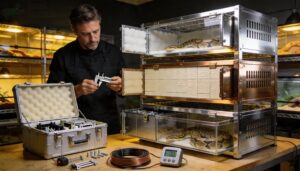
Price isn’t the only number that matters—shipping class, package completeness, and parts availability all factor into what you actually spend.
Boaphile, Freedom Breeder, and Vivarium Electronics each land in a different cost tier, and buying blind without knowing the full picture can mean surprises at checkout.
what to weigh before you commit.
Rack Pricing by Brand and Size
price scales with brand, frame type, and tub count—so knowing where each manufacturer lands saves you from sticker shock.
- Boaphile: $399–$868 depending on model and shelf count
- Freedom Breeder ProLine compact racks: $1,199.99–$1,449.99; large frames: $1,999.99–$2,399.99
- Vision V-180 racks: $1,609–$2,475 based on levels
- AP-70 economy racks: from $189
regional freight adds variance on larger orders.
Complete Packages Versus Add-on Components
Buying a complete package—like the Vivarium Electronics VE6 Rack bundle with eight V-180 tubs, 52 feet of heat cable, casters, and guide stops—cuts setup to under 30 minutes and simplifies inventory management. Add-on components cost less upfront but stack quickly.
Boaphile ships fully assembled, zero tool requirements.
Freedom Breeder ProLine arrives unassembled; budget 1–2 hours.
Factor in warranty coverage and vendor support before choosing modular PVC rack components for hobbyists over premium snake and boa enclosures built for scale.
Replacement Parts and Accessory Costs
Parts wear out—plan for it. Warranty duration variance matters: electrical components usually cover 12 months, plastics up to 24 months.
Tub liner pricing runs $40–$120 per tub; heat tape roll pricing falls between $15–$60 depending on wattage. Thermostat adapter costs range from $60–$180. Caster wheel replacement averages $8–$40 per wheel.
Boaphile’s 4x2x2 120 gallon V2 replacement parts and the 2×2 Corner Extension V2 ship fast—when they’re in stock.
Freight Shipping and Delivery Considerations
Complete rack orders from Vivarium Electronics ship freight—carrier selection matters here. Full rack-plus-tub packages require a trucking company, not UPS. Confirm scheduling coordination with the carrier before delivery day; these aren’t porch-drop shipments.
Documentation compliance keeps customs and billing clean.
Protect your investment by inspecting dimensions and capacity specs against the ecommerce product listings before checkout—damage claims start at the loading dock, not your snake room.
Best Value for Breeding Collections
Value in a breeding collection isn’t unit price—it’s lifecycle cost analysis across every animal you’ll house. Adjustable rack design, PVC reptile enclosures, and energy efficient heating with proportional thermostats cut long-term maintenance savings dramatically.
Factor in bulk accessory discounts, size scalability for growing snakes, and customizable reptile cage systems that handle captive breeding considerations without forced full replacements. Build the rack around the collection, not the budget.
Build the rack around the collection, not the budget
Frequently Asked Questions (FAQs)
How often should boa rack tubs be cleaned?
Daily spot cleaning, weekly sanitation, and a deep clean every three to six weeks—that’s your baseline cleaning protocol.
Substrate waste rate and water bowl hygiene dictate how fast that schedule tightens.
Can boa racks be used for other snake species?
Yes—burrowing species fit well. Low-humidity species need drilled tubs. Climbing species unsuitable due to height limits. Match thermal zone needs and species size limits before housing anything besides boas.
What substrate works best inside rack tubs?
Skip the reptile carpet—your boa deserves better.
Coco Fiber, Cypress Mulch, or Paper Bedding all work. Aspen Shavings and Unsuitable Substrates like cedar or sand don’t. Minimum 2 inches depth; 3 preferred.
How do you safely introduce new boas to racks?
Quarantine first—no exceptions. Run a full acclimation period of at least one week before handling.
Daily health checks catch mites and respiratory issues early. Follow strict transfer process protocols, and don’t rush feeding.
Conclusion
The perfect boa constrictor rack is a paradox: it’s most indispensable when your collection is smallest, yet often overlooked until it’s too late. As you scale up, boa constrictor racks for experienced keepers become the backbone of your operation.
Choose wisely, and your setup will adapt seamlessly; misstep, and daily friction mounts. Your rack is more than storage—it’s the foundation of a thriving, low-stress environment.
Invest in infrastructure that grows with you, not against you, for long-term success.