This site is supported by our readers. We may earn a commission, at no cost to you, if you purchase through links.

The rack you choose shapes every breeding season that follows. Wrong dimensions force premature upgrades. Poor materials warp under humidity cycles, and inconsistent heat tanks your breeding timelines before you notice a problem.
Experienced breeders have learned this the hard way—usually after one expensive mistake with a wire-frame setup or an undersized tub column.
The right boa constrictor racks for reptile breeders aren’t a luxury; they’re the infrastructure your animals’ welfare depends on.
Boaphile, Freedom Breeder ProLine, and Vivarium Electronics each solve these problems differently, and the differences matter more than the price tags suggest.
Table Of Contents
Key Takeaways
- Rack material—PVC, ABS, or welded steel—directly determines how well your setup holds up against humidity cycling, warping, and long-term structural stress.
- Tub size must scale with your boa’s body weight at every life stage, from 16×12 in for snakes under 500 g up to 24×16 in for pre‑adults over 1,800 g.
- Dual-zone thermostat wiring isn’t optional on stacks taller than five levels—one controller can’t maintain reliable heat gradients top to bottom.
- Quality racks from established brands like Boaphile, Freedom Breeder, or Vivarium Electronics run $600–$2,000 depending on size, but resell at 40–70% of original price when maintained properly.
Best Boa Breeder Racks Reviewed
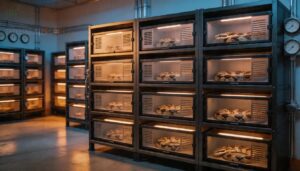
Not every rack deserves space in a serious breeding room.
The three brands below have proven themselves across real collections, different budgets, and long-term use. Here’s how each one actually stacks up.
Boaphile Rack Strengths for Breeder Setups
Boaphile earns its reputation through smart material selection and durability for reptile racks. Solid PVC resists moisture-driven warping — critical for breeding collection management in high-humidity rooms.
That’s why serious keepers often turn to PVC snake enclosures built for experienced reptile keepers when scaling up a collection that demands consistent heat retention and humidity control.
Front Sliding Tubs load clean and flush, cutting debris buildup between cycles.
Sealed Joint Design and Corrosion-Resistant Hardware extend service life without constant upkeep. Tool-Free Assembly gets your rack operational fast.
Custom Width Options and Modular Design adapt as your collection grows. It also offers belly heat tape compatibility for ideal temperature control.
Freedom Breeder ProLine Performance and Build
Freedom Breeder ProLine takes material selection and durability for reptile racks to a different level entirely. Welded Steel Stability means no flex under full tub loads. Reinforced Leg Design eliminates wobble on tall stacks. Plastic Level Connectors simplify reconfiguration without tools. Unstacked Door Access makes moving it through tight spaces straightforward.
Key ProLine build advantages:
- Welded stainless frames resist corrosion in high-humidity breeding rooms
- Insulated Heat Panels distribute warmth evenly across every tub level
- Modular design lets you add levels as your collection expands
- Ribbed channels keep tubs seated securely during daily handling
- Dual-zone thermostat support manages tall rack heat and humidity control strategies
Vivarium Electronics Rack Features and Bundles
Vivarium Electronics builds racks with breeders in mind. The Vivarium Electronics VE6 Rack and Vivarium Electronics VE2 Rack share a stackable locking system, letting you expand without dismantling anything.
VE108 interchangeable tubs fit two to six per shelf. Rounded front edges reduce handling injuries. Integrated thermostat slots and direct airflow slots manage microclimates precisely.
Bundle pricing includes Complete Package options with heat cable configuration built in.
| Feature | Benefit |
|---|---|
| Rounded Front Edges | Reduces injury during tub access |
| Integrated Thermostat Slots | Direct probe placement per shelf |
| Direct Airflow Slots | Even air circulation around tubs |
| Modular Rack System | Expand without full rebuild |
Best Use Cases by Collection Size
Your rack choice should match your headcount. Tiny Collection Setup of 6–12 tubs works fine on a single 2-level rack.
Juvenile Cohort Scaling generally needs 36–72 bays across mid-size units. Adult Breeding Capacity for serious programs starts at 80+ bays.
Space Utilization Strategies and Cost per Bay both improve as you scale up with an Expandable Rack System.
How Premium Racks Differ From Budget Models
Budget racks cut corners where it hurts most — material selection and durability for reptile racks, heat and humidity control strategies, and safety features and escape prevention.
Premium models deliver higher load capacity, integrated cable management, and modular and expandable rack designs for breeding collections.
You also get professional setup support, extended warranty coverage, and premium finish durability that holds up through years of deep cleaning.
Rack Sizes for Boa Life Stages
Boa constrictors don’t stay small, and your rack setup shouldn’t stay static either.
right tub size at each life stage directly affects feeding response, shedding success, and overall animal health.
Here’s how to match your rack layout to where your boas actually are right now.
Hatchling Tub Sizes and Starter Rack Layouts
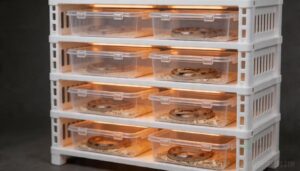
Start hatchlings in 6–8 qt tubs — compact space helps effective heat gradients, and reduces stress.
Clear Lid Visibility lets you check on neonates without disturbing them, and Snap-Fit Assembly keeps your Ventilation Vents secure without tools.
Vertical Stack Density, 4–6 shelves per column work well.
modular rack system built around tub sizing guidelines makes Tub Capacity Planning straightforward from day one.
Juvenile Tub Upgrades by Body Weight
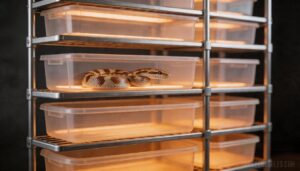
Once your juvenile crosses 500 grams, the Bodyweight Tub Upgrade isn’t optional — it’s overdue. Tub Footprint Scaling follows body weight directly, and sticking to rack sizing guidelines for different boa life stages keeps heat distribution clean and shed cycles predictable.
- Under 500 g: 16×12 in tub, dedicated Heat Mat Targeting beneath each unit
- 500–800 g: 18×13 in tub, 2.75 in shelf spacing, shared heat strip
- 800–1,200 g: 20×14 in Juvenile Size Shift, 3.0 in Shelf Height Adjustment
- 1,200–1,800 g: 22×15 in juvenile tub, increase tub volume for shed success
- 1,800 g+: 24×16 in tub, 3.5 in spacing, pre-adult life stage growth threshold
Adult Boa Tub Length and Shelf Spacing
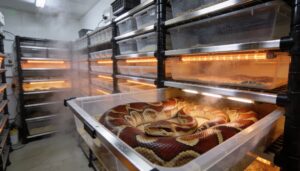
Adult boas demand real estate — Don’t underestimate Tub Length Impact. Your adult boa rack dimensions should target 32–40 inches per tub, with shelf gap optimization set at 6–8 inches of vertical clearance. That spacing helps maintain microclimate consistency and weight distribution balance across every level.
For larger females, custom tray solutions reaching 8 feet handle full extension without wall stress. Adjustable dividers let you fine-tune rack size and tub size description as your collection matures.
Capacity Planning for Breeding Groups
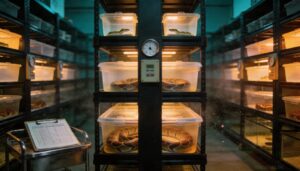
Running a breeding operation means treating rack space like a budget — spend it wrong and everything bottlenecks. Plan for 6 breeding females plus 2 males per cohort, with an 18% Cohort Buffer Calculation built in for annual growth.
- Quarterly Tub Occupancy Audits keep utilization at 75–90%
- Breeding Pair Rotation cycles every 6–8 weeks
- Seasonal Space Allocation reserves 10% of bays for hatchlings
- Growth Cohort Forecasting triggers tub upgrades at 150–200g
- Gravid females need adult boa rack dimensions to cut stress
When an Eight-level Rack Makes Sense

Eight levels make sense when floor space is gone but ceiling height isn’t. A standard 8-level rack holds 8 tubs in a 42 × 34.5-inch footprint — that’s Floor Space Maximization at its most efficient.
Use Multi-Stage Segregation to separate hatchlings from adults across levels.
Vertical Load Distribution keeps the frame stable.
Just remember: racks above five levels require dual-zone wiring.
Materials That Last in Boa Rooms

Material choice isn’t just a spec sheet detail — it directly affects how long your rack holds up in a humid boiler room. ABS, PVC, coated steel, and stainless hardware all behave differently under constant moisture and weight.
Here’s how the major options stack up.
ABS, PVC, and Coated Steel Compared
Each material pulls its weight differently.
ABS panels deliver impact toughness and dimensional stability, so your shelves stay precise under frequent reconfiguration.
PVC construction resists cleaning agents well — chemical compatibility is rarely an issue — and its low thermal conductivity adds passive insulation.
Coated steel handles heavier loads with solid corrosion resistance, but costs more upfront.
Your collection size and maintenance frequency determine which wins.
Stainless Hardware and Corrosion Resistance
Hardware matters more than most breeders expect. Stainless steel used across all major brands relies on a passivation process — a chromium oxide layer that self-heals after minor scratches.
Grade 316 isn’t cosmetic; Grade 316 performs better in chloride-rich humid rooms than 304. Surface finish, protective coatings, and consistent maintenance practices determine long-term material durability.
Stainless steel reinforcement won’t let moisture win.
Humidity-related Warping and Structural Stability
Stainless hardware holds up. panels beneath it are another story.
PVC expands 0.05–0.08 mm per meter per degree C — manageable until humidity cycling between 55% and 85% RH stacks onto belly heat. Moisture-Induced Bowing follows fast with MDF or particleboard. Watch for these failure points:
- Panel Expansion Rates increase under combined heat and humidity
- Joint Reinforcement weakens as moisture enters screw holes
- Cross-Bracing Benefits disappear when panels cup permanently
- Humidity Cycling Impact loosens joints faster than steady setpoints
PVC and ABS hold square. Wood doesn’t.
Weight Distribution Across Wider Adult Racks
Wider adult racks — 42 to 60 inches — demand deliberate Center Load Placement. Put your heaviest boas in middle bays.
Balanced Shelf Loading prevents long-term sag; edge-heavy setups bend cross members over time. Corner Bracing Effect tightens lateral movement under full load.
Use a Floor Anchor Strategy beneath each stand. Run a Load Audit Schedule quarterly. ABS and stainless hold; poor distribution doesn’t hold.
Why Wire-frame Racks Are Rarely Preferred
Wire frames look open and easy to clean, but they create real problems in humid bathroom rooms.
Metal Fatigue Risks appear at weld junctions where tubs slide repeatedly.
Corrosion resistance drops fast without premium coatings.
Airflow-Induced Dust passes through gaps, complicating sanitation.
Accessory Securing Challenges and escape prevention gaps make security features unreliable.
Solid ABS or PVC simply wins on humidity retention, thermal insulation, and Structural Flexibility Concerns.
Heating and Humidity Setup Essentials
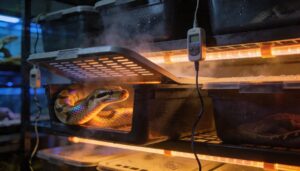
Getting heat and humidity right isn’t optional — it’s the difference between thriving animals and a struggling collection. Your rack setup determines how well you can control both, and the details matter more than most breeders expect.
Your rack setup decides whether your collection thrives or struggles — heat and humidity leave no room for guesswork
Here’s what you need to know before you wire a single thermostat or set a humidity target.
Heat Tape Versus Integrated Panel Heaters
Heat tape wins on Installation Flexibility — it’s thin, pliable, and cuts to length for tight shelf edges.
Integrated panels deliver better Temperature Uniformity across full bays. Energy Consumption favors self-regulating heat cable paired with a proportional thermostat and thermal sensors; panels with smart cycling match that efficiency.
Safety Features edge toward panels — no overlap hotspots, enclosed electronics, built-in shutoffs. Maintenance Frequency stays low for both with proper probe placement.
Ideal Heat Ranges for Breeder Racks
Dial warm side setpoints to 88–92°F for breeding females; cool side gradient should land at 76–82°F. That 10–15°F spread drives genuine thermoregulation. Run Gradient Uniformity Verification monthly alongside your Thermostat Calibration Routine.
- Warm side: 88–92°F
- Cool side: 76–82°F
- Seasonal Temperature Shifts: raise setpoints 2–4°F during peak breeding
- Never exceed 95°F — stress spikes, feeding drops.
Dual-zone Thermostat Wiring for Tall Stacks
Tall stacks — anything over five levels — need dual-zone wiring. One thermostat can’t reliably manage heat tape across that vertical spread.
Run Zone Panel Wiring with separate thermostats per section; Thermostat Labeling prevents costly miswiring during maintenance.
Route cables through dedicated tray channels for clean Cable Management. Use Safety Fusing on each low-voltage circuit.
Dual-zone thermostat implementation for tall rack stacks keeps temperature regulation stable top to bottom.
Proper Probe Placement Inside Representative Tubs
Probe placement is where temperature regulation either holds or falls apart. Position the tip level with the tub base, parallel to the floor — never angled.
Keep at least 2 inches of Heat Source Distance from any panel.
Depth Alignment and Tub Material Compatibility both affect accuracy.
Run your Calibration Procedure before each breeding cycle.
Safety Mounting with protective clips prevents dislodgement during routine access.
Daily and Pre-shed Humidity Targets
Baseline RH Monitoring starts at 55–65% daily. When you spot opaque eyes or dull scales, trigger your pre-shed spike — bump to 70–80% for 24–48 hours, then return to baseline within 12–24 hours post-shed.
A Localized Humid Hide delivers 75–85% RH without soaking the whole tub.
Use Data Log Visualization to track swings, and keep Sensor Calibration Frequency monthly for your digital hygrometer.
Features Breeders Should Prioritize

Not every rack feature matters equally when you’re managing a serious collection. The ones that do matter tend to show up fast — in your workflow, your animals’ health, and your sanity on feeding days.
Here’s what’s actually worth your attention.
Modular Expansion for Growing Collections
Your collection won’t stay small forever — plan for that now. A modular rack system built on a Standardized Track Interface lets you bolt on Modular Column Add-ons without touching existing tubs.
Future-proof Bay Design means each Vertical Clearance Module adds 12 inches overhead, keeping your flexible rack system ready for larger tubs. The Expandable Rail System locks new bays in fast, with no rebuild required.
Adjustable Dividers and Reconfigurable Bays
Snap‑Fit Divider Tracks let you reposition compartments every 10 cm — no tools, no downtime. The Bay Indexing System maintains alignment across reconfigurations.
Anti‑Lift Stop Design keeps tubs locked during routine access. Quick‑Release Latch Mechanism swaps dividers fast when snakes outgrow a zone.
Tier Height Adjustability runs 6.5 to 9 inches in half‑inch steps — a genuinely adjustable rack system built for real breeding schedules.
Belly-heat Channels for Even Warming
Recessed belly heat sits flush beneath each tub, running U-Channel Design and Serpentine Path geometry to kill cold spots at seam lines. Sealed Covers block moisture intrusion.
Snap-Fit Assembly covers pull without tools. Channel Geometry keeps temperature uniformity tight — 2 to 4°F variance across the shelf.
Zone isolation barriers prevent cross-tier interference.
That’s thermal management working the way your collection actually demands.
Locking Doors, Guide Stops, and Escape Prevention
Thermal control keeps snakes comfortable — containment keeps them safe.
Tub doors use internal locking pins rated to resist 1,500 N of shear force, paired with tamper-resistant screws on every hinge.
Sixteen 6-riveted guide stops hold alignment within 2 mm tolerance.
Anti lift mechanisms block upward prying.
Emergency override placement stays staff-accessible but tamper-proof.
Locking casters anchor the rack completely during feeding.
Mobility, Ventilation, and Workflow Efficiency
Caster Lock Mechanisms and Quick Release Wheels let you reposition an entire eight-level rack in under 20 seconds — no lifting, no strain. Locking casters engage with a single tap.
Vent Panel Design with Airflow Shutter Adjustment normalizes air exchange per bay, keeping humidity consistent across life stages.
Hidden Cable Management channels eliminate tangled thermostat leads.
That’s your modular vivarium working the way a real maintenance schedule demands.
Pricing, Shipping, and Long-Term Costs
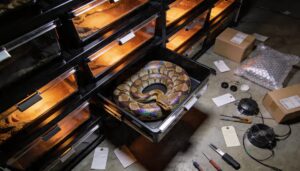
Budgeting for a boa rack goes beyond the sticker price. Shipping, replacement parts, and routine maintenance all add up over time.
Here’s what you need to know before committing to a setup.
From lighting and humidity to hide placement, these reptile habitat design ideas cover the details that can make the difference between a pet that merely survives and one that genuinely thrives.
Rack-only Versus Complete Package Options
Rack only gives you Future Upgrade Flexibility — source tubs and heaters on your terms. Complete Package options arrive matched and prewired, cutting Installation Complexity substantially.
Upfront Cost Comparison matters: rack only runs lower initially, but bundled packages often offset Price Range differences through Warranty Coverage Differences that extend to heating components.
Lead Time Variance favors rack only. Freight shipping applies to both.
Typical Price Ranges by Rack Size
Size drives cost fast. Six-level pricing starts around $600–$900 new; eight-level cost lands $750–$1,100. ten-level budget climbs to $900–$1,400, and twelve-level value ranges $1,100–$1,700.
Fourteen-level premium builds push $1,300–$2,000.
Each price tier reflects materials, heating integration, and rack size.
Factor refurbished options — often 30–40% less — into any cost and lifecycle analysis of boa rack systems.
Freight Shipping, Pallet Size, and Delivery Quotes
Full racks ship freight — no way around it. Standard parcel carriers won’t handle the weight or footprint. Dimensional Weight Pricing kicks in when pallet volume outpaces actual weight, so accuracy matters.
- Freight Class Selection and Pallet Weight Limits directly affect your custom freight quote
- Carrier Surcharge Types (liftgate, fuel, urban delivery) add up fast
- Quote Validity Period runs 7–30 days — lock rates quickly
Shipping within the contiguous United States is generally free for non-freight items; heavy equipment gets a custom quote post-order.
Assembly, Setup, and Replacement Parts
Assembly runs about three hours for a six-level unit using the included Tool Kit Essentials — hex keys in 3, 4, and 6 mm, plus an 8 mm Allen socket.
Follow the Bracket Alignment Guide and apply correct Fastener Torque Specs to avoid stripped threads.
Modular Shelf Adjustment happens in 25 mm increments.
Locking casters, Heating cable clips, and Replacement Gasket Options are all sold separately — budget for them upfront.
Cleaning, Tub Liners, and Maintenance Budgeting
Long-term costs don’t end at checkout. Budget allocation strategies should cover four essentials:
- V180 tub liners at $0.61–$1.93 each, replaced every 3–5 years
- Humidity sealants and perimeter caulking inspected monthly
- Cleaning supply tracking logged weekly to prevent stockouts
- Emergency liner fund for cracking or warping
Microbial prevention protocols — mild soap, microfiber cloths, no abrasives — protect your liner replacement schedule and extend equipment lifecycle cost.
Frequently Asked Questions (FAQs)
Can snakes live in a snake rack?
Yes — and they thrive. Racks handle heat tape, humidity control, and ventilation control efficiently.
With proper substrate choice and safety features, snakes show low handling stress and stable psychological well-being without traditional enclosures.
Can a boa live in a 20 gallon tank?
A 20 gallon tank won’t cut it for an adult boa. Space Requirements matter — adults need 6–8 feet of full enclosure length. That cramped setup causes Stress Indicators fast.
Can boa racks be used for other species?
Like a Swiss Army knife, boa racks adapt well.
Adjustable tub dimensions, cross-species temperature zones, and reptile substrate compatibility let you house corn snakes, gopher snakes, or pythons with minimal reconfiguration.
How long do quality boa racks typically last?
Quality boa racks last 8 to 15 years. ABS and PVC hold shape for up to 12 years. Stainless hardware resists corrosion indefinitely.
Warranty periods vary, but regular maintenance is your real lifecycle guarantee.
Are boa racks suitable for apartment living?
Boa racks work well in apartments. Vertical stacking maximizes space optimization with a compact rack footprint.
Locking casters aid mobility and security. Proper noise insulation, odor control, and energy-efficient heating keep neighbors unbothered.
Do racks require permits or local zoning approval?
Measure twice, cut once." Many municipalities trigger height permit thresholds around 5’9". Zoning district rules, authority review processes, and inspection requirements vary locally. Always verify before installing.
Can racks be resold or repurposed after breeding?
Yes. Well-built ABS or PVC racks resell at 40–70% of original price. Modular systems with intact tubs sell fastest. Local reptile forums consistently outperform general marketplaces for premium brands.
Conclusion
Thousands of breeding cycles hinge on your rack choice.
Invest in top-tier boa constrictor racks for reptile breeders, ensuring precise temperature control and humidity management.
A well-designed rack is the backbone of your operation, supporting the health and well-being of your animals.
Prioritize quality, and your collection will thrive with every detail carefully considered for best results, every time.