This site is supported by our readers. We may earn a commission, at no cost to you, if you purchase through links.

Running a boa rescue means your intake numbers don’t care about your square footage. A single surrender call can add three adults overnight, and suddenly your quarantine protocol is sleeping on the floor plan you designed for six animals.
That pressure is where boa constrictor racks for rescue caretakers stop being a convenience and start being infrastructure.
The right rack system compresses your footprint by 40%, centralizes temperature monitoring across dozens of tubs, and keeps clean zones genuinely clean—not just separated by good intentions.
What follows breaks down which systems hold up under daily tub pulls, heavy cleaning schedules, and the unpredictable volume that defines rescue work.
Table Of Contents
- Key Takeaways
- Rescue Rack Requirements for Boas
- Rack Sizes by Boa Stage
- Best Materials for Heavy Use
- Heat and Humidity Control
- Boa Rack Brands Compared
- Budget, Shipping, and Scaling
- Frequently Asked Questions (FAQs)
- How big should a boa constrictor enclosure be?
- What are boa constrictors?
- Which type of Boa constrictor cage should I buy?
- How do you keep a boa constrictor?
- Can volunteers safely operate racks without training?
- How often should tub substrates be fully replaced?
- Are rack systems suitable for injured or recovering boas?
- What lighting schedules work best for rescued boas?
- How do racks handle boas with behavioral aggression issues?
- Conclusion
Key Takeaways
- The right rack system can compress your facility’s footprint by up to 40% through vertical stacking and shared wall placement, giving you room to absorb sudden intake surges without expanding your building.
- Matching tub size to your boa’s life stage — from 5–8 qt hatchling tubs up to 40×31-inch V-180 adults — keeps feeding responses strong and health checks fast across every animal in your care.
- Freedom Breeder ProLine suits mid-to-large rescues best, with welded stainless frames, adjustable ventilation per level, and modular reconfiguration that handles fluctuating intake without a full rebuild.
- Budget planning can’t stop at the rack price — replacement tubs run $40–$120 each, heat tape costs $15–$60 per roll, and monthly energy overhead can hit $200, so factor total cost of ownership from day one.
Rescue Rack Requirements for Boas
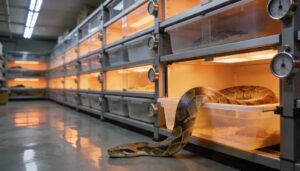
Running a boa rescue means every square foot counts, and the right rack system changes everything. Your setup needs to handle fluctuating intakes, quarantine rotations, and daily health checks without slowing your team down.
Here’s what to look for before you commit to a rack.
Floor-space Savings for Rescue Facilities
Floor space is the first thing rescue facilities run out of. A modular rack system fixes that fast.
Stacking vertically with modular boa constrictor racks designed for experienced keepers — especially ones with locking casters — lets you reclaim floor space without sacrificing easy access.
Vertical stacking puts three to four tubs in the footprint of one cage. Narrow aisle layouts drop circulation width to 24 inches. Shared wall placement saves 8–12 square feet per bay. Integrated door swing adds usable width. Tiered mounting cuts redundant fencing entirely.
- Vertical stacking reduces floor use by up to 40%
- Narrow aisle design saves 8–12 sq ft per bay
- Shared wall racks eliminate buffer zones between units
- Integrated door swing reclaims 2 inches of usable width
- Tiered mounting removes redundant fencing per section
This spacesaving design scales without expanding your building. minimum air changes per hour helps maintain healthy air quality for animals in dense rack setups.
Centralized Monitoring for Multiple Intakes
Once space is sorted, your next challenge is keeping tabs on every animal at once. Centralized monitoring consolidates environmental data — temperature set points, digital hygrometer readings, climate automation alerts — across all tubs from one point.
Solid staffing workflow means fewer missed checks. Alarm prioritization, device oversight, and clear communication channels flag problems before they become emergencies.
Data consolidation lets one coordinator track 96 intakes efficiently.
Quarantine-friendly Rack Layouts
Good monitoring means nothing if a sick intake contaminates your whole collection. A Separate Quarantine Room with a dedicated door, Cleanable Surface Materials, and a Dedicated Tool Set eliminates that risk.
Use paper towel substrate, a Tub Monitoring System with digital hygrometers, and Adjustable Ventilation Slots at 25–50% to balance airflow.
Modular rack designs let you expand zone isolation barriers without rebuilding your entire layout.
Escape Prevention and Staff Safety
Quarantine discipline keeps your collection clean — but a loose boa anywhere in the facility is a different kind of emergency.
Locking casters prevent rack drift during feeding chaos. A secure interlock mechanism on each tub stops opportunistic pushouts. Rounded edge safety on frame hardware means no snag hazards during rapid response.
For staff safety:
- Install Panic Bar Installation on all exit doors — staff shouldn’t fumble locks mid-emergency.
- Keep Unobstructed Pathways at a minimum 1-metre width through every rack aisle.
- Use Fail-safe Door Hardware so exits never require a key under pressure.
- Mount Emergency Lighting at every aisle bend and stairwell — power cuts happen.
- Post Clear Exit Signage at eye level; containment security means nothing if staff can’t get out fast.
When Racks Work Better Than Cages
Racks outperform cages when volume, consistency, and cost all matter at once. Plastic tubs deliver humidity control that screen tops can’t match — fluctuations drop under 5 percent daily. Belly heat tape cuts energy costs by 50 percent versus overhead lighting.
Reduced stress levels and improved feeding response follow naturally. Modular design simplifies quarantine protocols, and centralized layout allows enhanced health monitoring across every intake simultaneously.
Rack Sizes by Boa Stage
Matching rack size to your boa’s current stage isn’t optional — it’s the difference between a calm animal and a stressed one. The right tub at each life stage keeps feeding responses strong, shedding cleanly, and health checks fast.
Here’s what the rack lineup looks like from hatchling to full-grown adult.
Hatchling Tub Sizes for New Arrivals
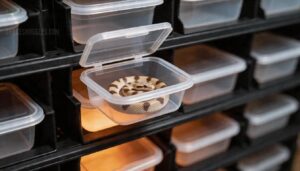
Fresh boa hatchlings need tight quarters — not because it’s cruel, but because security drives feeding response. Start with a 5–8 quart tub and nail your tub footprint ratio before worrying about upgrades.
- Cover snugness: rack tops act as lids; non-rack tubs need locking modifications
- Length-to-width ratio: tub length should match the snake’s body at a minimum
- Tub volume measurement: FB5 (5 qt) suits hatchlings under 200 g; FB8 (8 qt) accommodates up to 300 g
- Growth shift timing: these sizes are temporary — plan your next move early
- Weight capacity limits: low 3.5-inch tub height keeps belly heat efficient and checks fast
Juvenile Rack Options for Growing Boas
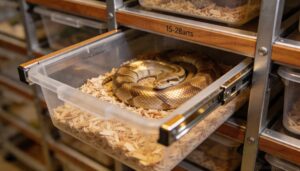
Once hatchlings hit 200–300 g, progressive tub upsizing becomes your next decision point. Move into 15- to 28-quart grow-out tubs for boas under 3.5 feet.
A low-profile frame design with a quick-release tray system lets you swap tub sizes without rebuilding. Modular shelf inserts and modular reconfiguration keep your rack size planning based on snake growth stages, practical, not reactive.
Adult Boa Racks With V-180 Tubs
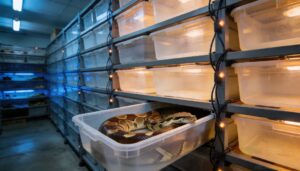
When your intakes tip past 4 feet, the V180 Boa Rack is the logical move. Each V180 Boa Tub measures 40 in × 31 in × 9.5 in — adult boa rack dimensions that give large-bodied rescues real floor space.
HDPE construction delivers weight savings without sacrificing seal integrity. Modular assembly and heat distribution uniformity across levels make tub capacity accuracy and stable temperature gradients manageable, not guesswork.
Shelf Spacing for Large-bodied Rescues

Shelf spacing isn’t cosmetic — it’s functional. Adult boas and breeding female space requirements demand 6–8 inches of clearance height per level, enough for tub slide ease and a secure two-handed grip.
Tight shelves kill airflow channels and wreck temperature uniformity.
Modular design considerations for expandable snake racks should factor in hand grip space from day one, so pulling a 40-pound tub never becomes a liability.
Capacity Planning for Fluctuating Intake
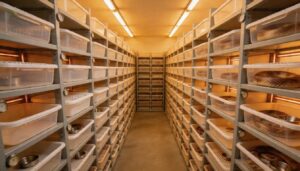
Rescue intake doesn’t arrive on a schedule. Buffer Tub Allocation means keeping 15–20% of your rack empty at all times — ready for quarantine holds, medical cases, or sudden seizures. Flexible Rack Reconfiguration and Staggered Intake Scheduling let you shift tub sizes by stage without buying new units.
Peak Load Forecasting based on breeding-season patterns keeps your expandable rack architecture ahead of the surge.
Best Materials for Heavy Use

Not all rack materials hold up equally when you’re running a high-volume rescue operation. Humidity, frequent cleaning cycles, and the sheer weight of fully loaded tubs will expose every weak point fast.
Here’s how ABS, PVC, and stainless steel each perform when the workload is real.
ABS Vs PVC Vs Stainless Steel
Material selection for snake rack durability comes down to three core options, each with real trade-offs.
- ABS plastic absorbs impacts without cracking—critical when tubs get yanked out daily
- PVC construction is stiffer but softens closer to 80°C, narrowing your heat margin
- Stainless steel helps win on cleaning durability and long‑term load strength
- Weight differences matter: ABS sits near 1.05 g/cm³ vs. steel’s 8.0
- Thermal stability and fabrication complexity both favor ABS for custom configurations
Corrosion Resistance in Humid Rooms
Weight savings from ABS plastic matter, but humidity control determines what survives long-term. Rooms holding 55–75% RH push corrosion risk fast — metal starts corroding above 60% without dew point control.
Stainless steel parts handle this best.
PVC construction and ABS resist moisture without coating maintenance headaches.
Galvanized protection helps, but monitor edges.
Corrosion monitoring and humidity buffering aren’t optional — they’re operational.
Load-bearing Strength for Stacked Tubs
Corrosion-resistant framing means nothing if the rack buckles under load. Tub wall thickness and shelf load distribution determine whether your setup holds through high-throughput snake operations.
Cross brace reinforcement stiffens frames against lateral sway; stainless steel bears stacked weight without deforming.
Plan a variable load margin — intake surges fast. Studded load distribution and heavy load capacity aren’t specs to skim.
Recessed Ventilation and Durable Hardware
Ventilation hardware matters just as much as the frame holding it all up. Flush Mount Grilles and Low‑Profile Air Diffusers sit recessed into each shelf, keeping airflow integration clean and snag‑free during tub pulls.
Durable Compression Gaskets seal edges against humidity drift.
Hidden Screw Fasteners and Weather‑Proof Screens lock everything flush — stainless steel brackets and welded steel construction handle the daily chemical cleaning without material corrosion resistance ever becoming a concern.
Casters, Guide Stops, and Tray Tracks
Every tub pull and rack repositioning depends on what’s underneath the frame.
- Swivel Casters handle tight aisle turns; Rigid Casters keep straight-line movement stable during relocation.
- Plate Caster Load ratings must account for six fully loaded V-180 tubs.
- Linear Tray Tracks with Adjustable Guide Stops prevent tub drift mid-pull.
- Locking Casters’ security and 6 Riveted Guide Stops lock everything once positioned.
Heat and Humidity Control

Getting heat and humidity right isn’t optional — it’s what separates a stable rescue environment from a health crisis waiting to happen. Every rack setup manages temperature and moisture a little differently, so knowing what each approach actually does in practice matters.
Here’s what you need to understand before choosing your system.
UVB output and spectral quality vary widely between fixtures, so reviewing UVB lighting systems designed for desert species can help you match the right setup to your animal’s D3 synthesis needs.
Belly Heat Vs Panel Heat
Belly heat and panel heat aren’t interchangeable — they solve different problems. Recessed belly heat via heat tape or heat cable creates a strong, localized temperature gradient, but substrate drying accelerates fast and burn risk climbs without thermostat precision.
Integrated heat panels spread warmth overhead, improving energy efficiency and thermal management strategies in multilevel reptile racks. For rescue use, panel heat usually wins on consistency.
Dual-zone Wiring for Taller Racks
Once your rack clears five levels, dual-zone wiring isn’t optional — it’s infrastructure.
Splitting the rack into independent A and B power paths gives you true Power Redundancy and Load Balancing across heating zones, which is central to thermal management strategies in multilevel reptile racks.
Vertical PDU Mounting keeps Cable Separation clean, Service Access fast, and zone isolation barriers intact if one feed needs servicing without dropping the whole rack.
Sensor Placement Inside Representative Tubs
Don’t trust a sensor that’s hiding in a corner. Place your temperature probe in the Airflow Center of each representative tub — mid-height, away from walls.
Wall Proximity skews readings; floors trap heat and moisture.
Dead Zone Avoidance matters more on larger racks, where Multi-point Sampling catches end-to-end variation.
Keep Maintenance Access clear so staff can verify and clean probes without disrupting the tub’s microclimate stability.
Humidity Targets for Daily Care and Shedding
Daily RH Range runs 55–75% for routine care — non‑negotiable baseline. When the blue phase hits, push your Shedding Humidity Boost to 75–85%.
Watch for these Humidity Problem Signs:
- Patchy sheds or retained eyecaps
- Dull, flaky skin post-shed
- Repeated incomplete sheds across multiple animals
Humidity Monitoring Placement matters: read mid-enclosure, where your boa actually sits. Moisture Control Methods — cypress mulch, damp moss hides, large water bowls — keep microclimate stability steady without soaking the substrate.
Ventilation Balance for Respiratory Health
Stagnant Zones kill boas quietly — respiratory infections follow when airflow design fails across stacked rows.
Stagnant air doesn’t just stall airflow — it quietly breeds the respiratory infections that kill boas
Aim for negative pressure: exhaust roughly 10% more than you supply.
Smoke Testing reveals dead pockets fast.
| Factor | Target | Risk if Wrong |
|---|---|---|
| Airflow Uniformity | Every level reached | Bottom-rack infections |
| Pressure Differential | ~2.5 Pa negative | Contaminant recirculation |
| Filter Efficiency | Particulates removed | Airborne pathogen buildup |
Test ventilation control monthly — don’t assume it holds.
Boa Rack Brands Compared
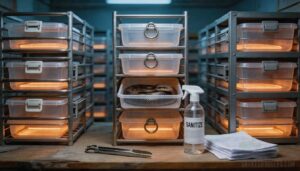
Not every rack brand suits every rescue operation, and the differences go beyond price tags. Build quality, tub access, and cleaning efficiency all vary in ways that matter when you’re cycling through dozens of intakes a year.
Here’s how the three major brands stack up.
Boaphile Rack Strengths and Limitations
durability track record — prototypes from 2000 are still running in collections today.
You get weight-saving plastic construction with solid load-bearing capacity, front-sliding access for quick daily checks, and custom tub fit for mixed-stage intakes.
Humidity regulation stays consistent inside the enclosed PVC build.
Downside: modular design considerations for expandable snake racks become complicated, and reconfiguring a full room is not fast.
Freedom Breeder ProLine for Rescue Use
Where Boaphile limits reconfiguration, Freedom Breeder ProLine picks up the slack.
Welded J4 stainless frames won’t rust in humid rooms. Standardized Tub Channels slide cleanly in seconds. Adjustable Ventilation Inserts — 0%, 25%, 50%, or 100% — give you real humidity control per level. Thermostat Compatibility enables dual-zone setups for thermal uniformity across taller boa constrictor racks. Modular Level Conversion manages modular design considerations for expandable snake racks cleanly.
Vivarium Electronics VE6 Pros and Cons
The Vivarium Electronics VE6 Rack shifts the conversation toward flexibility. Its Modular Frame Design accepts VE108-8, VE108-11, or VE108-23 tubs — one frame, multiple life stages.
Integrated Heat Tape runs through every shelf via embedded heat cable, with a dedicated thermostat probe slot per level supporting environmental monitoring and climate automation for reptile racks.
Flat-Pack Shipping and Tool-Free Disassembly keep logistics manageable.
Downside: tubs are sold separately.
Build Quality, Access, and Cleaning Comparison
Here’s how the three brands stack up where it matters most in a rescue setting:
- Rail Alignment & Front Opening Width — Freedom Breeder’s dual-roller bearing tracks keep tubs flush and centered; clean pulls every time.
- Surface Cleanability — stainless steel provides nonporous surfaces that wipe dry fast; ABS plastic durability holds up through repeated disinfection cycles.
- Modular Disassembly — Edge roundness, tub cleaning protocol efficiency, and tool‑free breakdown make weekly deep cleans manageable.
Best Fit for Small, Mid-size, and Large Rescues
Match your rack to your operation — don’t overbuild or underequip.
Small rescues handling under 20 boas thrive with Boaphile’s starter units: low cost, minimal footprint, solid long-term durability.
Mid-size facilities benefit from Freedom Breeder ProLine’s modular expansion and labor efficiency across 50 animals.
Large operations need expandable rack architecture — Freedom Breeder or VE6 systems, built for load-bearing capacity and high intake volumes.
Budget, Shipping, and Scaling

Running a rescue means budget decisions hit differently — every dollar saved on infrastructure is a dollar toward animal care.
Before you commit to a rack system, you need a clear picture of upfront costs, freight logistics, and how far your setup can actually scale.
Here’s what you should know across each of those fronts.
Upfront Rack Pricing by Brand
Budget gaps between brands are wider than most rescues expect. Tiered Pricing means your entry point varies dramatically — from $249 to $2,399 depending on scale and brand.
- Vivarium Electronics VE-6E: $249–$289 for six-tub compact setups
- Boaphile neonate Rhinorack: $289, holds 10 shoeboxes
- Vision V-35S 10-level frame: $844 rack-only
- Freedom Breeder FB10 ProLine: $1,449–$1,799
- FB40 ProLine tops Brand Price Gaps at $2,399
Volume Discounts apply on orders over $3,000 — Boaphile offers 5% upfront. Canadian operations should factor Currency Adjustments; VE-6E lists near $479 CAD. Bundle Savings on stack combos cut pedestal costs roughly in half. Always request a custom freight quote before finalizing — rack dimensions require freight shipping, not standard parcel.
Replacement Tubs, Liners, and Heat Tape Costs
Ongoing costs hit harder than the upfront rack price.
Tub Replacement Pricing runs $40–$120 per V180 Tub Liner, and liner installation labor adds up fast across a full rack.
Heat tape and heat cable usually cost $15–$60 per roll, with Heat Tape Energy Costs averaging $40–$200 monthly.
Factor these into your Total Cost Ownership and Budget Scaling Strategies from day one.
Freight Shipping and Delivery Planning
Full racks ship freight only — standard parcel carriers won’t touch the dimensions. Plan your delivery time windows early, because freight carrier handling requires scheduling around facility access hours.
Carrier coordination matters here: confirm capacity before you place the order. Route optimization and risk management reduce delays.
Compliance documentation travels with every shipment, so have your receiving paperwork ready before the truck arrives.
Complete Package Accessories Worth Buying
The Complete Package already covers the rack, six V-180 tubs, heat cable, and casters — but a few additions pull real weight. Add a digital thermostat, foil tape for heat reflection, low-profile bowls, and labeled tub tags for tracking intakes.
Microfiber cleaning cloths work cleanly on stainless steel frames.
Modular design considerations for expandable snake racks mean buying these now saves time later.
Expanding From Six to Larger Collections
Six boas is just the starting line. Scaling reptile rack systems for large boa collections means thinking vertically before you think horizontally — but vertical stacking limits hit fast.
The 6-level V-180 rack stands 78.75 inches; the 8-level reaches 90.25 inches. Run this checklist before ordering:
- Measure doorway clearance and ceiling height constraints
- Confirm floor load-bearing and structural integrity in high-throughput snake operations
- Plan modular frame extensions by snake growth stages
Frequently Asked Questions (FAQs)
How big should a boa constrictor enclosure be?
Enclosure size follows the snake. Length-to-Width Ratio, Vertical Clearance, and Growth Projection all drive the decision. Species-specific Dimensions vary by stage — hatchlings need 2×5×1 ft; adults demand 6×3×3 ft minimum.
What are boa constrictors?
Boa constrictors are large, nonvenomous snakes with heavy, muscular bodies, reaching 8–10 feet. Their geographic range spans Mexico through South America, thriving across habitat diversity from rainforests to semi-desert scrub.
Which type of Boa constrictor cage should I buy?
For rescue use, PVC racks win on durability, humidity retention, and modular design considerations for expandable snake racks.
They scale fast, clean faster, and keep your boa constrictor cages practical under heavy intake pressure.
How do you keep a boa constrictor?
Keep the heat gradient solid — 90°F warm side, 75–80°F cool. Match prey selection to body girth, dial feeding frequency to every 7–14 days, and hold humidity regulation steady at 55–75%.
Can volunteers safely operate racks without training?
No. Training requirement isn’t optional — it’s non-negotiable. Supervision is needed until competency evaluation confirms proficiency.
Untrained volunteers risk load errors, hygiene failures, and animal welfare violations.
Safety protocols exist for a reason.
How often should tub substrates be fully replaced?
Substrate lifespan isn’t fixed — it’s a read. Spot cleaning buys time; odor monitoring and wet patch detection tell you when it’s done.
Full replacement: every three to six weeks, substrate and condition permitting.
Are rack systems suitable for injured or recovering boas?
Yes, but only short-term. For weak or injured boas, low-stimulation housing with paper towel liners, stable temperature control, and simplified observation makes rack tubs genuinely practical during early recovery.
What lighting schedules work best for rescued boas?
A fixed 12-hour cycle, complete night darkness, and automated timer control give rescued boas the predictable rhythm they need.
Sync UVB timing to daylight hours and allow gradual seasonal shifts in winter.
How do racks handle boas with behavioral aggression issues?
Lockable Tub Doors keep a defensive boa contained while you assess behavior first. Use Hook Handling Tools, open One‑Tub Access only, and follow Rapid Response Protocols — stress stays manageable.
Conclusion
Freedom in confinement: a paradox for boa constrictor racks for rescue caretakers. Efficient design saves space, streamlines care.
With the right rack system, you can centralize temperature monitoring, prioritize clean zones, and guarantee escape prevention.
Investing in a quality rack system optimizes daily operations, ultimately improving the lives of rescued boas.