This site is supported by our readers. We may earn a commission, at no cost to you, if you purchase through links.

Humidity kills more reptiles than owners realize—not from too little, but from the wrong kind of control. A fogger that runs unchecked can saturate bedding, spike bacterial growth, and stress a species that needs precise moisture cycling rather than constant dampness.
The difference between a thriving enclosure and a soggy, mold-prone one often comes down to how the fogger is installed, calibrated, and maintained. Get those details right, and you’ve built an environment that actually mirrors what your animal evolved to live in.
Table Of Contents
Key Takeaways
- Matching your fogger’s output to enclosure size—and pairing it with ultrasonic technology, auto shut-off, and adjustable mist settings—keeps humidity precise without waterlogging your setup.
- Where you place the fogger matters as much as the unit itself: keep it at least 12 inches from heat and UVB sources, aim the nozzles toward the center, and plan tubing routes before you plug anything in.
- Always use distilled or RO water under 50 ppm TDS, fill the reservoir to 60–80% capacity, and set species-specific humidity targets—tropical reptiles need 60–90% RH, while desert species top out around 40%.
- Regular maintenance—weekly reservoir cleaning, monthly O-ring checks, vinegar descaling, and ground fault protection—prevents mold, mineral buildup, and electrical hazards that turn a good setup into a dangerous one.
Choose The Right Fogger

Picking the right fogger isn’t just about grabbing whatever’s on sale — the wrong unit can waterlog your enclosure or leave your reptile gasping in dry air.
Getting humidity right also means choosing the right substrate — some materials hold moisture far better than others, as covered in this guide to safe substrates for shedding snakes.
A few key factors will narrow your options fast. Here’s what to look for before you buy.
Match Output to Enclosure Size
The size of your reptile’s enclosure drives every fogger decision you make. Volume-based scaling means a small tank needs low mist output, while larger vivariums demand higher settings or parallel fogger arrays with multiple nozzles for even coverage. Adaptive calibration keeps things dialed in as conditions shift.
- Small enclosures: single nozzle, low output
- Medium tanks: adjustable mid-range settings
- Large setups: multiple nozzles, wider surface area ratio
Ultrasonic Vs. Thermal Foggers
Once you’ve matched output to enclosure volume, the next call is fogger type.
Ultrasonic foggers use high-frequency vibrations to produce droplets around 1–5 microns — no heat, lower energy use, and quieter operation.
Thermal foggers run hotter, increasing heat hazard risk near delicate skin.
The cost difference is real too: ultrasonics generally win on both safety and long-term fogger maintenance and cleaning procedures.
For detailed operation principles, see the basic working principle overview.
Pick Adjustable Mist Settings
Now that you’ve chosen your fogger type, getting the mist settings right is where the real control begins.
Most foggers offer distinct Mist Output Levels — low, medium, and high — letting you dial in Fine Coarse Mist without drenching surfaces. Pair Droplet Size Selection with Ambient Temperature Compatibility to avoid humidity spikes.
- Set adjustable mist output to medium after installation
- Use a digital timer for consistent mist cycle timing
- Match the mist nozzle angle to enclosure size
- Activate Energy Efficiency Mode to reduce power draw
Customizing misting programs for different species starts here.
Look for Auto Shut-off Features
Once your mist settings are dialed in, the next layer of control is knowing when the fogger stops—automatically.
| Shutoff Type | How It Works | Why It Matters |
|---|---|---|
| Humidity Trigger | Stops at target RH% | Prevents over-humidification |
| Water Level Sensor | Cuts power when reservoir runs dry | Protects heating element |
| Safety Circuit | Shuts down on fault or disconnect | Reduces electrical risk |
Look for Digital Display timers with Battery Backup and built‑in Alert Indicators.
A Self-Test Routine on startup catches problems early—that’s smart fogger safety built right in.
Choose Low-noise, Energy-efficient Models
Quiet matters more than you’d think—your reptile feels vibrations, and a loud fogger adds unnecessary stress. Look for models with Brushless DC Motors and Inverter Drive Technology, which keep Sound Dampening Design and Low Power Consumption working together efficiently.
Pairing a quiet fogger with clean, mineral-free water goes a long way—keeping your snake’s water bowl fresh and mold-free is just as important as reducing the noise around their enclosure.
Ultrasonic foggers and cool mist foggers with Energy Star Certification generally run under 40 dB, making noise level considerations for foggers and energy efficiency in reptile misting systems easy wins.
Prepare The Enclosure Setup

Before you plug anything in, the enclosure setup itself needs a little thought. Where you place the fogger — and what’s around it — makes a bigger difference than most people expect.
Here’s what to sort out before installation day.
Find a Stable Mounting Location
Your fogger is only as reliable as what it’s sitting on. Choose a weight-bearing surface that supports at least twice the combined load of the unit, water, and tubing.
Add vibration damping mats underneath, and confirm leveling precision within one degree so the nozzle stays aligned. Use corrosion-resistant hardware throughout, and leave 12 inches of airflow clearance around the fogger for safe, consistent reptile fogger installation.
Keep Distance From Heat and UVB
Heat and UVB distance guidelines aren’t suggestions — they’re your reptile’s first line of defense. Keep your fogger at least 12 inches from any heat or UVB source, and bump that to 18 inches near reflective wall effects that concentrate light.
infrared thermometer checks to confirm basking temps stay safe. Adjustable mounting arms make repositioning simple, and they help prevent condensation on UVB lights.
Plan Airflow and Mist Distribution
Think of your enclosure airflow optimization like a slow drain — mist should spiral inward, not pool in corners. A spiral airflow pattern keeps humidity even throughout.
- Aim nozzle orientation along the walls so mist drifts toward the center.
- Keep air velocity control between 0.2–0.8 m/s using a lightweight anemometer.
- Target mist output at 0.5–1.5 liters per hour for mid-sized enclosures.
- Apply mist pulse timing — short bursts with gaps prevent over‑saturation.
- Use microzone zoning near hides with placement and ventilation strategies for foggers.
Prevent Condensation on Walls and Lights
Condensation on walls and UVB lights isn’t just unsightly — it shortens equipment life and breeds mold in reptile habitats.
Apply surface coatings or insulation strategies to keep wall temperatures above the dew point.
Position lights away from walls using smart lighting placement, and improve ventilation to move humid air away from fixtures.
A vapor barrier installation behind panels adds reliable water condensation control.
Check Space for Tubing and Power
Before you connect the hose or finalize fogger placement, map out your space. Route tubing in a straight, elevated path with at least 4 inches of Tubing Clearance from walls to prevent wear.
Use clips every 12 inches for clean Cable Management, and build in Future Expansion Slack. Set your Power Brick Gap to 6 inches for Ventilation Clearance, keeping the power source dry and elevated.
Install Tubing and Water Supply
Getting the tubing and water supply right is what separates a fogger that works from one that causes problems. Every step here — from filling the reservoir to positioning the nozzle — directly affects how well reptile’s humidity stays on target.
Here’s what you need to do to set it up correctly.
Fill With Distilled or RO Water
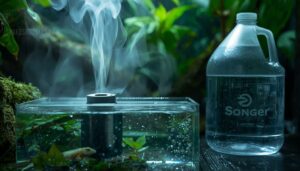
Water quality makes or breaks your fogger’s lifespan. Always fill the reservoir with distilled water or reverse osmosis water — both offer low TDS (under 50 ppm), which means minimal mineral deposits in your nozzles and tubing.
Distilled or RO water under 50 ppm TDS is the simplest way to protect your fogger from mineral buildup
- Purity Impact: Distilled water sits below 5 ppm TDS, eliminating mineral buildup avoidance concerns almost entirely.
- Remineralization Choices: RO water with a remineralizer balances pH stability without introducing excess minerals.
- Storage Container Hygiene: Keep purified water in sealed, clean containers to prevent recontamination before each refill.
Regular TDS monitoring helps you catch quality drift early.
Set The Reservoir Fill Level Correctly
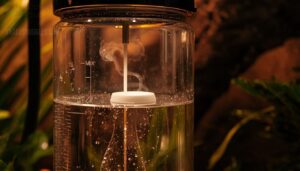
Now that you’re using distilled water, filling the reservoir correctly is your next step toward stable humidity level monitoring. Keep the fill level between 60–80% capacity — overfilling pushes water into tubing and creates air pocket prevention problems, while underfilling causes pump cavitation.
| Fill Level | What Happens |
|---|---|
| Below MIN indicator | Pump pulls air, mist drops |
| 60–80% capacity | Stable, consistent mist output |
| At MAX indicator | Risk of leaks or shorts |
| Overfilled | Air pockets, uneven distribution |
| Sensor contact zone | Float alignment stays accurate |
Check fill level indicators regularly and verify float alignment by gently lifting the reservoir — the float should move freely. Sensor calibration matters too; a stuck float gives false readings and wrecks your humidity targets before you even notice.
Route Tubing Without Kinks or Bends
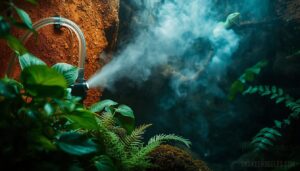
Once your reservoir is set, focus on how tubing runs from the fogger unit to the misting nozzles. Follow bend radius guidelines from your manufacturer — sharp angles collapse the inner wall and cut off airflow.
Map tubing paths before installation, favoring smooth curve planning over abrupt turns. Keep tubing support spacing consistent, and route everything away from heat to prevent softening during regular maintenance.
Secure Hoses With Clips or Suction Cups

With your tubing routed cleanly, securing it properly keeps everything stable during daily fogging cycles. Loose hoses shift over time — and that’s when leaks start.
- Clip material choice matters: soft silicone grips tubing without kinking.
- Match tubing diameter fit precisely — clips handle 6–12 mm outer diameter.
- Suction cup sealing works best on clean, dry glass or acrylic.
- Attachment positioning should keep hose weight resting on the enclosure, not the clip.
- Periodic inspection catches worn cups before they release mid-cycle.
Position The Nozzle Toward The Center

Once your hoses are locked in, aim the misting nozzles toward the center of the enclosure — not the corners.
This single adjustment delivers even mist distribution and a balanced humidity gradient across the full interior. It also means reduced condensation risk on walls and lights, minimized electrical exposure from stray droplets, and simplified calibration when you fine-tune your reptile fogger installation guide settings later.
Set Humidity Controls

Getting the humidity right is where your fogger setup really comes together. You’ve got a few key steps that work together to keep conditions stable and safe for your reptile. Here’s what to dial in.
Place a Calibrated Hygrometer Correctly
Your digital hygrometer is only as good as where you put it. Mount it at breathing height — mid-enclosure — away from direct sunlight and the mist nozzle itself. Central placement gives you accurate, representative readings rather than localized spikes.
Use a shielded but ventilated housing, and run a calibration routine every few weeks using the salt-solution method to keep your humidity sensor calibration dialed in.
Program Timer or Humidity Trigger Mode
Once your hygrometer is reading accurately, it’s time to put your controller to work. Most foggers let you choose between a simple timer and a humidistat-triggered mode — and picking the right one matters.
- Use timer mode with automated misting timers for predictable, species-matched cycles
- Enable trigger hysteresis to prevent rapid on/off cycling
- Combine your humidity sensor calibration data with app alert integration for remote monitoring
- Apply cycle interval optimization by adjusting on/off durations in one-minute increments
Adjust Output in Small Increments
Think of your fogger output like a dimmer switch — small turns, big difference. Start with a 2 percent stepwise output increase, then wait five minutes to let the humidity settle before adjusting again.
This incremental calibration approach prevents overshoot and condensation.
Fine-tuned humidity comes from feedback loop optimization: log each micro-adjustment strategy change, watch your humidistat respond, and dial in ideal mist timing precisely.
Set Species-specific Humidity Targets
Every species lives by its own humidity rulebook. Set your fogger’s targets based on what your animal actually needs:
- Tropical reptile RH: 60–90%, with amphibian moisture needs reaching 70–100% continuously
- Desert species RH: 20–40% ambient — bearded dragons suffer above 50%
- Microclimate hide targets: 85–95% for shedding support
Seasonal humidity tweaking matters too — adjust targets as temperatures shift.
Use Humid Hides for Localized Moisture
A humid hide gives your reptile a personal moisture zone without soaking the whole enclosure — think of it as a spa corner. Aim for 60–70% RH inside, lined with damp sphagnum moss for smart material selection.
Temperature pairing near the heat source helps shedding.
Maintain a weekly cleaning schedule and adjust ventilation adjustment to sustain a healthy moisture gradient.
| Feature | Recommendation | Purpose |
|---|---|---|
| Moisture Substrate | Sphagnum moss or damp paper towels | Retains humidity without waterlogging |
| Humidity Target | 60–70% RH inside hide | Helps shedding and respiratory health |
| Cleaning Schedule | Weekly wipe, replace lining every 1–2 weeks | Prevents mold and bacterial growth |
Maintain and Troubleshoot Safely
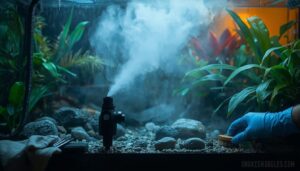
A fogger that’s running well is only half the job — keeping it that way takes a little routine care. Small issues like mineral buildup, worn parts, or a loose hose can snowball fast if you ignore them.
Here’s what to stay on top of to keep things running safely and smoothly.
A wide, shallow water bowl for raising snake humidity is one of the simplest upgrades you can make, using passive evaporation to maintain steady moisture all day.
Clean Reservoir and Nozzle Regularly
Regular maintenance keeps your fogger running safely and your reptile healthy.
Follow a Reservoir Inspection Checklist weekly — clean with warm water and mild soap, rinse completely, then dry fully before reassembly. Check your water reservoir size and replace the water frequently, every two to three days.
For Nozzle Wear Inspection, swap worn parts using filter and nozzle replacement guidelines, keeping Spare Nozzle Stock ready.
Hydrogen Peroxide Sanitizing (3%) works well for deep contamination.
Stick to consistent Cleaning Frequency Guidelines.
Remove Mineral Buildup With Vinegar Solution
Mineral deposits are a natural byproduct of fogging — but left alone, they’ll clog your nozzle fast. That’s where Vinegar Reaction Chemistry earns its keep: acetic acid in white vinegar breaks down calcium carbonate on contact.
Use Warm Vinegar Application for stubborn scale, soaking parts 15–30 minutes. Always do a Surface Compatibility Check first — vinegar is safe on glass and stainless steel, not on porous materials.
- Use a 1:1 water-to-white-vinegar solution for regular descaling
- Soak nozzles and reservoir components, never exceed 60 minutes on metal
- Follow Safety Precautions — never mix vinegar with bleach
- Choose soft Cleaning Tools Selection like an old toothbrush to scrub loosened buildup without scratching
Rinse thoroughly with distilled water afterward. Preventing mineral buildup in foggers is far easier when cleaning becomes part of your regular maintenance routine.
Replace Worn Filters, O-rings, and Nozzles
Once your nozzle is clean, shift focus to what’s underneath — the seals, filters, and O-rings keeping everything airtight. Follow a fogger maintenance schedule: inspect O-rings monthly, swap filters every 3–6 months, and replace nozzle seals every 6–12 months.
Your O-ring Material Choice matters — use rubber rated for moisture.
Run Nozzle Calibration Steps after each swap, and keep a Spare Parts Inventory ready.
Prevent Leaks and Electrical Hazards
Sealing your parts is only half the battle — electricity and water are a dangerous mix. Protect your setup with these four steps:
- Use IP Rated Connectors and apply Dielectric Grease Application on all metal-to-plastic junctions to block corrosion.
- Install Ground Fault Protection (at least 30 mA RCD) to cut power instantly during leaks and water spills.
- Add Moisture Sensor Integration near components for automatic shutdown within 0.1 seconds of contact.
- Seal cable entries using Cable Gland Sealing to prevent electrical shock and fire risk from water spill prevention techniques.
Reduce Over-fogging, Mold, and Condensation
Too much mist can be just as harmful as too little. If you notice condensation on UVB lights or walls, cut your fogger’s cycle time and improve Ventilation Timing.
Use Mold Resistant Materials for hides and substrate, and integrate a Dehumidifier Integration unit to stabilize humidity regulation.
A reliable humidity sensor eliminates guesswork around overmisting.
| Issue | Cause | Fix |
|---|---|---|
| Condensation on UVB lights | Overmisting near fixtures | Add Airflow Barriers, reduce cycle |
| Mold growth on hides | Trapped moisture, poor airflow | Switch to Mold Resistant Materials |
| Persistent fogging | Poor Surface Temperature Control | Adjust Ventilation Timing, reposition nozzle |
Frequently Asked Questions (FAQs)
Can foggers be used with live plants safely?
Yes, foggers work safely with live plants—think of them as a double-duty tool.
Prioritize plant species tolerance, manage foliar residue, and time misting away from direct light to protect foliage.
How does fogging affect reptile respiratory health?
Done right, fogging promotes respiratory health.
Done wrong, droplet inhalation, mineral aerosol exposure, airflow stagnation, and mold spore inhalation cause mucosal irritation.
Use distilled water, proper ventilation, humidity control, and mold and bacterial growth prevention practices.
Which reptile species benefit most from fogging?
Montane chameleons, dart frogs, glass frogs, tree geckos, and emerald tree skinks thrive with fogging. These tropical species need 70–90% humidity.
Unlike bearded dragons or iguanas, their reptile species’ humidity needs demand consistent tropical habitat simulation for reptile health benefits of proper humidity.
Can foggers replace a water dish entirely?
No, foggers can’t replace a water dish. Most reptiles show clear drinking preferences for surface droplets or standing water. A dish ensures reliable reptile hydration when your mist system fluctuates.
How do foggers perform during winter heating months?
Winter months push your fogger harder. Dry indoor air causes Winter Humidity Drift, demanding longer run times.
Sync your fogger with Heating Cycle Sync to stabilize humidity levels and avoid temperature regulation swings.
Conclusion
Your reptile isn’t just surviving—it’s finally living in conditions that speak its language.
A well-executed reptile fogger setup guide doesn’t just prevent moisture problems; it builds an environment where humidity works for your animal, not against it.
Every calibrated cycle, clean nozzle, and properly routed tube adds up to something your reptile feels but can’t tell you: that its world finally makes sense.
That’s not maintenance—that’s stewardship.