This site is supported by our readers. We may earn a commission, at no cost to you, if you purchase through links.
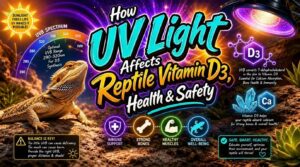
A bearded dragon basking under the wrong lamp can develop soft, rubbery bones within months—not from poor diet but from invisible light.
UVB radiation between 290 and 315 nanometers triggers a precise photochemical reaction in reptile skin, converting 7-dehydrocholesterol into previtamin D3. Without that narrow wavelength range, dietary calcium moves through the gut unused, starving the skeleton of what it needs most.
Understanding how UV light affects reptile vitamin D3 synthesis isn’t just biochemistry trivia—it determines whether your animal thrives or quietly deteriorates behind glass that blocks every photon responsible for keeping it healthy.
Table Of Contents
- Key Takeaways
- UVB Light Creates Reptile Vitamin D3
- Vitamin D3 Supports Calcium Absorption
- UVB Deficiency Causes Bone Disease
- Species Need Different UVB Levels
- Proper UVB Setup Matters
- Too Much UVB Can Harm Reptiles
- Monitor UVB for Healthy Vitamin D
- Frequently Asked Questions (FAQs)
- Can ultraviolet light destroy vitamin D?
- Can I use a reptile lamp for vitamin D?
- Can reptiles overdose on vitamin D3 supplements?
- Does stress affect vitamin D3 absorption in reptiles?
- How does UVB lighting affect reptile immune function?
- Do reptiles need UVB during brumation or hibernation?
- Can skin color or pigmentation affect UVB absorption?
- Conclusion
Key Takeaways
- UVB light in the 290–315 nm range is the only wavelength that triggers vitamin D3 synthesis in reptile skin — UVA, visible light, and supplements alone cannot substitute for it.
- Without functional vitamin D3, dietary calcium passes through the gut unused, leaving bones, muscles, and nerves progressively depleted regardless of how much calcium you add to the diet.
- Different species need vastly different UVB intensities — desert baskers require UVI 4–6 at the basking spot, while nocturnal and crepuscular species thrive on much lower levels with behavioral access to shade.
- UVB bulbs lose effective output long before they stop glowing, so regular measurement with a UV index meter and scheduled replacement — every 6–12 months depending on bulb type — is the only reliable way to confirm your reptile is actually synthesizing vitamin D3.
For a deeper look at getting this right in practice, UVB lighting systems for small reptile enclosures breaks down how to choose and position bulbs that actually hit that critical 290–315 nm range.
UVB Light Creates Reptile Vitamin D3
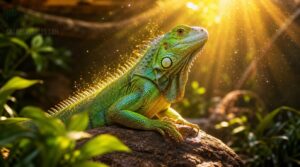
Your reptile’s skin does something impressive every time it basks under the right light. UVB rays — specifically those in the 290–315 nm range — kick off a chain reaction that ends with usable vitamin D3 in the bloodstream.
That same D3 powers calcium absorption, which is why balanced reptile nutrition matters just as much as the light above the basking spot.
Here’s how that process actually works, step by step.
How UVB Wavelengths Trigger Vitamin D3 Production in Reptile Skin
UVB photons in the 290–315 nm range — with peak efficiency near 297 nm — strike your reptile’s skin, they deliver enough photon energy to convert 7-dehydrocholesterol into previtamin D3 through photoisomerization.
dose-response process depends on adequate skin penetration depth and unfiltered UVB; any spectral filtering enclosure, like glass, blocks the wavelengths essential for vitamin D3 synthesis before they ever reach your reptile.
high UVB output needed for desert species.
Why UVB, Not UVA or Visible Light, Drives Synthesis
Not all light is created equal — and that’s the point. Vitamin D3 synthesis depends on photochemical specificity: only UVB light carries enough energy to cross the absorption band threshold needed to initiate photoisomerization of 7-dehydrocholesterol into previtamin D3.
UVA and visible light simply don’t meet that energy threshold. Their wavelength selectivity and skin penetration differ too much to trigger the reaction, making UVB light irreplaceable for vitamin D3 synthesis.
The Role of 7-dehydrocholesterol in The Skin
Your reptile’s skin does more than protect — it acts as a photosynthesis site. The epidermal precursor 7-dehydrocholesterol (7-DHC) sits within keratinocytes, ready for UVB activation. Skin cholesterol flux, hydration, and competing sterol pathways all influence how much 7-DHC remains available.
- Younger reptiles may show higher age 7-DHC concentrations
- Dehydrated skin reduces UVB responsiveness
- Competing sterol pathways can divert 7-DHC before vitamin D3 synthesis begins
How Previtamin D3 Becomes Usable Vitamin D3
Once UVB converts 7-dehydrocholesterol into previtamin D3, the molecule is not finished yet. Thermal isomerization kinetics take over — a temperature-driven molecular rearrangement that shifts previtamin D3 toward usable vitamin D3.
At 37°C, the conversion half-life is roughly 2.5 hours, with an equilibrium constant shift strongly favoring vitamin D3. Excess previtamin D3 undergoes photodegradation avoidance, breaking into inactive byproducts rather than accumulating to toxic levels.
Why Heat and Proper Basking Temperatures Matter
Thermal isomerization doesn’t happen in a vacuum — it depends directly on your reptile reaching the right body temperature at the basking spot. proper temperature gradient promotes digestion efficiency, metabolic rate, and immune function, while enabling behavioral thermoregulation.
Without adequate heat, previtamin D3 converts more slowly, and UVB’s role in vitamin D3 synthesis for reptiles — and downstream calcium metabolism — can’t reach its full potential.
Vitamin D3 Supports Calcium Absorption
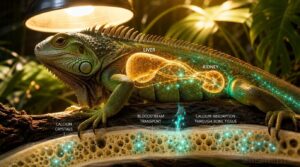
Vitamin D3 doesn’t just get made and sit there — it has real work to do, starting with helping your reptile actually use the calcium in its diet. Without it, even the best calcium supplement mostly passes right through.
Here’s how that process works, from liver to kidney to bone.
How Vitamin D3 Helps Reptiles Absorb Dietary Calcium
Calcium in your reptile’s dish means nothing if it can’t cross the gut wall — and that’s exactly where vitamin D3 earns its place.
- Intestinal calcium channels open only when calcitriol signals them
- Calbindin D28k shuttles calcium through intestinal cells into blood
- Serum calcium regulation and phosphate homeostasis both depend on this step
- UVB deficiency breaks this chain, risking metabolic bone disease despite supplementation
The Liver and Kidney Conversion Process
Once your reptile’s skin produces vitamin D3, two organs carry the process forward. Liver Hydroxylation converts vitamin D3 into calcidiol, launching Calcidiol Circulation through the bloodstream.
Kidney Hydroxylation then completes Calcitriol Synthesis through tightly controlled Enzyme Regulation — a step shaped by parathyroid hormone and calcium metabolism demands.
Without both conversions working, vitamin D metabolism stalls, and calcium absorption suffers regardless of how much UVB your setup delivers.
Calcitriol as The Active Vitamin D Hormone
Calcitriol is where the whole UVB-to-calcium chain pays off. After the Kidney Hydroxylation Step, this active hormone binds the vitamin D receptor (VDR), triggering VDR Genomic Signaling that switches on genes controlling Systemic Calcium Homeostasis and Bone Mineralization Regulation.
- Drives intestinal calcium uptake into the bloodstream
- Suppresses Parathyroid Hormone Interaction when calcium is sufficient
- Promotes osteoblast activity for healthy bone density
- Depends entirely on successful vitamin D3 synthesis via UVB
Why Calcium Supplements Alone May Not Be Enough
Dumping extra calcium into your reptile’s bowl won’t fix weak bones if vitamin D3 synthesis and calcium metabolism in reptiles aren’t working together. Without adequate UVB, calcitriol can’t activate intestinal absorption — so most of that mineral simply passes through.
Without adequate UVB, even the best calcium supplement simply passes through — bones stay weak regardless
| Factor | Why It Matters |
|---|---|
| Elemental calcium variance | Carbonate vs. citrate delivers very different actual calcium doses |
| Phosphorus-calcium ratio | High feeder phosphorus blocks effective bone mineralization |
| Supplement form bioavailability | Poor hormonal regulation interplay limits absorption regardless of dose |
| Dosing timing considerations | UVB role in vitamin D3 synthesis for reptiles must precede supplementation |
Risks of metabolic bone disease caused by UVB deficiency remain even when calcium metabolism and bone health linked to UVB exposure are overlooked in favor of supplements alone.
Supplementing calcium alone can’t replicate what proper UVB exposure does for your reptile’s body, as explained in this guide to UVB lighting benefits for reptile health.
How Vitamin D3 Supports Bones, Muscles, and Nerves
Vitamin D3 doesn’t stop at bones — it’s the common thread linking bone remodeling, muscle strength, and nerve signaling into one connected system. Calcitriol maintains calcium homeostasis so your reptile’s muscles contract reliably and nerve impulse transmission stays accurate.
Without adequate vitamin D3 synthesis and hormonal regulation, calcium metabolism breaks down, bone mineralization slows, and calcium absorption drops — leaving bones, muscles, and nerves all compromised simultaneously.
UVB Deficiency Causes Bone Disease
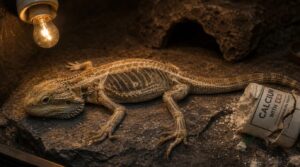
When a reptile doesn’t get enough UVB, the consequences go deeper than dull skin or low energy — they reach the bones. Without adequate vitamin D3, calcium absorption breaks down, and the skeleton quietly pays the price.
Here’s what that looks like, and why catching it early makes all the difference.
How Low UVB Leads to Metabolic Bone Disease
When UVB exposure falls short, your reptile’s skin can’t synthesize enough vitamin D3 to drive calcium metabolism — and that gap sets off a damaging chain reaction.
Parathyroid overactivity kicks in to compensate, increasing calcium mobilization through bone resorption.
Over time, that hormonal imbalance produces fibrous osteodystrophy: metabolic bone disease caused by UVB deficiency, where bone progressively weakens from within.
Early Signs of Vitamin D3 and Calcium Deficiency
Before fibrous osteodystrophy becomes visible, subtler warnings appear. Dropping blood calcium triggers hypocalcemia, producing nerve tingling that shows as facial twitching or weak jaw control during feeding.
early red flags:
- Appetite decline despite normal feeding routines
- Muscle fatigue causing hesitant, wobbly movement
- Bone softness detectable through gentle palpation
- Egg vulnerability in females laying thinner shells
Catching skeletal problems here prevents irreversible damage.
Soft Bones, Limb Swelling, Tremors, and Weakness
Once early warning signs go unaddressed, metabolic bone disease progresses into harder-to-reverse territory.
Skeletal fragility sets in as vitamin D3 synthesis fails to support calcium uptake, leaving bones genuinely soft — not just fragile.
| Symptom | What You’re Seeing |
|---|---|
| Soft Bones | Jaw or limbs flex under light pressure |
| Limb Swelling | Puffy legs from disrupted calcium regulation |
| Muscle Tremors | Shaking or twitching during handling |
| General Weakness | Reptile can’t lift body off substrate |
| Swollen Limbs | Movement becomes awkward and painful |
Insufficient UVB exposure drives this cascade.
Without it, even calcium-rich diets can’t compensate.
Appetite Loss and Poor Movement in Affected Reptiles
Appetite loss and poor movement often arrive together once metabolic bone disease takes hold. Muscle weakness from disrupted calcium metabolism makes climbing or reaching food genuinely costly.
Reduced feeding drive follows naturally — your reptile isn’t being stubborn; it’s conserving energy.
Behavioral lethargy, thermoregulation stress, and energy deficiency compound each other.
corrected UVB exposure, hypocalcemia and impaired vitamin D3 synthesis keep this cycle locked in place.
Why Young, Growing, and Egg-laying Reptiles Are Vulnerable
Young reptiles and egg-laying females face the highest risk because their calcium demands are rarely stable. Rapid bone mineralization during growth leaves little margin for error — any gap in the UVB role in vitamin D3 synthesis for reptiles quickly disrupts calcium absorption.
breeding females, maternal calcium depletion accelerates during eggshell calcification.
developmental windows, combined with high metabolic demand and limited vitamin D reserves, make Metabolic Bone Disease a real, fast-moving threat.
When Veterinary Care is Needed
Once bone deformities, tremors, or anorexia emerge, don’t wait — metabolic bone disease progresses fast. Disrupted calcium metabolism rarely corrects itself without clinical support.
Watch for these urgent signs:
- Bone deformities — swollen or bent limbs
- Anorexia emergency — refusal to eat beyond two days
- Stuck shedding — swollen, darkened toes needing same-day care
- Respiratory distress — open-mouth breathing or wheezing
- Eye injury — persistent redness or corneal cloudiness
Species Need Different UVB Levels
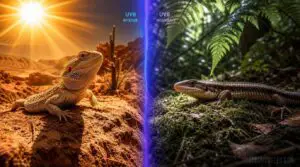
Not every reptile needs the same amount of UVB — a desert-dwelling bearded dragon and a forest-floor skink live in completely different worlds. Getting this wrong is one of the most common mistakes keepers make.
Temperature problems often go hand in hand with lighting mistakes, so it’s worth reading about the common habitat temperature mistakes reptile keepers make before you adjust your UVB setup.
Here’s how to match UVB intensity to what your specific species actually needs.
Why Desert, Tropical, Nocturnal, and Shade-dwelling Reptiles Differ
Not all reptiles experience sunlight the same way.
Desert species bask intensely for 20–60 minutes per session, relying on high habitat UVB intensity and short basking duration to drive rapid vitamin D3 synthesis.
Tropical diurnal lizards work with filtered, diffuse light under canopies.
Nocturnal reptiles shift toward dietary calcium dependence and strategic circadian activity patterns, making species-specific UVB requirements the foundation of proper care.
Using Ferguson Zones to Estimate UVB Needs
Ferguson zone calibration gives you a practical framework for matching UVB lighting requirements to your reptile’s natural habitat UV conversion. Each zone defines a UVI dose integration range — Zone 1 sits near UVI 0.7, while Zone 4 exceeds UVI 2.5.
gradient zone targeting within the enclosure lets your animal self-regulate exposure, directly supporting vitamin D3 synthesis and reducing metabolic bone disease risk.
UVB Requirements for Basking Reptiles
Open-sun baskers like bearded dragons and uromastyx demand the highest UVB requirements of any captive reptile.
At the basking spot, target these UVI thresholds to drive reliable vitamin D3 synthesis and support calcium metabolism:
- UVI 4–6 for primary basking zones
- UVI 2–3 across mid-enclosure UVB gradient areas
- UVI below 1 in shaded retreats
Enclosure UV mapping, combined with Temperature‑UVB Synergy, ensures your animal self-regulates exposure safely.
UVB Considerations for Snakes and Crepuscular Species
Snakes like ball pythons and corn snakes don’t chase the sun — they catch it in brief windows. Crepuscular UVB Timing matters here: low-angle dawn and dusk exposures drive modest Vitamin D3 synthesis through Ventral Skin Exposure when snakes rest flat near the light source.
A Burrow Shade Gradient gives them UVB Behavioral Choice, while Dietary D3 Backup covers gaps.
| Species Type | UVB Lighting Requirements |
|---|---|
| Ball pythons | UVI 0.5–1.0 with shade access |
| Corn snakes | UVI 1.0–2.0, brief daily windows |
| Nocturnal reptiles | Minimal UVB; diet-dependent D3 |
| Crepuscular species | Low UVI gradient, behavioral choice |
Why One UVB Setup Does Not Fit All Reptiles
Just as ball pythons and corn snakes need only brief, low‑intensity UVB windows, every species carries its own species‑specific UVB requirements shaped by Ferguson Zones, age‑related dosage, activity cycle timing, and microhabitat selection.
Enclosure material impact and bulb aging curves shift UVB dosage further — meaning a single setup can’t reliably support vitamin D3 synthesis and calcium metabolism across different reptiles, nor prevent metabolic bone disease effectively.
Matching UVB Strength to Natural Habitat
Matching reptile’s lamp to its natural habitat means more than picking a "10.0" or "5.0" bulb. A desert basker experiences high habitat UV index over open ground, while a forest species selects microhabitat gradients of filtered shade.
Basking height adjustments shift species-specific irradiance substantially — even a few centimeters change the dose your reptile actually receives.
Proper UVB Setup Matters
Getting your UVB setup right isn’t complicated, but the details genuinely matter.
The bulb you choose, where you position it, and how you structure the enclosure all affect how much vitamin D3 your reptile actually produces.
Here’s what to keep in mind for each part of the setup.
Choosing The Right UVB Bulb Type
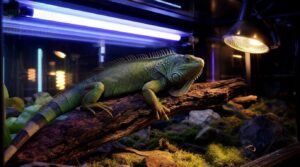
Not every enclosure calls for the same solution—spectral matching, fixture compatibility, and cost efficiency all factor into the right choice.
T5 fluorescent tubes deliver high UVB intensity across a broad basking zone, while T8 fluorescent tubes suit smaller setups.
Mercury vapor bulbs combine heat and UVB in one unit.
UVB LEDs are emerging, but vary in output.
Always verify bulb lifespan before committing.
T5 Versus T8 Fluorescent UVB Bulbs
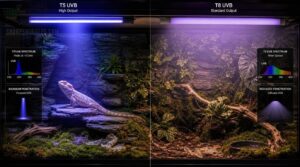
tube formats are fluorescent, but they perform quite differently in practice.
T5 fluorescent tubes win on wattage efficiency and beam shape—they push UVB deeper into taller enclosures, supporting consistent vitamin D3 synthesis at greater distances.
T8 fluorescent tubes spread UVB more broadly, but fade faster, requiring stricter replacement frequency.
For lifespan comparison and cost effectiveness, T5s deliver roughly 12 months of reliable UVB lighting; T8s drop off around six, raising metabolic bone disease risk if overlooked.
Reptile UVB LEDs and Emerging Lighting Options
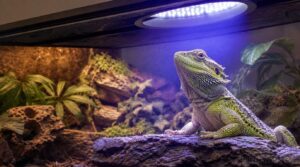
UVB LED lighting has quietly reshaped what’s possible in reptile enclosures since entering the market after 2019. Unlike fluorescent tubes, UVB LED fixtures offer longer fixture lifespan, genuine energy efficiency, and spectral tuning that aligns emission peaks closer to the 290–315 nm synthesis window.
Hybrid fixtures combine UVB with visible output in one unit, while smart dimming lets you automate photoperiods precisely — real UVB lighting benefits worth considering.
Correct Lamp Distance From The Basking Area
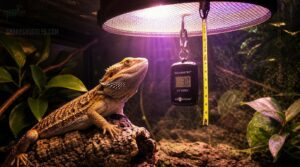
Distance calibration starts at the bulb surface, not the fixture edge — measure down to the highest point your reptile actually reaches while basking.
Most setups land in the 12–18 inch range, but mesh attenuation cuts UVB output by 30–45%, pulling that target closer.
UV index targeting at the basking site (aim for 4.0–4.5) confirms accuracy, while a safety buffer zone prevents direct contact burns.
Why Glass and Plastic Block UVB
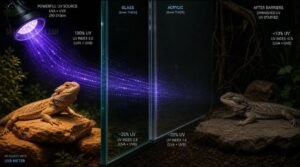
Even clear glass stops most UVB radiation before it reaches your reptile’s skin. Standard soda-lime and UV-blocking glass can absorb over 90% of the UVB spectrum, making UVB transmission effectively zero at the basking spot.
- Glass thickness increases UVB-blocking glass performance — thicker panes transmit even less.
- Plastic absorption affects acrylic and polycarbonate similarly, despite looking transparent.
- UVB permeable materials are rare; most clear covers still block UVB exposure.
- Testing penetration with a Solarmeter confirms whether UVB radiation actually reaches your animal.
Creating a Safe UVB Gradient
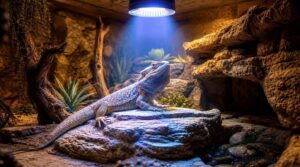
Think of UVB output as a cone-shaped intensity field — strongest directly beneath the lamp’s center, tapering steadily outward. A well-designed peak-retreat gradient lets your reptile self-regulate vitamin D3 synthesis by moving between high and low zones.
For accurate UVB gradient mapping, measure at multiple measurement zones: the basking surface, mid-enclosure, and retreat. Adjustable basking height lets you fine-tune UVB safety guidelines without replacing bulbs.
Providing Shade and Hiding Areas
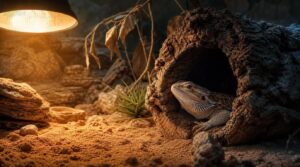
Shade isn’t just comfort — it’s a critical part of your UVB gradient and reptile enclosure design. Without proper retreat options, reptiles can’t self-regulate exposure or body temperature effectively.
- Hide Placement Strategy: Position hides on the cool end, away from the lamp’s center.
- Shade Temperature Control: Verify shaded surfaces stay cooler than the basking spot.
- Ventilation Flow Management: Don’t let hides trap heat — airflow matters on both sides.
- Behavioral Preference Monitoring: Watch whether your reptile voluntarily retreats vs. presses against enclosure walls.
Too Much UVB Can Harm Reptiles
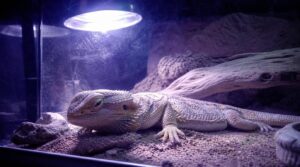
UVB light is essential, but too much of it crosses a line your reptile can’t always avoid on its own. Even with good intentions, the wrong setup can lead to real harm — from skin damage to serious eye problems.
Here’s what to watch for and how to keep things in a safe range.
How Reptiles Naturally Avoid Excess UV Exposure
Reptiles are far from passive under a lamp — they actively manage their own UV dose through several built-in strategies.
| Strategy | How It Works | Enclosure Application |
|---|---|---|
| Behavioral Shade Choice | Moving into hides reduces UVB sharply | Include solid-roofed hides away from the lamp |
| Adjustable Basking Distance | Shifting farther from the bulb lowers irradiance | Create a UVB gradient across the enclosure length |
| Circadian UV Timing | Basking occurs during natural activity windows, matching circadian rhythm | Use timers to align lamp cycles with species-specific photoperiods |
Skin photochemistry limits also help — once precursor molecules near the skin surface are saturated, vitamin D3 production slows naturally. Microhabitat cover, like logs and overhangs, let reptiles thermoregulate while stepping out of direct UVB. Understanding UVB exposure and reptile behavior patterns — including species-specific UVB requirements using Ferguson Zones — helps you design enclosures that support this self-regulation without relying on the animal to compensate for poor setup.
Signs of UVB Overexposure
Even well-intentioned setups can tip into overexposure territory. Key signs of excessive UVB exposure in reptiles include:
- A squinting reflex, feeding reluctance, and hiding behavior that persists beyond normal resting periods.
- Reduced activity paired with skin peeling or early skin erosion.
- Corneal opacity and the early stages of ulcerative keratoconjunctivitis, a serious eye condition.
Watch for these before hypervitaminosis D3 compounds the damage.
Eye Irritation, Corneal Damage, and Skin Problems
Corneal opacity and ulcerative keratoconjunctivitis aren’t abstract risks — they develop when photokeratitis prevention is overlooked.
Intense UVB breaks down skin barrier integrity around the eyelids, triggering eyelid inflammation and corneal ulcer progression.
Skin erosion follows prolonged overexposure, complicating UVB burn mitigation efforts.
| Sign | Tissue Affected |
|---|---|
| Cloudy, opaque eye surface | Cornea |
| Swollen, red eyelid margins | Eyelid skin barrier |
| Raw, peeling facial skin | Epidermal layer |
Risks From Lamps Placed Too Close
Skin erosion isn’t the only consequence when lamps are placed too close. A lamp mounted low creates localized heat hotspots and basking platform overheating — temperatures spike rapidly before your reptile can retreat.
Reptile behavioral avoidance kicks in, reducing beneficial UVB time.
Enclosure material warping, contact burns, and compounding risks of hypervitaminosis D3 alongside skin damage and eye injury follow quickly.
Preventing Burns With Proper Distance and Coverage
Preventing burns starts with three core adjustments:
- Guard Mesh Use — Install wire mesh guards to block direct lamp contact while preserving UVB transmission.
- Heat UVB Separation — Position heat and UVB sources independently, preventing forced overexposure at the only warm spot.
- UVB Meter Verification — Confirm UVB intensity across your Basking Platform Spread using a UVB meter, ensuring Obstruction-Free Illumination at safe UVB lamp placement distances.
Why Stronger Bulbs Are Not Always Better
A bulb labeled "stronger" doesn’t automatically mean safer or more effective—it often just raises the Overexposure Risk before you notice a problem.
Here’s what actually shifts when output increases:
| Factor | Effect of Stronger Bulb |
|---|---|
| Steep UVB Gradient | Safe zones shrink; escape areas disappear |
| Thermal Stress | Basking temps spike, reducing voluntary exposure |
| Aging Output Decline | Early overshoot worsens UVB bulb degradation later |
| Species Sensitivity | Shade-dwellers exceed Species-specific UVB intensity guidelines instantly |
Match UVB dosage to your species—not wattage.
Monitor UVB for Healthy Vitamin D
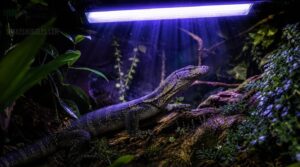
Getting your UVB setup right is only half the job — keeping it right is where most keepers fall short. Bulbs fade, schedules slip, and small gaps in exposure add up faster than you’d think.
Here’s what to track so your reptile stays in the vitamin D sweet spot.
Using a UV Index Meter at The Basking Spot
A UV Index meter takes the guesswork out of your reptile’s basking site.
Follow these Meter Positioning Tips: hold the sensor upright at your reptile’s back height, aimed directly at the lamp, with nothing casting a shadow on it.
This Reading Consistency Protocol ensures Spot Light Uniformity across measurements.
Compare your peak UVI against Safety Thresholds Interpretation guidelines for your species — accurate readings directly protect vitamin D3 synthesis and calcium metabolism.
Checking Bulb Output as Lamps Age
Even a bulb that glows normally can quietly fall below therapeutic UVB output. Tracking the Output Decay Curve with regular UVB meter readings — following Distance Consistency Checks each session — reveals real spectral output decay over time.
Log Bulb Age Metrics alongside readings to spot Bulb Replacement Triggers early.
Consistent Meter Calibration Frequency keeps your UVB lighting setup and maintenance best practices grounded in actual data, not assumptions.
When to Replace UVB Bulbs
Visible light isn’t a reliable indicator of UVB output — a glowing bulb can be functionally useless for vitamin D3 synthesis.
Use Service Hours Tracking and Calendar Replacement Cycle planning to stay ahead of Output Decline Indicators:
- Compact bulbs: replace every 6–8 months
- T8 fluorescents: replace every 6–8 months
- T5 HO bulbs: replace every 10–12 months
- Mercury vapor: replace every 8–10 months
Early Replacement Guidance matters most when you can’t verify UVB intensity with a UVB meter — choose the shorter interval.
Setting a Healthy Daily Photoperiod
A consistent light schedule is the foundation of circadian rhythm alignment for your reptile.
Run UVB lighting 10–14 hours daily for diurnal species, keeping nights fully dark — dark period integrity directly promotes natural hormone cycling. Use timer automation to eliminate guesswork, and apply gradual seasonal shifts across multiple days when adjusting photoperiod.
Stable, predictable lighting schedules improve daily UVB dosage without disrupting your reptile’s internal clock.
Adjusting UVB for Diurnal and Nocturnal Reptiles
Diurnal and nocturnal reptiles don’t share the same UVB photoperiod needs — and treating them identically is a common mistake.
Diurnal patterns call for 10–14 hours of UVB intensity titration aligned with active basking windows. Nocturnal species benefit from 4–6 focused hours during overlap periods.
Temperature-UVB coupling and shade-spot placement, guided by species-specific activity patterns and adjustable lighting controls, keep vitamin D3 synthesis and calcium metabolism on track.
Watching Behavior, Appetite, Shedding, and Activity
Once your photoperiod is dialed in, your reptile’s behavior becomes the most honest feedback tool you have. Shifts in basking frequency, feeding motivation, shedding quality, and activity patterns often signal UVB problems before clinical signs appear.
Watch for:
- Reduced basking sessions — often the first sign of disrupted circadian rhythm synchronization using UVB cycles
- Skipped meals — poor UVB photoperiod weakens feeding motivation noticeably
- Incomplete sheds — compromised vitamin D3 synthesis and calcium metabolism in reptiles affects skin cycling
- Sluggish reptile basking behavior — declining circadian rhythm and muscle function show up as reduced activity patterns
Balancing UVB Lighting With Diet and Calcium Supplementation
Behavior shifts tell part of the story — but they only make sense alongside what your reptile is eating.
UVB lighting requirements for reptiles don’t work in isolation: dietary calcium, feeding timing, and supplement synergy all shape whether vitamin D3 synthesis and calcium metabolism in reptiles actually deliver results.
seasonal UVB output, maintain calcium ratio balance, and revisit enclosure layout planning whenever you change any single variable.
Frequently Asked Questions (FAQs)
Can ultraviolet light destroy vitamin D?
Yes, UV-induced degradation is real.
Excessive UVB exposure triggers Vitamin D photoinactivation, converting previtamin D3 into inactive lumisterol and tachysterol. This dose-dependent destruction is actually a built-in safety valve — preventing vitamin D3 toxicity before it starts.
Can I use a reptile lamp for vitamin D?
A properly certified reptile UVB lamp does support natural vitamin D3 synthesis—but only if it emits sufficient UVB intensity for your species and follows a consistent bulb replacement schedule.
Can reptiles overdose on vitamin D3 supplements?
Reptiles can absolutely overdose on vitamin D3 supplements.
When UVB already drives synthesis, adding oral D3 risks hypercalcemia, kidney damage, and soft-tissue calcification — classic hypervitaminosis D toxicity signs that escalate quickly.
Does stress affect vitamin D3 absorption in reptiles?
Stress-induced basking reduction cuts UVB exposure time, directly lowering vitamin D3 synthesis.
Cortisol metabolic effects can impair gut calcium uptake, disrupt stress organ conversion, suppress immune function, and destabilize calcium homeostasis and hormonal balance.
How does UVB lighting affect reptile immune function?
UVB-induced synthesis of vitamin D3 drives calcitriol immune modulation, enabling immune cell activation and UVB cytokine balance.
Adequate UVB dosage promotes D3 antimicrobial peptides, vitamin D3 immunomodulation, and pathogen resistance boost — key UVB lighting benefits often overlooked.
Do reptiles need UVB during brumation or hibernation?
Like a bear in winter, a brumating reptile’s metabolic rate drops sharply — so UVB exposure isn’t critical during dormancy, but calcium repletion after post-brumation recovery depends on restoring it promptly.
Can skin color or pigmentation affect UVB absorption?
Yes — melanin UVB attenuation is real in reptiles.
Darker pigmentation absorbs more UVB before it reaches the skin’s 7-dehydrocholesterol layer, shifting the pigmentation dose response and reducing vitamin D synthesis efficiency.
Conclusion
UVB bulbs lose up to 50% of their effective output before the tube visibly dims—meaning your reptile may be living under what looks like a working light but functions like a blackout curtain. Understanding how UV light affects reptile vitamin D3 synthesis closes the gap between good intentions and genuine care.
A bulb that measures correctly, placed at the right distance, makes the difference between a skeleton that holds and one that quietly fails.