This site is supported by our readers. We may earn a commission, at no cost to you, if you purchase through links.
An unregulated heat mat can reach 140°F—hot enough to cause deep tissue burns before a snake even shows signs of distress. Most keepers don’t realize the danger until they’re at the vet, wondering how a product designed to keep their reptile comfortable ended up harming it. The mat itself isn’t the problem; the temperature it reaches without proper control is.
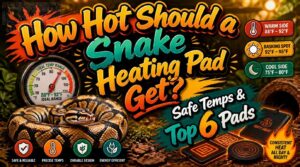
For tropical snakes like ball pythons and corn snakes, the warm side needs to stay between 88°F and 92°F, with 100°F as the absolute ceiling.
Achieving this range depends on the thermostat setup, probe placement, substrate depth, and mat sizing—all of which work together in ways that aren’t obvious at first glance.
Table Of Contents
- Key Takeaways
- Reptile Heat Mats Should Reach 88–92°F
- Match Temperature to Your Snake
- Use a Thermostat Every Time
- Measure The Actual Surface Temperature
- Size The Mat Correctly
- Substrate Changes Heat Mat Performance
- Frequently Asked Questions (FAQs)
- Will a heating pad help gastritis?
- Should a heat mat be hot to the touch?
- Is 30 degrees too hot for a corn snake?
- Can heat mats cause burns through thick substrate?
- How long does a heat mat take to warm up?
- Do heat mats work under bioactive enclosure setups?
- Should heat mats run overnight or be turned off?
- Conclusion
Key Takeaways
- An unregulated heat mat can silently reach 140°F and cause deep-tissue burns before your snake shows any sign of distress, making a thermostat non-negotiable for every setup.
- Your heat mat should maintain surface temperatures between 88°F and 92°F for most tropical snakes, with 100°F as the absolute ceiling you never cross.
- The mat should cover only one-third of the enclosure floor, creating a warm-to-cool gradient that lets your snake actively regulate its own body temperature.
- Substrate type, depth, and probe placement all directly affect the temperature your snake actually feels, so always verify with an infrared thermometer—not just your thermostat’s readout.
Reptile Heat Mats Should Reach 88–92°F
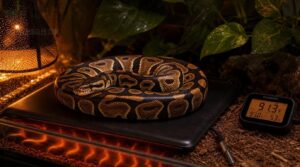
For most tropical reptiles, a heat mat surface between 88°F and 92°F hits the sweet spot — warm enough to support digestion, cool enough to stay safe.
If you want to dial things in further, this snake heating pad buyers guide breaks down which mats actually hold that 88–92°F range reliably.
But that range isn’t one-size-fits-all, and a few key principles determine whether your setup actually works. Here’s what you need to know before adjusting anything.
Safe Tropical Reptile Range
Most tropical reptiles thrive when your heat mat maintains a surface temperature between 88°F and 92°F. This range facilitates digestion, immunity, and natural behavior without crossing into dangerous territory.
- Green tree pythons: 92°F warm side
- Humidity balance: 70–90% with a consistent misting schedule
- Ventilation design: mesh tops prevent stagnant air
- Clutter placement: barrier materials like cork redirect heat evenly
- Temperature monitoring: check surface temperatures weekly
Ensuring a single-species enclosure prevents competition supports better health outcomes.
Never Exceed 100°F
Once your mat hits that 88–92°F sweet spot, the line you never cross is 100°F. That’s your maximum safe surface temperature — the Overheat Cut-off Threshold that separates safe heat from real danger. Unregulated mats can spike past 140°F, making Heat-Mat Burn Prevention and consistent temperature monitoring non-negotiable for your animal’s safety.
Without proper overheat protection and User-Defined Limit Settings on your thermostat, Insulation Failure Risks grow fast.
Warm Zone, Not Whole Tank
Your heat mat’s job isn’t to warm the whole tank — it’s to create a Focused Warm Spot on one side. This approach, known as Side Gradient Design, ensures Selective Floor Heating across roughly one-third of the floor, paired with a Mat Edge Buffer to maintain a truly cool area on the opposite side.
This Heat Zone Zoning empowers your reptile to actively regulate its body temperature. By allowing natural movement along the temperature gradient, the setup mimics wild behaviors, giving the animal direct control over its thermal environment.
Check Species Needs
Arboreal reptiles require Arboreal Heat Access at climbing height, while burrowing species depend on Burrowing Warm Hides for warmth. Juveniles exhibit Juvenile Temperature Sensitivity, necessitating vigilant monitoring.
Before finalizing temperature setpoints or ideal basking temperatures, consider Seasonal Thermoregulation, Humidity-Heat Balance, and species-specific heating needs to ensure comprehensive care.
Match Temperature to Your Snake
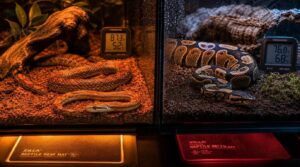
Not every snake needs the same temperature, and getting it wrong can stress your animal more than you’d expect. The difference between a corn snake and a ball python setup isn’t huge, but it matters.
Here’s what each common species actually needs from its heat mat.
Corn Snake Warm Side
Corn snakes don’t need extreme warmth — your warm side should stay around 85–88°F, with a basking spot placement reaching no higher than 92°F. That temperature gradient lets your snake self-regulate naturally.
Matching heat mat wattage to your tank size keeps energy efficiency high and prevents thermal drift. These are practical steps to ensure stable heating conditions.
These are core species-specific heating needs every corn snake keeper should understand.
Ball Python Warm Hide
Ball pythons need their warm hide to sit between 88 and 92°F — that’s your non-negotiable target for proper digestion and immune function.
Thermostat integration ensures temperature uniformity, while material conductivity and seal tightness affect how consistently heat transfers.
Check hide accessibility regularly as part of your maintenance routine, and confirm heat mat wattage matches your enclosure for reliable heat mat safety.
Boa Constrictor Heat Needs
Boas have species-specific heating needs that align with tropical reptile standards—your warm side should stay between 88 and 92°F to support digestion and thermal acclimation.
Heat source types range from under-tank mats to radiant panels, but energy consumption stays manageable when thermostat placement is precise.
Humidity effects and seasonal temperature shifts can alter your thermal gradient, so monitor regularly.
Checking readings each morning and evening helps you catch these fluctuations before they stress your reptile, and this terrarium temperature monitoring schedule breaks down exactly when to look.
Cool Side Matters
A proper temperature gradient depends just as much on the cool side as the warm side. Your cool zone temperature should sit between 75 and 80°F, giving your snake a clear escape from heat. Without distinct temperature zones, your snake cannot thermoregulate properly — and that’s when heat mat hazards and stress can take hold.
Cool hide location and airflow management both affect this balance.
Digestion and Metabolism
Temperature regulation isn’t just about comfort — it drives your snake’s entire digestive process. Without adequate post-feeding warmth, enzyme efficiency drops, gut motility slows, and nutrient absorption becomes inconsistent.
- Enzymes need warmth to break food down
- Gut motility slows in cool conditions
- Metabolic rate drops below ideal substrate temperature
- Nutrient absorption suffers without a stable thermal gradient
- Digestion support requires consistent reptile metabolism
Use a Thermostat Every Time
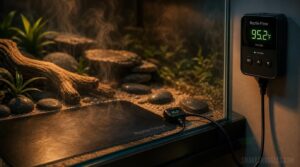
A thermostat isn’t optional — it’s the critical safeguard between your reptile and a dangerously hot mat. Without one, even a modest heat mat can climb well past 100°F and cause serious burns before you notice anything is wrong.
This essential device prevents overheating by regulating temperature, ensuring your reptile’s habitat remains safe.
Here’s what you need to know to set it up correctly.
Prevent Dangerous Overheating
An unregulated heat mat can silently climb past 140°F — hot enough to cause serious burns before your reptile even reacts. That’s why duty-cycle management through a thermostat isn’t optional. It cuts power based on real readings, protecting against heat mat overheating caused by wiring integrity failures or connector heating from poor connections. Overheat alarm testing confirms your backup protection actually works.
An unregulated heat mat can silently reach 140°F and burn your reptile before you ever notice
| Risk Factor | What Happens | Prevention |
|---|---|---|
| No thermostat | Mat exceeds 140°F | Use temp monitoring device |
| Poor wiring integrity | Connector heating, hot spots | Inspect connections regularly |
| No air-gap enforcement | Heat concentrates dangerously | Maintain ¼-inch gap beneath tank |
| Skipped alarm testing | Overheat goes undetected | Test shutoff monthly |
| Loose substrate | Burn prevention fails | Keep substrate thin and even |
Heat source safety depends on layered protection — not just one control.
Set Target Surface Temperature
Once your thermostat manages heat mat overheating risks, your next step is dialing in the right temperature set point. For most tropical reptiles, target 88–92°F at the mat surface — your safety margin before hitting the 100°F ceiling.
Drift monitoring catches gradual shifts, while ambient compensation and power-to-setpoint matching keep temperature control consistent.
Calibration protocols and burn prevention depend on setting this correctly from the start.
Probe Placement Matters
Setting the right temperature is only half the job — where you place your temperature probe determines whether that number actually protects your snake.
A centered probe positioned 1–2 mm beneath the substrate, directly above the mat’s densest heating path, gives the most reliable reading. Poor heat mat mounting or a misplaced probe creates a dangerous gap between what the thermostat reads and what your snake actually feels.
- Hide contact probe: Position the probe where your snake’s belly will rest inside the hide, not at the mat’s edge
- Substrate thickness calibration: Deeper or looser bedding insulates against heat transfer, so recheck surface temps after any substrate change
- Air gap elimination: Secure the probe flush against a representative surface — any gap causes the sensor to read cooler than actual contact temperature
- Post-decor probe check: After reorganizing hides or logs, your thermal gradient shifts, so previous probe placement strategies may no longer reflect the snake’s resting zone
- Temperature monitoring confirmation: Always verify temperature monitoring readings using an infrared thermometer at multiple points across the mat surface
Digital Thermostat Benefits
Once your probe is correctly placed, a digital thermostat does the heavy lifting. A PID thermostat maintains surface temperatures within ±0.5°F — far tighter than analog dials.
| Feature | Benefit |
|---|---|
| Remote Scheduling | Adjust heat via app anywhere |
| Energy Usage Dashboard | Track daily power consumption |
| Occupancy Sensing | Auto-lowers heat when unoccupied |
| Temperature Lockout | Prevents accidental setting changes |
Smart Home Integration ensures consistent temperature monitoring without daily manual adjustments.
Alarm and Shutoff Features
Good digital thermostats go beyond just holding a set point — they actively protect your reptile with built-in alarm and shutoff features.
- Threshold Alerts trigger at dual alarm levels, warning you before overheating hazards escalate
- Automatic Power Cut shuts the mat off within seconds when temperatures breach the limit
- Battery Backup keeps temperature monitoring running during outages
- Remote Notifications send real-time alerts straight to your phone
Measure The Actual Surface Temperature
Your thermostat gives a target, but the thermometer tells the truth. Readings can vary depending on substrate depth, hide placement, and even how the mat is sitting against the glass.
Here’s what to check so you know your setup is actually doing its job.
Use Infrared Thermometer
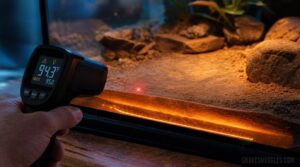
An infrared thermometer is one of the most reliable temperature monitoring devices you can use for your heat mat. Point it directly at the mat surface — line-of-sight positioning is essential for accurate readings. Mind your distance guidelines and spot size calibration so you’re measuring the right area.
Adjust emissivity settings for your substrate type, and use data logging features to track trends over time.
Check Inside The Hide
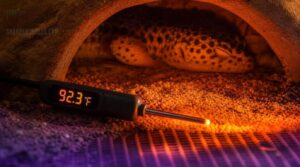
Once your infrared thermometer confirms the mat surface appears correct, don’t stop there — microclimate stability inside the hide is what actually matters for your reptile. Place a digital probe inside the hide and run a dual thermometer check to detect any temperature drift in the hide.
Record readings daily for at least a week to establish a solid baseline recording routine, ensuring the temperature requirements for your species remain consistently within 88–92°F.
Measure Through Substrate
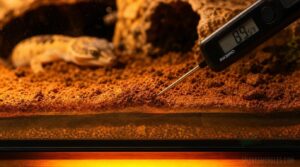
Substrate density subtly influences your reptile’s sensory experience. Moisture and conductivity variations mean a damp or loose bedding layer can reduce surface temperatures by several degrees, disrupting your entire temperature gradient. Use thermometers to verify the substrate temperature directly, not just the mat surface.
Here’s what influences heat mat installation performance through substrate:
- Dense tile transfers heat quickly, improving temperature regulation
- Loose bedding blocks warmth through conductivity variation
- Composite layering evens out surface readings
- Air gap cooling beneath the tank reduces heat delivery
Watch for Hot Spots

Hot spots don’t announce themselves — they build quietly under hides and rocks, leading to burns and overheating. Hide warm pockets concentrate heat beneath enclosed spaces, while rock heat accumulation can push surface temperatures well above your thermostat’s target. Mat warping effects and air gap variability create uneven contact zones, causing unpredictable temperature spikes.
To mitigate risks, use thermometers on a consistent temperature monitoring schedule to map multiple floor points. Focus on high-risk areas, as outlined below:
| Location | Risk Level | What to Watch |
|---|---|---|
| Under hide center | High | Hide warm pockets concentrating heat |
| Over rock base | Medium–High | Rock heat accumulation spiking temps |
| Mat edge/warped zone | Medium | Mat warping effects, air gap variability |
Temperature spike detection catches heat mat failure early, preventing serious injury.
Recheck After Changes
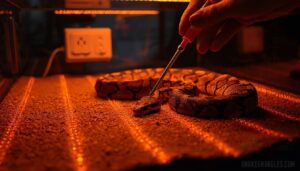
Any change to your setup — repositioning the probe, swapping a power strip, or adding a substrate barrier — resets your baseline. Run a Thermometer Calibration Check and Power Source Verification before trusting new readings. Rechecking after adjustments is critical for accuracy.
Your temperature monitoring schedule should also include a Wiring Integrity Check, Airflow Influence Review, and Barrier Adjustment Test. These steps ensure system reliability and prevent oversight in dynamic environments.
Proper temperature regulation and reptile health monitoring depend on rechecking after every adjustment. Consistent verification safeguards against fluctuations that could compromise habitat stability.
Size The Mat Correctly
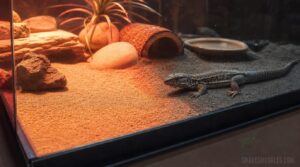
Getting the mat size right makes a bigger difference than most people realize. A mat that’s too large heats the whole tank floor, leaving your reptile no cool escape — and that’s a problem.
Here’s what to keep in mind when sizing your heat mat correctly.
Cover One-third of Floor
Your heat mat should cover roughly one-third of the enclosure floor — no more than this. This size creates a defined warm zone while leaving the rest of the tank cooler. Use offset placement, positioning the mat slightly away from the edges to support edge-hotspot reduction and improve heat distribution.
Ventilation clearance beneath the tank ensures safe, consistent thermostat control within the warm zone.
Create a Heat Gradient
A well-placed mat doesn’t just warm one spot — it creates a thermal gradient your reptile actually uses. Maintain a temperature difference between the basking spot and cool-side shade of at least 8–15°F.
Think of it like a sliding scale: a gradual shift from warm to cool, requiring careful attention to mat positioning, heat distribution ratios, and edge heat loss. This supports consistent temperature regulation across the entire enclosure.
Avoid Oversized Mats
Oversized mats break that gradient fast. When your heat mat size exceeds one-third of the floor, footprint calibration goes off, and hot spots appear near hides.
Keep these safety precautions in mind:
- Align shape alignment to the warm zone only
- Respect hide proximity — don’t extend beneath the entire hide
- Preserve airflow preservation with proper gaps
- Consider modular heat units for larger tanks
Wattage limitations and temperature requirements suffer when coverage spreads too wide.
Match Tank Wattage
Wattage selection begins with tank size: a 20-gallon enclosure requires an 8–15W low wattage UTH, while a 40-gallon demands a 15–25W medium wattage UTH. Your power-to-volume ratio directly influences mat capacity planning and energy consumption estimates.
Don’t exceed safe current limits — running an underpowered mat strains the heating element and skews wattage calculations.
Leave an Air Gap
Once you’ve matched wattage to tank size, protect that investment with one simple step: install your heat mat with a proper air gap beneath the enclosure.
To maintain this setup effectively:
- Place Non-Conductive Barriers like ceramic tile spacers to maintain gap clearance; checks should be performed monthly.
- Air Gap Spacers prevent heat flow mitigation issues caused by substrate compression.
- Gap Safety Protocols guard against thermal conductivity spikes and unintended heat loss.
Substrate Changes Heat Mat Performance
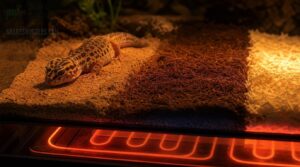
What you put on the floor of the enclosure affects how well heat actually reaches your reptile. The substrate you choose can either help the mat do its job or quietly work against it.
Here’s how different options change the equation.
Thin Substrate Transfers Heat
Think of thin substrate as a clear window for heat — it lets warmth pass through quickly because there’s minimal thermal mass blocking the path. Substrate thickness directly affects thermal conductivity and heat transfer to your reptile’s belly.
Thinner layers improve contact uniformity and heat concentration, though edge cooling effects can create uneven thermal gradients.
Always confirm how hot your reptile heating pad gets by measuring surface temperatures throughout the mat.
Loose Bedding Blocks Warmth
Loose bedding acts like a thermal blanket — insulation thickness directly reduces heat transfer from the mat to your reptile’s belly. Block material choice matters, too: wool or wood fiber traps air gaps that slow conductive heating and alter the thermal gradient.
This thermal mass effect means surface temperatures drop 5–8°C, so keep substrate thin and perform regular maintenance to prevent compressed bedding from blocking warmth entirely.
Tile Holds Heat Well
Ceramic tile is one of the smartest substrate choices you can make. Its thermal mass advantage means it absorbs heat from your heat mat steadily, then releases it slowly — providing your reptile a stable, consistent warm zone.
Porcelain tile’s efficiency is even better, thanks to its denser composition and higher heat conduction rate. This radiant stability ensures a reliable thermal gradient with minimal substrate depth adjustment needed.
Room Temperature Effects
Your ambient room temperature is the silent partner in every heat mat setup. When the room drops below 70°F, your mat works harder to maintain the thermal gradient — and energy usage impact climbs noticeably.
Rooms near 75°F keep thermostat calibration stable and reduce dew point condensation risk on glass. This baseline ambient range directly shapes temperature regulation.
Monitor ventilation airflow to prevent temperature fluctuation stress on your animal.
Adjust Gradually and Safely
Small incremental setpoints protect your reptile better than one big jump. After each thermostat calibration adjustment, allow full stabilization wait time before reading results — the enclosure needs to settle.
Keep consistent probe securing so temperature fluctuations don’t fool your readings.
Monitor the temperature and watch your animal’s behavior closely.
Your thermostat’s automatic shutoff and safety cutoff features exist for good reason — routine heat mat maintenance keeps them reliable.
Frequently Asked Questions (FAQs)
Will a heating pad help gastritis?
A heating pad won’t cure gastritis, but it can provide temporary relief for abdominal discomfort. The pain relief mechanism is muscle relaxation, not treatment.
Always address the underlying cause of gastritis. Watch for red flag symptoms like bloody stools, which require immediate medical attention.
Should a heat mat be hot to the touch?
A heat mat should feel warm to the touch — not painfully hot. If the Human Hand Test feels uncomfortable after 3 seconds, it’s likely exceeding the 100°F Safety Touch Threshold.
Is 30 degrees too hot for a corn snake?
30°C (86°F) sits just below the ideal 88–92°F basking range for corn snakes — not dangerously hot, but slightly cool for efficient digestion.
Monitor the temperature closely and adjust your thermostat accordingly.
Can heat mats cause burns through thick substrate?
Yes, thick substrate creates heat transfer lag, trapping dangerous warmth near the mat’s base. Bedding burn risk stays real even through layers, so always verify the actual animal-contact surface temperature.
How long does a heat mat take to warm up?
Most mats reach their target surface temperature within 10 to 30 minutes. Wattage significantly influences this process—higher-wattage mats close that gap fast.
Preheating 5 to 10 minutes before adding your reptile improves heat mat reliability substantially.
Do heat mats work under bioactive enclosure setups?
Bioactive enclosures can work with heat mats, but only when paired with a thermostat. Keep surface temperatures at 88–92°F to ensure optimal conditions.
Use a thin substrate and consistently monitor moisture levels to protect the mat’s longevity and support healthy microflora interactions.
Should heat mats run overnight or be turned off?
Run the mat overnight if your room drops below your species’ minimum warm-zone temperature. Use a thermostat every time — nighttime thermostat testing confirms it holds target without drifting dangerously high.
Conclusion
Consider a keeper who followed every setup step correctly—thermostat installed, probe positioned under the hide, substrate measured—yet still found their ball python restless and refusing food. The surface temperature read 97°F. Dropping it to 90°F resolved the issue within days. That is how precise this has to be.
Knowing how hot a reptile heat mat should get is not just technical knowledge; it is the difference between a thriving snake and a stressed one.
- https://www.evolutionreptiles.co.uk/blog/vivarium-thermostat-probe-position/?srsltid=AfmBOoqnQogjz-ra0dXB1GWkRRb1PC5QMTuTVyNmkEkfBqX5pA56TWro
- https://www.aussiepythons.com/threads/thermostat-settings-and-placement-with-a-heat-mat.225065/
- https://www.thebiodude.com/blogs/reptile-and-amphibian-lighting-faqs-and-help/here-s-why-you-shouldn-t-be-using-a-heat-mat-for-your-reptile?srsltid=AfmBOopOautRcmhYy9tqWFQdlGD873x5Q1cOtqk5Gc-JyEyezhW5k2JW