This site is supported by our readers. We may earn a commission, at no cost to you, if you purchase through links.

A snake doesn’t shiver. It doesn’t sweat. When its body temperature drops, it can’t simply burn more calories to warm up—it borrows heat from the world around it instead. Snake thermoregulation in the wild is less a passive quirk of biology and more an active, calculated negotiation between animal and environment, one that shapes every decision a snake makes from sunrise to dusk.
What looks like a reptile lazily sunning itself on a flat rock is actually precision physiology. That basking posture—body flattened, scales pressed against warm stone—is the snake pulling radiant and conductive heat into muscle tissue that won’t function properly without it. Strike speed, digestion, reproduction: all of it hinges on hitting the right internal temperature at the right moment.
Understanding how snakes pull this off reveals something truly impressive about cold-blooded survival.
Table Of Contents
Key Takeaways
- Snakes are active thermal strategists, not passive sunbathers—every basking posture, burrow retreat, and shade-seeking move is a calculated decision to hit the precise body temperature that unlocks digestion, hunting, and reproduction.
- Temperature isn’t just comfort for a snake; it’s the engine of survival, with too little slowing enzyme activity and immune function, and too much causing irreversible neurological damage.
- Species don’t share a universal heat target—adders thrive near 33°C while grass snakes prefer 23°C, meaning a snake’s thermal needs are as species-specific as its venom or scale pattern.
- Climate change poses an existential threat to snake thermoregulation because behavioral adaptation can shift quickly, but evolutionary hardwiring can’t keep pace with rapidly moving thermal envelopes and disappearing microhabitats.
How Wild Snakes Thermoregulate

Snakes don’t generate their own body heat — they borrow it from the world around them, and that single fact shapes almost everything about how they live.
That’s why a warm basking spot isn’t just comfort — it’s a biological necessity, as explored in this guide on how heating pads support snake digestion.
Understanding this opens the door to seeing snake behavior not as random, but as a series of calculated thermal decisions made throughout each day. Here’s how that process actually works in the wild.
Ectothermy Explained Simply
What separates a snake from a mammal isn’t just scales — it’s who controls the thermostat. Snakes are ectothermic organisms, meaning their body temperature tracks the environment rather than internal combustion. Their metabolic rates stay tightly linked to surrounding warmth, so:
- Activity depends on external heat sources
- Cold slows digestion and movement
- Warmth unlocks full physiological function
Behavioral thermoregulation replaces the furnace mammals carry internally. Because they rely on the environment, these animals often have lower food requirements compared to endotherms.
Body Heat From Surroundings
Snakes harvest heat through four main channels: radiant rock heat, infrared ground radiation, conductive water warmth, and ambient air temperature.
Sun-warmed surfaces can raise body temperature within minutes, while nearby rocks emit measurable infrared energy, adding 1–3°C passively. Even moist soil or shallow water transfers warmth through direct contact — every microhabitat becomes a thermal tool for these ectothermic organisms.
Why Temperature Control Matters
Harvesting heat is only half the equation. What a snake does with that warmth determines whether it thrives or merely survives.
Metabolic efficiency in ectothermic organisms depends entirely on body temperature — too cool, and enzyme activity slows, stalling digestion, nutrient assimilation, and growth rates. Stable thermal regulation isn’t comfort; it’s the difference between energy conservation and metabolic collapse.
Daily Thermal Decision-making
That metabolic precision doesn’t happen by accident — it’s the result of constant, active decision-making.
Every few minutes, a snake reassesses its surroundings, reading ambient cue assessment signals like substrate heat, wind, and humidity to choose its next position. Warmer mornings trigger foraging; cooler midday surfaces push snakes toward thermal refuges. Through these circadian thermal shifts, ectothermic animals choreograph their entire day around available heat.
Survival Without Internal Heating
What truly sets ectothermic animals apart is how effectively they thrive without generating a single calorie of internal warmth. A snake’s environmental heat reliance isn’t a weakness — it’s an elegantly efficient survival strategy.
A snake’s reliance on environmental heat is not a weakness — it is an elegantly efficient survival strategy
Through behavioral thermoregulation and precise ambient temperature tracking, passive heat absorption sustains every metabolic process, from digestion to immune defense, without burning precious energy reserves on body heat production.
Wild Snake Temperature Ranges

Not every snake is chasing the same temperature, and that’s exactly what makes wild thermoregulation so fascinating.
Some species even seek out specific microhabitats year-round, much like the best hiding caves for pet snakes that mimic the cool, sheltered retreats wild snakes instinctively gravitate toward.
The ranges vary considerably depending on species, season, and what the snake needs to do — whether that’s digest a meal, flee a predator, or simply stay alive. Here’s a closer look at the key temperature ranges that shape a wild snake’s daily existence.
Preferred Body Temperatures
Wild snakes don’t chase warmth randomly — they target a preferred optimum temperature zone that sits between 25°C and 35°C for most species. Within that window, metabolic activity peaks, digestion runs efficiently, and movement stays sharp.
Juveniles tolerate slightly cooler conditions, but as thermal tolerance narrows with age, hitting that range consistently becomes less optional and more essential to survival.
Species-specific Heat Needs
Not every snake is working toward the same thermal target. Adders maintain a mean body temperature of 33.2°C, while grass snakes average a cooler 23.19°C — two ectothermic species with fundamentally different thermoregulatory behavior.
Pythons require 32°C to 35°C for basic physiological health, whereas desert specialists often peak at 28–32°C. Your species determines your range. There’s no universal setting.
Seasonal Temperature Shifts
Snakes don’t experience seasons — they’re governed by them. Seasonal temperature shifts determine when brumation begins, when foraging resumes, and how behavioral adaptations must flex. Three factors drive regional variability:
- Latitude and solar radiation exposure
- Microhabitat access and thermal refugia availability
- Species-specific thermal tolerance ranges
Louisiana pine snakes illustrate this starkly, swinging from 5°C in winter to 38.5°C in summer — temperature fluctuations few vertebrates could survive.
Active Versus Resting Temperatures
A resting snake isn’t simply idle — it’s conserving energy at a carefully maintained thermal baseline. Most temperate species settle between 22 to 26°C while inactive, rising 5 to 10°C during peak activity as behavioral thermotaxis kicks in.
Digestion nudges internal temperatures slightly higher through metabolic heat production. Diel temperature cycles do the rest, letting nighttime cooling reset the body for the next day’s demands.
Dangerous Heat and Cold
Beyond a certain threshold, temperature stops being a resource and becomes a threat. Extreme overheating causes irreversible neurological damage, while prolonged cold suppresses immune function and strips a snake of its ability to flee predators.
Cold-induced lethargy isn’t passive rest — it’s vulnerability. At the margins of their thermal tolerance, snakes don’t adapt. They fail.
Even species praised for scaling harsh, high-altitude terrain can slip past their limits fast, which is why understanding which mountain snake species thrive at specific elevation ranges matters so much.
Behavioral Thermoregulation Strategies
Snakes don’t leave their temperature management to chance — they’ve developed a surprisingly active set of behaviors to stay within their ideal thermal window.
Every movement a snake makes, from stretching across a sun-warmed rock to retreating beneath a log, is basically a calculated decision. Here are the key behavioral strategies wild snakes rely on to regulate their body temperature.
Basking in Sunlight

Watch a snake stretch across a sun-warmed rock on a cool morning, and you’re witnessing solar radiation absorption at its most deliberate.
By flattening the body against the substrate, a snake maximizes its dorsal surface area, pulling heat directly from sunlight and conductive ground warmth. Darker individuals heat faster — sometimes within minutes — while posture adjustments fine-tune the process, preventing dangerous overshoot.
Moving Between Sun and Shade

Once a snake has absorbed enough solar radiation, the next move is just as deliberate — retreating to shade before body temperature climbs past a safe threshold.
Shaded microhabitats can run 5–10°C cooler than exposed basking sites nearby, giving snakes a reliable thermal refuge. That temperature gap is what makes behavioral thermoregulation so precise — not passive drifting, but calculated shuttling between zones throughout the day.
Hiding Under Cover

Shade offers a first line of defense, but when temperatures push higher, snakes move deeper — tucking beneath leaf litter, rocks, and fallen logs where thermal refuge stability holds steady.
Thicker leaf litter maintains temperatures around 20–28°C, while substrate moisture aids cooling through evaporation. Clay-rich soils slow heat exchange, letting snakes balance digestion, hydration, and energy without unnecessary exposure.
Burrow Shuttling Behavior
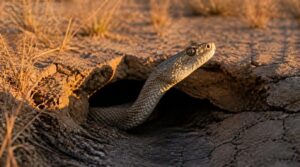
Tucking beneath cover buys time, but some snakes need something more active. North American sidewinders, for instance, move partially in and out of burrows to hold temperatures near 30°C — a technique called burrow shuttling.
The tunnel network acts as a thermal buffer, with soil conductivity and moisture retention stabilizing internal setpoints that surface conditions alone can’t reliably provide.
Refuge Basking Habits

Where burrow shuttling ends, refuge basking begins. Many snakes expose less than 25% of their body to the open sky — enough to absorb radiant heat from sun-warmed rock surfaces without becoming visible targets. Rough, dark-toned ledges warm fastest in the morning, letting snakes reach preferred temperatures quickly.
Individual snakes return to the same spots daily, a pattern of site fidelity that balances thermal gain against predator exposure.
Habitat and Microclimate Choices

Behavior only tells part of the story — where a snake chooses to be matters just as much as what it does once it gets there. Every rock outcrop, burrow entrance, and shaded patch of soil represents a deliberate thermal decision, not just a random resting spot.
Here’s a closer look at the specific microhabitats wild snakes rely on to stay within their survival range.
Rocks, Soil, and Vegetation
Rocky substrates aren’t passive backdrops — they’re thermal tools. Quartz-rich outcrops heat rapidly under direct sun, creating steep thermal gradients that snakes exploit within seconds of emergence. Dark surfaces absorb far more energy than pale limestone, whose albedo differences can shift surface temperatures by several degrees across just a few meters.
Moss-lined crevices and soil moisture buffers in rock crannies stabilize these microclimates, giving snakes precise thermal options.
Burrows and Underground Shelters
When surface temperatures climb or crash, snakes retreat underground — and burrows deliver far more than simple shelter. Subterranean microclimates buffer daily temperature swings far better than exposed soil, while multi-chamber networks let snakes shift between warmer and cooler zones without surfacing.
Damp soil composition slows heat loss, and burrow depth — commonly 20 to 60 centimeters — determines just how stable that thermal refuge becomes.
Water and Humid Areas
Water doesn’t just quench thirst — it reshapes the thermal landscape entirely. Evaporative cooling from streams and wetland surfaces can drop surrounding air temperatures by several degrees, giving snakes a precise thermal tool that rocks and soil simply can’t match.
Dense reed beds and moist leaf litter trap humidity, letting snakes thermoregulate during midday heat without full sun exposure. Higher insect activity near standing water also concentrates hunting opportunities.
Communal Winter Hibernacula
When winter arrives, snakes consolidate. Communal hibernacula are thermal refuges where hundreds enter brumation together, sharing warmth.
Four features define these sites:
- Concealed entry points limit predator access
- Deep substrate buffers against cold snaps
- Collective body heat reduces individual energy loss
- Elevated den humidity protects skin surfaces
Multiple species often share a single hibernaculum, emerging only when spring temperatures stabilize.
Cool Microhabitat Importance
Shade isn’t just comfort — it’s survival infrastructure. Soil moisture regulation and canopy cooling effects can drop ground temperatures by several degrees, giving snakes precise thermal options without exposure risk.
Rock thermal inertia extends usable warmth past sunset, while subterranean humidity benefits reduce desiccation stress. Riparian thermal buffers near streams complete the picture, offering snakes a variety of cool retreat zones that make fine-tuned thermal regulation possible.
Thermoregulation and Snake Survival

Thermoregulation isn’t just about comfort for a snake — it’s the engine driving nearly every critical life function. Get the temperature wrong, and digestion stalls, hunting fails, reproduction suffers, and escape from predators becomes nearly impossible. Here’s how temperature shapes each of those survival essentials.
Digestion and Metabolism
Temperature doesn’t just warm a snake — it drives every metabolic process inside it. Postprandial thermophily compels snakes to bask after feeding, accelerating enzyme secretion and nutrient absorption:
- Stomach acid breaks proteins into chyme
- Pancreatic enzymes split fats and carbohydrates
- Intestinal villi absorb amino acids into blood
- Gut microbes harvest energy from remaining matter
Without warmth, dietary assimilation fails.
Hunting and Movement
Once digestion is complete, hunting demands precise thermal alignment.
| Strategy | Condition |
|---|---|
| Ambush | Warm afternoon |
| Active stalking | Early morning |
| Burrow retreat | Peak midday heat |
Strike accuracy peaks when muscle temperature rises sharply. Early morning and late afternoon create ideal thermal foraging windows — prey moves actively while body heat holds. When predators appear, snakes shift quickly to short, cautious bursts toward cover.
Mating and Reproduction
Hunting sharpens the body. Mating demands it entirely.
Pheromone signaling guides males toward fertile females, while courtship displays — tongue flicks, body undulations — confirm readiness. Reproductive synchrony aligns with warm periods:
- Males surge movement during female receptive windows
- Sperm competition intensifies when multiple suitors arrive
- Gravid females increase basking to support vitellogenesis
- Parental investment remains minimal post-birth in most species
Temperature shapes everything here.
Predator Avoidance Risks
Thermoregulation and predator avoidance don’t always cooperate. Every minute a snake spends basking in open sunlight is a minute it’s visible to aerial and terrestrial hunters — hawks, foxes, and larger snakes included. When threat cues appear, snakes must weigh the thermal cost of abandoning a warm spot against the survival cost of staying exposed. That trade-off isn’t abstract; it’s immediate and often lethal.
Escape terrain shapes the outcome a lot. A snake caught in open ground with no rock crevice or dense vegetation nearby faces sharply reduced survival odds, since flight distance alone can’t compensate for limited cover.
Climate Change Pressures
Climate change is quietly rewriting the rules snakes have followed for millions of years. Shifting temperatures force habitat range shifts, pushing species beyond the microclimates they’ve evolved to exploit.
When prey availability changes unpredictably and extreme heat events spike past survivable thresholds, thermal stress vulnerability escalates fast. Snakes can adapt behaviorally — but evolutionary response moves slowly, and the climate isn’t waiting.
Frequently Asked Questions (FAQs)
Do snakes thermoregulate differently at high altitudes?
Like a climber adjusting to thinner air, high-altitude snakes face compressed thermal windows and cooler basking conditions, demanding more flexible behavioral adaptations to maintain the body temperatures that drive metabolism, movement, and survival.
Can snakes sense temperature changes through their skin?
Yes, snakes detect temperature changes through skin thermoreceptors that relay signals via distinct nerve pathways to the brain, integrating thermal feedback with other senses to trigger immediate posture adjustments and guide precise movement decisions.
How do nocturnal snakes regulate body heat at night?
Nocturnal snakes exploit residual ground heat stored in rocks and soil from the day. Flattened postures help increase contact, while microhabitat shuttling keeps body temperature stable without sunlight.
Do captive snakes lose natural thermoregulation instincts?
No — captive snakes retain thermoregulation instincts naturally. Given a proper enclosure gradient, they’ll actively seek warm or cool zones just as they would in the wild, driven by the same biological hardwiring.
How does dehydration affect a snakes thermal regulation?
A snake needs warmth to survive, yet the heat that sustains it is the same force that accelerates dangerous water loss — dehydration narrows basking windows, driving snakes toward cooler, moisture-retaining refuges and delaying postprandial thermal peaks.
Conclusion
Like a chess player who never stops calculating, a snake engaged in snake thermoregulation in wild environments plays every environmental cue with deliberate precision. Nothing is passive. Every patch of sunlight, every cool shadow, every hidden burrow represents a move in an ongoing survival calculation.
Temperature governs everything—digestion, speed, reproduction, escape. When you watch a snake press against warm stone, you’re not witnessing laziness. You’re watching one of nature’s most refined strategies play out, exactly as it should.
- https://www.thebhs.org/publications/the-herpetological-bulletin/issue-number-126-winter-2013/287-02-differences-in-basking-site-selection-between-the-sympatric-snakes-i-vipera-berus-i-and-i-natrix-natrix-i/file
- https://www.jstor.org/stable/2423461
- https://pmc.ncbi.nlm.nih.gov/articles/PMC11737337
- https://www.britannica.com/science/thermoreception/Reptiles-and-amphibians
- https://www.eyncrattlesnakes.com?tag=thermoregulation