This site is supported by our readers. We may earn a commission, at no cost to you, if you purchase through links.
A snake that won’t leave its warm hide isn’t being lazy—it’s compensating. When the thermal gradient inside an enclosure fails, the animal has no choice but to anchor itself to the one microhabitat that keeps its metabolism functional. That behavioral signal is easy to misread as personality. It isn’t.
Snakes moving between temperatures isn’t voluntary comfort-seeking; it’s a physiological necessity called shuttling behavior. Without cycling between a warm zone and a cool one, enzyme activity stalls, digestion arrests, and immune function degrades. The thermal gradient you build—or fail to build—directly governs how well your animal thrives.
Getting it right requires more precision than most husbandry guides suggest.
Table Of Contents
- Key Takeaways
- Why Snakes Move Between Temperatures
- Set Up Safe Temperature Zones
- Move Your Snake Gradually
- Spot Temperature Stress Quickly
- Adjust Temperatures by Species
- Frequently Asked Questions (FAQs)
- How cold is too cold for snakes to move?
- Where do snakes go in October?
- What do snakes do when they get too cold?
- What are signs of stress in a snake?
- Can snakes feel pain from temperature changes?
- Do wild snakes thermoregulate differently than captive ones?
- How do snakes survive extreme desert or arctic climates?
- Can temperature affect a snakes reproductive cycle?
- Do snakes communicate thermal preferences to other snakes?
- Conclusion
Key Takeaways
- Snakes move between warm and cool zones in their enclosure to regulate body temperature, a process essential for digestion, enzyme function, and immune health.
- A precise thermal gradient—distinct warm and cool areas with specific temperatures—is critical for proper snake husbandry and prevents stress or illness.
- Behavioral cues like persistent hiding, constant soaking, lethargy, or open-mouth breathing signal temperature imbalance and require immediate adjustment.
- Different snake species and life stages demand unique temperature ranges, making species-specific gradient setup and monitoring vital for their wellbeing.
Why Snakes Move Between Temperatures
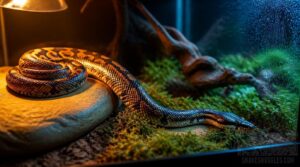
Your snake isn’t restless or confused when it moves from one end of its enclosure to the other—it’s doing exactly what its biology demands.
This restless roaming is a sign of a thriving animal—learn how healthy snake skin and body care supports that natural, confident movement.
Unlike mammals, snakes generate no meaningful body heat internally, so every temperature decision is a deliberate act of survival. Understanding why they shuttle between warm and cool zones is the first step toward building an enclosure that actually works for them.
Ectotherms Need External Heat
Unlike mammals, your snake generates virtually no metabolic heat internally. Every degree of body temperature it achieves comes from the environment — radiant energy absorbed from surfaces, conductive warmth transferred through substrate contact, ambient air pushing baseline thermal levels up or down.
Because they rely on external sources, snakes are classified as ectotherms for temperature regulation.
Vasodilation expands peripheral blood vessels during warming, accelerating heat exchange. Without that external input, enzyme activity stalls, digestion stops, and movement slows to almost nothing.
Warm Side Versus Cool Side
That external dependency is why the enclosure’s layout matters so much.
A proper thermal gradient gives your snake two distinct zones — a warm side peaking around 31–33°C and a cool side holding near 23–26°C — so it can self-regulate by simply moving. Without that range, it can’t choose. The gradient isn’t a luxury; it’s the mechanism.
Digestion and Activity Needs
Temperature doesn’t just govern movement — it drives metabolic enzyme activity and gastric emptying speed directly. When your snake moves to the warm side after eating, it’s executing postprandial thermophily: raising body temperature to accelerate specific active action and nutrient absorption.
Drop the enclosure too cool, and digestion stalls. Enzymatic breakdown slows, the meal sits longer, and assimilation efficiency drops measurably.
Shedding and Comfort
Shedding shifts your snake’s thermoregulatory priorities entirely. Rather than chasing peak warmth for digestion, it seeks stable warm microclimates that sustain skin hydration. Humidity — ideally 60–80% — softens the old layer and directly prevents eye cap retention.
- Dull, milky eyes signal an imminent shed cycle
- Reduced activity and increased hide use are expected shedding stress signs
- Retained eye caps result from insufficient ideal moisture levels
- Post-shed hydration requires immediate access to fresh water
- Restlessness indicates discomfort in poorly controlled environmental conditions
Natural Shuttling Behavior
Captive snakes shuttle between warm and cool zones with the same precision wild individuals apply when tracking sun-shade interfaces. This isn’t random movement — it’s metabolic energy budgeting in action.
Your snake modulates exposure duration to hold body temperature within a narrow, species-specific window, adjusting shuttling frequency as digestion demands rise or ambient conditions shift.
Set Up Safe Temperature Zones
Getting the thermal gradient right inside your snake’s enclosure is the foundation of everything else. Before you can move your snake safely between temperatures, the zones themselves need to be properly built and monitored. Here’s what you need to set that up correctly.
Knowing signs your snake’s enclosure is running too hot — like open-mouthed gaping or frantic soaking — helps you catch dangerous temperature imbalances before they become emergencies.
Choose Correct Heat Source

The heat source you choose shapes every thermal decision your snake makes. Ceramic heat emitters deliver steady infrared warmth without light disruption — preferable for nocturnal species. Heat mats offer conductive surface warmth but require undertank placement to avoid burns.
Always pair any source with a thermostat; unregulated heat climbs unpredictably and risks neurological damage before you notice a problem.
Create a Thermal Gradient

Position your heat source at one end only — this single decision creates the continuous temperature range your snake relies on for microhabitat selection. Aim for a warm zone near 28–32°C tapering to 22–26°C at the cool end, across at least 10–15 cm of traversable space.
Place digital probes at substrate level, not near enclosure walls. Surface readings will run higher than ambient air, so measure both.
Add Warm and Cool Hides

Two hides anchor the gradient — one over the heat source at 28–32°C, one at the cool end hitting 22–26°C. Dark, snug interiors trigger natural retreat behavior; oversized hides do the opposite.
Place each hide so your snake can slip in without obstruction. That physical access is what allows shuttling — the main thermoregulatory mechanism you’re designing the entire enclosure around.
Measure Surface Temperatures
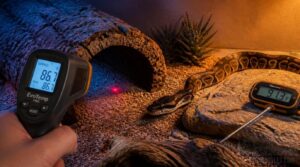
An air thermometer tells you almost nothing about what your snake actually touches. Use an infrared thermometer pointed at substrate and hide floors — not air — to capture real contact temperatures. Set emissivity to roughly 0.95 for matte surfaces; shiny hides skew readings low.
Cross-check periodically with a contact probe placed directly on the basking spot for ground truth.
Use Thermostats Safely
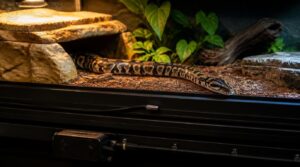
A thermostat isn’t optional — it’s the mechanism that keeps thermal regulation precise rather than guesswork.
- Match your thermostat’s device load rating to your heat source exactly
- Position the sensor away from direct heat for accurate ambient readings
- Inspect wiring regularly for fraying — loose connections cause dangerous fluctuations
Choose models with overheat protection features; your snake’s thermal tolerance ranges are narrow.
Move Your Snake Gradually

Snakes don’t tolerate abrupt temperature shifts—their physiology simply isn’t built for it. Even a well-intentioned move from a warm enclosure into a cooler room can disrupt thermoregulation if it happens too fast. Here’s how to handle each step without putting your snake’s body under unnecessary stress.
Check Current Enclosure Temperature
Before you lift the lid, verify your thermal gradient is stable. Check both the warm zone (32–35°C) and cool side (24–28°C) using a calibrated infrared thermometer — surface readings on substrate can diverge sharply from air temperature.
Log the readings. A single anomalous spike tells you less than a week of time-stamped data revealing a genuine trend.
Warm Hands Before Handling
Cold hands function as environmental stressors to a snake — the thermal mismatch disrupts its body temperature before handling begins. Target 34–36°C skin warmth first.
- Rub palms together for two to three minutes
- Hold a warm cup to raise skin temperature
- Test heat against your wrist, not fingertips
- Moisturize lightly for better tactile feedback
- Skip hot water — burns defeat the purpose
Avoid Sudden Temperature Swings
Warm hands reduce one thermal variable — but the ambient environment introduces another. Moving a snake from a 30°C enclosure into a 20°C room triggers rapid metabolic disruption: enzyme activity slows, digestion stalls, and the snake’s ability to sustain a stable body temperature collapses temporarily.
Even brief exposure to sudden temperature swings forces physiological recovery that compounds stress unnecessarily. Keep transitions gradual.
Limit Cold-room Exposure
Extending that exposure into a cold room — anything below 4°C — compounds the disruption. Your snake can’t escape the ambient drop; you control how long it lasts.
- Cap sessions at two hours per 24-hour period
- Log entry and exit times
- Wear PPE to preserve dexterity
- Make sure ventilation is good to prevent CO2 buildup
- Take mandatory rewarming breaks
CO2 accumulation worsens in poorly sealed spaces.
Return Snake to Gradient
Once you’re back at the enclosure, set your snake down on the warm side of the gradient — 29–32°C — and step back. Midbody support during placement prevents startle responses. Let it drive the process; self-selection tells you the gradient is working. Rushed returns cause thermal shock, not recovery.
| Gradient Zone | Target Temperature |
|---|---|
| Warm hide | 29–32°C |
| Mid-gradient | 26–28°C |
| Cool hide | 22–26°C |
Spot Temperature Stress Quickly

Temperature stress in snakes rarely announces itself loudly—it shows up in subtle behavioral shifts that are easy to misread or dismiss.
Knowing what you’re actually looking at makes the difference between catching a problem early and dealing with a sick animal. Watch for these five signs that your snake’s thermoregulation has gone off track.
Refusing to Leave Heat
A snake that won’t leave its warm zone despite accessible cooler hides isn’t being stubborn — it’s signaling that something in the gradient isn’t working.
Watch for repeated returns to the heat source after brief excursions, or tight coiling near the hottest spot during inactive periods. Both are deliberate thermoregulatory choices, not habits. An improperly balanced gradient often drives this behavior before illness does.
Constant Soaking Behavior
Prolonged soaking is rarely about thirst. When thermal gradients are inadequate, a snake may retreat to water as a substitute warm-cool shuttle — a misfire in microhabitat selection driven by unmet thermoregulatory needs.
Watch for:
- Skin maceration from extended immersion
- Stress-induced soaking tied to humidity regulation issues
- Substrate moisture compounding the problem
Adjust the gradient first before assuming illness.
Lethargy or Weak Movement
A cold snake doesn’t announce itself — it just stops moving purposefully. Body temperature below the preferred range suppresses enzyme activity, muscle performance, and neuromuscular drive, turning coordinated locomotion into a slow, stiff creep. Dehydration compounds this: reduced skin pliability and metabolic stress from irregular feeding both make sluggish movement even worse. If your snake won’t explore its thermal gradient, check the warm side first.
A cold snake doesn’t announce its distress — it simply stops moving with purpose
| Sign | Likely Cause | Action |
|---|---|---|
| Slow, stiff movement | Low body temperature | Raise warm-side surface temp |
| Minimal repositioning | Inadequate thermal gradient | Add basking surface or hide |
| Appetite suppression | Metabolic slowdown | Verify full gradient range |
| Sunken eyes, dry mouth | Dehydration or metabolic stress | Refresh water; assess humidity |
| Fatigue after brief activity | Neuromuscular weakness | Evaluate temps; consult a vet |
Open-mouth Breathing
Open-mouth breathing in snakes signals thermal tolerance breach, not respiratory habit. Unlike mammals, snakes don’t pant — when yours gapes, body temperature has likely pushed past safe limits, impairing heat dissipation and mucosal health simultaneously. Nasal filtration is bypassed, respiratory efficiency drops, and hyperthermia becomes a real risk.
Move it to the cool side immediately and call your vet.
Restless Escape Attempts
Persistent boundary pacing isn’t curiosity — it’s your snake communicating a thermal gradient failure. When the enclosure lacks accessible microhabitats, shuttling behavior collapses into frantic lid-testing and wall-pressing.
A steep or uneven thermal bias is usually the trigger. Check your gradient immediately, confirm hide placement on both ends, and inspect lid security before friction against edges causes skin damage.
Adjust Temperatures by Species

Thermoregulation targets aren’t universal — a ball python and a corn snake sitting side by side in identically heated enclosures aren’t getting the same deal.
Species-specific physiology, geographic origin, and life stage all shift what "ideal" actually means in practice. Here’s what each common captive species genuinely needs.
Ball Python Temperature Needs
Ball pythons operate within a narrow preferred optimum temperature zone that demands precision. Keep the basking spot at 88–92°F, the warm side at 80–85°F, and the cool side at 76–80°F — a gradient that drives thermoregulation naturally.
Post-feeding, they’ll anchor to heat for digestion. Nighttime drops to 70–75°F are safe, provided no zone dips below 70°F.
Corn Snake Temperature Needs
Corn snakes tolerate a wider thermal range than ball pythons. Keep the warm side at 85–90°F, the basking spot at 88–92°F, and the cool side at 75–82°F — a 10–15°F gradient that helps with natural thermoregulation.
- Best Digestion Ranges: 85–90°F warm side
- Hatchling Thermal Care: don’t drop below 75°F at night
- Ideal Humidity Levels: 40–60%
Boa Constrictor Temperature Needs
Boas run warmer than corn snakes across every zone. Reptilian thermoregulation at this scale demands a thermal gradient spanning 75–95°F — cool end at 75–80°F, warm end at 86–90°F. The ideal basking spot should reach 90–95°F to satisfy digestive heat requirements after feeding. Nights can safely drop to 70–80°F without suppressing metabolic activity or disrupting thermoregulation.
| Zone | Target Range |
|---|---|
| Cool end | 75–80°F (24–27°C) |
| Warm end | 86–90°F (30–32°C) |
| Basking spot | 90–95°F (32–35°C) |
| Nighttime | 70–80°F (21–27°C) |
Young Versus Adult Snakes
Age changes everything. Juveniles demand tighter thermal gradients — their rapid growth, frequent feeding cycles, and higher susceptibility to dehydration leave almost no margin for error.
Adults tolerate slightly wider ranges as metabolic demands stabilize. That said, don’t loosen your gradient carelessly; even experienced snakes shuttle between zones deliberately, using warmth to drive digestion and cooler areas to pace activity.
When to Call a Vet
Open-mouth breathing, audible wheezing, or mucus around the nares aren’t thermoregulation failures — they’re respiratory emergencies. The same urgency applies to a snake soaking compulsively despite a correct gradient, or one that can’t right itself after being placed upright.
Prolonged cool-zone retreat paired with lethargy signals systemic illness, not preference. Don’t wait. A reptile-experienced vet, contacted early, is the difference between intervention and organ damage.
Frequently Asked Questions (FAQs)
How cold is too cold for snakes to move?
Like a engine starved of fuel, a snake’s muscles simply stop firing in the cold. Below 60°F (5°C), movement slows dramatically. Near 40°F (4°C), thermoregulation collapses entirely.
Where do snakes go in October?
In October, snakes migrate toward denning sites—rock crevices, burrows, or beneath logs—triggered by cooling nights and shorter days. They select thermal refuges and hibernacula, often crossing roads, seeking stable microhabitats for winter brumation and energy conservation.
For captive snakes, proper snake bedding depth supports natural burrowing without trapping excess moisture.
What do snakes do when they get too cold?
Coincidentally, when ambient temperatures drop, snakes enter brumation—slowing metabolism and movement. They seek thermal refuges like burrows, may regurgitate undigested prey, and risk muscle performance decline.
Sensory delays and hypothermia survival strategies dominate until warmth returns.
What are signs of stress in a snake?
Defensive postures, tail fleeing, and muscle tremors signal acute stress. Appetite changes, persistent hiding, abnormal shedding, and open-mouth breathing indicate chronic distress.
Watch for lethargy, seeking shade, or escape attempts—signs your snake’s thermal tolerance limits are breached.
Can snakes feel pain from temperature changes?
When things get too hot to handle, snakes rely on thermal nociception pathways to detect harmful temperatures. They respond with protective avoidance behaviors—retreating or seeking shade—since heat stress signals can exceed their thermal tolerance limits and threaten welfare.
Do wild snakes thermoregulate differently than captive ones?
Wild snakes rely on microhabitat diversity and behavioral thermoregulation—constantly shuttling between sun, shade, and cover. Captive snakes, constrained by artificial gradients, lose access to complex thermal landscapes and exhibit less seasonal variation and subtle heat-driven behavior.
How do snakes survive extreme desert or arctic climates?
Desert snakes rely on thick scales and wax coatings for water conservation, efficient kidneys, and behavioral thermoregulation. Arctic species use fat reserves, metabolic downregulation, and subsurface microhabitats to withstand cold, minimizing energy and water loss through seasonal torpor.
Can temperature affect a snakes reproductive cycle?
Paradoxically, warmer temperatures can both accelerate gestation and increase embryo mortality.
Your snake’s reproductive cycle hinges on thermal cues—higher heat speeds development, affects neonate size, and shapes offspring phenotype, but extremes risk viability and disrupt metabolic and physiological functions.
Do snakes communicate thermal preferences to other snakes?
Snakes use gular pushing signals, tail skin contact, and heat gradient cues to indicate preferred thermal niches.
Communal clustering and subtle behavioral signals—like coiling or movement—help establish thermal social boundaries and guide conspecifics toward ideal thermoregulatory behavior.
Conclusion
A snake’s journey through its thermal gradient is an allegory for survival—a precise negotiation between extremes, dictated by thermoregulatory need.
Your role mirrors that of a steward, calibrating the environment so shuttling isn’t a gamble but a calculated move. When a snake moving between temperatures becomes smooth, you witness biology at its most honest. Every adjustment you make is a safeguard. The gradient isn’t just habitat—it’s the line between dysfunction and peak health.
- https://esajournals.onlinelibrary.wiley.com/doi/10.1890/0012-9658%282001%29082%5B3025%3ATEOBRS%5D2.0.CO%3B2
- https://www.nature.com/articles/s41598-024-69378-4
- https://herpetozoa.pensoft.net/article/162512
- https://journals.biologists.com/jeb/article/213/2/242/9936/Thermal-plasticity-in-young-snakes-how-will
- https://www.desertmuseum.org/books/nhsd_adaptations_amph.php