This site is supported by our readers. We may earn a commission, at no cost to you, if you purchase through links.

Your ball python emerges at dusk, right on schedule, while your garter snake basked hours earlier and now hides, full and still. Same reptile family, opposite clocks. That split runs deeper than habit—it’s wired into pit organs, retinas, and even hypothalamic temperature control.
Understanding nocturnal vs diurnal snake species isn’t trivia for reptile keepers. It shapes lighting schedules, feeding times, and handling windows that keep a snake calm instead of stressed.
Once you see why timing matters, care stops feeling like guesswork.
Table Of Contents
- Key Takeaways
- Nocturnal Vs Diurnal Snakes
- Common Snake Activity Patterns
- Why Snakes Choose Active Hours
- Sleep and Hunting Adaptations
- Pet Snake Care by Schedule
- Frequently Asked Questions (FAQs)
- Are most snakes diurnal or nocturnal?
- What snakes are diurnal?
- What snakes are not nocturnal?
- What venomous snakes are nocturnal?
- Can a snake switch from diurnal to nocturnal permanently?
- Do snakes dream during REM sleep episodes?
- Are nocturnal snakes more dangerous to encounter than diurnal ones?
- Does activity pattern affect a snakes lifespan?
- Conclusion
Key Takeaways
- A snake’s activity pattern is wired into its pit organs, retinas, and hypothalamus, driving everything from hunting strategy to sleep cycles.
- Sensory adaptations differ sharply by schedule: nocturnal snakes rely on rod-dominated retinas and heat-sensing pit organs, while diurnal snakes depend on daylight vision and sunlit basking to hunt.
- Matching enclosure lighting, heating, feeding times, and handling windows to a snake’s natural activity cycle reduces stress and supports its health.
- Activity timing isn’t fixed—temperature, prey availability, predator pressure, habitat, and season all interact with genetic instinct to shape when a snake is active.
Nocturnal Vs Diurnal Snakes
Every snake follows its own internal clock, and that clock shapes almost everything it does. Knowing whether your snake is wired for daytime or nighttime activity changes how you’ll approach its care. Here’s a closer look at what sets these two patterns apart.
Since day-active and night-active snakes often need different basking temperatures, checking how hot a snake heating pad should get helps you match warmth to your snake’s natural rhythm.
Daytime Activity
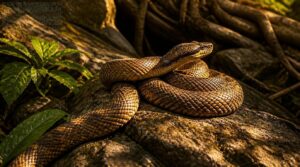
Sunrise changes everything for a snake. As temperatures climb, daytime basking behavior kicks in—stretching along sunlit rocks to increase solar gain.
| Time | Activity | Location |
|---|---|---|
| Morning | Basking | Sunlit rocks |
| Midday | Foraging | Open canopy gaps |
| Afternoon | Resting | Shaded retreats |
Diurnal foraging cues like moving prey trigger hunts. Microhabitat selection balances warmth against predator exposure throughout the day.
Nighttime Activity
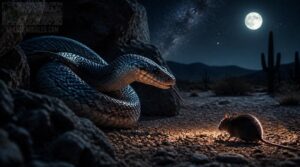
Once the sun drops, nocturnal snakes take over. Cooler ground temperatures and post-sunset movement trigger hunting, tapping nighttime thermal reserves built from afternoon basking.
temporal separation from diurnal competitors reduces resource competition for these night hunters.
| Cue | Response | Benefit |
|---|---|---|
| Falling temps | Emerge from cover | Avoid overheating |
| Prey waves | Ambush strikes | Efficient energy use |
| Full moon | Increased activity | Better visibility |
Nighttime heat detection and dark substrate stealth help snakes move unseen, exploiting nocturnal prey waves most diurnal snakes miss entirely.
Crepuscular Behavior
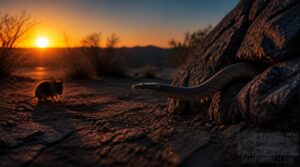
Between the extremes sits a third strategy: crepuscular activity, tied to dawn and dusk twilight windows.
| Twilight Factor | Effect on Behavior |
|---|---|
| Low-light contrast | Sharpens prey silhouettes |
| Transitional temperature cycles | Optimizes muscle performance |
| Crepuscular prey alignment | Boosts ambush success |
| Microhabitat shelter selection | Helps circadian rhythm |
This behavioral ecology of snakes reflects reptile ecology balancing risk and reward during twilight foraging windows.
Key Differences
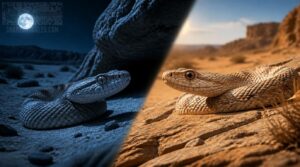
Twilight foragers aside, the real split comes down to Temporal Hunting Cycles and Visual Sensory Divergence.
| Trait | Nocturnal/Diurnal Difference |
|---|---|
| Peak activity | Night vs. daylight hours |
| Pupil shape | Vertical vs. round |
| Thermoregulation | Pavement warmth vs. basking |
| Predator avoidance | Camouflage vs. speed |
| Microhabitat selection | Cool refuges vs. sunny edges |
Your activity cycle knowledge shapes better care decisions ahead.
Understanding how a snake’s tongue works reveals why nocturnal hunting comes so naturally to these fascinating reptiles.
Pet Snake Relevance
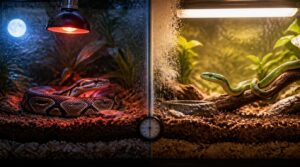
Knowing whether your snake hunts by day or night isn’t trivia—it’s the backbone of good reptile husbandry. It shapes enclosure lighting, feeding schedule, and temperature gradient decisions.
| Care Element | Adjusted By Activity Pattern |
|---|---|
| Lighting | Matches natural photoperiod |
| Feeding | Offered during active phase |
| Handling | Timed to reduce stress |
| Heating | Warm zone placement |
Watching these rhythms builds patience and sparks real conservation interest in young keepers.
Common Snake Activity Patterns
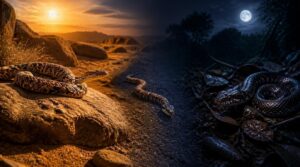
Not all snakes follow the same clock, and knowing who’s who makes a real difference. Some species bask under the sun, others hunt in darkness, and a few split the difference at dawn and dusk. Here’s a closer look at where each type fits, along with how their schedules can shift with the seasons.
Diurnal Snake Species
Diurnal snakes—like garter snakes and copperheads—rely on sun basking each morning before hunting. They use sunlit habitat camouflage, blending into grasslands and rocky shores while employing daytime prey selection to catch lizards and small mammals.
Daylight hunting strategies depend on basking microhabitats: rocks, logs, open soil. Seasonal activity shifts push these species earlier into spring, later into fall, showing distinct species-specific activity patterns.
Nocturnal Snake Species
When darkness falls, ball pythons and boa constrictors switch into full ambush mode, relying on thermal prey detection through facial pits rather than sight alone. Their rod-dominated retinas capture what little light exists, while nighttime hunting strategies favor stillness over pursuit.
Moonlight activity modulation matters too—brighter nights often mean less movement, since exposed nocturnal snakes risk becoming visible themselves.
Crepuscular Snake Species
Some snakes split the difference, hunting only at dawn and dusk. Crepuscular species like the corn snake and MacClelland’s coral snake time their twilight hunting peaks to cooler air and dim light.
This window offers real crepuscular activity advantages: prey moves more, predators see less, and heat stress drops. Low-light visual cues and ground vibrations guide these crepuscular foraging windows effectively.
Seasonal Pattern Shifts
Activity schedules aren’t fixed—they drift with the calendar. Warmer spring days can push temperature-induced shifts, moving hunting hours earlier by days or weeks.
Prey surge timing matters too: migrating rodents in spring often pull species toward daytime foraging, while summer droughts send them back to dusk. Come winter, brumation and seasonal acclimatization dial activity down until microclimates warm again.
Species Comparison Chart
Picture five snakes side by side—each one running on a completely different clock. King cobras and garter snakes hunt by day, ball pythons and boas by night, while corn snakes split the difference at twilight.
That’s species-specific activity patterns in short: activity timing differences trace back to habitat, metabolism, and hunting strategy, not random chance.
Why Snakes Choose Active Hours
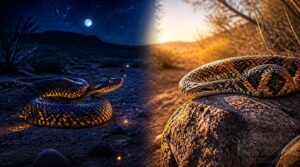
A snake’s schedule isn’t random; it’s shaped by real survival pressures. Body temperature, food, safety, and even instinct all play a part in when a snake chooses to move. Here’s what actually drives that timing.
Temperature and Thermoregulation
Because you can’t shiver away a chill, your snake’s schedule bends entirely around thermal conditions. As ectotherms, snakes depend on basking and shade-seeking to hit that 25–32°C sweet spot.
The hypothalamus reads these cues, triggering vasodilation to shed heat or vasoconstriction to conserve it—driving temperature-dependent activity toward whichever hours offer the safest thermal niche.
Prey Availability
Where the food is shapes your snake’s clock as much as temperature does. Rodent booms, wetland frog pulses, and lizard hotspots pull hunters toward specific hours.
- Seasonal birthing peaks boost mammal numbers
- Rain triggers wetland amphibian surges
- Invertebrate swarms create brief feeding windows
- Rock piles cluster lizards for daytime hunters
Nocturnal foragers track rodent activity; diurnal hunters key into sunlit prey clusters.
Predator Avoidance
Hunger isn’t the only clock-setter—staying alive matters just as much. Many snakes time activity to dodge predator pressure, favoring hours when hawks or foxes hunt less.
Camouflage and cryptic stillness help during exposed moments, while quick shelter-seeking behavior into crevices offers backup. Coiling, hissing, or flattening the body serve as last-resort defensive postures when retreat isn’t fast enough.
Habitat Type
Where a snake lives shapes when it moves.
Aquatic environments push species toward daytime hunting near shorelines, since riparian zones stay cooler under direct sun. Terrestrial habitats vary more—forest floor dwellers use leaf litter and root zones for nighttime cover, while grassland snakes bask on open mounds. Urban patches offer wall crevices and irrigation runoff, creating their own temperature gradient for resting.
Genetic Instincts
Before a snake ever feels sun on its scales, its schedule is already written into its DNA. Neural circuit wiring established during embryogenesis shapes activity timing, while neurotransmitter system regulation fine-tunes motivation.
Long before a snake feels the sun, its activity schedule is already written into its DNA
- Epigenetic instinct modulation adjusts gene expression without changing DNA
- Sensorimotor sequence encoding hardwires escape and foraging patterns
- Circadian rhythm in reptiles stems from genetic heritage
- Evolutionary behavioral conservation links species-specific activity patterns across lineages
Behavioral plasticity still allows some flexibility within these inherited limits.
Sleep and Hunting Adaptations
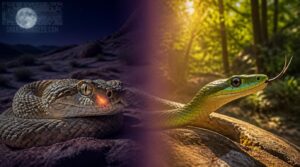
Snakes don’t just rest differently than you do—their bodies hunt differently too. Sleep patterns, eyes, and specialized senses all work together to help them find food in their preferred light conditions. Here’s a look at the five adaptations that make this possible.
Snake Sleep Cycles
Do reptiles dream? Snakes cycle through REM-like sleep and slower, deeper stages, each tied to circadian rhythm.
Neural activity bursts appear as twitches or tongue flicks, brief sensory checks that keep watch without full wakefulness. During deeper stages, metabolic rate drops, breathing slows, and the brain likely consolidates memories of hunting routes—reinforcing paths worth remembering.
Brilles Instead of Eyelids
Ever notice a snake’s eyes never blink? That’s the brille, a fixed transparent scale replacing eyelids entirely.
It seals in ocular moisture and shields against dust, protecting vision without movement. During shedding cycles, the brille turns cloudy or bluish beforehand, then renews completely.
This adaptation helps nocturnal snakes, diurnal snakes, and crepuscular species alike, part of essential reptile physiology preserving visual acuity across all activity patterns.
Low-Light Vision
Picture trying to read in a room lit only by starlight—that’s a nocturnal snake’s nightly reality. Their retinas lean on rod cells, sacrificing color for motion detection through scotopic vision mechanics.
Lateral inhibition sharpens edges against visual signal noise, while retinal adaptation takes 20-30 minutes. This light sensitivity helps visual hunting when rod-cone interactions boost contrast, letting snakes track prey shapes despite grainy, colorless surroundings.
Heat-Sensing Pits
Some snakes see heat itself. Pit organs use a thin membrane loaded with TRPA1 proteins, converting tiny warmth shifts into nerve signals mapped by the trigeminal nerve.
This heatsensing vision detects differences as small as 0.003°C, giving pit vipers and boas sharp infrared spatial resolution. Your snake’s brain fuses this thermal image with other prey detection cues for precise strikes.
Vibration Detection
Your snake doesn’t need eyes to "hear" a footstep. Ground vibrations travel through jawbone sound transmission straight to the inner ear, giving nocturnal hunters a backup sense when darkness limits vision.
- Substrate motion sensing detects stepping prey
- Prey vibration cues guide ambush timing
- Environmental noise can dull sensitivity
This coordination between senses sharpens hunting strategy for any nocturnal snake moving through a moonless night.
Pet Snake Care by Schedule
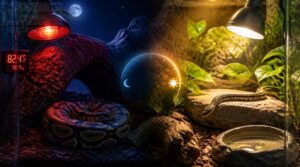
Knowing your snake’s natural schedule changes everything about how you care for it. Lighting, heating, handling, feeding, and hiding spots all need to match its active hours. Here’s what that looks like in practice.
Lighting and Photoperiods
Get your light-dark cycle right, and you’re halfway to a thriving snake. Diurnal species need 1,000 to 2,000 lux daytime brightness for 12-14 hours; nocturnal snakes want darkness below 0.5 lux at night.
Red light lets you observe without disrupting rest. Skip UV unless your species requires it. Automated timers keep photoperiods consistent, protecting circadian rhythm stability and minimizing light pollution near sleeping areas.
Nighttime Heating
Once the lights go dark, heat still matters. Ectothermic bodies can’t regulate their own warmth, so overnight temperature drops (below 60°F) cause sluggishness fast.
Radiant heat sources like ceramic emitters warm objects directly without light, protecting darkness while maintaining a stable gradient.
- Prevents chronic stress
- Avoids dangerous cold-snaps
- Preserves natural rhythms
Keep nighttime setpoints steady; thermal stability protects sleep and health alike.
Best Handling Times
Timing matters as much as technique. Approach diurnal species mid-morning, after basking, and handle nocturnal snakes shortly after they wake at dusk.
Keep sessions to 2-4 minutes, watching for tail tremors or gaping. Stop immediately if stress appears, then let them retreat to a hide.
Reassess your handling schedule monthly, since activity patterns shift with seasons.
Feeding Active Snakes
Match prey to your snake’s activity cycle. Offer frozen thawed prey sized to body width using tongs, mimicking natural strikes.
- A coiled ambush pose before the strike
- Steady tongue-flicks scenting the air
- A quick constriction, then stillness
Feed nocturnal species at dusk, diurnal ones midday. Watch post-feeding digestion—firm bellies signal healthy feeding responses.
Stress-Free Hides
Once your snake retreats to its hiding spot, resist checking on it constantly—repeated disturbance undermines the purpose.
| Hide Feature | Ideal Range |
|---|---|
| Warm hide temp | 28–32°C |
| Cool hide temp | 22–26°C |
| Humidity | 60–70% |
Best hide sizes vary by growth stage, so keep two options available. This stress reduction approach reflects genuine habitat preference and promotes long-term welfare.
Frequently Asked Questions (FAQs)
Are most snakes diurnal or nocturnal?
It’s a mixed bag out there. A European survey found 68% of snake species are diurnal, 15% nocturnal, and 17% crepuscular—so daylight hunters dominate, though nighttime and twilight snakes still make up a notable share.
What snakes are diurnal?
Corn snakes, garter snakes, rat snakes, and racers all count as diurnal, hunting lizards and rodents through daytime basking and sunlit habitat foraging, using visual cues rather than heat-sensing to guide their daily hunting tactics.
What snakes are not nocturnal?
Think of it as flipping night into day: strictly diurnal species like Black Mambas and Copperheads embrace sun-seeking behaviors, showing daylight activity patterns and diurnal hunting tactics rather than darkness-based foraging.
What venomous snakes are nocturnal?
Kraits deliver neurotoxic venom after dark, Gaboon vipers use heat sensing, and rattlesnakes rely on thermal detection. These venomous snakes favor nighttime ambush tactics and specialize in nocturnal prey, unlike diurnal or crepuscular species with different activity patterns.
Can a snake switch from diurnal to nocturnal permanently?
Permanent switches are rare, but diel plasticity allows temporary shifts. Environmental triggers like temperature and prey availability drive activity shifting more than fixed circadian adaptation, so behavioral flexibility persists rather than becoming truly permanent for most species long-term.
Do snakes dream during REM sleep episodes?
You might assume active REM means active dreaming, but that’s not quite right here. Snakes show minimal REM signatures, simpler brain structures, and no dream-like narratives—rest helps energy conservation and basic neural maintenance, not mammalian-style dreaming.
Are nocturnal snakes more dangerous to encounter than diurnal ones?
Not inherently. Danger depends on species, not activity cycle — venom potency doesn’t track nocturnal or diurnal habits. Ambush hunters may strike if disturbed, while diurnal species usually detect and avoid you first, reducing bite risk through visual awareness.
Does activity pattern affect a snakes lifespan?
Yes. Foraging energy costs and metabolic aging rates shape longevity — active hunters burn more energy and face greater environmental hazard exposure, while sit-and-wait species conserve energy, lowering wear and pathogen encounter risks over their lifespan.
Conclusion
Funny thing—the snake ignoring you at noon isn’t lazy, it’s just waiting for its shift to start. That’s the quiet irony of keeping reptiles: the pet you barely see may be the healthiest one in the room.
Grasping nocturnal vs diurnal snake species turns confusion into confidence, replacing guesswork with a schedule that matches biology. Watch the clock your snake keeps, not the one on your wall. Timing isn’t a detail. It’s the whole relationship.
- https://www.pixfra.com/snakes-after-dark-hunting-patterns-and-behaviors-revealed
- https://a-z-animals.com/blog/are-snakes-nocturnal-or-diurnal-their-sleep-behavior-explained
- https://journals.biologists.com/jeb/article/225/24/jeb244478/286197/Pit-viper-thermography-the-pit-organ-used-by
- https://timesofindia.indiatimes.com/etimes/trending/night-snakes-discover-more-about-hypsiglena-torquatas-habitat-behaviour-diet-physical-traits-and-ecological-role/articleshow/126140164.cms
- https://animaldiversity.org/accounts/Hypsiglena_torquata