This site is supported by our readers. We may earn a commission, at no cost to you, if you purchase through links.

A rattlesnake can strike in under half a second, faster than you can pull your hand back. That single fact explains why do snake owners use handling hooks in nearly every enclosure, from beginner ball python setups to venomous species collections. Bare-hand contact isn’t just risky, it’s unpredictable: your hand carries warmth, motion, and pressure cues that snakes read as feeding time, threat, or both.
A hook changes that equation. When you approach mid-body with a smooth steel shaft instead of fingers, you create distance, control the strike path, and send a clear, non-feeding signal the snake can recognize.
That distinction, between hands that feed and tools that handle, sits at the center of safer, calmer snake ownership.
Table Of Contents
- Key Takeaways
- Snake Owners Use Hooks for Safety
- Hooks Reduce Stressful Hand Contact
- Hooks Separate Feeding From Handling
- Hooks Help Move Snakes Safely
- Choosing The Right Snake Hook
- When Hooks Are Not Enough
- Frequently Asked Questions (FAQs)
- Why do snake handlers use a hook?
- What snake has a 100% fatality rate?
- What do snakes absolutely hate?
- Do any snakes enjoy handling?
- How much does a snake hook typically cost?
- How do you sanitize a snake hook properly?
- How often should hooks be inspected for wear?
- What hygiene steps follow handling a snake?
- What results show a hook training is working?
- Conclusion
Key Takeaways
- Handling hooks create physical distance from bites by keeping fangs beyond arm’s reach, since a rattlesnake can strike faster than a hand can react.
- Hooks eliminate warmth, pressure, and grip cues bare hands send, which snakes often misread as feeding or threat signals, reducing defensive strikes and stress.
- Consistent hook use, motion, and timing teaches snakes to distinguish handling from feeding, cutting down on mistaken bites over time.
- Hooks aren’t a substitute for caution with sick, recently fed, highly defensive, or very large snakes, where professional or veterinary guidance is the safer choice.
Snake Owners Use Hooks for Safety

When you reach for a hook instead of your bare hand, you’re buying yourself a safety margin that matters. A rattlesnake can close half its body length in under a second, so distance isn’t optional, it’s strategy. Here’s what that extra distance actually does for you and your snake.
Picking the wrong tool can turn that safety margin into a false sense of security, which is why this guide to choosing the right hook length for experienced keepers walks through matching hook size to species and situation.
A rattlesnake can close half its body length in under a second, so the extra distance a hook gives you is strategy, not option
More Distance From Bites
When a rattlesnake strikes, it can cover half its body length in under a second, which means your safety distance matters more than reflexes.
A snake handling hook gives you that arm length buffer, keeping fangs beyond reach. You’ll extend your strike range margin well past the bite zone, so bite risk mitigation becomes automatic instead of reactive—no guesswork, just distance doing the work for you.
Safer Enclosure Opening
Safer enclosure opening starts before your hand ever crosses the threshold. If you’re using a hook to sweep or check position first, you’ll avoid startling a coiled snake near the door—the same snake handling safety logic that keeps interlocks and secure access points standard in industrial enclosures, just applied to a glass tank.
Reduced Defensive Strikes
Once you’re inside, the hook keeps working for you. Placing it near the midsection gives you midsection coil control, disrupting the strike path before it starts.
- Fewer frantic thrashing episodes
- Lower escape attempts
- Calmer snake behavior overall
This controlled containment reduces snake stress and builds real strike avoidance skill into your snake handling hook routine.
Better Control During Lifting
Once you’ve moved past strike control, lifting becomes the next test of your snake handling technique. Midbody placement keeps the center of mass aligned with the lifting axis, minimizing angular twisting as you raise the snake.
| Lift Element | Benefit |
|---|---|
| Controlled ascent speed | Prevents startle |
| Smooth lifting arcs | Reduces strain |
You’ll notice steadier, more predictable movement with proper lifting techniques.
Helpful for Nervous Snakes
When your snake’s temperament runs anxious, a snake handling hook works like a translator between you two. Warm hands trigger defensive strikes, but hook contact avoids that trigger entirely, keeping hormone spikes down and letting body softening occur naturally—signaling trust instead of threat during your reptile stress management routine.
Just as with people, learning to manage healthy boundaries is essential for maintaining safety and control.
Hooks Reduce Stressful Hand Contact

Your hands carry warmth and a grip your snake reads as threat, not affection. A hook changes that entire equation before you even make contact. Here’s what shifts when you swap hands for steel.
Less Sudden Warmth
Your bare hand carries body heat that a snake reads as a threat cue, triggering defensive strikes before you even make contact. A snake handling hook keeps that warmth at a distance, letting thermal cue anticipation work in your favor instead of against you.
When your snake stays relaxed during handling, it’s easier to spot subtle mood shifts, so it helps to learn how to read your ball python’s stress signals before reaching for the hook.
When you avoid sudden thermal spikes, you support stable metabolic rates and calmer responses—key to real snake handling safety and lasting reptile stress management.
Gentler First Contact
That first touch sets the tone for everything after. A snake hook offers a non-threatening silhouette, easing tactile familiarity without triggering hormone spikes tied to grabbing hands.
Gentle contact conditions calmer responses over time. Three payoffs stand out:
- Lower startle reactions
- Predictable handling cues
- Reduced defensive strikes
When you introduce touch this way, you’re building trust your snake will recognize session after session.
Branch-like Body Support
Think of a tree limb your snake would choose on its own, and you’ve got the idea behind branch contact design. The curved surface mimics that natural perch, delivering Natural Mimicry Benefits while spreading pressure evenly across the body.
This distribution matters. When weight spreads across a wider contact area, you’re preventing rib compression and giving stable ventral contact that a single-point grip never could.
Less Grabbing Pressure
Grabbing tight around a snake’s midsection invites trouble—distributed force beats a death grip every time. When you use a hook instead of your hands, you’re applying minimalist contact that protects ribs and prevents thrashing.
Benefits include:
- Rib protection
- Predictable movement
- Reduced injury risk
- Smoother restraint
- Lower stress signals
Calmer Handling Sessions
Consistency builds trust. When you keep your routine handling cues and movement patterns predictable, your snake learns what’s coming next, and physiological stress indicators like tail flicking and elevated head posture start dropping off.
Stabilize the room’s temperature and humidity, position yourself near an escape route, and end each session the same way. That’s how calm becomes the norm, not the exception.
Hooks Separate Feeding From Handling

When your snake can’t tell whether your hand means dinner or a checkup, mistaken bites happen. A hook fixes that confusion by giving each activity its own distinct signal. Here’s how that separation actually works in practice.
Clear Handling Signal
Why does your snake seem to "know" when it’s about to be lifted? Because you’ve taught it to.
When you use a consistent visual signal—the same hook motion, speed, and 1.5–3 second duration—your snake builds anticipatory behavior, recognizing your gesture before contact. This gesture recognition training relies on minimizing sudden movements, giving your snake predictable cues that separate calm handling from feeding time entirely.
Gentle Hook Tapping
Once your snake recognizes the signal, the actual tap pressure calibration matters just as much. You’ll want brief, light contact—not restraint—applied at 2-4 inches per second, which prompts movement without triggering a startle response.
Slow, consistent tapping rhythms beat sudden grabs every time. This gentler technique acclimates nervous snakes to periodic handling, making inspections predictable rather than threatening.
Lower Feeding Response
Your snake’s mouth opens fast when it mistakes touch for prey, but a snake hook keeps that trigger quiet by minimizing thermal cues your bare hands would send. Cooler contact means less confusion between feeding time and routine handling.
This lowers cortisol spikes and prevents olfactory confusion, so feeding latency stays predictable across sessions—especially useful with high-strung temperaments.
Fewer Mistaken Bites
When your hook approaches at mid-body instead of striking distance from the head, your snake reads that as strike avoidance techniques in action, not an attack. This visual distance cue lets it track your movement calmly.
You’ll manage strike misidentification by signaling intent clearly through slow, deliberate contact, giving both of you a safety buffer that prevents accidental strikes and reduces startle reflexes during routine snake handling.
Consistent Routine Cues
Every time you handle at the same hour, using the same daily timing anchor, your snake’s nervous system learns what’s coming before you even open the enclosure.
- Morning handling sessions before feeding
- Same storage spot for your hook
- Logged sessions tracking temperament shifts
That routine, paired with visual tool placement near the enclosure, builds behavioral cues your snake trusts, lowering strike risk and keeping sessions calm.
Hooks Help Move Snakes Safely

When you’ve got the feeding cues sorted, the next challenge is getting your snake from one place to another without a struggle.
Moving a snake safely takes more than just scooping it up, and a hook gives you the extra stability and control that bare hands can’t. Here’s what safe, hook-assisted movement actually looks like in practice.
Mid-body Support
Midbody contact is where torso stability meets snake restraint. When you place the hook one-third back from the head, you’ll create a pivot point that steers motion while keeping weight distributed across your forearm and shoulder—not your fingers.
If your grip relies on wrist strength alone, fatigue sets in fast; muscle memory drills fix that habit.
Slow Controlled Movement
Speed kills control. Keeping the hook’s velocity under 0.5 meters per second lets you make micro-adjustments before problems start.
- Steadier snake, calmer nerves
- Fewer startled strikes
- Cleaner, safer transfers
- Confidence that builds session by session
This pace relies on even muscle tension and breath synchronization, reinforcing the kinesthetic mapping your hand already knows from precision drills—essential to safe snake handling techniques.
Safer Cage Cleaning
Cleaning a live enclosure means moving an animal that doesn’t understand your intentions. If you guide the snake onto a snake hook and support mid-body, you’ll clear tank space for daily spot cleaning or weekly bedding replacement without bare-hand contact.
Pair this with gloves, safe cleaning agents like diluted vinegar, and a sanitation log tracking each session—your hands stay protected while cleaning stays consistent.
Easier Health Checks
A hook turns a squirming exam into a controlled one. When you support mid-body and let the snake rest along the shaft, you get a clear view for visual health indicators—eyes, mouth, skin condition—plus room for respiratory cue monitoring and digestive health tracking.
You’ll log findings through standardized documentation methods, building a real health record instead of guesswork.
Secure Short Relocations
Moving a snake between enclosures doesn’t have to turn into a wrestling match. When you plan the relocation route in advance and pick transfer equipment suited to the snake’s size, you avoid noisy detours and rushed handling.
You’ll score stress using a simple scale, check environmental consistency between enclosures, and confirm post-transfer health within 24 hours—keeping every short move as calm as the last.
Choosing The Right Snake Hook
When you pick the wrong hook, you’ll fight your equipment instead of your snake’s behavior. The right choice depends on size, material, and grip, not just what’s on sale. Here’s what to look for before you buy.
Match Snake Size

Why does hook size matter as much as your snake’s diet? Because a hook that’s too short or too flimsy won’t give you enough control.
Match shaft length to your snake’s body length, considering body width proportions and species morphology differences—slender colubrids and thick-bodied boas need different-scaled snake handling equipment for safe, controlled reptile handling.
Mini-hooks for Hatchlings

Scaling down doesn’t just mean a shorter shaft—it means rethinking the whole tool. Minihooks run 4-6 inches with a 1-1.5 inch head, sized to avoid minimizing jaw crowding on a hatchling’s small mouth.
Stainless construction keeps things light without sacrificing hatchling scale safety, while a blunt tip and lightweight hook maneuverability support short lifts that avoid preventing spine bending during delicate handling.
Longer Hooks for Adults
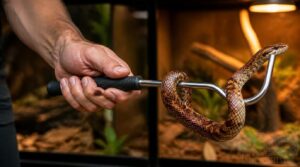
Once you graduate past hatchlings, you’ll need a tool built for better control and balance, not just reach. Adult snake hooks run 12-16 inches with a 1-1 to 1-2 inch shaft.
Look for:
- Rust-resistant steel construction
- Weight distribution favoring the head
- Ergonomic handle design
- Precise lifting angles without wrist strain
Smooth Rounded Hook Heads

The head shape matters as much as shaft length. A continuous curved profile slides under scales without snagging, distributing pressure evenly to protect delicate skin.
| Feature | Benefit |
|---|---|
| Rounded geometry | Even pressure distribution |
| Polished coating | Friction reduction, corrosion resistance |
| Broad contact area | Stable lifts |
| Smooth edges | No snagging on décor |
| Alloy steel build | Material durability standards |
That scale-friendly tip keeps handling sessions calmer.
Comfortable Non-slip Grips

Grip quality decides whether your hook stays steady during a strike or slips at the worst moment. Look for contoured grips with textured rubber or silicone—materials that shed sweat and resist oil buildup.
Closed-cell foam channels keep traction reliable after washing, while crosshatched or siped surfaces hold up through repeated cleaning without cracking, peeling, or losing their non-slip edge.
When Hooks Are Not Enough

A hook gives you distance and control, but it doesn’t fix every situation you’ll face. Some snakes need a different approach altogether, whether that’s due to their condition, temperament, or sheer size. Here’s when you should set the hook aside and rethink your plan.
Sick or Injured Snakes
A hook can’t fix a snake that’s already struggling to breathe. If you spot open-mouth breathing, wheezing, lethargy, sunken eyes, mouth swelling, or a snake too weak to coil when touched, skip the hook entirely.
These signal respiratory distress, dehydration, or infection—handling adds stress your snake can’t afford. Contact a reptile veterinarian instead; forcing normal handling routines onto a sick animal risks real injury.
Recently Fed Snakes
Ever wonder why your snake ignores the hook after a big meal? A visible meal bulge signals active digestion, and that changes everything about safe contact.
Handling risks regurgitation for 24-72 hours (up to 7 days for larger species):
- Disturbing peak digestion
- Skipping thermal gradient support
- Skipping visual-only checks
Support the body if handling’s unavoidable, or wait it out.
Highly Defensive Behavior
A tightly coiled body with the head raised high is your cue to stop, that’s strike readiness, not simple crankiness. Watch for tail thrashing, hissing, or gaping jaws too.
If Stress Triggers like bright light or recent overhandling stack up, the hook won’t calm things down. When Threat Displays override Avoidance Signals, back off and let the snake settle before trying again.
Large Powerful Species
A 3-meter constrictor exceeding 90 kilograms brings muscular constriction strength no standard hook can offset. When body mass outweighs your control margin, mid-body support becomes a shove-and-hope situation, not a technique.
Large constrictors demand heavyweight snake management: reinforced enclosure weight capacity, two-handler protocols, and specialized snake handling equipment beyond typical reptile handling tools. Solo hook work on massive prey-sized specimens isn’t safety, it’s a gamble.
Need Expert Help
Some situations call for more than better equipment. If your snake shows chronic wheezing, sudden appetite loss, or repeated bites despite calm technique, you need specialized behavior assessment or veterinary diagnosis, not another hook.
A qualified herpetologist identifies niche risks, interprets subtle behavioral cues, and builds a professional handling plan made specifically for your species. That expertise, paired with proper snake handling equipment, keeps snake safety and bite prevention grounded in real handling methods.
Frequently Asked Questions (FAQs)
Why do snake handlers use a hook?
Better safe than sorry: a snake hook gives you enhanced handler distance, cutting bite risk and accidental contact. It mimics natural perches, letting you guide movement with minimal physical restraint—keeping both you and your snake calmer during handling.
What snake has a 100% fatality rate?
The inland taipan, native to remote Australian outback habitats, tops the list: untreated bites approach 100% fatality. Its neurotoxins cause rapid paralysis, making antivenom and proper snake handling equipment—like a reliable snake hook—non-negotiable for safety.
Even a taipan that loses a fang mid-strike stays dangerous, since its continuous fang replacement process keeps a fresh venom delivery system ready at all times.
What do snakes absolutely hate?
Picture a coyote’s scent drifting through the grass, an ammonia cloud near the fence, and sudden vibrations underfoot—snakes flee all three.
They hate predator scents, ammonia repellents, temperature extremes, habitat disturbance, and motion vibrations that signal danger to their sensitive body language.
Do any snakes enjoy handling?
Not quite. Snakes don’t experience affection the way mammals do—they tolerate handling rather than seek it. Docile species like ball pythons show relaxed body language, but that’s socialization through consistent, gentle handling, not genuine enjoyment.
How much does a snake hook typically cost?
You’ll pay $10 to $60 depending on material and features. Basic aluminum runs $10-20, while telescoping designs and stainless steel add $15-40 more. Shipping and seller location can shift your final cost by $5-
How do you sanitize a snake hook properly?
One speck of leftover residue can undo a hundred careful handling sessions. Scrub with hot soapy water, then follow disinfectant contact times on the label, rinse thoroughly to prevent chemical exposure, and air-dry completely before storing your snake hook.
How often should hooks be inspected for wear?
You’ll want daily visual checks before each use, with periodic wear measurement frequency and NDT inspection schedule reviews per manufacturer standards.
Log inspection intervals consistently—following compliance inspection standards keeps your snake hook safe, preventing reptile injury during handling.
What hygiene steps follow handling a snake?
Snakes won’t judge your handwashing skills, but Salmonella will. Wash hands for 20 seconds with soap afterward, disinfect tools with 70% isopropyl alcohol, and avoid touching your face until you’ve completed thorough hand hygiene—your health depends on it.
What results show a hook training is working?
When your snake shows calmer breathing patterns, reduced tail flicking, and relaxed body posture during lifts, hook training is working.
Minimal head tucking and faster baseline recovery confirm improved snake temperament, giving you real handler confidence backed by consistent behavior analysis.
Conclusion
Nobody brags at parties about their steel snake stick, yet that humble tool prevents more emergency room visits than any "expert" bare-hand bravado ever will.
Why do snake owners use handling hooks? Because calm control beats quick reflexes every single time. When you swap fingers for a smooth shaft, you’re not being dramatic, you’re being smart. Your snake reads the signal, your hand stays safe, and confidence replaces guesswork. That’s not overcautious. That’s mastery.