This site is supported by our readers. We may earn a commission, at no cost to you, if you purchase through links.
Twenty minutes after sunset, something shifts in the yard. Temperatures drop, humidity climbs, and a coiled shape you never noticed slides out from beneath the patio stones. Most homeowners never catch this moment—but the evidence sits right there in the morning light.
Snake night activity signs show up as drag marks in soft dirt, faint rustles near the woodpile, or a papery shed skin tucked against a warm rock. Your dog’s stiffened ears at the back door might mean more than you think.
Understanding these clues turns guesswork into recognition—and gives you a clearer read on what’s really moving through your space after dark.
Table Of Contents
- Key Takeaways
- Signs Snakes Are Active at Night
- Why Snakes Move After Dark
- When Night Activity Usually Peaks
- Where to Spot Nighttime Signs
- Pet Snake Night Activity Clues
- Frequently Asked Questions (FAQs)
- How do you know if a snake is nocturnal or diurnal?
- Are Snakes Active during the day?
- When are nocturnal snakes most active?
- Why are snakes nocturnal?
- How to tell if a snake is in your house at night?
- Can snakes see well in complete darkness?
- How do infrared pits detect warm prey?
- Do snakes use scent to track prey?
- What deters snakes from approaching my property?
- Conclusion
Key Takeaways
- Snakes become active roughly 20-30 minutes after sunset, when cooling temperatures and rising humidity create ideal conditions for hunting and travel.
- Physical evidence like fresh drag marks, shed skins, and droppings near walls, along with rustling sounds near woodpiles or crevices, reveal snake presence even when you never see the animal itself.
- Snakes gravitate toward warm surfaces like patios and rocks, plus humid spots like mulch beds, burrows, and streambanks, because these areas offer heat retention and moisture that support their hunting and thermoregulation needs.
- Pets often detect snakes before you do, since dogs and cats show alertness through stiffened ears, fixed stares, or pacing near entryways in response to nearby activity.
Signs Snakes Are Active at Night
Ever wonder if something’s been moving through your yard after dark? Snakes leave behind clues, even when you never spot the animal itself. Here’s what to watch for.
Shed skins, tracks in dust, and disturbed mulch are common giveaways, and knowing how to avoid a snake encounter in your own backyard can help you act on those signs early.
Fresh Tracks or Trails
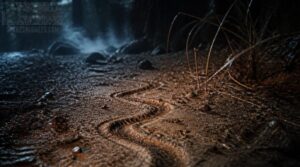
Before you spot a snake, you’ll likely spot where it’s been. Fresh trails show up as elongated drag marks across soft soil, sand, or mud, with crisp, sharp edges signaling recent passage.
Check substrate texture: damp clay holds detail longer than gravel. Gait pattern and print spacing reveal direction and speed, while ground vibrations from your footsteps may still linger nearby—a subtle nod to their seismic sensing during nighttime foraging.
Rustling Near Hiding Spots
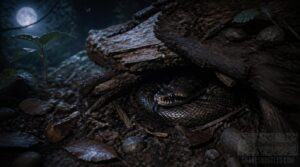
Tracks tell you where a snake’s been. Rustling tells you it’s still there.
Tracks show where a snake has traveled, but rustling in the dark means it hasn’t left yet
Listen close near crevices and log piles:
- Bark rustling as it shifts position
- Mulch movement with a faint crackle
- Gravel crunching under a coiling body
- Leaf litter scuffling during nighttime foraging
Tail repositioning sounds often follow—part predator avoidance, part ground vibration detection at work.
Observe disturbed vegetation indicates possible snake hideouts.
Shed Skin Sightings
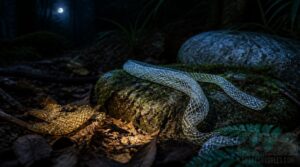
Sound isn’t the only clue snakes leave behind. A complete shed skin, papery and full-length, marks confirmed nighttime presence.
| Shed Trait | What It Tells You | Where Found |
|---|---|---|
| Fresh, moist | Recent molt | Near basking rocks |
| Dry, yellowed | Older shed | Leaf litter |
| Faded pattern | Aging exposure | Wall edges |
Humidity speeds molting cycles. Skip bare-hand handling—residue irritates skin.
Droppings Near Walls
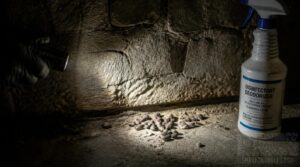
After shed skins, droppings near walls are a subtle but telling sign. Snake feces are drier, fibrous, and often near wall crevices—favored for warmth or hidden corridors. Unlike rodents’ glossy pellets, reptile droppings may appear with shed fragments.
Watch for repeated deposits; that means ongoing nocturnal activity.
Always use gloves and disinfectant—pathogen risk rises in tight, low-airflow spaces.
Pets Acting Alert
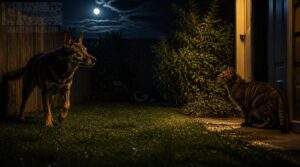
Ever notice your dog frozen mid-step, ears pinned forward toward the fence line? That’s canine vigilance kicking in.
Cats show feline scent response too—nose lifted, whiskers stiff, circling a doorway.
Soft growls, sudden barks, or pacing near entryways signal unusual nocturnal behavior. Trust it. Your pet’s senses often catch nighttime snake activity long before you do.
Why Snakes Move After Dark

Nightfall isn’t random for snakes—it’s a calculated shift driven by biology and opportunity. Temperature, moisture, safety, and food all play a role in flipping that switch. Here’s what actually pulls a snake out after dark.
Even a snake’s nighttime hunting instincts can backfire if it’s fed too large a meal, which is why understanding common snake digestive problems helps keep those after-dark feeding sessions safe.
Cooler Evening Temperatures
Why does the mercury drop matter so much to a snake? Because thermoregulation drives everything. As the sun sets, radiative heat loss cools open ground fast—especially without cloud cover insulation.
- Asphalt and patios hold warmth longer (surface thermal inertia)
- Clear skies speed cooling
- Urban heat retention delays activity in cities
That 2–6°C dip triggers nocturnal activity, pulling snakes from daytime shelter into cooler nighttime activity.
Higher Nighttime Humidity
As air cools, it holds less moisture—pushing relative humidity toward saturation. That damp air preserves scent trail integrity, fueling moisture-driven foraging.
| Humidity Source | Effect |
|---|---|
| Soil & vegetation | Sustains RH |
| Water bodies | Boosts shoreline humidity |
| Calm skies | Traps ground moisture |
| Mulch layers | Slow-release dampness |
Above 60% RH extends hunting time, creating humid microclimates snakes exploit after dark.
Safer Travel Conditions
Darkness cuts danger. Cooler ground means fewer daytime predators like hawks watching from above, so nocturnal movement doubles as predator avoidance.
Snakes favor:
- Reduced avian threats
- Fewer human encounters
- Cooler travel surfaces
- Less competition for shelter
Much like travelers checking destination advisories before departure, snakes read environmental cues—temperature, cover, risk—before committing to a route after dusk.
Active Prey Nearby
Food finds them first. Rodent scent trails along garden edges guide prey detection before a snake even moves, while crushed leaf litter near fences signals fresh rodent traffic.
Insect husk clusters under patio lights draw amphibians, and their soft calls become cues too.
That’s efficient foraging strategy—snakes simply follow where scent tracking and night hunting overlap with abundant prey.
Less Daytime Competition
Why share the buffet when you don’t have to? Nocturnal activity lets snakes dodge daytime rivals entirely—hawks, larger reptiles, competing predators all clock out by dusk.
This niche partitioning boosts hunting success and eases sympatric species interactions through:
- Reduced diurnal rival reduction pressure
- Fewer territorial clashes
- Uninterrupted crepuscular hunting windows
- Better prey availability access
- Lower predator avoidance energy costs
Quieter nights simply mean better odds.
When Night Activity Usually Peaks
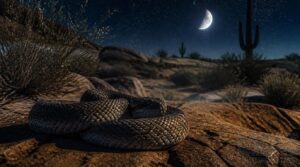
Timing isn’t random—it follows patterns you can actually predict. Temperature, humidity, moonlight, even the species itself all shift when snakes get moving. Here’s what usually drives that nightly schedule.
Just After Sunset
Watch the sky first. As twilight fades from dusky pink to near black, that’s your cue—within 20 to 30 minutes after sunset, temperatures drop, humidity climbs, and crepuscular insects stir.
Owls patrol, bats lift off in waves. Snakes read these same environmental cues, timing their emergence to that narrow twilight foraging window before full dark settles in.
Warm Humid Nights
Muggy air changes the game. Once relative humidity climbs above 60%, scent trail integrity holds longer on damp ground, so snakes hunt longer.
Thick, humid air traps heat—thermal radiation trapping—keeping surfaces warmer well past midnight.
- Sluggish moisture evaporation off skin
- Slower ground cooling after sunset
- Extended prey scent windows
- Urban heat amplification near pavement
- Longer active hunting stretches
Seasonal Summer Shifts
Summer flips the whole schedule. Summer heat spikes push snakes that normally wander at dusk or dawn into full nocturnal behavior, avoiding daytime highs entirely.
Nighttime surfaces above 18°C stretch peak activity by 1.5–2 hours. Add nocturnal prey surges—rodents, amphibians, insects—and warm, humid air, and you get extended hunting windows driven by classic temperature-dependent activity patterns tied to seasonal diet changes.
Moonlight Effects
Ever notice how a full moon night feels different for wildlife? That’s lunar influence effects at work. Brighter nights raise moonlight predation risk, so snakes favor rock crevices over open ground.
Visual detection shifts matter too—predators spot movement easier. Even moonlight scent dispersion changes tracking. New moon darkness pushes reliance onto smell and heat sensing, shifting nocturnal behavior toward stealth over sight.
Species-specific Timing
No two species keep quite the same clock. Nocturnal snakes and crepuscular species split the night differently, shaped by latitude, prey pulses, and mating season windows.
- Ball pythons: active 1–2 hours post-dusk
- Corn snakes: twilight foraging windows
- Rat snakes: crepuscular peak patterns, not deep night
- Northern latitudes: shorter midnight movement cycles
- Breeding season: reproductive movement cycles shift timing
Where to Spot Nighttime Signs
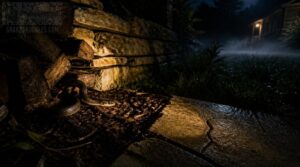
Snakes don’t roam randomly after dark—they follow heat, moisture, and cover. Certain spots around your property practically guarantee activity once the sun goes down. Here’s where you should really be watching.
Warm Rocks and Patios
Why does that patio feel warm at 10 PM? Thermal mass in dark stone and pavers stores solar heat, releasing it for hours after sunset. Snakes exploit this thermal gradient for temperature regulation, lingering on residual warmth 2–5°C above surrounding ground.
Urban heat islands compound this effect. If your patio uses dark volcanic rock or basalt, expect longer visits after dark—prime microhabitat selection territory.
Burrows and Crevices
Burrows and crevices tell you plenty, if you know where to look. Fresh soil overhangs or displaced substrate near a burrow entrance signal recent use—these microhabitats hold stable humidity regulation and cooler nighttime temps.
- Mounded soil at entrances
- Narrow rock crevices with debris
- Damp, musty smells nearby
- Multiple connected openings
- Shelter connectivity between chambers
Substrate composition affects moisture retention, shaping thermal niche and habitat selection.
Leaf Litter and Mulch
A pile of decaying leaves isn’t just yard clutter—it’s a snake’s climate-controlled hideout. Microhabitat moisture retention in mulch beds preserves scent trails and buffers temperature swings, drawing snakes into leaf piles, woodpiles, and overgrown brush.
Tall grass and dense vegetation nearby only sweeten the deal, since decomposing organic matter attracts soil organisms snakes hunt after dark.
Streams and Damp Ground
Water draws snakes like a dinner bell after dark. Streams create riparian moisture halos—saturated soil zones packed with amphibians and invertebrates, boosting scent trail persistence for hunting through smell alone.
What pulls snakes to damp banks:
- Newts and salamanders congregating nightly
- Constant humidity preserving prey scent
- Soft mud showing fresh trails
- Ground vibrations from foraging wildlife
Indoor Entry Points
Ever wonder how a snake ends up in your hallway? Weatherstripping gaps under main doors and worn threshold sealing are prime culprits, especially in urban wildlife corridors with high human-wildlife conflict.
Check garage entry security and door sweep installation first. Sliding doors and vent mesh protection matter too. Seal cracks, mesh vents, install sweeps—simple habitat control that keeps snakes hunting outside, not inside.
Pet Snake Night Activity Clues
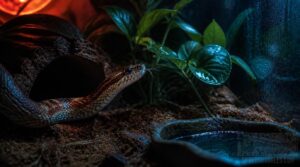
Your pet snake doesn’t need moonlight to tell you it’s switched into night mode. Its enclosure becomes a stage for subtle behavioral cues, ones you can learn to read with a little patience. Here’s what to watch for once the lights go down.
Evening Tongue Flicking
Watch the tongue closely after dusk, and you’ll notice it: quicker, sharper flicks as your snake shifts into scent tracking mode.
- Fast tongueflicking signals active risk assessment flicking
- Chemosensory Triangulation pinpoints scent direction
- Vomeronasal Organ Function processes captured particles
- Volatile Chemical Capture peaks in cool air
Evening humidity boosts Scent-Trail Persistence, sharpening sensory perception in snakes right when the vomeronasal system matters most.
Increased Enclosure Roaming
That tongue-flicking isn’t happening in a vacuum—your snake’s whole body follows, tracing wider laps once dusk hits.
Enclosure layout complexity matters here: multi-zone setups with logs, rock piles, and hides boost roaming by roughly 25% over bare tanks. Snakes patrol thermal gradients, favoring warm corridors.
Rotate enrichment items, and coverage broadens further, especially when scent trails or prey enrichment near walls extend those nightly circuits.
Hide Switching Behavior
Notice your snake pause near a rock, then reappear in the open seconds later? That’s hide switching—a microhabitat thermal regulation tactic.
- Cooler zones after dusk
- Predator avoidance instincts
- Prey scent triggers
- Disturbance response near enclosure walls
Fragmented cover (multiple hides) encourages frequent switches, sharpening ambush hunting efficiency while keeping your snake’s circadian rhythm-driven temperature-dependent activity in balance.
Hunting Posture Changes
Hide switching sets the stage; hunting posture is the payoff. After dusk, watch for a tighter S-curve coil and slower head sway—classic ambush prep tied to strike reflex readiness.
This isn’t random. It’s behavioral ecology in action: your snake’s balancing stability versus speed, minimizing sway before committing to a strike, just like a predator reading terrain before moving.
Feeding and Shedding Changes
Once temperatures dip after dusk, appetite often shifts rather than vanishes—cooler nights mean slower digestion, so feeding windows narrow.
Post-shedding hunger hits fast, often within 24-72 hours.
- Smaller portions right after shedding
- Extra hydration before a shed
- Reduced appetite in cooler months
- Prey chosen for quick, quiet handling
Humidity matters too: it keeps digestion efficient and scent trails intact for hunting.
Frequently Asked Questions (FAQs)
How do you know if a snake is nocturnal or diurnal?
It’s like reading a clock without numbers: circadian rhythm tells the tale.
Diurnal snakes bask and hunt by day; nocturnal snake behavior patterns emerge after sunset. Seasonal activity shifts and species timing variations mean rat snakes stay crepuscular, while ball pythons go fully nocturnal.
Are Snakes Active during the day?
Yes — many snakes follow a diurnal circadian rhythm, basking on warm rocks for thermoregulation and foraging by daylight, especially spring and fall. Seasonal heat and habitat microclimates often push these species toward crepuscular or nocturnal shifts as temperatures climb.
When are nocturnal snakes most active?
Peak activity hits just after sunset, when temps sit between 18–28°C and humidity climbs above 60%. Warm, humid nights extend hunting windows, while moonless skies barely slow snakes relying on heat and scent over sight.
Why are snakes nocturnal?
It’s all about survival math: cooler air aids thermoregulation and water conservation, while darkness offers predator avoidance, low-light hunting advantages, and better prey alignment—rodents and amphibians surface after dusk, giving snakes a thermal niche all their own.
How to tell if a snake is in your house at night?
Watch for fresh shed skins in dark corners, faint musky odors near damp spots, scuffling behind walls, and pets fixated on empty space.
These snake behavior patterns, tied to ground vibration detection and predator avoidance, reveal hidden activity fast.
Can snakes see well in complete darkness?
Picture a rat snake gliding through pitch-black brush, never bumping a branch.
Not through sharp sight—its rod-dominant retinas handle motion, while infrared pit organs create thermal image perception, blending heat vision with multimodal sensory blending for confident, lowlight navigation.
How do infrared pits detect warm prey?
Heatsensing pit organs use a thin membrane packed with nerve endings, detecting temperature shifts as small as 003°C. This creates thermal contrast detection, letting the snake track a warm body’s heat signature through neural signal processing alone.
Do snakes use scent to track prey?
No stinger, no fangs bared, just tongue flicks. Yes: snakes rely on stereo scent detection through the vomeronasal organ, comparing odor intensity between flicks to track fresh trails and pinpoint prey location in total darkness.
What deters snakes from approaching my property?
Snake-proof fencing, gravel ground cover, and yard debris removal cut shelter and prey access.
Add motion sensor lights and a rodent control plan—reducing attractants, curbing predator presence and human-wildlife conflict near your home’s edges.
Conclusion
Your yard is a stage, and dusk raises the curtain on a performance most homeowners sleep through. Reading snake night activity signs isn’t about fear—it’s about literacy, the same way tracking footprints or reading clouds tells you what’s coming.
A drag mark, a shed skin, a dog’s raised hackles: these are sentences in a language written every night outside your door.
Learn to read them, and your yard stops feeling unpredictable. It starts feeling known.