This site is supported by our readers. We may earn a commission, at no cost to you, if you purchase through links.
Power outages don’t ask permission. One tripped breaker and your bearded dragon’s enclosure drops below safe basking temps within 2-4 hours — faster than most keepers realize. Run a single tank and that’s manageable. Run five, ten, or a whole rack, and one bad circuit can turn into a welfare emergency across your entire collection.
That’s the real challenge with reptile heat lamps for multiple tanks: it’s not just picking a bulb, it’s engineering a system that won’t fail you at 2 a.m.
Get the wattage, wiring, and backup planning right, and multi-tank heating stops being a liability and starts running itself.
Table Of Contents
- Key Takeaways
- Top 10 Heat Lamps for Multi-Tank Setups
- 1. Reptile Basking Heat Lamp Bulbs
- 2. Reptile Heat Lamp with Timer
- 3. Fluker’s heavy duty reptile clamp lamp
- 4. Lucky Herp 150W Ceramic Heat Emitter
- 5. Repti Zoo Basking Heat Lamp
- 6. Lucky Herp Reptile Basking Heat Lamp
- 7. DaToo Reptile Heat Lamp
- 8. Reptizoo Day and Night Heat Lamps
- 9. Repti Zoo Ceramic Heat Emitters
- 10. Koheopt 50W UVA Reptile Bulbs
- Lighting Setup for Stacked or Rack Tanks
- Choosing UVB and Heat Sources
- Managing Heat Across Multiple Tanks
- Heat Lamp Safety and Electricity Costs
- Frequently Asked Questions (FAQs)
- Can you leave a reptile heat lamp on all night?
- What’s the difference between a basking lamp and a heat lamp?
- Do reptile heat lamps use a lot of electricity?
- How long can lizards go without a heat lamp?
- Can I use one thermostat for multiple heat lamps?
- How often should reptile heat lamp bulbs be replaced?
- Are ceramic heat emitters safe for humid enclosures?
- Can different tanks in a rack need different wattages?
- What happens if a heat lamp fails overnight?
- Conclusion
Key Takeaways
- Power outages can drop enclosure temperatures to dangerous levels within just 2-4 hours, so multi-tank setups need redundancy like backup bulbs, staggered circuits, and battery-powered alarms to prevent a welfare emergency.
- Circuit safety is critical: a standard 15A circuit should never exceed 1440W of continuous load (80% of its 1800W max), so you must distribute lamps, pumps, and fans across multiple circuits with GFCI protection.
- Matching heat sources to species and setup matters most—use ceramic emitters for 24-hour light-free heat in nocturnal enclosures, basking bulbs for daytime species, and follow the 3-5 watts-per-gallon rule to size wattage correctly.
- Rack and stacked-tank systems require specialized hardware—riser brackets, rail-compatible fixtures, and independent timers per tier—to manage clearance, heat buildup, and individual photoperiods across multiple enclosures.
Top 10 Heat Lamps for Multi-Tank Setups
Running multiple tanks means juggling different wattages, bulb types, and mounting styles—and picking the wrong one wastes money fast.
This guide to choosing UVB lighting for multi-tank reptile setups breaks down which wattages and fixtures actually pair well across different enclosures.
Some setups call for steady basking heat, others need ceramic emitters or timer-controlled cycles to keep things consistent overnight.
Here are ten options worth comparing before you commit to a lineup for your whole collection.
1. Reptile Basking Heat Lamp Bulbs
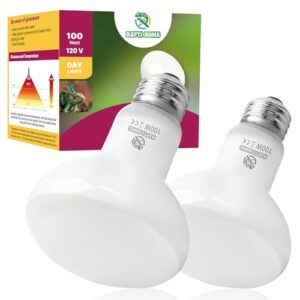
A 100-watt basking bulb like the HL-100W model does one job well: it converts electricity into concentrated infrared heat, mimicking natural sunlight for species like bearded dragons, turtles, and larger lizards.
At 3.1 x 3.1 x 4.3 inches and just 5.61 ounces, it’s compact but generates serious heat—so mount it outside the enclosure on a compatible fixture. High wattage means real risk if placement’s careless.
Works well for amphibian terrariums too, provided you’re monitoring surface temps closely.
| Best For | Reptile owners with bearded dragons, lizards, turtles, or snakes who need a reliable basking spot in their terrarium setup. |
|---|---|
| Power | 100W |
| Base Type | Standard fixture |
| Target Animals | Reptiles/amphibians |
| Basking Support | Yes |
| Safety Certification | Not specified |
| Enclosure Compatibility | Terrariums |
| Additional Features |
|
- Simulates natural sunlight to create an effective basking zone
- Compact and lightweight design at just 5.61 ounces
- Versatile enough for a range of reptiles and amphibian terrariums
- Requires a compatible heat lamp fixture, which isn’t included
- High wattage can produce intense heat if not monitored carefully
- Not a plug-and-play solution—needs proper mounting outside the enclosure for safety
2. Reptile Heat Lamp with Timer
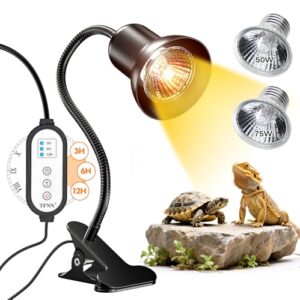
Manual bulb-swapping across several tanks gets old fast — that’s where a timer-equipped fixture earns its keep, cycling power automatically at 3H, 6H, or 12H intervals.
Set it once and it repeats daily, holding your photoperiod steady without you hovering over each enclosure. Some units pair timer functions with adjustable brightness levels, letting you dial in basking temps per tank.
The 360-degree swan neck adds aim flexibility, but remember: timers cut power, not heat retention.
| Best For | Reptile keepers managing multiple enclosures — turtles, bearded dragons, lizards, geckos, and snakes — who want consistent, hands-free heat and UVA/B exposure. |
|---|---|
| Power | 50W/75W |
| Base Type | Clamp mount |
| Target Animals | Reptiles/birds/plants |
| Basking Support | Yes |
| Safety Certification | Not specified |
| Enclosure Compatibility | Multiple enclosures |
| Additional Features |
|
- Intelligent cycle timer (3H, 6H, 12H) keeps photoperiods consistent without daily manual adjustments
- Three brightness levels let you fine-tune basking temperature for different species
- 360-degree rotatable swan neck makes it easy to aim light and heat exactly where needed
- Timer controls power only, not heat retention, so enclosure insulation still matters
- Requires a stable edge or surface for the clamp, which may limit placement options
- Lamp surface gets hot during use, so care is needed to avoid accidental contact
3. Fluker’s heavy duty reptile clamp lamp

Timers handle when the heat kicks on, but for tanks needing raw durability, Fluker’s clamp lamp controls the how. Heavy gauge painted aluminum housing shrugs off daily use, while the ceramic socket tolerates high-wattage bulbs and emitters without warping.
The clamp bites down hard on rims — no slippage, no midnight tank collapses. At 8.5 inches and just one pound, it fits tight rack spacing without crowding neighboring enclosures.
UL/CUL approval means it meets real electrical safety standards, not just marketing claims.
| Best For | Reptile owners with large terrariums who need a rugged, high-heat clamp lamp for reliable basking setups. |
|---|---|
| Power | 150W max |
| Base Type | Ceramic socket |
| Target Animals | Reptiles |
| Basking Support | Yes |
| Safety Certification | UL/CUL approved |
| Enclosure Compatibility | Large terrariums |
| Additional Features |
|
- Heavy gauge painted aluminum construction stands up to daily wear and tear
- Ceramic socket handles high-wattage bulbs and heat emitters without issue
- Secure clamp design keeps the lamp firmly attached with no slipping
- Product listing lists the material as plastic, which conflicts with the aluminum build described
- Listed dimensions (1"L x 1"W x 1"H) don’t match up with an 8.5-inch lamp
- Limited to 150 watts max, which may not suit setups needing higher heat output
4. Lucky Herp 150W Ceramic Heat Emitter
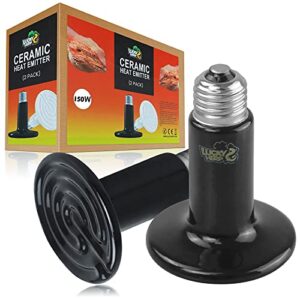
No visible light, just steady infrared — that’s the trade-off with Lucky Herp’s 150W ceramic emitter, and for nocturnal species it’s a welcome one. Full temperature hits around the four-minute mark, with warmth noticeable in seconds.
Ceramic housing (no glass) survives humid terrariums that would fog or crack standard bulbs. Rated for roughly 10,000 hours, it screws into any E26 socket.
Pair it with a thermostat — this emitter alone won’t self-regulate, and unchecked wattage in a 40-gallon tank can overshoot fast.
| Best For | Reptile, amphibian, poultry, and small-mammal keepers who need steady overnight warmth without disrupting their animals’ natural day-night cycle. |
|---|---|
| Power | 150W |
| Base Type | E26 |
| Target Animals | Reptiles/poultry/mammals |
| Basking Support | Yes (heat only) |
| Safety Certification | Not specified |
| Enclosure Compatibility | Heated enclosures |
| Additional Features |
|
- Emits heat only, with no visible light to disturb pets’ sleep
- Rapid warm-up, reaching full temperature in about 4 minutes with heat felt in seconds
- Durable ceramic housing rated for up to 10,000 hours, fits standard E26 sockets
- Doesn’t self-regulate temperature, so it should be paired with a thermostat
- Provides no UV output, meaning supplemental lighting may still be needed
- Requires careful setup — at least 30 cm from animals and a quality ceramic holder, since frequent cycling shortens lifespan
5. Repti Zoo Basking Heat Lamp
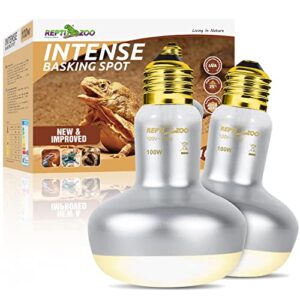
A double reflector sets this one apart, throwing a tight basking beam instead of a diffuse glow. Diurnal species — bearded dragons, iguanas — get a defined hot spot without cooking the rest of the enclosure.
For a broader look at daytime heating options, this guide to choosing the right heat lamp breaks down how basking bulbs compare to ceramic and infrared setups.
Visible light plus UVA keeps daytime activity levels up, mimicking sun exposure desert and tropical setups both need.
Lightweight housing means quick swaps when bulbs dim or crack. Keep it clear of reflective hoods, though — proximity there overheats surfaces fast.
| Best For | This lamp is best for reptile and amphibian keepers who need a focused, high-heat basking spot for bearded dragons, tortoises, lizards, iguanas, and other diurnal desert or tropical species. |
|---|---|
| Power | 100W |
| Base Type | E26 |
| Target Animals | Reptiles/hermit crabs |
| Basking Support | Yes |
| Safety Certification | Quality inspected |
| Enclosure Compatibility | Terrariums |
| Additional Features |
|
- Flat bottom shape and vacuum aluminizing technology focus heat into a tight, efficient beam while cutting energy use
- Simulates natural sunlight with UVA to support activity levels and healthy appetite
- Runs quietly with no buzzing or flickering, and passes a four-stage quality inspection process
- Short lifespan of only 2,000 to 3,000 hours means more frequent bulb replacements
- Provides UVA only, not full-spectrum UVB, so it won’t meet all reptile lighting needs
- High-intensity heat demands careful placement to avoid burns or overheating nearby surfaces
6. Lucky Herp Reptile Basking Heat Lamp
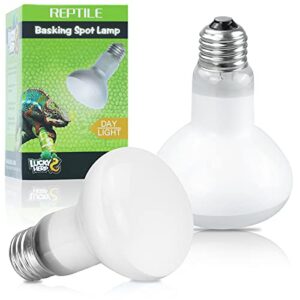
Ten thousand hours of rated lifespan puts this bulb well ahead of standard basking lamps, which means fewer swaps across a rack of enclosures.
E26 base and 120V compatibility mean it drops into fixtures you already own — no adapters needed.
UVA output aids thermoregulation and breeding behavior, useful for bearded dragons or turtles housed in multiples.
Ceramic housing resists warping under sustained heat. Still, verify surface temps with an IR thermometer; rapid heat-up doesn’t mean unlimited tolerance.
| Best For | reptile and amphibian keepers—like those with bearded dragons, turtles, lizards, or other basking species—who need a reliable heat and UVA source to support natural behaviors and physiological health. |
|---|---|
| Power | 100W |
| Base Type | E26 |
| Target Animals | Reptiles/amphibians |
| Basking Support | Yes |
| Safety Certification | Safety certified |
| Enclosure Compatibility | Terrariums |
| Additional Features |
|
- Simulates natural sunlight with UVA rays to support basking and thermoregulation
- Durable glass and filament build that passes strict safety certification
- Standard E26 base and 120V compatibility make it easy to use with existing fixtures
- Bulb needs replacing every 3 months to maintain optimal UVA effectiveness
- Rated lifespan of up to 2000 hours is shorter than some alternatives
- Provides UVA and heat only, with no mention of UVB output
7. DaToo Reptile Heat Lamp
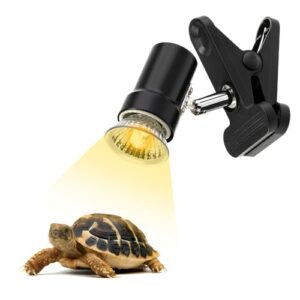
No visible light, no wasted watts — that’s the DaToo’s whole pitch. This 150W ceramic emitter screws into standard E26 fixtures, throwing infrared heat without disturbing nocturnal species during night cycles.
The deep reflector concentrates heat onto basking zones instead of scattering it, which matters in multi-tank racks where efficient heat transfer keeps electricity costs manageable. Corrosion-resistant aluminum housing shrugs off humidity.
Pair it with a thermostat — non-negotiable at this wattage — and verify basking-zone temps with an IR thermometer before trusting it unsupervised.
| Best For | This heat lamp is best for reptile, amphibian, and bird owners who need a reliable UVA/UVB and heat source for terrariums, turtle tanks, or aquariums. |
|---|---|
| Power | 50W |
| Base Type | E27 |
| Target Animals | Reptiles/birds |
| Basking Support | Yes |
| Safety Certification | Fire-resistant rated |
| Enclosure Compatibility | Tanks/aquariums |
| Additional Features |
|
- Delivers 97% UVA and 3% UVB to support metabolism, digestion, and healthy bone growth
- 360-degree rotatable head with a secure non-slip clamp makes positioning easy in any setup
- Durable, fire-resistant aluminum alloy shell with a ceramic socket built to handle high heat
- Bulb life is short at only 2000–3000 hours, meaning frequent replacements
- Requires heat-resistant gloves and careful placement at least 12 inches from surfaces
- Not meant for continuous use, needing a break after 6 hours of operation
8. Reptizoo Day and Night Heat Lamps
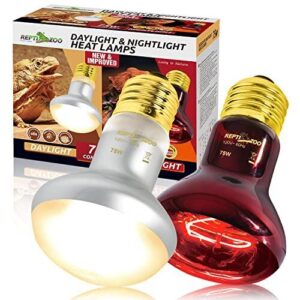
Two bulbs, one photoperiod problem solved. Reptizoo’s combo kit pairs a UVA daylight lamp with an infrared emitter, running off shared E26 sockets so both fire on synchronized cycles.
The daylight bulb helps with appetite and basking activity; the infrared holds ambient warmth after dark without bright light disrupting sleep. Expect 2,000 to 3,000 hours of runtime.
Good for 40-gallon tanks needing dual-zone coverage. Just don’t touch bulb surfaces bare-handed — skin oils shorten lifespan fast.
| Best For | reptile and amphibian owners who need a simple way to mimic natural day-night cycles for pets like bearded dragons, tortoises, geckos, and snakes. |
|---|---|
| Power | 75W |
| Base Type | E26 |
| Target Animals | Reptiles/domestic pets |
| Basking Support | Yes |
| Safety Certification | Not specified |
| Enclosure Compatibility | Various enclosures |
| Additional Features |
|
- Combines a UVA daylight lamp and infrared heat lamp in one kit, covering both light and warmth needs
- Infrared bulb keeps enclosures warm 24/7 without bright light disturbing nocturnal pets’ sleep
- UVA rays support healthy appetite and growth, and both bulbs share standard E26 sockets for easy setup
- Wattage is fixed at 75W, so it may not suit every enclosure size or heat requirement
- Bulb lifespan (2,000–3,000 hours) means fairly regular replacements
- Replacement policy only covers 90 days from purchase, which is a short window if a bulb fails later
9. Repti Zoo Ceramic Heat Emitters
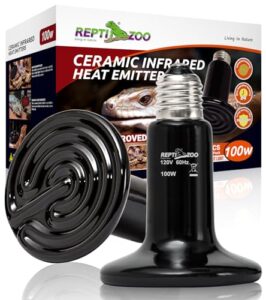
No glow, no glare, just steady infrared warmth — perfect for nocturnal geckos and snakes that need heat without a light cue disrupting their sleep cycle. The high-purity ceramic body resists cracking and holds up around 10,000 hours.
Rated at 100W on a standard E26 base, it’s CE-certified and built for high-humidity glass terrariums. Screw it into a porcelain socket, mount it outside the enclosure, and you’ve got reliable 24-hour thermoregulation without the burnout worries of glass bulbs.
| Best For | Reptile and amphibian owners seeking steady, round-the-clock heat for nocturnal species like geckos and snakes without disrupting their natural sleep cycle with light. |
|---|---|
| Power | 100W |
| Base Type | E26 |
| Target Animals | Reptiles/amphibians |
| Basking Support | Yes (heat only) |
| Safety Certification | CE/RoHS |
| Enclosure Compatibility | Glass terrariums |
| Additional Features |
|
- Emits infrared heat without any light, so it won’t disturb sleep patterns in nocturnal reptiles
- High-purity ceramic construction resists cracking and lasts up to 10,000 hours
- CE-certified and RoHS-compliant, making it safe and reliable for high-humidity terrarium setups
- Only compatible with standard E26 sockets, so it won’t work with other base types
- Provides heat only, meaning you’ll need a separate light source for illumination
- Best paired with specific Repti Zoo fixtures, which may limit compatibility with other brands
10. Koheopt 50W UVA Reptile Bulbs
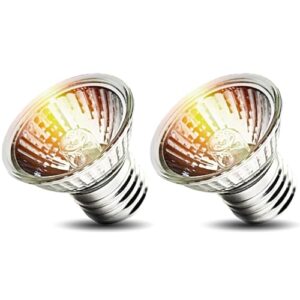
Rounding out the list is a bulb built for behavior, not brawn: the Koheopt 50W UVA screws into a standard E26 base and pairs well with ceramic emitters or UVB tubes already running in your rack. At 50 watts, it adds basking warmth and appetite-triggering UVA without overloading your circuit.
Rated past 3,000 hours, it’s CE and ROHS certified. Mount it in an external hood, keep it clear of lids, and let it do secondary duty across stacked enclosures.
| Best For | Reptile keepers who already run a UVB setup and want to add extra basking warmth and appetite-triggering UVA to encourage natural feeding and breeding behavior. |
|---|---|
| Power | 50W |
| Base Type | E26 |
| Target Animals | Reptiles/birds |
| Basking Support | Yes |
| Safety Certification | CE/RoHS |
| Enclosure Compatibility | Tanks/cages |
| Additional Features |
|
- Sun-mimicking UVA output supports metabolism, mood, and breeding activity
- CE and ROHS certified with a long-lasting 3,000 hour bulb life
- Simple E26 base fits easily into most existing lamp fixtures and hoods
- Surface gets very hot, so it needs a cooling period before handling
- Must be mounted with enough clearance to keep pets safely away from the heat
- Works best as a supplement to UVB lighting rather than a standalone solution
Lighting Setup for Stacked or Rack Tanks
Stacking tanks or running a rack system changes the lighting game entirely—what works for a single enclosure won’t cut it here. You need fixtures that handle heat buildup, fit tight spaces, and let you control each tier on its own schedule. Here’s what to look for before you start mounting anything.
External Hoods and Riser Brackets
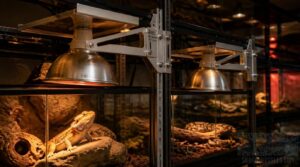
External hoods and riser brackets solve a real problem in stacked reptile racks: heat sources need clearance without eating your vertical space. Riser brackets usually add 3–8 inches, using adjustable riser increments for precise leveling on uneven frames.
Look for anodized aluminum construction—bracket material durability and corrosion resistance matter in humid rooms. Quality mounts feature heat shield connection and universal socket compatibility (E26/E27), sliding cleanly onto rail systems across multiple enclosures.
Modular Bar Lights for Racks
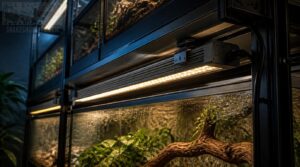
Once brackets solve your clearance problem, rack width becomes the next puzzle—modular lighting systems fix this with expandable bars in standard footprints.
Daisy-chaining bars across tiers makes synchronized dimming possible, so every enclosure follows one schedule. Universal clamp systems and interchangeable end caps allow corner mounting configurations, closing gaps in stacked enclosures.
Integrated heat sinking keeps LED output stable, protecting reptile enclosure accessories from thermal stress.
Ideal Mounting Height Above Lids
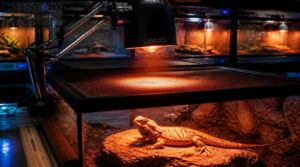
Get this wrong and you’ll cook your reptile or leave it shivering. Mount basking lamps 4 to 6 inches above the lid—5 inches hits the sweet spot for most 60–100W bulbs, holding 93–100°F at the basking surface.
Too low, temps spike past safe ranges. Too high, gradients flatten out. Check lid material durability and mounting hardware stability regularly; vibration shifts clearance over time.
Rail-compatible Fixture Brackets
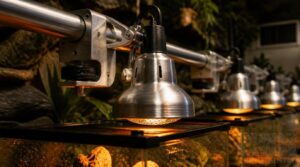
Once your basking lamps sit at the right height, the next fix is stopping them from sliding out of position on a rack.
Rail-compatible brackets clamp onto standard 50mm or 75mm profiles, letting you daisychain fixtures across multiple enclosures. Check bracket load limits (5–60N) against bulb weight, insist on corrosion resistant materials like stainless steel, and use adjustable mounting heights with vibration reduction pads to keep temperature control locked in.
Independent Timers Per Tier
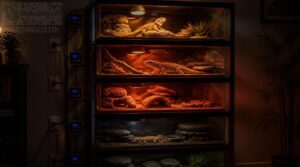
Five tanks, five different needs—your monitor wants a 12-hour photoperiod, but your nocturnal gecko doesn’t. Independent timers per tier solve this: each rack level runs its own schedule, preventing staggered startup surges when everything kicks on at once.
You get localized power draw, tiered energy audits, individual tier alerts, and easy seasonal schedule adjustments—all through smart timer setup that protects thermal gradients across multiple enclosures.
Choosing UVB and Heat Sources
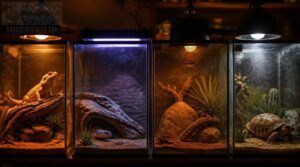
Not every reptile needs the same UVB or heat setup — species, enclosure type, and budget all shape that choice. Get the wrong bulb or emitter, and you’re looking at weak basking spots, dead UVB zones, or a fixture that burns out in weeks.
Here’s what separates the options worth your money from the ones that’ll leave your reptile shortchanged.
T5 UVB Vs LED Bars
T5 or LED — which one actually keeps your reptiles healthy? For multi-tank rooms, T5 HO tubes deliver higher UVB output density and uniform irradiance across wide enclosures, while LED bars run cooler but often underperform on true UVB.
Selecting the right reptile uvb lights is essential for meeting the specific biological needs of various species.
- T5: consistent spectrum, 12-month replacement cycle
- LED: 50,000+ hour lifespan, less heat
- T5: better spectral zoning across tiers
- LED: uneven UVB without proper lens design
Ceramic Heat Emitters Explained
Porcelain heating devices earn their spot in reptile rooms for one reason: infrared radiation without light. Ceramic Heat Emitters warm nocturnal species around the clock using self-regulating PTC technology to curb overheating.
| Feature | Ceramic Heat Bulbs | Standard Bulbs |
|---|---|---|
| Light emitted | None | Yes |
| Lifespan | Thousands of hrs | Shorter |
| 24 hour use | Yes | Limited |
Durable ceramic elements outlast glass, resisting shatter in busy racks.
Basking Bulbs Vs Heat Lamps
Not every reptile needs the same glow. A Basking Spot Bulb floods the zone with visible light and heat together, mimicking sun exposure and supporting circadian rhythm. A Ceramic Heat Emitter skips the light entirely, delivering pure infrared heat penetration for nighttime warmth.
Match the bulb to the species’ thermoregulation needs and desired thermal gradients—not just tank size.
Mesh Lid UVB Blockage
That mesh lid sitting between your bulb and your basking reptile isn’t neutral—it’s a filter, and a sloppy one can quietly starve your animal of UVB.
- Hole size dictates flux: 2mm openings block far more than 1cm gaps
- Weave density and material finish affect reflectivity and attenuation
- Dust buildup scatters UVB, so clean screen tops regularly
Stacked layers compound blockage—measure intensity, don’t guess.
Bulb and Lamp Replacement Cycles
Waiting for a bulb to fail is how basking spots go cold overnight. Track runtime, not calendar guesses—T5 UVB lamps degrade around 12 months; standard Basking Spot Bulbs vary by wattage and cycling. Watch for bulb degradation signs: dimming, flickering, weaker heat readings. Ceramic Heat Emitters last longer but still fade. Build a replacement schedule, weigh cost-benefit upfront—LEDs cost more but cut long-term waste across your reptile enclosure accessories.
Managing Heat Across Multiple Tanks
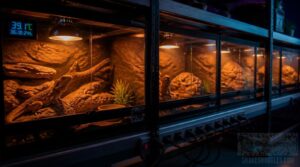
One heat lamp is easy. Five tanks pulling power on the same circuit is a different problem entirely. Here’s how to keep every enclosure warm without tripping a breaker or leaving one tank colder than the rest.
Thermostats for Several Enclosures
Six tanks, six thermoregulation targets — one thermostat won’t cut it. Independent channel control lets each enclosure run its own setpoint, with sensor probes placed near each basking zone for accurate readings.
DIN rail models simplify wiring into existing circuits. Calibrate offsets against a known reference periodically; drift happens.
This is how you keep habitat temperature control consistent across reptile heat lamps and heat mats alike.
Safe Circuit Wattage Limits
Calibrated thermostats mean nothing if the circuit feeding them overloads. A standard 120V, 15A circuit maxes out at 1800W theoretical — but the 80 percent rule caps continuous load at 1440W.
Sum every lamp, pump, and fan sharing that circuit. Avoid daisychaining fixtures; distribute wattage across multiple circuits, use GFCI outlets, and label each one so overloads stay preventable, not surprising.
Two Bulbs Vs One Bulb
Once your circuits are budgeted, the next question is fixture count. A single high-wattage Basking Spot Bulb creates intense hotspots but uneven ambient heat; two lower-wattage bulbs spread warmth more evenly across multiple enclosures.
- Better heat distribution efficiency across tank rows
- Thermal redundancy if one bulb fails
- Microclimate customization with mixed wattages
- Easier circuit load management per tier
Two bulbs mean steadier thermal regulation, not just brighter basking spots.
Heat Tape for Tank Rows
Bulbs work tank by tank—heat tape covers whole rows. This resistive-core exothermic element runs flat beneath enclosures, paired with a thermostat probe placed inside the tank.
| Feature | Heat Pads | Heat Tape |
|---|---|---|
| Coverage | Single tank | Multiple enclosures |
| Wattage/ft | Fixed | 5-20W |
| Layout | Spot | Continuous |
Seal edges with heat-resistant caulk against moisture; inspect insulation monthly for cracks.
Matching Wattage to Tank Size
Ten gallons rarely needs more than a 50W bulb, but jump to a 40-gallon breeder and you’re scaling wattage upwards toward 120-200W depending on ambient temperature and glass insulation. A 75W Basking Spot Bulb suits mid-size tanks; 100W works for larger setups or drafty rooms.
Follow the 3-5 watts-per-gallon rule across multiple enclosures, and pair bulbs with Heat Pads to prevent cold spots near substrate.
Heat Lamp Safety and Electricity Costs
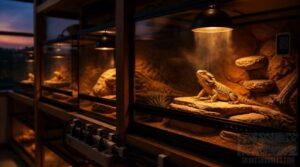
Running heat lamps across several tanks isn’t just about warmth—it’s about not burning your house down or your reptile’s back. Placement, wattage, and runtime all carry real risk if you get them wrong. Here’s what you need to know before your next electric bill or vet visit surprises you.
Preventing Burns and Fire Hazards
A single spark from an overheated fixture can turn a rack room into a disaster in minutes. Keep 12 inches of clearance between lamps and bedding or cardboard. Use metal mounts, not plastic, and install heat shields over lids.
- Inspect mounting hardware monthly
- Avoid glass envelopes near dry substrate
- Mount Basking Spot Bulbs outside enclosures
- Keep a fire extinguisher accessible
Checking Surface Temperatures Safely
Infrared vs contact thermometers each catch different things—infrared gives instant surface readings within 2-3°C, while contact probes confirm accuracy within 0.5°C. Check hotspots twice daily; log readings by tank ID. If temps exceed safety threshold limits (over 104°F) for 5+ minutes, cut heat 10% immediately.
| Tool | Best Use |
|---|---|
| Infrared | Quick spot-checks |
| Contact probe | Calibration verification |
| Datalogger | Continuous monitoring |
Can Lamps Run All Night
Yes—but not with just any bulb. Ceramic heat emitters run 24 hours light-free, avoiding nocturnal rhythm disruption while maintaining thermoregulation. Skip Halogen Basking Spot Lamps overnight; they disrupt sleep cycles.
- Use thermostat precision to prevent overheating
- Match wattage to species heat requirements
- Verify continuous operation risks stay low with monthly checks
A proportional thermostat keeps nighttime heat steady without babysitting the tank.
Do Heat Lamps Cost Much
Running a single 50W bulb 8 hours daily costs 12 to 31 USD monthly; jump to 250W and you’re looking at 75-188 USD. Multiple enclosures multiply fast.
Your electricity rate matters just as much as wattage—12 versus 20 cents per kWh changes everything. Timers cut waste without sacrificing heat.
Ceramic emitters cost similarly to 150W lamps but skip the light, making them efficient 24-hour options worth the upfront investment.
How Long Tanks Go Unheated
How long can your reptile go without heat before it’s an emergency? Shorter than you’d think—glass tanks bleed warmth fast once power cuts, and cold stress sets in within hours, not days.
Glass tanks bleed warmth fast, and once the power cuts, cold stress can set in within hours
- Tropical species: heat loss danger within 2-4 hours
- Desert species: slightly more buffer, still need basking heat soon
- Juveniles: lose body heat faster than adults
- Battery lamps or insulation buy time
- Rewarm gradually—never shock a cold reptile back to temp
Frequently Asked Questions (FAQs)
Can you leave a reptile heat lamp on all night?
Bright bulbs left on overnight cause circadian rhythm disruption, blocking the 12-hour darkness reptiles need.
For 24 hour heat without light, switch to ceramic heat emitters or under-tank pads—they mimic natural nighttime temperature drops while avoiding nocturnal confusion and hormonal cycle problems.
What’s the difference between a basking lamp and a heat lamp?
Basking lamps emit visible light plus infrared-A, drawing reptiles to intense hotspots for daytime thermoregulation.
Heat-only lamps (ceramic emitters) skip light entirely, delivering infrared-B/C as ambient, 24 hour heat source—ideal for nighttime warmth without disrupting natural photoperiod cues.
Do reptile heat lamps use a lot of electricity?
Not drastically, but it adds up: a 150W lamp costs roughly $86 monthly. A thermostat cuts that 30-50%, and switching to LED trims electricity consumption further—critical math once you’re powering multiple enclosures instead of one.
How long can lizards go without a heat lamp?
A bearded dragon owner once rode out a blackout with just blankets — dragon fine 24 hours later. That’s the ceiling, not the norm: most lizards turn sluggish and stop digesting within hours below their species’ critical temperature threshold, risking real harm fast.
Can I use one thermostat for multiple heat lamps?
Yes—but respect thermostat wattage limits. Multi-zone controllers like the Herpstat let you run separate probes per enclosure, ensuring accurate exothermic and infrared heating across multiple enclosures without overloading circuits or risking electrical safety overload.
How often should reptile heat lamp bulbs be replaced?
Ever notice a bulb looking fine while your reptile’s calcium metabolism quietly suffers? Visual inspection lies—UVB output testing tells the truth.
Follow species-specific schedules: 6-8 months for T8/compact fluorescents, 10-12 for T5HO, monitoring bulb efficacy against lumen decay rather than gut instinct.
Are ceramic heat emitters safe for humid enclosures?
They work fine for humid setups, but expect moisture loss — exothermic heating dries air fast. Pair with misting systems, boost ventilation, and monitor humidity closely; tropical species need extra moisture retention strategies to offset the evaporation these heating elements cause.
Can different tanks in a rack need different wattages?
Rack position really rewrites the rules. Vertical rack gradients mean top tanks lose less ambient heat than bottom ones, so tank position wattage varies—bottom levels need higher bulbs to offset floor heat compensation and ambient heat loss across multiple enclosures.
What happens if a heat lamp fails overnight?
Overnight temperature drops trigger cold stress fast—lethargy, regurgitation, weakened immunity. Ambient heat plummets 15-20°F below basking range, disrupting digestion and microclimate stability.
Emergency heat restoration matters: use backup mats, target 85-90°F, and monitor closely until normal husbandry conditions return.
Conclusion
A little inconvenience at 2 a.m. — that’s all a breaker trip should ever become, never a welfare emergency.
Build reptile heat lamps for multiple tanks with redundancy baked in: backup bulbs, staggered circuits, battery-powered alarms that warn you before temps crash. One bulb fails; your system shouldn’t. That’s the gap between reacting to disaster and never facing one.
Master the wiring, and every tank stays warm, safe, and thriving, whatever the grid decides to do.