This site is supported by our readers. We may earn a commission, at no cost to you, if you purchase through links.
A single stop codon buried in the TFEC gene can leave patches of a ball python’s body without a single melanocyte, and that microscopic glitch is what produces every piebald snake you’ve ever seen. Piebald ball python genetics hinge on this one recessive mutation, which stalls pigment cells before they ever migrate into place during embryonic development.
That’s why the trait behaves so predictably at the breeding table, even when the white patterning itself varies wildly from animal to animal. Two copies of the mutant allele guarantee a visual pied, but the coverage, from a modest belly blaze to sweeping 90% white, depends on separate modifier genes doing their own work.
Understanding how genotype and phenotype diverge here gives you the tools to predict clutch outcomes, spot hidden hets, and read a shed skin like a genetic report card.
Table Of Contents
- Key Takeaways
- What is The Piebald Ball Python Gene?
- Is Piebald Dominant or Recessive?
- Piebald Ball Python Breeding Outcomes
- How Piebald Genetics Affect Appearance
- How Breeders Confirm Piebald Genetics
- Frequently Asked Questions (FAQs)
- Is piebald dominant or recessive?
- Where do piebald ball pythons come from?
- Is pied a dominant gene in ball pythons?
- How rare is a piebald ball python?
- How long do piebald ball pythons typically live?
- What size enclosure does a piebald ball python need?
- Do piebald ball pythons have unique health concerns?
- How does temperature affect piebald coloration over time?
- Are piebald ball pythons good pets for beginners?
- Are there health issues linked to piebald genetics?
- Conclusion
Key Takeaways
- Piebald patterning comes from a recessive mutation in the TFEC gene, which stops pigment cells from migrating during development, so a snake needs two copies of the mutant allele to actually show white patches.
- Het pieds look completely normal since one healthy copy of the gene masks the mutation entirely, which means shed-skin DNA testing is the only reliable way to confirm hidden carriers.
- The amount of white varies a lot from snake to snake even among siblings, since separate modifier genes control coverage while the main gene just determines whether the trait shows up at all.
- Breeding math follows predictable Mendelian ratios—het x het gives roughly a 25% chance of a visual pied per egg, pied x het gets you closer to 50%, and pied x pied produces pieds every time.
What is The Piebald Ball Python Gene?
The piebald gene works quietly behind the scenes, but its effects are anything but subtle once you know where to look. Understanding what drives this trait means breaking it down piece by piece, from the allele itself to the cells it disrupts. Here’s what’s actually happening underneath that striking white-and-color pattern.
If you’re curious how this recessive gene stacks up against other morphs, ball python colors and patterns offers a closer look at how piebald compares.
Piebald Phenotype Defined
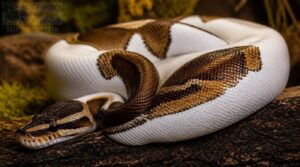
Picture a snake wearing two different coats stitched together: that’s the piebald phenotype, a coat color genetics trait causing white patch formation from missing melanocytes. Neural crest cells fail to reach certain regions during development. Key markers include:
- Ventral white consistency
- Head pattern retention
- Tail tip whiteness
- Irregular dorsal patching
This genetic inheritance pattern remains stable from birth onward. Beyond snakes, this same piebald spotting pattern appears across many species, from horses and dogs to cattle and even squirrels.
Wild-Type and Piebald Alleles
Every ball python carries two alleles at this locus, and the pairing decides the outcome. Wild-type dominance means one normal copy masks piebald entirely. Only two piebald alleles together disrupt melanocyte migration, producing white patches.
This inheritance mechanism drives ball python morph genetics, letting breeders predict outcomes long before eggs hatch by tracking allele interaction patterns across generations.
TFEC Mutation and Pigment Cells
That masking only holds when TFEC does its job. This gene acts as a master regulator guiding neural crest cells toward iridophore and melanocyte fates. The mutation creates a premature stop codon, so:
- Transcription factor function fails
- Iridophore specification stalls
- Pigment cell lineages lose direction
Melanocyte Migration During Development
Every pigment cell starts as a neural crest cell, migrating along the dorsolateral pathway between somites and the dorsal neural tube. Melanoblast differentiation happens after specification but before epidermal colonization, and hair follicle inclusion follows.
TFEC guides that journey; when it fails, melanocyte migration stalls, leaving embryonic development incomplete in patches you’ll soon see as skin.
Why White Patches Form
Because those neural crest cells never reach certain regions, melanocyte absence leaves patches with no pigment source at all.
This developmental disruption follows migration routes, not random placement, so white patch origins map directly onto where TFEC-guided cells failed to travel.
The result: fixed, permanent zones defining the piebald pattern in ball pythons.
Is Piebald Dominant or Recessive?
Piebald inheritance comes down to one straightforward rule, and once you understand it, breeding decisions get a lot less mysterious. You’ll want to know exactly how the recessive gene behaves before pairing any snakes together. Here’s what determines whether your hatchlings show that signature white patterning.
Since piebald only shows up when both parents carry the recessive gene, this corn snake morphs explained guide is worth a look before you plan any pairings.
Simple Recessive Inheritance
Piebald follows simple recessive inheritance, meaning the trait stays hidden unless a snake inherits two copies of the mutant TFEC allele, one from each parent. A single copy gets masked entirely.
Three genotype outcomes exist:
- Homozygous dominant (NN) – normal appearance, no piebald allele
- Heterozygous (Nn) – carrier, normal looking, carries one mutation
- Homozygous recessive (nn) – visual piebald expression
Mendelian ratios govern every clutch produced this way.
Visual Pieds and Homozygosity
That striking white-and-black patchwork you see on a visual pied only shows up when both TFEC alleles carry the mutation, making it homozygous for the trait. This double dose drives homozygous patch consistency, giving breeders more predictable white coverage across clutches.
Still, visual paradoxes crop up: two homozygous pieds can produce offspring with noticeably different patterning, proving genotype-phenotype correlation isn’t always a perfect match in ball python morph breeding.
Het Pieds and Carriers
You can’t tell a het by looking at it, and that’s exactly the point. Genotype and phenotype diverge here: one wild-type allele, one piebald allele, zero visible patches.
A het pied looks perfectly normal, yet silently carries one piebald allele alongside its wild-type partner
Breed a het to wild-type and you get:
- Roughly 50% het offspring
- Roughly 50% non-carriers
- Zero visual pieds, per Mendelian transmission rates
Shed-skin DNA testing confirms what your eyes can’t.
Possible Het Percentages
That 25% figure isn’t gospel, it’s a starting point. Carrier frequency analysis shifts with lineage-based het variation, so pairing history matters more than textbook odds.
Offspring prediction models help, but multi-gene inheritance impact complicates things further. When you’re stacking morphs, genetic testing accuracy through shed-skin DNA becomes your most reliable tool, not assumptions about breeding outcomes.
Genotype Versus Phenotype
Your genotype is fixed at fertilization, but phenotype tells a messier story. A het carries one piebald allele silently; a homozygous pair produces the visual trait. This genotype-phenotype distinction explains genetic expression variability across ball python breeding projects, where allele interaction, trait penetrance, and even environmental influence shape outcomes far more than a punnett square alone.
Piebald Ball Python Breeding Outcomes
Once you know piebald works as a recessive trait, the next question is practical: what actually happens when you pair specific genotypes together? Every combination produces different odds, and those numbers determine how you plan your breeding projects and set expectations for each clutch. Here’s how each common pairing breaks down.
Pied × Wild Type
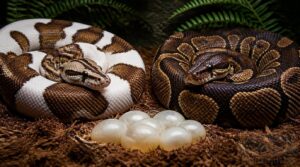
Crossing a visual pied with a wild type produces 100% het pied offspring, all appearing normal despite carrying one copy of the mutant allele. No visual pieds emerge from this pairing since piebald inheritance is strictly recessive, requiring two mutant alleles.
Allele segregation guarantees every hatchling inherits one wild type and one piebald allele, hiding genotype behind ordinary phenotype until later confirmed.
Pied × Het Pied
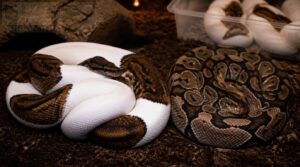
Pair a visual pied with a het pied, and the odds shift. Each egg carries a 50 percent chance of hatching pied, since the het parent passes its single mutant allele half the time.
The rest emerge as het pieds themselves, visually normal but genetically loaded, useful for confirming carrier status through pedigree and future test pairings.
Het Pied × Het Pied
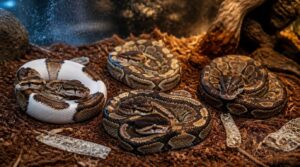
Two het pieds produce the classic 25/50/25 split described by the Mendelian Inheritance Model: roughly 25 percent piebald, 50 percent het pied carriers, 25 percent wild type. This Genetic Probability Chart guides breeding outcome predictions, though modifiers can skew visible ratios.
Carrier frequency analysis and pedigree tracking remain necessary since het offspring show no visual clues to their genetic mutation.
Pied × Pied
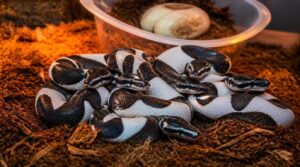
Once both parents carry two piebald alleles, the guesswork drops away. Homozygous pied outcomes dominate: every offspring inherits piebald genes, producing consistent white patterning across the clutch, though white coverage still varies egg to egg.
This pairing remains the standard for breeders chasing reliable pied offspring ratios without relying on genetic testing to confirm carrier status.
Odds for Each Egg
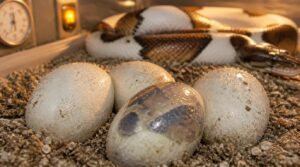
Every clutch obeys the same Mendelian inheritance rules, but the parental genotype impact changes the math entirely.
Het x Het yields a 1 in 4 odds per egg for visual pieds. Pied x Het pushes that to roughly 50%. Pied x Pied approaches full expression.
Allele frequency effects mean each egg is an independent roll, not a guarantee.
How Piebald Genetics Affect Appearance
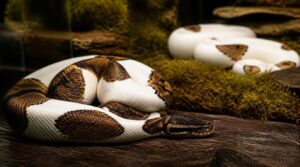
The same recessive genotype can still produce wildly different snakes, and that’s where things get interesting for you as a breeder. White coverage isn’t fixed by the gene alone, so two pieds from the same clutch can look nothing alike.
Here’s what actually shows up on the skin, and why some traits stay predictable no matter how much white you’re working with.
High-White Versus Low-White Pieds
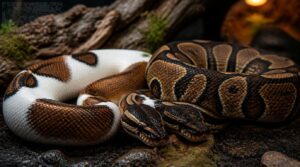
Not all pieds wear their genetics the same way. High-White Pieds show 60-90% white, often crawling onto the head and belly, while Low-White Pieds keep patches smaller and confined:
- Ground color contrast
- Head white extent
- Belly patch variation
Modifier genes, not the main allele, drive this range, letting you plan pairings for specific coverage goals.
White Coverage Variation
No two clutches wear their white the same way. Patch shapes range from rounded ovals to jagged, lace-like margins, often concentrating near the shoulders and along the ventral midline, where belly white usually exceeds dorsal coverage. Distribution usually stays symmetrical left to right.
Unlike leucistic snakes, piebald patterning stems from patchy melanocyte loss, not full-body absence, so siblings can still vary widely.
Typically Patterned Head
You can spot a piebald ball python by its head alone. Unlike the body, it keeps normal patterning, often with light patches around the eyes, an eye band, subtle nuchal shading, and darker snout tones, all shaped by:
- Melanocyte migration
- Allele activity
- Patch location trends
This head consistency is a hallmark of piebald inheritance in reptile morph genetics.
White Belly and Tail
Run your fingers along a pied’s underside and you’ll find it’s completely white, no exceptions, regardless of dorsal coverage. Tail patching varies more, often capping the tip and creeping upward.
Belly patch density and tail white extent differ even among clutch mates, a reminder that piebald inheritance sets the trait but not its precise expression.
Pattern Distribution Along Body
Trace a pied from nose to tail and you’ll see a clear map. White patches spine shoulder first, spreading along the dorsal midline lateral extension into fan shaped patches. Midbody patch density peaks mid-body, tapering toward the tail.
Head crown markings stay symmetrical, and the tail ventral change fades gradually, showing how phenotypic variation in reptiles plays out scale by scale.
How Breeders Confirm Piebald Genetics
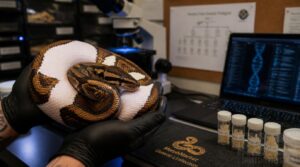
Spotting a visual pied is easy, but confirming what an animal actually carries genetically takes more than a glance. Since heterozygous pieds show no outward sign of their hidden allele, you’ll need methods that go beyond appearance to verify lineage with certainty.
Here’s how breeders combine visual checks, testing, and record-keeping to confirm piebald genetics with confidence.
Visual Identification of Pieds
Recognizing a visual pied starts with your eyes: irregular white patch patterns breaking across a tan or brown base, often outlining dorsal segmentation like scattered continents on a map.
Check head coloration first, since it usually stays patterned rather than white. Then confirm belly whiteness and any tail tip white, both strong indicators supporting scale pigmentation anomalies tied to the piebald trait.
Why Hets Look Normal
Unlike visual pieds, heterozygotes carry a single mutant TFEC allele masked by the wild-type masking effect, so pigment cells develop normally almost everywhere.
Melanocyte activity patches stay absent, preserving scale color throughout. This heterozygote trait suppression means:
- Normal dorsal pattern
- Standard belly pigmentation
- Typical head markings
- No visible white patches
Genotype and phenotype simply don’t match here, which is why visual ID alone can’t confirm carrier status.
Shed-Skin DNA Testing
Since visual ID can’t reveal het status, shed-skin DNA testing fills the gap. Collect skin within 24 hours of shedding, store it dry and breathable, then send it for TFEC-focused genotyping. Fresh, clean sheds yield the most reliable DNA.
Turnaround runs 3 to 7 business days, giving you accurate, non-invasive confirmation of piebald genetics before you ever plan a pairing.
Pedigrees and Pairing Records
DNA testing confirms genotype, but pedigrees and pairing records turn that data into breeding strategy. Track sire, dam, and offspring across generations to map inheritance of the piebald trait.
- Lineage charts revealing hidden het carriers
- Mating outcome logs showing clutch ratios
- Sire dam documentation preventing accidental pairings
- Diversity assessments flagging inbreeding risk
Solid records protect genetic diversity while guiding smarter morph pairings ahead.
Piebald in Multi-Gene Morphs
Pairing piebald with other recessive genes rarely produces simple, additive results. Modifier gene influence and allele expression order can shift white coverage, patch edges, or head patterning in multi-gene morph outcomes.
Combinations with certain chromosomal modifiers may boost high-white piebald patterns, so tracking genetic expression across generations helps you predict, rather than guess, how compatible co-genes will shape your next clutch.
Frequently Asked Questions (FAQs)
Is piebald dominant or recessive?
Piebald follows simple recessive inheritance, meaning a single mutant allele won’t cut it. Your snake needs two copies of that TFEC mutation to actually show the trait visually. One copy just creates a het, a silent carrier hiding the genetic potential.
Where do piebald ball pythons come from?
Wild snakes bearing this ancestral mutation turned up across Ghana, Togo, and Benin before US breeders, including the Peter Kahl program, captured the trait, sparking piebald’s 1990s rise through global ball python morph breeding.
Is pied a dominant gene in ball pythons?
No, pied follows a recessive inheritance pattern, not dominant. You need two copies of the mutant allele, one from each parent, before that classic white patching shows up anywhere on the snake’s body.
How rare is a piebald ball python?
Genetic rarity, not wild occurrence, drives scarcity. Recessive inheritance of the piebald trait means two het parents produce visual pieds only 25% of the time, limiting market availability and keeping breeding odds firmly against every clutch.
How long do piebald ball pythons typically live?
One captive ball python reached 62 years old, proof of what proper care can achieve. Most live 20–30 years in captivity versus just 10 in the wild, since husbandry, diet, and vet care outpace nature’s harsher odds.
What size enclosure does a piebald ball python need?
Adults need at least a 4×2×2 ft enclosure for full stretching. Juveniles start around 20 gallons, moving to 30-40 as subadults. Prioritize secure materials, a stable temperature gradient, hides, and climbing enrichment for healthy growth.
Do piebald ball pythons have unique health concerns?
A breeder once assumed her het pied lacked vigor, but bloodwork showed normal function. Pigmentation loss stays cosmetic; TFEC affects only melanocyte migration. Real risks trace to husbandry, inbreeding, or disease exposure, not the piebald allele itself.
How does temperature affect piebald coloration over time?
Warmth speeds pigment cell activity, deepening colored patches within days, while cold exposure sharpens patch edges and slows melanocyte development.
Seasonal shifts drive gradual darkening or lightening, though mature pythons show more stable, temperature-resistant patterning over time.
Are piebald ball pythons good pets for beginners?
Rarer than a snake with wings, this gentle morph still behaves like any beginner-friendly python.
Calm temperament, easy feeding, simple enclosure needs, and manageable handling make piebald ball pythons a genuinely practical, low-stress choice for first-time reptile keepers.
Are there health issues linked to piebald genetics?
Genetically speaking, no. The TFEC mutation driving piebald expression only disrupts pigment cell migration, so affected ball pythons carry no elevated cancer, immune, or organ risk, distinguishing them from clinical piebaldism syndromes seen in mammals.
Conclusion
Like a scribe deciphering an old manuscript, you now read patched scales as inherited text rather than mystery.
Piebald ball python genetics reward patience: one recessive allele, faithfully passed down, produces every white patch you’ll ever breed for. Pairing two hets won’t guarantee a pied, but it stacks the odds in your favor.
Track your pedigrees, verify with shed DNA, and trust the math. The pattern was always written in the genes, waiting for you to read it.