This site is supported by our readers. We may earn a commission, at no cost to you, if you purchase through links.
Two corn snakes can share the same species, the same size, even the same wild lineage, and still look like they belong on different planets. One wears the classic rust-and-orange pattern you’d spot in a Georgia leaf pile. The other glows pink, white, or ghost-pale, a result of decades of deliberate breeding choices, not chance.
That gap between "wild-caught look" and "jaw-dropping designer morph" comes down to genetics, and once you understand the basics, you’ll never look at a pet store tank the same way. Corn snake morphs explained properly means tracing pigment mutations, pattern genes, and breeding pedigrees back to their roots.
You’re about to discover how a single recessive gene creates an Amelanistic, why Snow morphs stack two traits at once, and what separates a true locality strain from a marketing label.
Table Of Contents
- Key Takeaways
- Corn Snake Morphs Explained and Classified
- How Corn Snake Morph Genetics Work
- Popular Corn Snake Color Morphs
- Pattern, Rare, and Designer Morphs
- Corn Snake Morph Prices and Selection
- Frequently Asked Questions (FAQs)
- How to tell what morph your corn snake is?
- What is the rarest corn snake morph?
- What are the most beautiful corn snake morphs?
- How many different morphs of corn snakes are there?
- What are corn snake morphs?
- Why do corn snakes have different color morphs?
- How do you identify a corn snake morph?
- Are corn snake morphs genetic?
- Are corn snakes a good morph?
- What is the corn snake morph Conservation Society (csmcs)?
- Conclusion
Key Takeaways
- Corn snake morphs come from genetic mutations locked in through selective breeding, while wild-type snakes keep their natural rust-and-orange coloring untouched by human hands.
- Recessive traits (like Amelanistic or Anerythristic) need two gene copies to show up, dominant traits need just one, and combos like Snow stack two recessive mutations together for a whole new look.
- Prices swing from around $20 for common morphs up to $650 or more for rare designer combos, driven by genetic complexity, breeder reputation, and market demand.
- Choosing a reputable breeder matters as much as picking a morph, since documented lineage, health guarantees, and genetic testing transparency protect you from costly surprises.
Corn Snake Morphs Explained and Classified
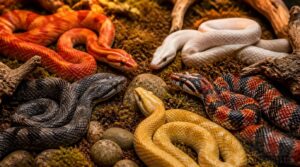
Corn snakes come in a jaw-dropping range of colors and patterns, but figuring out where to start can feel overwhelming. That’s why breeders classify them into clear categories based on genetics, strains, and visual traits. Here’s how the whole system breaks down.
Once you understand the basics, diving into corn snake breeding and genetics will help you predict which morphs a given pairing might actually produce.
Wild-Type Snakes Versus Morphs
Picture a rust-and-orange snake sliding through Georgia leaf litter, unmarked by human hands. That’s wildtype genetics at work, ancestral coloring nature perfected long before breeders got involved.
A rust-and-orange snake in Georgia leaf litter carries wildtype genetics, ancestral coloring nature perfected before breeders ever intervened
Morphs? Those come from genetic mutations, then get locked in through selective breeding. Popular examples include albino corn snake morphs, which display combinations of orange, pink, red, white, and yellow with striking red-orange eyes.
- Wild types: natural, common, typical scale counts
- Morphs: captive-bred, mutation-driven, visually striking
- Both: same species, different genetic stories
Morphs, Strains, and Localities
So how do breeders keep genetics straight across 800+ morphs? Enter locality tracking, snakes named for origin points like Okeetee, South Carolina. Regional variations show stable, generation-spanning traits.
Strains group snakes sharing ancestry and defined traits within a locality. Reputable breeders guard ancestral strain purity, documenting pedigrees so you know exactly what genetic combinations you’re buying before attempting any designer cross.
Color and Pattern Categories
Once pedigree’s locked in, color’s next. Two forces shape every snake: pigment mutations (melanin and erythrin production) and pattern expression, how blotches, stripes, or diffused edges spread across scales.
- Amelanistic: no melanin, yellow-orange body, dark eyes
- Anerythristic: no erythrin, cream-to-tan tones
- Motley: irregular blotches, broken lateral markings
Dominance hierarchy and polygenic traits decide which mutation wins out.
Designer Morph Combinations
Now stack two morphs and watch the magic multiply. Designer morph creation pairs recessive genes, codominant genes, and polygenic traits, think Amelanistic x Lavender for pale bodies, or Snow x Coral Snow for stark contrast.
Predictive breeding models rely on documented genotypes, so morph compatibility isn’t guesswork. Rare trait expression and market-driven morph design keep prices climbing, especially when ethical combination practices back the lineage.
History of Selective Breeding
Long before genetics had a name, humans were already shaping life around them. That 10,000-year-old habit birthed today’s designer morph creation.
- Ancient farmers picked tame, hardy stock
- Classical breeders fixed traits through culling
- Darwin borrowed these lessons for natural selection
- Industrial methods scaled up genetic inheritance control, raising ethical questions
How Corn Snake Morph Genetics Work
Ever wonder why two normal-looking corn snakes can produce a clutch full of jaw-dropping morphs?
It all comes down to recessive genes hiding beneath normal coloring, and this guide to corn snake morphs, colors, and prices breaks down exactly how those hidden traits combine to create such surprising results.
The answer lies in genetics working behind the scenes, from simple recessive pairings to complex multi-gene combos.
Here’s how each type of inheritance shapes what you’ll actually see in the eggs.
Recessive Trait Inheritance
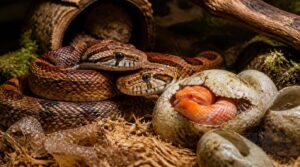
Ever wonder why two normal-looking corn snakes can produce a jaw-dropping Amelanistic baby? That’s Mendelian inheritance at work. Recessive alleles hide silently in carriers, only showing up in homozygous offspring.
Pair two carriers, and you’re looking at roughly 25% odds of that recessive trait appearing, classic allele pairing likelihood breeders track through careful pedigree records.
It’s worth knowing the difference before you start naming morphs, since mixing up co-dominant and incompletely dominant traits can throw off your whole breeding plan — this ball python genetics and super form guide breaks down how those inheritance patterns actually differ.
Dominant and Incomplete-Dominant Traits
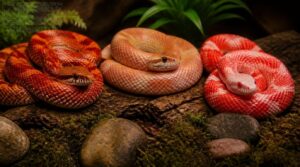
Skip the recessive math here: dominant genes need just one copy to show up, no carrier guesswork required. Pair a dominant morph with a normal, and you’ll see that trait in every clutch.
Incomplete-dominant traits mix instead, producing intermediate phenotype expression, think Pastel-style softening rather than an on/off switch. That allele interaction shapes predictable, blended offspring.
Pigment Gene Mutations
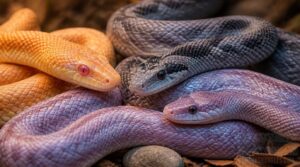
What actually flips a snake’s colors on and off? Pigment mutations target melanin reduction pathways directly. Faulty tyrosinase enzyme function causes amelanistic traits, while pigment distribution genes and melanosome transport mechanisms create anerythristic and lavender morph effects. Each mutation produces distinct contrast alteration phenotypes, proof that genetic inheritance at the cellular level drives every color you’ll breed for.
Polygenic Color and Pattern Traits
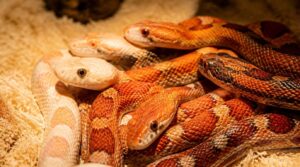
Why do clutch-mates never look quite identical? Polygenic trait inheritance stacks many small-effect genes together, creating a true color intensity variation and pattern density continuum instead of clean on/off switches. Environmental modulation effects nudge things further. Add in wide allele combination diversity across breeding lines, and you get everything from pale cream bellies to rich copper backs in one litter.
Predicting Designer Morph Offspring
Want a Bloodred hatchling from two Amelanistic parents? Not happening. Punnett squares turn guesswork into genetic inheritance math.
- Identify each parent’s recessive traits
- Calculate carrier probability percentages
- Map gene interaction across loci
- Predict heterozygous offspring ratios
Lineage tracking beats hope every time, since dominant genes and recessive traits combine predictably once you know the parents’ actual genotypes.
Popular Corn Snake Color Morphs
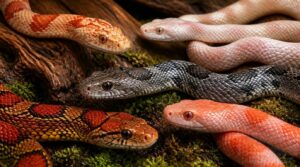
Now that you know how genes stack up, it’s time to see what they actually look like on a snake. From ghostly whites to fiery reds, corn snake breeders have turned a handful of mutations into a color palette. Here’s your rundown of the morphs you’ll spot most often in breeder lists and reptile expos.
Amelanistic and Anerythristic Morphs
Ever wonder why some corn snakes glow red-orange while others look smoky grey? That’s recessive inheritance at work.
Amelanistic morphs lack melanin, showing bright red, orange, and yellow patterning with dark eyes. Anerythristic snakes suppress erythrin instead, producing cream, tan, or coppery bodies with bold dark markings. Both traits need two copies to express, so pairing carriers strategically unlocks these striking pigment mutations.
Lavender and Opal Morphs
Purple snakes? That’s lavender genetics, a tyrosinase-positive form of albinism producing pale purple washes over intact patterning, running $200-$300.
Opal takes a different path: patternless white bodies with red undertones, blending amelanistic and lavender traits, averaging $275-$300.
Both soften pattern boundaries while boosting color intensity through recessive trait inheritance, proving genetic mechanics can turn subtle mutations into showstopping color inheritance results.
Butter and Caramel Morphs
Butter morphs bring golden-yellow warmth over cream, with amber eyes emerging after that first shed. Caramel morphs run tan to warm brown, dense saddles, sharp head stamps.
Both trace back to recessive genes, so pairing them creates striking Butter Caramel hybrids where color inheritance gets genuinely complex, proof that genetic complexity rewards patient breeders.
Bloodred and Red Factor
If Butter and Caramel prove patience pays off, Bloodred takes things further. This recessive morph strips melanin, letting red dominate through carotenoid deposition and reduced pheomelanin muting.
Pair it with Red Factor, a dominant modifier, and you’ll get jaw-dropping saturation along the Jonathan stripe. Eye color stays consistent with wild types. Genotype knowledge matters here, offspring intensity varies wildly without it.
Snow and Whiteout Morphs
When Amelanistic meets Anerythristic, you get Snow, a recessive combo stripping both melanin and erythrin for pale, pattern-reduced bodies. Whiteout pushes further toward solid white, sometimes blending Lavender or Hypo for lilac tints or cleaner contrast. Genetic inheritance requires two copies from both parents.
Expect faint saddles occasionally, plus consistent humidity and hiding spots to keep sheds clean.
Pattern, Rare, and Designer Morphs
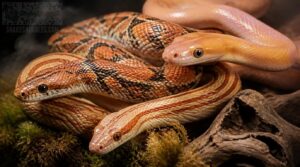
Color grabs the spotlight, but pattern is where corn snakes really flex their genetic creativity. From racing stripes to speckled pixels to skin that ditches scales altogether, these morphs prove structure matters as much as hue. Here’s where things get jaw-dropping.
Motley, Stripe, and Tessera
Think of pattern genes as your genetic toolbox for reshaping a corn snake’s blueprint. Motley patterns scatter irregular blotches with jaw-dropping contrast, staying stable from hatchling to adult. Stripe patterns run four clean lines head to tail. Tessera works as dominant inheritance, sharpening vertebral stripes crisply.
Pattern interaction with other morphs? Wildly unpredictable, since polygenic influences mean breeders won’t guarantee exact intensity.
Diffused Pattern Characteristics
Ever seen a corn snake that looks smoky, like its colors melted into each other? That’s Diffused pattern at work, softening saddle boundaries until blotches vanish into blood-red haze.
Boundary blending shifts subtly with lighting and temperature, though genetics stay fixed. Breeders track inheritance carefully since diffusion co-occurs unpredictably with speckling, flecking, or other pattern modifier genes across generations.
Palmetto and Scaleless Morphs
Picture a snake with pixel-like white speckling over a warm peach ground, then strip away its scales entirely. That’s the Palmetto scaleless interaction, prized for:
- Stable inheritance traits in pattern
- Smooth scaleless skin texture
- Strong head pattern contrast
- Amber, copper-toned eyes
Both morphs stem from recessive traits and pigment mutations, so pairing them demands careful genetic inheritance tracking.
Avalanche and Blizzard Morphs
Snow-white and stunning, Avalanche and Blizzard morphs strip color down to almost nothing. Avalanche pairs amelanistic with anerythristic genetics, muting pattern into a pale, ghostly field. Blizzard pushes further, near-white with striking dark eyes. Both rely on recessive genetic inheritance, so expect careful pairing. Pricing runs $70-$400. Pale skin means diligent shedding care and stable humidity are non-negotiable.
Coral Snow and Plasma
Rarity has a price tag, and Coral Snow proves it. This recessive inheritance morph layers coral-pink speckling over cream, while Plasma washes muted red across gray-tan scales.
- Two recessive copies required
- Color intensity shifts with molt
- Erythromelanin drives Coral Snow’s tint
- Plasma preserves yellow, black patterning
- Pair with other designer morph combinations for jaw-dropping results
Corn Snake Morph Prices and Selection
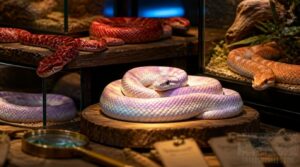
So you’ve fallen for a morph, but what’s it actually going to cost you? Price tags on corn snakes swing wildly, from $20 pocket-change bloodreds to $650 showstoppers like Plasma, and the reasons why aren’t always obvious. Let’s break down what drives those numbers and how to pick a snake that fits your budget and experience level.
Factors Affecting Morph Prices
Why does one hatchling sell for fifty bucks while its cousin costs a month’s rent? Genetic complexity drives it. Single-gene morphs breed easy, but triple-combo designers demand years of careful pairing, so rarity pushes prices skyward.
Breeder reputation matters just as much. Established breeders charge 15-30% more, and that premium buys genetic health, documented lineage, and fewer surprises down the road.
Three forces shape what you’ll pay:
- Market demand trends – viral morphs spike overnight
- Seasonal price fluctuations – expo season versus winter lulls
- Lineage popularity effects – proven bloodlines command loyalty
Health viability factors seal the deal too. A healthy, disease-free snake with strong hatch survival simply commands more trust, and trust, in this hobby, always carries a price tag.
Common Versus Rare Morph Costs
Trust that reputation buys? It costs. Common morphs run $50-$200, easy to find at any show. Rare combos start past 0, climbing into the thousands as genetic rarity compounds.
Locality matters too, urban markets skew higher, rural breeders undercut them. Health guarantees add another 5-15%, but that’s the price of sleeping easy.
Beginner-Friendly Morph Choices
Ready for your first snake? Skip the exotic combos and start with proven genetics.
- Amelanistic morphs: bright orange, forgiving beginners
- Anerythristic traits: gray tones, hardy stock
- Lavender morphs: soft purple, easy temperament
- Butter morphs: creamy yellow, budget-friendly
- Snow morphs: near-white, jaw-dropping simplicity
Each comes from well-documented recessive traits, so breeders know exactly what you’re getting.
Specialized Morph Care Needs
Scaleless or lavender morphs aren’t just "beginner snakes with fancier paint jobs." Their skin and pigment quirks demand real temperature gradients (84-88°F days, 78-82°F nights), 40-60% humidity, and humidity boxes during sheds.
Smooth substrate prevents irritation; shallow water dishes ease hydration.
Watch for shedding troubles and respiratory issues, and keep handling gentle, stress-reducing, and consistent.
Vet checks catch problems early.
Choosing Ethical, Reputable Breeders
A gorgeous Avalanche means nothing if the breeder can’t back it up. Ask for health clearances, tour the facility, meet the parents, and request genetic testing transparency.
- Clean, climate-controlled enclosures
- Curious, alert parent snakes
- Documented lineage and health guarantees
- Willingness to answer questions
- Post-sale support and care guidance
Reputation matters more than price tags. Choose breeders who prioritize welfare, not just jaw-dropping morphs.
Frequently Asked Questions (FAQs)
How to tell what morph your corn snake is?
Start with eye color analysis and a pigment absence test: red eyes hint amelanistic, black eyes suggest anerythristic. Then check scale pattern and trace parentage, since Mendelian ratios and allele tracking often reveal what genetics alone won’t show.
What is the rarest corn snake morph?
Good things come in small, scarce packages: the Opal morph takes the crown, blending amelanistic and lavender genetics into a patternless, pink-eyed rarity that few breeders successfully produce, commanding premium pricing well above typical designer combinations.
What are the most beautiful corn snake morphs?
Beauty’s subjective, but Avalanche morph beauty, Blizzard morph elegance, and Opal morph radiance top most breeders’ lists. Whiteout’s purity, Plasma’s rarity, and Palmetto’s speckled charm prove selective breeding turns corn snakes into living art.
How many different morphs of corn snakes are there?
You won’t find one fixed number, since morph counting methods vary by source. Breeders document over 800 recognized combinations from roughly 33 basic genetic traits, with new pairings constantly added to morph databases.
What are corn snake morphs?
Ever wonder why two corn snakes can look nothing alike?
Selective breeding unlocks hidden genetic mutations, transforming wild-type coloring into over 800 recognized morphs, each one a one-of-a-kind mix of color variations and pattern inheritance passed down through careful genetic strain selection.
Why do corn snakes have different color morphs?
Think of each snake as a painter’s canvas: genetic mutations reshape pigment pathways during chromatophore development, while selective breeding amplifies these shifts, blending melanin and erythrin production into hundreds of inherited color intensities and patterns.
How do you identify a corn snake morph?
You’ll spot a morph by reading four clues together: pigment absence, pattern style, scale texture, and eye color. Cross-check hunches against breeder documentation or genetic testing since visual guesses alone can’t always confirm true lineage.
Are corn snake morphs genetic?
Yes, morph traits are 100% genetic. Recessive genes need two copies, dominant genes need one, and codominant genes mix both. That’s straightforward Punnett square math, letting you predict offspring colors and patterns generations before they hatch.
Are corn snakes a good morph?
Corn snakes aren’t a morph, they’re the species. Morphs are color and pattern variations within them, and nearly all offer beginner-friendly temperaments, easy handling, and simple enclosure needs, making careful morph suitability assessment less about difficulty and more about personal taste.
What is the corn snake morph Conservation Society (csmcs)?
Picture a guild hall for snake nerds: CSMCS champions ethical breeding practices, morph documentation standards, and community verification, guiding genetic research, lineage quality, breeder reputation, and conservation minded keeping through hands-on education outreach.
Conclusion
Funny thing about a snake that never asks for makeup: humans gave it hundreds of colors anyway. That’s the irony sitting at the center of every ghost-pale Snow or blushing Bloodred.
Corn snake morphs explained simply means understanding that one flipped gene can rewrite an animal’s entire story. Now you know the difference between a locality and a label, a het and a homozygote.
Pick your favorite trait, find a reputable breeder, and start building your own bloodline.