This site is supported by our readers. We may earn a commission, at no cost to you, if you purchase through links.
Pick the wrong substrate and you’ll spend months fighting mold, odor, and a collapsing microfauna colony instead of enjoying your enclosure. Bioactive setups live or die by what’s under the surface, since the liner controls drainage, humidity, and whether springtails and isopods actually thrive or quietly starve.
That’s why seasoned keepers treat substrate liners for bioactive enclosures as foundational, not decorative. The right combination of coir, sphagnum, and drainage layers determines whether your tropical terrarium holds 70% humidity or dries out by Tuesday.
Below, you’ll find nine standout options, how to match them to your species, and the layering strategy that keeps everything balanced for years, not weeks.
Table Of Contents
- Key Takeaways
- Top 9 Bioactive Substrate Liner Options
- 1. Bio Dude Terra Firma Reptile Substrate
- 2. Joshs Frogs BioBedding Tropical Substrate
- 3. Zilla Jungle Mix Reptile Substrate
- 4. Better Gro Long Fiber Sphagnum Moss
- 5. Zoo Med Eco Earth Coconut Fiber
- 6. Back to the Roots Coir
- 7. Zoo Med ReptiSand Natural
- 8. Galapagos Cypress Tank Mulch Bedding
- 9. Flukers Premium Cypress Bedding Reptiles
- Match Liners to Snake Habitats
- Compare Liner Materials and Performance
- Layer Substrates for Bioactive Success
- Maintain Bioactive Substrate Liners
- Frequently Asked Questions (FAQs)
- What is the best substrate for a bioactive terrarium?
- What to use as a drainage layer in a bioactive terrarium?
- Can I make my own bioactive substrate?
- Do you need to change substrate in a bioactive terrarium?
- What safety precautions matter most during liner installation?
- How often should enclosure liners be disinfected between uses?
- What vent clearance is needed to prevent overheating risks?
- How should liner edges be sealed to prevent snagging?
- Conclusion
Key Takeaways
- Your substrate liner is the real foundation of a bioactive enclosure, since it controls drainage, humidity, and whether your cleanup crew of springtails and isopods actually survives.
- Match your material to your species: coconut coir and cypress mulch suit tropical and humid setups, sphagnum moss boosts hydration for shedding and humid hides, and sand works best for arid, desert-dwelling reptiles.
- A proper layering system, drainage layer, mesh barrier, correct depth, and leaf litter on top prevents waterlogging and compaction while keeping your microfauna colony stable for years.
- Regular upkeep like checking moisture weekly, watching for mold or odor, and refreshing organic matter every 6-12 months keeps your bioactive setup self-sustaining instead of collapsing.
Top 9 Bioactive Substrate Liner Options
Choosing the right substrate can make or break your bioactive enclosure’s long-term success, since the wrong mix leads to compaction, mold, or unhappy microfauna.
If your enclosure feels cramped or the substrate stays damp too long, it’s worth checking whether these conditions are behind unexplained snake weight loss, since stress and bacteria buildup often show up there first.
Choosing the right substrate is essential for long-term success.
You need options that match your species’ humidity needs, burrowing habits, and maintenance tolerance, which is why comparing top products matters before you commit.
matching species’ humidity needs, burrowing habits, and maintenance tolerance is key.
Here are nine substrate liners worth knowing, each suited to different setups and skill levels.
nine substrate liners worth knowing are outlined here.
1. Bio Dude Terra Firma Reptile Substrate
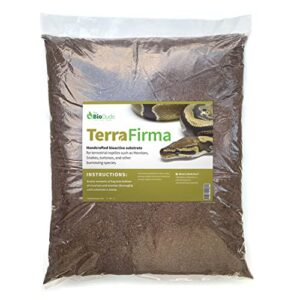
If you want a top choice all-in-one mix, Terra Firma delivers. It simulates silty soil, which lets savanna and semiarid species dig reusable burrows that stay firm through shedding cycles without collapsing.
You won’t need a separate drainage layer in most builds, since the mix retains moisture without waterlogging. It accommodates live plants and clean-up crews alike, though the premium price and 35 lb weight are real tradeoffs for larger enclosures needing frequent rearranging.
| Best For | Keepers of savanna, semiarid, coastal rainforest, or riverbank reptiles and amphibians who want a bioactive setup with real burrowing, moderate humidity (50-75%), and support for live plants. |
|---|---|
| Moisture Retention | High |
| Supports Burrowing | Yes |
| Bioactive Suitable | Yes |
| Odor Control | Moderate |
| Material Base | Soil blend |
| Replacement Frequency | Rarely |
| Additional Features |
|
- Supports natural burrowing and tunneling while staying stable through shedding
- Works well in bioactive setups, sustaining everything from succulents to tropical plants alongside a clean-up crew
- Retains moisture effectively, cutting down on how often you need to mist
- Costs more than basic substrates like coconut fiber
- Heavy at 35 lb, which can make handling tougher in larger enclosures
- May need occasional fluffing or added moisture, and isn’t ideal outside the 50-75% humidity range without tweaks
2. Joshs Frogs BioBedding Tropical Substrate
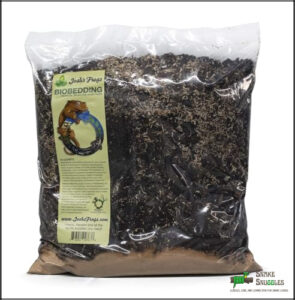
Terra Firma suits burrowers, but dart frogs and tree frogs need a different profile entirely. That’s where BioBedding Tropical earns its place, balancing drainage and nutrient retention so anaerobic pockets never form.
Beneficial fungi and trace elements jumpstart your cleanup crew fast, giving springtails and isopods a foundation to establish stable populations. Mix contents thoroughly and moisten with dechlorinated or RO water until it sticks when squeezed but won’t release liquid, that’s your consistency standard before setup.
| Best For | Keepers setting up high-humidity tropical terrariums for dart frogs, tree frogs, geckos, or similar species who want a long-term bioactive substrate that supports live plants and a springtail/isopod cleanup crew. |
|---|---|
| Moisture Retention | High |
| Supports Burrowing | Yes |
| Bioactive Suitable | Yes |
| Odor Control | Good |
| Material Base | Organic/inorganic mix |
| Replacement Frequency | Years |
| Additional Features |
|
- Blend of organic and inorganic material with beneficial fungi and trace elements jumpstarts a thriving bioactive environment
- Maintains humidity and supports live plant growth while remaining stable for years without needing to be changed
- Helps reduce bacterial disease risk by keeping the enclosure cleaner
- May contain hitchhiking organisms like snails or worms, which not every keeper wants
- Requires moistening with dechlorinated or RO water and thorough mixing before it’s ready to use
- Not ideal for animals prone to mite issues unless they’re already long-term established
3. Zilla Jungle Mix Reptile Substrate
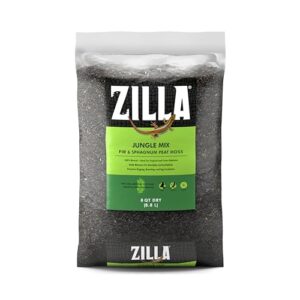
Budget matters, and Zilla Jungle Mix delivers a cost-effective foundation without the boutique price tag. Aged Douglas fir bark and sphagnum peat moss create a soft, loamy substrate that absorbs many times its weight in moisture.
Frogs, geckos, toads, and snakes all tolerate this generalist mix well, though it lacks the mineral complexity of premium soils. Amend it with leaf litter or sphagnum moss if your species needs more. Stick to 1-2 inches deep, replacing monthly to prevent odor buildup.
| Best For | Budget-conscious keepers of humidity-loving frogs, geckos, toads, and snakes who want a reliable, moisture-retentive substrate for tropical or forest-style enclosures. |
|---|---|
| Moisture Retention | High |
| Supports Burrowing | Yes |
| Bioactive Suitable | Yes |
| Odor Control | Moderate |
| Material Base | Bark and peat |
| Replacement Frequency | Monthly |
| Additional Features |
|
- Affordable, cost-effective alternative to premium substrates
- Highly absorbent blend that helps maintain stable humidity
- Encourages natural digging, burrowing, and breeding behaviors
- May contain wood splinters that can irritate handlers
- Not suitable for desert or low-humidity species
- Breaks down quickly and requires monthly replacement
4. Better Gro Long Fiber Sphagnum Moss
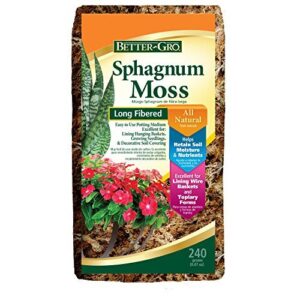
Sphagnum moss earns its keep as a humidity booster rather than a full substrate, and Better Gro’s long-fiber variety is the top choice for shedding support. The springy fibers resist matting, so they hold moisture without turning to mush.
Rehydrate before use, then tuck it into humid hides or layer it over drainage for burrowing species. It’s naturally acidic too, which helps curb mold growth in enclosed, damp microhabitats.
| Best For | Reptile keepers and plant growers who need a natural, moisture-retentive medium for humid hides, orchid potting, or fern and hosta cultivation. |
|---|---|
| Moisture Retention | High |
| Supports Burrowing | Limited |
| Bioactive Suitable | Yes |
| Odor Control | Moderate |
| Material Base | Sphagnum moss |
| Replacement Frequency | As needed |
| Additional Features |
|
- Long, springy fibers resist matting and hold moisture effectively without becoming mushy
- Naturally acidic composition helps discourage mold growth in enclosed, damp environments
- Versatile across uses, from reptile shedding support to lining baskets and mounting bromeliads
- Dries out fairly quickly, so it needs frequent rehydrating to stay effective
- Not sterilized, meaning it may carry organic debris that could be a concern in sensitive setups
- Quality can be inconsistent, with some batches containing twigs, dirt, or uneven fiber length
5. Zoo Med Eco Earth Coconut Fiber
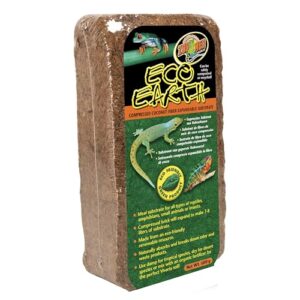
Building your own bioactive mix from scratch? Eco Earth is the blank-slate foundation most keepers start with. This coconut husk substrate stays loose and porous, letting you customize depth and mix in amendments freely.
For best results, try balancing particle size and moisture to keep coconut fiber safe for snakes before adding your own amendments.
It absorbs moisture without going soggy, buffering humidity for tropical species while resisting compaction that traps burrowing reptiles. Roots penetrate easily, and isopods thrive on the organic matter.
The catch: it needs added fertilizer for sustained plant growth, since Eco Earth alone lacks nutrients.
| Best For | Keepers building a custom bioactive enclosure who want a loose, additive-friendly base substrate to mix with amendments. |
|---|---|
| Moisture Retention | Moderate |
| Supports Burrowing | Yes |
| Bioactive Suitable | Limited |
| Odor Control | Good |
| Material Base | Coconut fiber |
| Replacement Frequency | As needed |
| Additional Features |
|
- Expands from a compact brick into 7-8 liters of substrate, offering great value and easy storage
- Made from renewable coconut fiber that stays loose and porous, resisting compaction and letting roots and burrowing reptiles move freely
- Naturally low-dust and helps absorb and break down odor and waste for easier cleanup
- Lacks nutrients on its own, so plants need added fertilizer for sustained growth
- Can dry out quickly in low-humidity environments, requiring frequent re-moisturizing
- May retain less moisture than expected, with some keepers needing to blend it with other substrates for better humidity control
6. Back to the Roots Coir
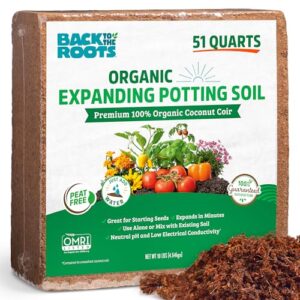
For keepers who want a peat-free, OMRI-listed option, this 10 lb compressed brick expands to roughly 51 quarts of loose coconut fiber, enough to fill about two cubic feet.
The dry block is stubborn, often requiring a hammer or saw to break apart before soaking. Rinse it first, since coir carries natural salts that can affect sensitive microfauna.
Expect occasional plastic debris in the coir, a minor tradeoff for a substrate that helps root growth and isopod colonies once fully hydrated.
| Best For | Isopod and bioactive terrarium keepers who want a peat-free, OMRI-listed coconut coir substrate for building moisture-retentive, well-aerated enclosures. |
|---|---|
| Moisture Retention | High |
| Supports Burrowing | No |
| Bioactive Suitable | Limited |
| Odor Control | Moderate |
| Material Base | Coco coir |
| Replacement Frequency | Seasonal |
| Additional Features |
|
- Expands from a compact 10 lb brick into roughly 51 quarts (about 2 cubic feet) of usable substrate
- Peat-free and OMRI listed, making it a solid choice for organic and eco-conscious setups
- Retains moisture well while still allowing aeration, supporting healthy root and colony development
- The dry block is very hard and often needs a hammer or saw to break apart before use
- Thin plastic packaging can tear in high heat or humidity, causing premature expansion
- Some users report occasional plastic debris or inconsistent texture in the coir
7. Zoo Med ReptiSand Natural
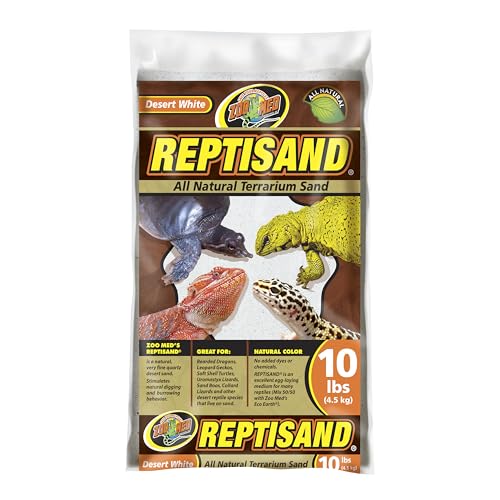
When your setup calls for arid rather than tropical conditions, ReptiSand Natural becomes the obvious pivot away from coir and moss. This 100% natural quartz sand contains no dyes or added chemicals, and its heat-conductive properties help stabilize basking temperatures for bearded dragons, leopard geckos, and sand boas.
Expect tan rather than pure white coloring despite the "Desert White" label. The fine, low-dust texture encourages digging while resisting clumping, though you’ll want to prevent substantial ingestion as with any loose substrate.
| Best For | Owners of desert reptiles like bearded dragons, leopard geckos, and sand boas who want a natural, dye-free substrate that supports digging behavior and proper heat regulation. |
|---|---|
| Moisture Retention | Low |
| Supports Burrowing | Yes |
| Bioactive Suitable | No |
| Odor Control | Moderate |
| Material Base | Sand |
| Replacement Frequency | As needed |
| Additional Features |
|
- Made from 100% natural quartz with no added dyes or chemicals
- Excellent heat conductivity helps maintain stable basking temperatures
- Fine texture encourages natural digging and burrowing while resisting clumping
- Color runs more tan than the "Desert White" name suggests
- Larger enclosures may need multiple bags for adequate depth
- Loose sand can be tracked outside the enclosure if not managed carefully
8. Galapagos Cypress Tank Mulch Bedding
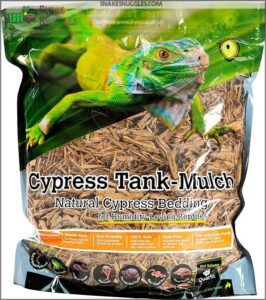
Cypress bark earns its keep through large, chunky pieces built for burrowing texture rather than fine, dusty fill. Galapagos washes and sieves each batch to strip out dust, then packages it in resealable bags that lock in moisture and freshness before you even open the bag.
That processing matters for iguanas, ball pythons, and monitors needing steady humidity. You can also mix it with coconut husk when a single substrate won’t hit your target moisture range.
| Best For | Reptile keepers housing humidity-loving species like ball pythons, iguanas, frogs, and monitors, especially in bioactive setups with live plants. |
|---|---|
| Moisture Retention | High |
| Supports Burrowing | Yes |
| Bioactive Suitable | Yes |
| Odor Control | Good |
| Material Base | Cypress bark |
| Replacement Frequency | Periodic |
| Additional Features |
|
- Sieved and washed to reduce dust, with high absorbency that helps maintain tropical humidity levels
- Soft, burrow-friendly texture supports natural digging and feeding behaviors in snakes and tortoises
- Free of salt, chemicals, oils, and parasites, and can be blended with coconut husk to fine-tune moisture
- Larger wood chips may not suit very small reptile or amphibian species
- Some bags have arrived damaged during shipping, leading to product loss
- Costs more than many alternative bedding options and may need spot-cleaning depending on enclosure ventilation
9. Flukers Premium Cypress Bedding Reptiles
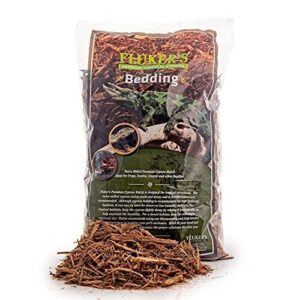
Twice-milled for uniform texture, Fluker’s version trades Galapagos’s chunky bark for a finer, softer bed suited to shedding and burrowing alike. It works with both humidity extremes, mist it for tree frogs and dart frogs, or keep it dry for arid-leaning setups with boas and leopard geckos.
Batch consistency varies, though, with some bags running dusty or underfilled. Mix with coconut coir when using it as a primary substrate, since fine-particle species need that added structure.
| Best For | Reptile and amphibian owners who want a soft, twice-milled bedding that supports burrowing and shedding across both humid and dry enclosure setups. |
|---|---|
| Moisture Retention | Moderate |
| Supports Burrowing | Yes |
| Bioactive Suitable | Limited |
| Odor Control | Good |
| Material Base | Cypress mulch |
| Replacement Frequency | Periodic |
| Additional Features |
|
- Uniform, soft texture that’s gentle for burrowing and shedding
- Adapts to both humid and dry habitats depending on misting
- Helps control odor and is easy to spot-clean
- Batch consistency can vary, with some bags overly dusty or chunky
- Packages may arrive underfilled compared to the advertised weight
- Not fine enough on its own for species like leopard geckos without mixing in coconut coir
Match Liners to Snake Habitats
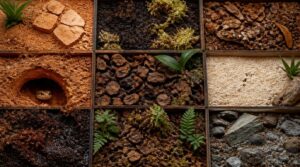
Not every snake needs the same ground beneath it, and matching substrate to species is where bioactive setups succeed or fail.
Your snake’s natural range dictates everything from moisture retention to burrowing depth, so a one-size-fits-all approach won’t cut it.
Here’s how to break down the right conditions for each habitat type your snake might call home.
Tropical Humidity Requirements
Ever wonder why your dart frog tank fogs up like a rainforest at dawn? That’s stable humidity, not chaos. Tropical species need 60-80% daytime humidity, staying above 70% overnight.
Tropical species need 60-80% daytime humidity, staying above 70% overnight, that’s stable humidity, not chaos
- Choose moisture-retentive substrate liners
- Control misting frequency, avoid spikes
- Monitor vapor pressure deficit
- Balance airflow with humidity control
Consistent warmth prevents rapid moisture loss, keeping nighttime humidity stable.
Temperate Moisture Balance
Temperate species swing between soggy springs and bone-dry summers, so your substrate liners need real soil moisture capacity, not just surface dampness.
Coconut fiber and coir handle these seasonal moisture shifts well, drawing on moisturewicking properties while a false bottom drainage layer prevents waterlogging.
Watch evapotranspiration balance closely; microfauna moisture needs stay narrow, and humidity regulation strategies keep isopods active without inviting mold.
Arid Enclosure Conditions
Desert species flip the moisture script entirely. Your desert terrarium needs low humidity maintenance, 10-40%, with a false bottom preventing capillary rise.
UVB exposure needs run 10-12 hours daily at index 5-10 for calcium metabolism, while temperature gradient control spans 75-85°F daytime.
Choose Lugarti bedding for drought-tolerant desert plant selection, it dries fast without dusting, reducing impaction risk for arid species.
Burrowing Support and Stability
Fossorial species need more than moisture control, they need architecture. Aim for 6-8 inches of substrate depth, layering coarse-to-fine for burrow wall stabilization and tunnel collapse prevention.
Particle size grading matters: fine dust clogs pores and weakens walls. Entrance funnel design and rigid drainage layer support keep tunnels from caving, giving you the burrow stability breeders count on.
Plant and Microfauna Needs
Burrow architecture only gets you halfway there. A living enclosure also needs substrate that feeds itself, supporting root exudate exchange, plant microbe relationship, and steady nutrient cycling.
Leaf litter and organic matter fuel beneficial springtails, which sustain microfauna population growth and break debris into usable nutrients. Balance moisture retention carefully, damp enough for isopods, dry enough to prevent anaerobic rot.
Compare Liner Materials and Performance
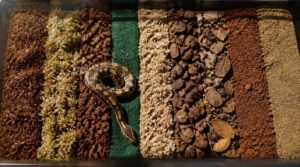
Once you know what your snake needs, the next question is which material actually delivers it. Every substrate controls moisture, structure, and durability differently, and those differences decide how much work you’ll do down the road. Here’s how the top options stack up against each other.
Coconut Coir Moisture Retention
Coconut coir soaks up 5 to 8 times its weight in water, releasing it slowly to isopods and roots. Reaching full saturation within 30-60 minutes, it stays neutral to slightly acidic, which stabilizes microbial activity and slows decomposition.
- Excellent Water Holding Capacity
- Fast Absorption Rate
- Stable pH Buffering
- Sustained Microbial Support
Its lignin content also gives coir a thermosetting binderless fiber structure, which contributes to its durability as a long-lasting substrate layer.
That’s what makes it the top choice for breeders.
Cypress Mulch Humidity Durability
While coir wins on absorption, cypress mulch earns its place through sheer durability, resisting breakdown for weeks while buffering temperature and humidity in your bioactive enclosure.
| Trait | Benefit |
|---|---|
| Slow decomposition | Stable structure |
| Insulating layer | Steady humidity |
| Moderate compaction | Isopod-friendly |
Aromatic compounds deter decay-causing microbes, making this a durable pick for breeders prioritizing long-term moisture retention without constant substrate turnover.
Sphagnum Moss Moisture Control
When hydration matters more than anything else, sphagnum moss delivers water holding capacity rivaling any substrate on this list, some species absorb 16 to 26 times their dry weight.
Josh’s Frogs Chilean Sphagnum Moss 100 g bag offers reliable desiccation tolerance and moisture regulation for breeders, while its naturally acidic microenvironment helps maintain amphibian-friendly microbial balance across your bioactive enclosure.
Sand Drainage and Structure
Sand belongs in your drainage system, not your topsoil. Silica sand with uniform particle size boosts drainage efficiency, while fine sand mixed into substrate causes compaction fast.
- Layer coarse gravel or LECA false bottom pebbles below
- Add a false bottom for water pooling
- Keep particle sizes consistent for even flow
- Skip sand near root zones
Premixed Substrate Convenience
Not every keeper wants to mix soil from scratch, and that’s fine. Premixed options like BioDude Terra Firma, Josh’s Frogs BioBedding, Zilla Jungle Mix, Zoo Med Eco Earth, and Lugarti Natural Reptile Bedding deliver time saving convenience with uniform particles, moisture consistency, and low dust. They’re stocked year round, so restocking your bioactive setup never stalls your momentum.
Layer Substrates for Bioactive Success
Picking the right substrate is only half the job, since how you layer it determines whether your enclosure actually thrives long-term. Drainage, barriers, and depth all work together to keep moisture balanced and your bioactive cleanup crew alive. Here’s how to build that structure from the ground up.
Build an Effective Drainage Layer
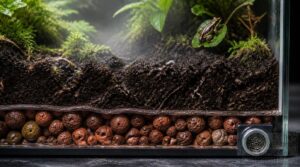
Think of your drainage layer as the enclosure’s lungs. Use LECA or expanded clay pebbles at 1-3 inches deep, sloped 1-2 degrees toward your outlet:
- Porous surface for airflow
- Even coverage, no dry pockets
- Clog-free outlet placement
Flush monthly. This false bottom keeps breeders’ substrate liners from waterlogging.
Add a Porous Barrier
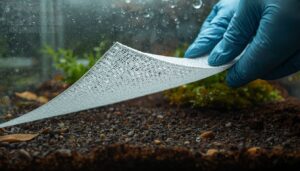
Once that false bottom’s flushing clean, lay your substrate separator directly on top. A nonwoven polypropylene mesh separator resists mold and blocks capillary rise while letting gas exchange through.
Overlap seams two inches, off-center, no staples. Patch tears fast, since pinholes bypass your barrier and flood substrate liners for breeders with stagnant moisture.
Set Proper Substrate Depth
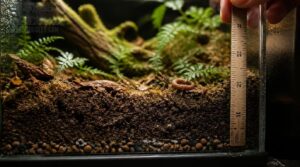
With your barrier down, depth becomes the next variable worth getting right.
Forest floor setups run 2 to 4 inches, burrowing snakes need 4 to 6, and arid tanks stay shallower near 2. Measure at three points, corner to corner, to catch settling above the false bottom and drainage layer. Top up monthly as feeding debris compacts the substrate layer.
Top With Leaf Litter
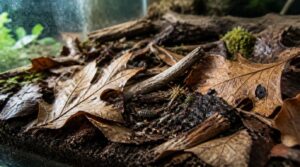
Once depth is set, finish with a 2 to 4 centimeter leaf litter layer for microfauna habitat and moisture retention. Use untreated, pesticide-free leaves.
- Mix dry and slightly moist leaves for balanced humidity
- Add twigs and bark for forest floor texture
- Skip moldy-smelling leaves
- Include plant-derived litter for incorporation
Your cleanup crew thrives here, and it looks naturally beautiful.
Prevent Compaction and Waterlogging
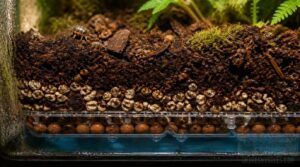
Leaf litter looks great, but it won’t save you from a waterlogged tub. Particle size selection matters most: coarse bark and clay chunks resist packing better than fine coir.
Mix in perlite or orchid bark as an aeration layer, and keep your compaction resistant mix loose.
A working false bottom and moisture buffer materials stop puddling before it starts.
Maintain Bioactive Substrate Liners
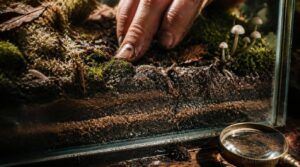
Building the perfect substrate layer is only half the job, since even the best bioactive setup needs consistent upkeep to stay balanced.
Moisture levels shift, waste breaks down, and your cleanup crew depends on you catching small problems before they turn into big ones.
Here’s exactly what to watch for and how to keep your enclosure thriving long after installation day.
Monitor Moisture and Odors
Your nose is a diagnostic tool, so trust it.
Check substrate moisture weekly with a meter, keep readings between 60-80% for tropical setups, and place sensors near the drainage layer and far corners to catch uneven drying.
A sour smell means anaerobic pockets; act fast with air exchange vents or odor neutralizing agents before it spreads through your liner.
Check Mold and Anaerobic Spots
Grab a flashlight and check corners weekly for fuzzy or powdery patches, since mold growth can establish within 24-72 hours in damp zones.
Press deep substrate pockets: darkened areas that stay wet after surface drying signal anaerobic conditions brewing beneath the liner.
Rotten-egg odors mean hydrogen sulfide production, while musty smells point to active mold. Break up compacted spots to restore substrate aeration and stop waterlogging before it spreads.
Support Isopods and Springtails
A cleanup crew earns its keep only when your substrate liner works with it. Isopods thrive at 70-80°F with high humidity, while springtails need a shiny, non-pooling surface.
- Isopods shred leaf litter and wood debris
- Springtails devour mold before it spreads
- Springtails double their numbers every 7-10 days
- Microhabitats give isopods daytime refuge
- Diverse species build stability against collapse
Refresh Depleted Organic Matter
Bioactive systems slow down over months, not days, so a Leaf Litter Boost matters once decomposition outpaces supply. Add fresh leaf litter and organic compost for nutrient cycling, then try Microfauna Seeding with isopods and springtails.
Top with sphagnum moss as a Crust Prevention Layer, apply Gentle Mixing to redistribute matter, and hold Temperature Control between 70-85°F for steady leaf litter decomposition.
Replace Damaged Substrate Sections
Uneven substrate isn’t just cosmetic, it signals hidden anaerobic pockets. Start with damage assessment steps: check moisture, odor, and texture before cutting.
Use seam repair techniques with matched particle size and color for a smooth patch, easing microfauna reintroduction. Apply odor control methods if sour smells linger. Reversible sealant on your substrate barrier or separator simplifies the next substrate topup.
Frequently Asked Questions (FAQs)
What is the best substrate for a bioactive terrarium?
There’s no single holy grail mix, that’s a unicorn hunt. Your best bet blends coconut coir for moisture retention, sphagnum moss for airy structure, and leaf litter feeding your cleanup crew, tuned to species-specific humidity and burrow needs.
What to use as a drainage layer in a bioactive terrarium?
Go with LECA or clay hydroballs as your base, topped with a mesh barrier. Systems like Josh’s Frogs False Bottom or Exo Terra BioDrain simplify this drainage layer, preventing waterlogging while keeping isopods and springtails thriving.
Can I make my own bioactive substrate?
Ambitious keepers often combine coir, leaf litter, and topsoil themselves, mixing your own DIY substrate at a 0-0 pH, then inoculating with isopods and springtails for a truly custom bioactive layer.
Do you need to change substrate in a bioactive terrarium?
You won’t swap everything out, but partial refreshes matter. Watch for compaction indicators, mold, and CUC decline, then top up organic matter every 6-12 months to support your cleanup crew maintenance and keep the nutrient refresh cycle running smoothly.
What safety precautions matter most during liner installation?
Installation is a construction site in miniature: gloves, eye protection, and a dust mask guard against sharp mesh separators and airborne particles, while proper ventilation, packaging checks, and keeping supplies away from kids and pets round out the basics.
How often should enclosure liners be disinfected between uses?
Reusable liners need disinfecting between every animal transfer, following a contact time compliance window on the label. Tropical setups demand tighter cleaning intervals for odor control and cross contamination avoidance, while arid enclosures tolerate longer sanitation schedules.
What vent clearance is needed to prevent overheating risks?
Keep at least 2 inches of clearance around every vent, using 1/8-inch mesh sizing, so airflow stays unobstructed and heat buildup near heat mats can’t compromise your enclosure’s temperature stability or gradient.
How should liner edges be sealed to prevent snagging?
Like stitching a wound closed, edges need care: trim loose fibers first, then run food-grade silicone along seams for a flush, elastic seal, closing gaps so nothing snags your reptile’s scales or claws.
Conclusion
Nobody dreams of becoming a substrate connoisseur, yet here you’re, debating coir versus cypress like it’s a fine wine tasting. That’s bioactive keeping for you.
The truth is simple: substrate liners for bioactive enclosures aren’t glamorous, but they’re the quiet engine behind every thriving colony and healthy snake. Layer wisely, monitor closely, and your enclosure rewards you with years of self-sustaining balance. Master the ground, and everything above it takes care of itself.