This site is supported by our readers. We may earn a commission, at no cost to you, if you purchase through links.
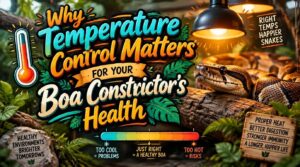
A boa constrictor that can’t digest its last meal isn’t sick from bacteria or parasites. It’s cold. As ectotherms, boas depend entirely on external heat to power digestion, immune response, and growth, and a single degree off can shift a thriving snake into a slow decline.
Why temperature control matters for boa constrictors goes far beyond keeping the enclosure warm. Get it wrong and you’re looking at regurgitated prey, respiratory infections, and stunted juveniles who never reach their potential.
This guide breaks down the exact ranges, tools, and gradients your boa needs at every life stage.
Table Of Contents
- Key Takeaways
- Why Does Temperature Control Affect Boa Health?
- Ideal Temperature Ranges by Life Stage
- Building an Effective Thermal Gradient
- Choosing Heaters, Thermometers, and Thermostats
- Health Risks of Poor Temperature Management
- Frequently Asked Questions (FAQs)
- What is the ideal temperature for boa constrictors?
- Is 90 degrees too hot for a snake?
- What temperature is too cold for a snake?
- Do snakes come out in 100 degree weather?
- How does temperature affect boa breeding and reproduction?
- Can outdoor enclosures maintain safe boa temperatures?
- Do temperature needs change during boa shedding?
- How long can boas safely tolerate a power outage?
- Should temperatures differ for sick or recovering boas?
- Conclusion
Key Takeaways
- As ectotherms, boa constrictors rely entirely on external heat to power digestion, immunity, and growth, so even a single degree off can turn a healthy snake into a declining one.
- Temperature targets shift by life stage: juveniles need a basking spot of 82–88°F, sub-adults 84–90°F, and adults an 80–85°F ambient range with an 88–92°F basking microhabitat that never exceeds 95°F.
- A proper enclosure needs a continuous warm-to-cool gradient with multiple accessible temperature zones, verified by calibrated digital thermometers and a thermostat with a secondary safety cutout to prevent both cold stress and burns.
- Poor temperature control causes the most common captive boa health problems—respiratory infections, regurgitation, weakened immunity, and stunted growth—while sick boas benefit from a basking spot raised 2–4°F to support immune function.
Why Does Temperature Control Affect Boa Health?

How your boa constrictor regulates its body temperature shapes nearly every biological process that keeps it healthy. Unlike mammals, boas can’t generate their own heat internally, so they depend on a carefully designed temperature gradient to drive metabolism, digestion, immune response, and tissue repair.
Providing a warm side and a cool side gives your boa the autonomy to self-regulate — a practice covered in depth in this guide to boa constrictor handling and habitat setup.
When thermal conditions fall short, biochemical reactions slow across the board. A poorly calibrated thermostat or an insufficient warm zone can disrupt your boa’s digestive enzymes, compromise immune cell function, and disturb its shedding cycle correlation with normal metabolic rhythms. Sustained cold also raises the risk of respiratory problems and, over time, weakens bone mineral regulation, contributing to metabolic bone disease. A boa constrictor care sheet from an exotic veterinary practice can help you recognize early warning signs of these cold-related health issues before they become serious.
Consistent, properly monitored heat isn’t optional. It’s the physiological foundation your boa’s health depends on.
Consistent, properly monitored heat is not optional—it is the physiological foundation your boa’s health depends on
Ideal Temperature Ranges by Life Stage

Getting the temperatures right depends on where your boa is in its development. The target numbers shift at each life stage, and using juvenile settings for an adult boa, or vice versa, creates real health problems.
A hatchling or juvenile boa needs a basking spot of 82–88°F, with the cool end staying between 78–86°F. That tighter range helps the faster metabolic rate of a growing snake.
Sub-adults run warmer. Their basking zone should reach 84–90°F, while the cool end drops to 75–80°F.
Adult boas naturally settle into a broader temperature gradient. They’re comfortable with ambient temperatures of 80–85°F and a basking microhabitat of 88–92°F.
Review your setup as your boa moves between stages; the right temperature range shifts each time.
Building an Effective Thermal Gradient
You know the target numbers now, so the next step is arranging your enclosure so your boa can actually use them. A proper temperature gradient spans at least 10–15 cm of active space with a 10–15°C difference, giving your snake a continuous thermal path from warm to cool. A quality reptile enclosure heating kit makes establishing and maintaining that gradient far more consistent from day one.
Since snakes rely entirely on external heat sources to manage digestion, immunity, and metabolism, following a tested approach to snake enclosure temperature gradient setup helps ensure your boa can move fluidly between zones as its needs shift throughout the day.
Place your heat source on one side so the basking spot anchors the warm end, and keep cooler refuges at the opposite side. Avoid any hotspot above 40°C, and give your boa three to five accessible temperature points so it isn’t chasing a single extreme.
Your thermal gradient setup depends on honest measurement. Position one thermometer at the basking spot, one at the cool end, and one midrange. Keep your temperature monitoring frequency daily during setup, and let your thermostat hold the range while you confirm your boa settles comfortably into each zone.
A dual probe reptile thermometer lets you read the warm and cool ends simultaneously, making it easier to catch drift before your boa notices.
Choosing Heaters, Thermometers, and Thermostats
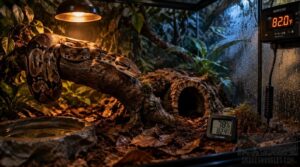
You’ve built your thermal gradient, and now you need the right equipment to maintain it. Choosing your heat sources, thermometers, and thermostats is essential, because the gear you pick determines how stable your boa’s temperatures stay day and night.
Below, you’ll find the practical options that work, so you can match your setup to your snake’s needs and your budget.
Heat Sources for Boas
A client once draped a heat lamp over an uncovered screen top, and her boa pressed against it, suffering a burn. That injury was preventable with the right heat source.
Your options include:
- Infrared heat lamps for a basking spot reaching 28–32°C
- A ceramic heater, which radiates warmth without disrupting night cycles
- An under-tank heater wired to a thermostat
Whichever you choose, guard it. Position the basking surface 10–15 cm below the lamp, and secure cords away from curious mouths.
Thermometers and Thermostat Basics
Because accurate readings drive every heating decision, you’ll need reliable equipment. Use calibrated digital thermometers at both basking and cool zones, shielding each temperature probe from direct contact with heat sources. Pair them with a quality thermostat or temperature controller that modulates output within 1–2°C, plus a secondary safety cutout against overheating. Calibrate everything independently, and recheck after power outages.
For setups involving automated humidity alongside heat, pairing your controller with a well-chosen reptile misting system for large enclosures prevents temperature spikes that can throw off your thermostat readings.
Health Risks of Poor Temperature Management
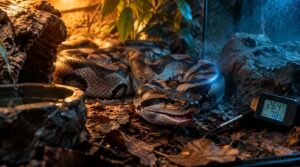
You’ve set up your heating equipment, but you also need to understand what’s at stake when temperatures slip. Poor thermal management isn’t a minor issue; it’s the root cause of the most common health problems we see in captive boas.
Below, you’ll find the five major risks you must watch for, from respiratory infections to stunted growth.
Respiratory Infection Risk
Respiratory infections are the most common consequence of poor temperature control in boas. When your boa runs cool, mucociliary clearance slows, letting bacteria settle in the airways. Here’s what raises respiratory infection risk:
- A thermometer reading below 75°F overnight.
- Frequent temperature fluctuation in the hide.
- Low ambient temperature raising humidity and condensation.
- A faulty temperature controller leaving cold zones.
Warm, stable conditions keep airway defenses working.
Impaired Digestion
Think of your boa’s gut as a furnace that only runs on heat. Without a proper basking spot and stable thermal gradient, your snake’s digestive efficiency plummets. Food sits undigested, and regurgitation risk climbs.
Juveniles suffer fastest because their metabolic rate control depends on hitting the right temperature range after every meal. Give them warmth they can choose.
Weakened Immune Function
When your boa runs cold, its immune function support runs on empty, and that’s where trouble starts. Chronic cool temperatures raise stress hormones, slow immune cells, and weaken barrier defenses, opening the door to respiratory infections and stubborn, recurring illness. Consistent thermal regulation is essential. Prioritize:
- A stable thermostat-controlled heat source
- Daily temperature monitoring at both gradient ends
- No prolonged nighttime drops
- Warm hides for recovery during illness
- Prompt vet care if symptoms appear
Stunted Growth
A boa that stays too cool can’t grow, no matter how much you feed it. Chronic temperatures below 24°C suppress protein synthesis, so calories never become lean mass.
| Life Stage | Warm Side | Growth Impact |
|---|---|---|
| Hatchling | 30–32°C | Rapid, steady gains |
| Juvenile | 30–32°C | Sensitive to nightly dips |
| Adult | 27–29°C | Stable maintenance |
| Any stage | 32°C | Increased metabolic demand |
Remember, digestive efficiency peaks at species-typical temperatures. If your boa’s metabolic rate runs cold, undigested meals pass through slowly, and juvenile growth optimization stalls by weeks. Consistent temperature monitoring catches these drops before they cost you size benchmarks.
Heat Stress And Burns
Your boa can’t sweat. When enclosure temperature climbs beyond safe limits with no cooler retreat, heat stress builds fast. Unguarded heaters cause thermal burns surprisingly quickly. Consistent temperature monitoring at the basking spot is essential for heat stress prevention. A reptile infrared thermometer gun lets you check your boa’s basking spot temperature instantly, without disturbing or stressing the snake.
Watch for:
- Mouth gaping or erratic movement
- Restlessness that doesn’t resolve
- Skin blistering or discoloration
- Prolonged pressing against cool enclosure walls
Frequently Asked Questions (FAQs)
What is the ideal temperature for boa constrictors?
Your boa needs a thermal gradient with a basking spot around 88-90°F and a cool side near 78-80°F. Juveniles need the warmer end of that ideal temperature range; adults can tolerate slightly lower basking temperatures.
Is 90 degrees too hot for a snake?
Like walking barefoot across summer asphalt, 90°F ambient air pushes your boa right to its breaking point. That temperature range suits a basking spot well, but as steady ambient air, it triggers real heat stress.
In fact, ambient temperatures should stay between 80-85°F with a basking hot spot of 88-90°F, never exceeding 95°F to avoid neurological damage or death.
What temperature is too cold for a snake?
Ever wonder why your boa slows down on a cool day? Below 24°C (75°F), activity drops. Under 20°C (68°F), lethargy sets in. Sustained ambient temperature below 22°C (72°F) risks hypothermia.
Do snakes come out in 100 degree weather?
In 100-degree weather, most snakes stay hidden. They avoid surface heat by burrowing or sheltering in cooler microhabitats until ambient temperature drops. You’ll rarely see basking behavior during peak heat; activity resumes at dusk.
How does temperature affect boa breeding and reproduction?
Can temperature really make or break breeding success? Yes. Keep your basking zone at 30–32°C with drops to 24–26°C at night; follow a seasonal adjustment protocol, since stable gradients protect reproductive health and ovulation.
Can outdoor enclosures maintain safe boa temperatures?
Outdoor enclosures rarely work reliably. Weather swings, shade, wind, and nighttime cooling make stable temperatures nearly impossible. You can’t control a proper temperature gradient outdoors, so your boa risks dangerous cold or overheating.
Do temperature needs change during boa shedding?
Yes, they do. During the shedding process, keep your temperature gradient rock steady: basking spot 30–32°C, ambient 26–28°C. Check your thermostat and thermometer readings every 6–8 hours, since temperature stability helps guarantee complete sloughing.
How long can boas safely tolerate a power outage?
There’s no universal number. Your boa’s power outage tolerance depends on how quickly the enclosure cools. Well-insulated setups with thermal inertia may hold safe temperatures for hours; poorly insulated ones won’t. Monitor the temperature range and prepare a backup heating system.
Should temperatures differ for sick or recovering boas?
They should. Raise your sick boa’s basking spot 2-4°F above normal, keeping it at 88-92°F. This behavioral fever support boosts immune function, so verify your thermostat and maintain a reliable backup heating system.
Conclusion
Warmth seems simple, yet it’s the most demanding part of boa husbandry. That’s why temperature control matters for boa constrictors: every system in your snake’s body runs on heat you provide.
Check your gradient daily, trust calibrated thermometers over guesswork, and connect every thermostat to a reliable heat source. Do this consistently, and you’ll prevent regurgitation, infections, and stunted growth before they start.
Your boa can’t regulate its own temperature. you’re its climate.