This site is supported by our readers. We may earn a commission, at no cost to you, if you purchase through links.
The wrong water bowl turns your bioactive enclosure into a drowning trap. Isopods pile up at the edges, springtails go under, and a scratched resin dish quietly cultures bacteria faster than your cleanup crew can compensate.
Bioactive setups demand more from every component, and water bowls are no exception. Depth, material, and placement each affect whether your microfauna thrives or quietly collapses, and a bowl that works fine in an inert setup can actively undermine a living one.
These three reptile water bowls for bioactive setups hold up where it counts, and here’s exactly why.
Table Of Contents
- Key Takeaways
- How to Choose Bioactive Reptile Water Bowls
- Top 3 Reptile Water Bowls for Bioactive Setups
- Match Water Bowl Size to Your Snake
- Protect Cleanup Crews Around Water Bowls
- Place and Clean Bioactive Water Bowls
- Frequently Asked Questions (FAQs)
- How to make a reptile water bowl?
- What to use for bioactive enclosure?
- What type of water bowl is best for bearded dragons?
- How does humidity affect bioactive water bowl needs?
- Do water bowls harbor parasites in bioactive tanks?
- Should hatchlings use different bowls than adults?
- Can water bowls double as egg-laying sites?
- Conclusion
Key Takeaways
- Bowl depth is the single most critical variable in a bioactive setup — keep it at or below your snake’s body width to protect both your reptile and the microfauna working the substrate below.
- Material choice determines how fast bacteria win: nonporous surfaces like intact ceramic or stainless steel resist biofilm, while scratched resin quietly becomes a bacterial breeding ground your cleanup crew can’t outpace.
- Your isopods and springtails need an exit strategy — a sloped edge, pebble ramp, or purpose-built escape design is non-negotiable, because a single overflow event can wipe out an entire colony faster than any predator would.
- Daily water changes and monthly vinegar scrubs aren’t optional maintenance rituals — they’re the minimum threshold that keeps contamination out of your substrate and your bioactive system actually functioning.
How to Choose Bioactive Reptile Water Bowls
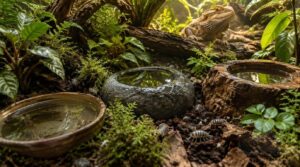
Picking the right water bowl isn’t just about aesthetics — it determines whether your cleanup crew survives, your reptile stays hydrated, and your bioactive setup actually functions. Five factors separate a good choice from a bad one: species-appropriate depth, bowl materials, stability, invertebrate safety, and hygiene. Get these right before you spend a single dollar on any product.
Understanding the full weight of each variable — from material texture to bowl depth — becomes easier when you explore a dedicated guide to water bowls designed specifically for small reptile enclosures.
Species-Appropriate Water Depth
Water depth control separates thriving bioactive setups from soggy disasters. Apply the bodywidth clearance rule: keep depth at or below your snake’s actual body width for drowning prevention.
Quick depth targets by species:
- Small colubrids and juveniles: shallow depth of 1–2 cm
- Mid-sized snakes: 2–4 cm
- Large species: 4–6 cm
- Semi-aquatic snakes: 5–8 cm
Species-appropriate sizing is always the goal.
Safe Bowl Materials
Once you’ve nailed depth, the bowl’s material decides how clean your setup stays. Pick wrong and biofilm moves in before your cleanup crew does.
| Material | Biofilm Risk | Key Feature |
|---|---|---|
| Silicone | Low | Flexible, humidity-resistant |
| Stainless Steel | Low | Sanitizes fast |
| Ceramic (intact glaze) | Low | Nonporous surface |
| Resin | Moderate | Naturalistic look |
Resin water bowls scratch easily, letting bacteria settle into surface grooves. Ceramic water bowls with a weighted base design and uncracked glaze stay cleaner longer. Reptile-safe materials aren’t all created equal. Nonporous surfaces set the standard.
Bowls designed with smooth interior geometry and simple rim construction eliminate the crevices where bacteria and mineral deposits typically accumulate.
Stability And Placement
A nonporous surface means nothing if your bowl’s tipping at 2 AM. Water bowl stability on loose substrate starts with a weighted base design that resists a corn snake’s bulldozing. A nonslip bottom cuts spill risk.
Avoid corner mounting. Enclosure walls create force that amplifies tipping. Center placement, slightly elevated on a flat rock, delivers spill resistance without sacrificing access.
Cleanup Crew Safety
Bowl placement protects your cleanup crews too. Isopods and springtails don’t swim. A spill converts substrate into a cleanup crew drowning zone fast.
Cleanup crew survival depends on escape ramp design: place a pebble or sloped edge at the rim so microfauna can climb out. Any bioactive terrarium setup demands reptile-safe materials since leaching glazes silently wipe out your colonies.
Low-profile reptile water bowls with escape ramps are purpose-built with sloped, unglazed edges that keep isopods and springtails safely climbing out rather than drowning.
Water Hygiene
A daily water change is non-negotiable. Biofilm builds fast, and that slick invisible layer coats your bowl within 24 hours, setting the stage for bacterial blooms your cleanup crew can’t outpace.
Dechlorinate every refill before it touches the enclosure; chlorine kills the beneficial organisms you’re actively cultivating.
Once a month, scrub with a 1% white-vinegar solution, rinse thoroughly, and refill.
A bulk white distilled vinegar gallon keeps the routine affordable and means you’ll never skip a scrub because you ran out.
Top 3 Reptile Water Bowls for Bioactive Setups
These three bowls cover the range of what bioactive keepers actually need. Each one controls a specific combination of depth, stability, and cleanup crew safety without making you compromise. Pick the one that fits your build.
1. Exo Terra Water Dish Large PT2803
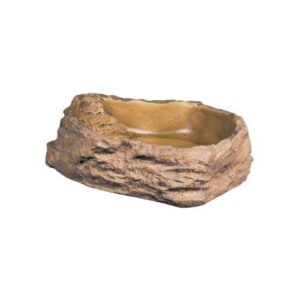
The PT2803’s rock-textured exterior blends naturally into any scape, desert or tropical. At 8.7 x 6.7 x 2 inches, it gives ball pythons and boas real room to soak without flooding your substrate.
The food-grade resin interior resists bacteria, and its dark color slows algae growth between rinses. Built-in safety steps keep your smaller reptiles and cleanup crew insects from drowning unnoticed.
Position it well away from heat sources, check the water daily, and it runs quietly in the background.
| Best For | Reptile keepers housing snakes, box turtles, ball pythons, or boas who want a natural-looking water dish that blends seamlessly into any terrarium setup. |
|---|---|
| Interior Surface | Smooth, non-porous |
| Drowning Prevention | Internal safety steps |
| Material | Food-grade resin |
| Profile | Low profile |
| Bowl Depth | 2 inches |
| Compatible Species | Snakes, box turtles, pythons, boas |
| Additional Features |
|
- The food-grade resin interior is non-porous and bacteria-resistant, making it easy to keep clean and safe for your animals.
- Built-in safety steps prevent smaller reptiles and cleanup crew insects from getting trapped and drowning.
- The realistic rock exterior pairs well with desert, tropical, or mixed terrariums without looking out of place.
- No volume or capacity measurement is provided, so it’s hard to know exactly how much water it holds before you buy.
- Not suitable for aquatic species that need deeper water to swim or fully submerge.
- There’s no information on heat or UV resistance, so placing it near basking spots or under strong lighting carries some uncertainty.
2. Exo Terra X-Large Water Dish
Most keepers overlook dish depth until their boa starts soaking in a shallow puddle. The Exo Terra X-Large fixes that.
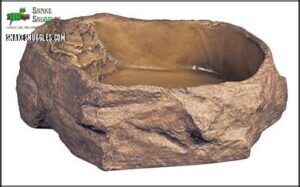
At 9.7 x 10 x 2.5 inches, it gives large snakes real soaking room, and the heavy base prevents tipping even when a determined boa leans into the wall. The food-grade resin exterior mimics rock convincingly.
Safety steps inside protect any cleanup crew that wanders in. One caveat: the 9.7-inch footprint won’t fit tight enclosures. Size up your space first.
| Best For | Keepers of large reptiles like tortoises and boas who need a spacious, stable soaking dish that blends naturally into any terrarium setup. |
|---|---|
| Interior Surface | Smooth, non-porous |
| Drowning Prevention | Internal safety steps |
| Material | Food-grade resin |
| Profile | Low profile |
| Bowl Depth | 2.5 inches |
| Compatible Species | Tortoises, boas, large reptiles |
| Additional Features |
|
- Generous 9.7 x 10 x 2.5-inch size gives large snakes and tortoises real room to soak comfortably
- Heavy base stays put even when big, active reptiles push against it
- Built-in safety steps protect small animals or cleanup crew from getting trapped
- Substantial weight makes daily water changes a chore for some keepers
- Large footprint rules it out for smaller or tighter enclosures
- At least one customer reports the actual dimensions differ from what’s listed
3. Zoo Med Reptile Rock Water Dish
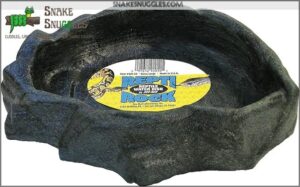
Looks deceive. The Zoo Med Rock Water Dish (WD50) passes as a naturalistic stone, but it’s actually 100% recycled plastic, smooth and non-porous inside, which means bacteria simply have nowhere to settle.
At 11 inches wide and 2 inches deep, it holds roughly 3 cups of water, enough for tortoises, bearded dragons, and snakes without drowning your juveniles, thanks to molded entry stairs.
One caveat: on smooth glass floors, it wobbles. Sink it slightly into substrate and that problem disappears.
| Best For | Juvenile lizards, bearded dragons, tortoises, and snakes that need a safe, easy-to-clean water source. |
|---|---|
| Interior Surface | Smooth, non-porous |
| Drowning Prevention | Molded stairs |
| Material | Foamed polystyrene |
| Profile | Low profile |
| Bowl Depth | 2 inches |
| Compatible Species | Lizards, dragons, tortoises, snakes |
| Additional Features |
|
- Made from 100% recycled plastic with a smooth, non-porous surface that resists bacteria buildup
- Molded entry stairs prevent juveniles from drowning
- Simple to clean with minimal effort — no scrubbing required
- May wobble on smooth glass surfaces unless partially buried in substrate
- Adhesive sticker can leave residue that’s tricky to remove
- Not suitable for extreme temperature swings without checking manufacturer guidelines first
Match Water Bowl Size to Your Snake
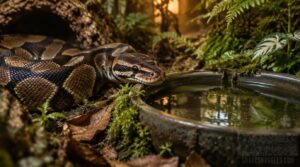
Size your bowl to your snake’s measurements, not your instincts. A poorly fitted bowl in bioactive terrariums disrupts moisture balance and stresses the animal.
Use these five rules:
- Bowl diameter: target 1.5 to 2 times head width; minimum 3 cm for small species.
- Water bowl depth: keep it at 10 to 20% of body length.
- Species-safe bowl size: semi-aquatic snakes need deeper water than arid species of the same length.
- Juvenile reptile care: halve the adult depth; hatchlings aspirate faster than you’d expect.
- Keeled belly species: go shallower to reduce slipping and flank contact.
Adult reptile needs shift as snakes grow. Reassess your bowl size at every shed cycle, because a bowl that fit last season probably won’t fit now.
Protect Cleanup Crews Around Water Bowls
Your isopods and springtails are doing real work down there. Treat them like the assets they are.
The biggest threat to cleanup crew compatibility isn’t your snake. It’s a puddle. Overflow soaks the substrate, and wet substrate becomes a breeding ground for bacterial growth that wipes out your microfauna faster than any predator would. Raise the bowl slightly, or tuck it behind a rock to limit splash range.
A puddle kills your cleanup crew faster than any predator ever will
Biofilm resistance starts with bowl material. Nonporous surfaces like ceramic or glass don’t give bacteria a foothold, which keeps the water cleaner and the area around it safer for invertebrates exploring nearby.
Position matters too. Keep the bowl away from high-traffic isopod zones so they’re not crowded out or accidentally drowned mid-cycle.
Place and Clean Bioactive Water Bowls
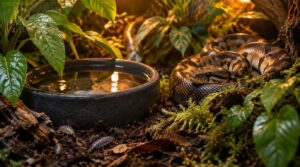
Placement sets up every cleaning win that follows. Position your water bowl on the warm side of the enclosure so your snake drinks near its basking zone, not in a cold corner where you’ll forget to check it.
Daily water changes aren’t optional in a bioactive enclosure setup. Stale water clouds fast, and biofilm builds on the bowl surface within 48 hours if you skip a day. Rinse it, scrub it, and refill it. That’s the whole job.
Once a week, pull the bowl and hit it with a dilute bleach solution (1:32), rinse it thoroughly, and air-dry before putting it back. Consistent water change frequency protects cleanup crew sustainability by keeping contamination out of the substrate before it spreads. If you prefer something purpose-made, a reptile-safe enclosure disinfectant gives you the same germ-killing power without the rinsing anxiety that comes with household bleach.
Frequently Asked Questions (FAQs)
How to make a reptile water bowl?
Daily water changes reduce bacterial load in reptile dishes by up to 95%. Use a BPA-free food-grade container, keep the depth under 2 cm, smooth any sharp edges, and you’ve got a safe, functional bowl.
What to use for bioactive enclosure?
Water is the pulse of any living system. In a bioactive terrarium, use heavy ceramic bowls, clean dechlorinated water, and reptile-safe naturalistic decor that won’t trap your cleanup crew or compromise solid water quality management.
What type of water bowl is best for bearded dragons?
Think of it like a kiddie pool, not a bathtub. Bearded dragons need shallow depth ceramic bowls, roughly 6 to 8 inches wide, from reptile-safe materials that won’t harbor bacteria between daily water quality checks.
How does humidity affect bioactive water bowl needs?
Humidity is a silent dial on your maintenance routine. Evaporation-driven humidity slows bowl water loss but actively invites bacteria, so even with solid substrate moisture balance, you’re still changing water every one to two days.
Do water bowls harbor parasites in bioactive tanks?
Bowls don’t self-generate parasites, but they concentrate them. Your snake introduces viable eggs and oocysts through feces or shed skin in standing water. Biofilm and substrate contamination make elimination harder, so frequent changes are essential.
Should hatchlings use different bowls than adults?
You wouldn’t hand a newborn a fire hose, would you? Hatchling hydration demands only 5 to 2 cm of water bowl depth. Grow into deeper adult water bowls as your bioactive terrarium’s species-specific sizing warrants.
Can water bowls double as egg-laying sites?
A water bowl is a drinking station, not a nursery. Your snake won’t treat water bowls for bioactive vivariums as egg-laying sites. Eggs need dry, stable substrate with real depth, not a terrarium water source.
Conclusion
A keeper running a humid tropical bioactive once swapped to a shallow ceramic dish and watched springtail populations double within a month.
Reptile water bowls for bioactive setups aren’t an afterthought. Depth keeps microfauna alive, material prevents bacterial buildup, and placement determines whether your cleanup crew can actually do its job. Get one element wrong and the whole system compensates poorly. Get all three right and your enclosure runs cleaner, longer, with less intervention from you.