This site is supported by our readers. We may earn a commission, at no cost to you, if you purchase through links.

A rat that’s too big can kill your snake. It won’t happen with a bite. It happens when a hatchling chokes mid-swallow, or when a juvenile regurgitates a meal it never had the girth to handle.
Age matters, but it’s only a rough guide. Choosing prey size by age works when you pair it with real numbers: your snake’s weight, its midbody width, and how fast it digests.
Most keepers eyeball it. You don’t have to. Measure, match, and adjust, and every meal fits the animal in front of you. Start with the tape and the scale.
Table Of Contents
- Key Takeaways
- Why Age is Only a Starting Point
- Measure Your Snake and Its Prey
- Choose Prey Size by Life Stage
- Adjust for Species and Body Condition
- Know When to Increase Prey Size
- Recognize Prey Sizing Problems
- Frequently Asked Questions (FAQs)
- How to know what size prey to feed a snake?
- What size prey should I offer my corn snake?
- How can I tell my ball python’s age?
- How big should a 2 year old corn snake be?
- Is frozen-thawed prey better than live prey?
- Can I feed two smaller prey instead of one?
- How long should I wait before handling after feeding?
- Should I feed my snake while it is shedding?
- What should I do if my snake refuses food?
- Conclusion
Key Takeaways
- Don’t feed by age alone: weigh your snake, measure its midbody girth, and judge its body condition, because two snakes the same age can safely swallow very different meals.
- Keep prey width at or below your snake’s midbody girth and aim for roughly 10 to 20 percent of its body weight per meal, going smaller for hatchlings, overweight snakes, or enclosures that run cool.
- Move up in prey size only after three clean, confident feedings and steady growth over a few weeks, and then step up by just 10 to 20 percent of the size you’ve been feeding.
- Treat regurgitation, slow swallowing, or a lump that won’t shrink as signs the prey was too big, and drop back in size for two to three feedings before trying again.
Why Age is Only a Starting Point
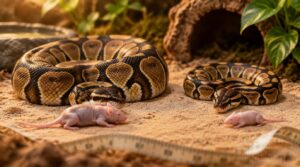
Feeding by calendar age alone sets you up for trouble. Age gives you a baseline, nothing more. Two snakes hatched the same week can differ wildly in growth rate, and that gap changes what each one can safely swallow.
Checking your snake’s body condition and growth every few weeks, and then adjusting using a snake feeding schedule by age and size, keeps meals matched to what your snake actually needs.
Your snake’s prey size should track its body, not its birthday. A fast grower with a heavy build controls larger meals than a slow, lean clutchmate. Snake girth, jaw development, and metabolic demand all shift the answer, and so do temperature and health.
Use age to pick a starting point. Then confirm it with a body condition assessment, a predator-prey size ratio, and a feeding frequency that fits your snake’s pace. Skip that check and you risk stunted growth or regurgitation.
Measure Your Snake and Its Prey
Numbers beat guesswork, so start with a scale and a tape. Weigh your snake on a digital scale accurate to 0.1 g, then record its length from snout to vent with a flexible tape, rounding to 0.5 cm. Hatchlings usually run 25 to 40 cm, depending on species.
Next, measure your snake’s thickest body section. That midbody number is your snake girth, and it drives every sizing call you’ll make. Since girth changes as your snake grows, pair that tape measurement with a digital reptile scale so you can track weight and size together.
Weigh and measure the prey too. Here’s your checklist:
- Weigh your snake before every meal.
- Measure snake girth at midbody.
- Weigh the prey item.
- Check prey width against that girth, never above 1.0×.
- Confirm a meal of 10 to 20% of your snake’s total body weight per feeding, and log it.
Prey width shouldn’t exceed your snake’s head opening capacity.
Since head and body size change as your boa grows, check a boa constrictor size chart to pick prey that stays safely in range.
Choose Prey Size by Life Stage

Your snake’s life stage sets the starting point for every meal you offer. Hatchlings, juveniles and subadults, and adults each handle different prey sizes, so you can’t use one rule for all three. Here’s how to match the meal to the stage, one at a time.
Hatchlings
Picture a corn snake hatchling, three days past its first shed, staring down a pinky mouse that’s clearly too fat. It strikes, struggles, and regurgitates by morning. Don’t repeat that mistake.
Match prey diameter to roughly 40–60% of midbody girth. If it swallows within two minutes, you’ve nailed it. Track body weight ratio weekly, and keep feeding frequency steady.
Juveniles and Subadults
Juveniles grow fast, and your mistakes show up faster. Raise prey size only after two clean meals, and judge body condition before you reach for the bigger mouse.
If your snake is a Burmese, the Burmese python care sheet offers helpful feeding benchmarks for each growth stage, so you can size up meals with confidence.
Here’s what a bad jump costs you:
- A refused meal.
- A stressed snake.
- A regurgitated rat.
- A setback of weeks.
Subadults tolerate more, but keep feeding frequency steady. Cap jumps at 15–20%.
Adults
Once your snake reaches adulthood, stop guessing and start matching. Adult mice and adult rats are your baseline, but prey size matching depends on girth. Aim for 70 to 100 percent of swallowing capacity.
Offer multiple medium prey instead of one oversized meal. Check body condition: overweight snakes need smaller items. Bigger meals slow digestion, so stretch your feeding frequency.
Adjust for Species and Body Condition

Belly shape tells you more than your snake’s birthday does. Start with body condition: a snake carrying heavy fat reserves empties its stomach slowly, so keep prey size modest and lower your feeding frequency. A lean, visibly underconditioned snake needs the opposite pacing, with steady meals and only small jumps in prey diameter.
Species variation matters too. Lighter-bodied snakes can finish digesting in 24 to 48 hours, while heavier species may need more than 72. Some species accept only mice or only rats, and that choice shapes growth.
Temperature changes the math. If your enclosure runs below the species’ optimum, cut prey size by 5 to 15 percent. If your snake is ill, shedding, or recovering, hold prey size steady.
A digital thermometer hygrometer with a probe on the warm side lets you confirm real enclosure temperatures before adjusting prey size.
Know When to Increase Prey Size

One keeper I know bumped her corn snake up to bigger mice at six months because the calendar said so. Two regurgitated meals later, she learned the hard way that age isn’t the trigger.
Wait for proof instead. Your snake should take three consecutive feedings without hesitation, striking within 5 to 10 seconds. Confirm a steady growth trend over 2 to 4 weeks, and log length and girth monthly. A flexible soft measuring tape wraps gently around your snake’s body, making monthly length and girth readings far more accurate than guessing by eye.
Then step up prey size by 10 to 20 percent, never a full category at once. Keep the same prey type so you’re testing size alone.
If your snake refuses, drop back 5 to 10 percent and try again in a week or two. Species variation matters here, so slow your prey change if digestion lags. Hold your feeding frequency schedule steady during any seasonal slump.
Recognize Prey Sizing Problems

Feeding a snake the wrong prey size is like forcing a couch through a doorway: something’s getting stuck. Catch the problem early, before it costs you a meal or your animal’s health.
Feed a snake prey that’s too big and you’re forcing a couch through a doorway, so catch the problem early
Watch for these four warning signs:
- Regurgitation within 24 to 48 hours, usually from prey diameter beyond the head width limitation.
- Swallowing that drags on, with saliva pooling or gaping.
- Refusal or weak strikes, often from prey too small to trigger real interest.
- A visible lump that doesn’t shrink, a sign prey circumference exceeded safe digestion.
Check your prey weight ratio after every single meal, and log it.
If you spot any sign, drop prey size for two to three feedings. Don’t rush the next step up.
Frequently Asked Questions (FAQs)
How to know what size prey to feed a snake?
Follow the golden rule: measure your snake’s thickest body section, then match prey size to that width. Prey width shouldn’t exceed your snake’s head opening capacity. Choose prey that’s roughly 10–15% of its body weight.
What size prey should I offer my corn snake?
Offer prey 8 to 2 times your corn snake’s mid-body girth. Hatchlings need prey diameter near 60 to 80 percent of that girth, juveniles about 9, adults roughly Measure monthly and adjust.
How can I tell my ball python’s age?
Measure your snake’s length. Hatchlings run 8 to 12 inches, juveniles fall between, and adults reach 3 to 5 feet. Growth varies with heat, so trust hatch records over length when setting your prey size.
How big should a 2 year old corn snake be?
Age is a rough map, not the territory. Your two-year-old corn snake should measure 30 to 36 inches and weigh 120 to 300 grams. Use weight monitoring and body condition score to confirm.
Is frozen-thawed prey better than live prey?
Does live prey really feed better? Rarely.
Frozen-thawed rodents deliver steady nutrition, while live prey risks include bites and stress.
Protect your snake’s digestive health, and always keep frozen-thawed through every prey size change stage.
Can I feed two smaller prey instead of one?
Two meals sound generous, yet your snake gets less out of them. Stick with one prey item near its midbody width. Two small ones cost extra digestion time, and your prey weight ratio slips.
How long should I wait before handling after feeding?
Handle too soon and you’ll wreck a meal, guaranteed. Wait 24 to 48 hours for hatchlings, 48 to 72 for juveniles, and 72 to 96 for adults. Digestion rules, so skip handling during shedding periods.
Should I feed my snake while it is shedding?
Picture your snake’s eyes gone cloudy, blue-white, its skin dull as old paper. Skip the meal. During the shedding period, feeding refusal is normal. Offer food after the shed, once weight monitoring shows steady appetite and body condition.
What should I do if my snake refuses food?
Don’t panic over feeding refusal. Check prey size first, since oversized prey is the usual culprit. Warm prey temperature to about 100°F, and try different feeding techniques. For picky eaters, try scent manipulation. Then wait before offering again.
Conclusion
The safest meal is often the smaller one. A rat that looks generous on the tray can be too much for the snake that has to swallow it.
Choosing prey size by age gets you to the right neighborhood. Your tape, your scale, and your snake’s body condition get you to the right door. Weigh before you feed. Watch the midbody after. Adjust when digestion runs fast or slow.
Feed the animal, not the calendar.