This site is supported by our readers. We may earn a commission, at no cost to you, if you purchase through links.

Your corn snake turns dull and milky, stops eating, and wedges itself into the tightest corner it can find. That’s not a mood. It’s a snake about to shed, and what happens next depends on the moisture around it.
A humid shed box gives your snake a small pocket of damp air where old skin softens and peels in one piece. Skip it, and you’ll often find stuck eye caps or a ring of skin on the tail tip. Hide boxes for shedding support take about ten minutes to build, and the right size, moss, and humidity make them work.
Table Of Contents
- Key Takeaways
- How Snake Hide Boxes Support Shedding
- Sizing and Setting Up Your Shed Box
- Fixing Common Shedding Problems With Humid Hides
- Top Hide Box Supplies for Shedding
- Frequently Asked Questions (FAQs)
- How to set up a humid hide for a leopard gecko?
- Why isn’t my ball python shedding?
- How can I make a DIY humidity hide for my corn snake?
- Why is my ball python shedding in pieces?
- How often should a humid hide be cleaned?
- Can leopard geckos use the same humid hide as snakes?
- What temperature should a humid hide be kept at?
- Is plastic or wood better for humid hide boxes?
- Where should a humid hide be placed in the enclosure?
- Conclusion
Key Takeaways
- A humid shed box gives your snake a small pocket of damp air that softens old skin, so you can support shedding without making the whole enclosure damp.
- Size the box to about one-third of your snake’s body length, cut the entrance in the lid, and fill it halfway with damp sphagnum moss to hold roughly 65-70% humidity.
- If your snake keeps retaining skin, check that it’s actually using the hide, then add or re-dampen moss, raise substrate depth, and replace any moss that molds or smells sour.
- Rough surfaces in the enclosure and a steady humidity gradient with dry zones work alongside the hide, since a humid hide alone often can’t deliver full shedding support.
How Snake Hide Boxes Support Shedding

Because shedding depends on moisture at the skin’s surface, a shed box gives you control over humidity without making the whole enclosure damp. Inside, the localized high-humidity microenvironment keeps moisture against your snake’s skin, which usually softens the old keratin and loosens it from the new layer. Pairing the box with humidity gradients with dry zones lets your snake self-regulate its moisture exposure based on need.
Good substrate moisture retention matters here. Damp sphagnum moss absorbs water and releases vapor slowly, so the box often stays near saturation for days. A moderate substrate depth helps it hold that moisture. If the air feels stale or condensation pools, a small ventilation adjustment usually fixes it, and your target humidity range stays steady.
For precise moisture control, this humidity hide box guide for snakes walks through how to fine-tune humidity once your substrate is set.
Your snake also needs security. Shedding often leaves it defensive and half-blind, so it seeks tight, enclosed spaces.
Shedding leaves a snake defensive and half-blind, so it craves the security of a tight, enclosed hiding space
Sizing and Setting Up Your Shed Box
Once you’ve decided to use a shed box, size it to your snake. The box length should be about one-third of your snake’s body length, so it can coil and turn comfortably. For most adult corn snakes, a recommended box footprint of 8 x 6 inches works well, so your suggested box dimensions are 8 L x 6 W.
Cut the entrance hole in the lid, not the side, so substrate stays put. Make it slightly wider than your snake’s thickest point, then smooth the edges with a soldering iron to prevent scrapes.
Fill the box halfway with damp sphagnum moss as your substrate type, keeping substrate depth at three inches. Aim for a target humidity inside hide of 65-70%.
Fixing Common Shedding Problems With Humid Hides
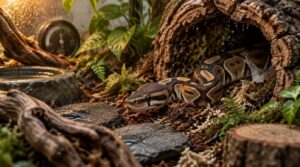
Shedding problems can still show up, so you’ll want to know what to check first.
If your snake keeps retaining skin, confirm it’s actually using the humid hide. Disturbed moss or condensation inside usually means it is. If it isn’t, move the box to the warm side, but not directly over a heat source.
Then adjust your humidity control based on what you see:
- Retained eye caps or tail tips: add more damp sphagnum moss and re-dampen on a fixed schedule.
- Moss drying out quickly: raise substrate depth or mix in vermiculite.
- Mold or sour smell: replace the moss right away.
Also add several rough surfaces in the enclosure, since a humid hide alone often can’t provide full shedding support.
If your snake struggles with stuck shed, pairing those rough surfaces with a safe substrate for snake shedding can help hold the right moisture around the hide.
Top Hide Box Supplies for Shedding
You’ve covered the setup and the fixes, so now it’s time to stock your shed box. The five supplies below help you control moisture and humidity levels and keep the hide clean. Pick the ones that fit your animal and your routine, and you’ll usually get steadier sheds.
1. Zoo Med Terrarium Mesh 18×18 Inches
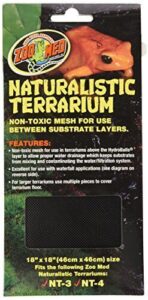
Say you’ve built a humid hide in a Zoo Med NT3, and a week later the bottom layer smells sour because the moss sank into the drainage pellets. That’s the problem the Zoo Med Terrarium Mesh solves.
It’s a black, nontoxic plastic mesh, 18 x 18 inches, built for NT3 and NT4 terrariums. Lay it over your hydroballs, and it keeps substrate out of the water. It’s lightweight at 0.04 kg, though some owners find it pricy.
| Best For | Reptile and amphibian keepers with an NT3 or NT4 terrarium who want to keep their substrate from mixing with the drainage layer. |
|---|---|
| Material | Plastic mesh |
| Weight | 0.04 kg |
| Terrarium Use | Substrate separation |
| Size | 18 x 18 inches |
| Quantity | 1 count |
| Main Drawback | Considered pricy |
| Additional Features |
|
- Keeps substrate out of the water and filtration systems
- Separates substrate layers and promotes drainage above the hydroballs layer
- Nontoxic plastic mesh that is lightweight at 0.04 kg
- Some customers consider it pricy
- Comes as only one 18 x 18 inch sheet per package
- Available in black only
2. LuckyRunes Live Moss 4-Pack
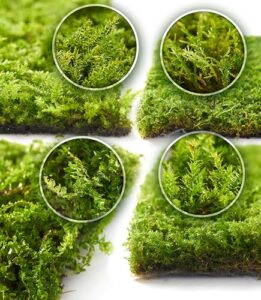
Soaking this moss before use usually helps it recover from shipping. The LuckyRunes pack includes four pieces of real, live moss, each about 3.5 x 7 inches, and the varieties may include Hypnum, Dicranum, or similar types. It’s dye-free and has no artificial coatings, so it suits your humid hide.
Expect it to arrive dry, compressed, or light brown. Mist it often and keep it in a shaded, humid setup to revive it. Some buyers report browning within two weeks.
| Best For | Hobbyists building closed terrariums, fairy gardens, or humid reptile and amphibian enclosures who are willing to revive and care for moss that may arrive dry or brown. |
|---|---|
| Material | Living natural moss |
| Weight | N/A |
| Terrarium Use | Closed terrarium decor |
| Size | 3.5 x 7 inches each |
| Quantity | 4 count |
| Main Drawback | May arrive dying |
| Additional Features |
|
- Includes four pieces of real, live moss, each about 3.5 x 7 inches
- Naturally grown, dye-free, and free of artificial coatings
- Works in many setups, including terrariums, bonsai top dressing, orchid pots, and humid animal habitats
- May arrive dry, compressed, or light brown from shipping
- Needs frequent misting and a shaded, humid spot to revive
- Some buyers report it browning or dying within two weeks
3. Duedusto Reptile Terrarium Substrate Barriers
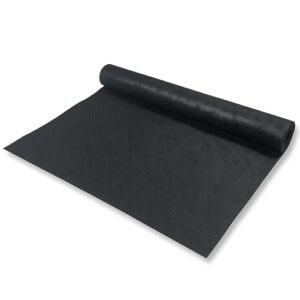
The Duedusto substrate barrier keeps your bioactive layers separate, so soil doesn’t wash down into the drainage layer below. The mesh lets water flow through while holding back debris, loose substrate and the bioactive organisms in your mix.
You get two 36.2" x 18.9" sheets in the pack. They fit tanks up to 36" x 18", leaving extra material for wrapping edges. Cut it to size for non-standard tanks, and keep it indoors, because prolonged UV exposure can degrade it.
| Best For | Reptile and amphibian keepers building a bioactive terrarium up to 36" x 18" who want to keep their soil and drainage layer cleanly separated. |
|---|---|
| Material | Natural lightweight fabric |
| Weight | 0.08 kg |
| Terrarium Use | Bioactive drainage separation |
| Size | 36.2 x 18.9 inches |
| Quantity | 2 sheets |
| Main Drawback | Requires cutting |
| Additional Features |
|
- Keeps substrate and bioactive organisms from mixing into the drainage layer
- Mesh lets water flow through while holding back debris and loose substrate
- Two large sheets with extra material for wrapping the edges
- Needs to be cut to fit non-standard tank sizes
- Made for indoor use only
- Material may degrade with prolonged UV exposure
4. Legigo 10 LB Organic Expanded Clay Balls
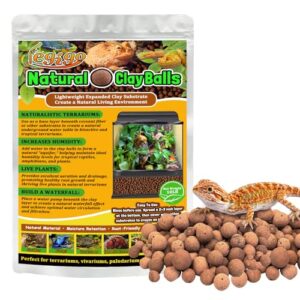
Say your ball python keeps shedding in patches, and the paper towel in her hide dries out by noon. A layer of these clay balls under damp moss can fix that.
The Legigo clay balls come in a 10 lb bag, sized 4-16mm. They’re pH-neutral, low-dust, and often hold water, then release it slowly, so humidity stays steadier. Rinse them 2-3 times first. It also works as a drainage layer in bioactive setups, though results may take months to judge.
| Best For | Reptile and amphibian keepers building bioactive terrariums or vivariums who want a reusable drainage layer that helps keep humidity steady. |
|---|---|
| Material | Natural expanded clay |
| Weight | 10 lbs |
| Terrarium Use | Bioactive drainage layer |
| Size | 4-16mm diameter |
| Quantity | 10 lbs |
| Main Drawback | Requires rinsing |
| Additional Features |
|
- Comes in a 10 lb bag of pH-neutral, low-dust clay balls (4-16mm) that resist crumbling.
- Can be rinsed and reused many times while still draining and aerating well.
- Works across many setups, including terrariums, aquaponics, hydroponics, and propagation, and helps prevent root rot.
- Needs to be rinsed 2-3 times before use to get rid of surface dust.
- Results in bioactive setups can take months to fully judge.
- Not specified for saltwater aquariums or marine environments.
5. LUCKYRUNES Live Moss for Terrariums
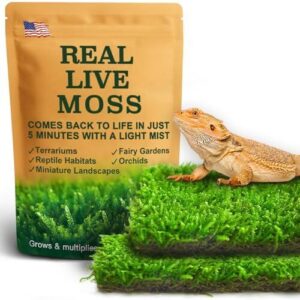
Say your corn snake’s shed came off in patches last month, and her hide feels dry.
This live moss arrives dry or compressed, so mist it on arrival to rehydrate. Once it’s damp, it holds moisture and often keeps humidity steady in a humid hide. One pack covers about 50 square inches, and you can trim, place, or layer pieces.
Keep it out of strong direct sunlight and give it airflow. Longevity varies, and some users report moss dying within days.
| Best For | Reptile and amphibian keepers, such as owners of corn snakes, geckos, or frogs, who want a natural-looking moss layer to help keep a humid hide or terrarium damp. |
|---|---|
| Material | Live moss |
| Weight | 1.44 ounces |
| Terrarium Use | Terrarium bedding |
| Size | 10.04 x 7.56 x 1.26 inches |
| Quantity | N/A |
| Main Drawback | May die quickly |
| Additional Features |
|
- Real live moss gives tanks and humid hides a natural forest-floor look.
- Once misted, it holds moisture and can help keep humidity steady.
- One pack covers about 50 square inches, and you can trim, place, or layer it as a decorative accent.
- It arrives dry or compressed, so you must mist it right away to rehydrate it.
- It needs shade from strong direct sunlight, plus proper humidity and airflow.
- Durability varies, and some users report the moss dying within days.
Frequently Asked Questions (FAQs)
How to set up a humid hide for a leopard gecko?
Set up your humid hide on the cool side. Use a lidded container with a small, taped entrance hole, and fill it with damp sphagnum moss. Check it every 2-3 days, and remoisten usually.
Why isn’t my ball python shedding?
Think of your ball python’s skin as a tight winter coat that won’t unzip. Usually, low humidity is the cause, so check your humidity control for reptiles, substrate depth, and consider shedding assistance.
How can I make a DIY humidity hide for my corn snake?
Build a DIY humidity hide from a lidded plastic container. Cut a smooth entrance, then set substrate depth halfway with moist substrate. Mind the ventilation vs humidity balance, and keep a reptile hide comfort margin.
Why is my ball python shedding in pieces?
Your ball python usually sheds in pieces because humidity dropped during the shed cycle. Fix substrate moisture balance, add a humidity hut, and practice shed cycle management. Shedding assistance then often works well without soaking.
How often should a humid hide be cleaned?
Wondering how often your humid hide needs attention? Replace the moss every 4-6 weeks, and clean the container then. Swap it right away after waste or mold, which keeps mold risk and enclosure hygiene in check.
Can leopard geckos use the same humid hide as snakes?
Yes, you can, with one tweak. The main humid hide works the same, but your gecko only needs room to turn around, so a small container fits. Cut a smooth entrance, keep the moss damp, and place it on the warm side.
What temperature should a humid hide be kept at?
Picture a cool cave.
Keep your temperature control on the cooler side, usually around 70-80°F, since heat and moist substrate breed bacteria. That aids humidity retention, a reptile hydration aid, within ideal humidity range shedding.
Is plastic or wood better for humid hide boxes?
Plastic is usually better. Plastic reptile hides resist water, so humidity retention stays steady and mold prevention in vivariums gets easier.
Wood swells and warps. In your ventilated reptile enclosure, watch the substrate displacement effect.
Where should a humid hide be placed in the enclosure?
Think of the gradient’s middle as neutral ground. Put your humid hide there, away from heat, in a secure enclosure.
Watch ventilation effects and substrate refresh frequency; a shed box calculator helps you size it.
Conclusion
Mist the moss, check the hide, and watch the skin. Those three habits turn a stressful shed into a routine one.
Hide boxes for shedding support work because they give your snake control over its own humidity. You choose the size, the moss, and the moisture level, and your corn snake usually does the rest. Stuck eye caps and tail rings often fade once the setup is right.
Build it once, tune it, trust it.