This site is supported by our readers. We may earn a commission, at no cost to you, if you purchase through links.

A 40-pound boa constrictor can pull its full weight and then some while climbing. One cracked branch, one rusty screw, and your snake takes the fall.
That’s why safe branches for boa constrictor tanks matter more than any decorative choice you make. Pine and cedar leak oils that irritate a boa’s skin and lungs. A backyard oak limb can hide mites, mold, or pesticide residue. Even the right wood fails if it’s too thin or bolted down wrong.
You control every one of those risks. Pick the right wood, size it for your snake, clean it properly, and anchor it so it holds.
Table Of Contents
- Key Takeaways
- Choosing Safe Woods for Boa Constrictor Tanks
- Sizing Climbing Branches for Your Boa
- Cleaning Branches Before Tank Installation
- Securing Boa Branches for Safe Climbing
- Inspecting, Cleaning, and Replacing Boa Branches
- Frequently Asked Questions (FAQs)
- Can I use branches from outside for my snake?
- Are Hobby Lobby fake plants safe for reptiles?
- What kind of wood is safe for snakes?
- What plants are safe for boa constrictors?
- How often should climbing branches be rotated?
- Do climbing branches help reduce boa stress?
- How does climbing benefit a boas muscles?
- Can branches help boas regulate their body temperature?
- Why do boas need mental stimulation from branches?
- Conclusion
Key Takeaways
- Choose untreated hardwoods like oak, maple, or ash, or store-bought options like cork bark and mopani, and never use pine, cedar, eucalyptus, pressure-treated wood, or anything sprayed with pesticides.
- Match branch thickness to your boa’s size, 1 to 1.5 inches for juveniles and 1.5 to 2 inches or more for adults, and choose wood that can support two to three times your snake’s weight.
- Scrub every branch and sterilize it by boiling, baking, or a bleach soak before it goes in the tank, then let it dry fully so mites, fungus, and sap don’t come along.
- Anchor each branch so it can’t wobble, keep basking perches at least 12 inches from heat sources, and inspect weekly, replacing any wood that turns soft, musty, or moldy.
Choosing Safe Woods for Boa Constrictor Tanks
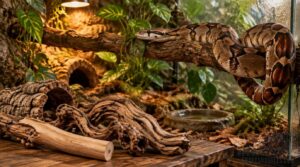
Your boa’s climbing branch can either keep your snake thriving or quietly cause trouble, so the wood you pick matters. Below, we’ll look at store-bought reptile wood, safe branches from your own backyard, and the unsafe woods and treatments to skip. Ready to build a climbing setup you can trust?
If you’re unsure which branches are actually safe for a boa, this guide to safe climbing branches for boa constrictors covers sturdy, non-toxic options worth considering.
Store-Bought Reptile Wood Options
Most reptile shops carry nontoxic woods your boa will love. Skip the guesswork and pick these durable woods:
- Cork bark
- Mopani wood
- Spiderwood
- Grapevine
- Maple, birch, or oak
Smart branch preparation matters. Rinse everything, then use gentle sterilization methods like baking. Stick with trusted brands such as Zoo Med or Exo Terra, and you’re avoiding unsafe woods from the start. Suppliers such as Lugarti offer five spider wood sizes, from small to jumbo, which makes it easier to fit a branch to your boa’s enclosure.
Identifying Safe Outdoor Branches
Prefer the backyard to the shop? You can, but be picky. Only collect fallen branches from trees you know are pesticide-free, and skip anything near roads or fields.
Stick with hardwoods like oak, maple, or ash. Strip all the bark, then check for rot, cracks, and hollow spots. Choose a sturdy, properly sized piece, with a branch diameter your boa can coil around and a branch length that spans the tank.
If you’re setting up a boa enclosure for the first time, this beginner’s guide to climbing branches for snakes covers how to position and secure each piece safely.
Unsafe Woods and Chemical Treatments
Even a pretty branch can be a bad one, so know what to skip. Pine, cedar, and eucalyptus carry oils and compounds that raise wood toxicity concerns. Never use pressure-treated lumber, plywood, or anything sprayed with pesticides.
Chemicals leach as wood ages. Boil and bake finds, then wipe with a reptilesafe disinfectant. Stick to a cleaning schedule for mold prevention.
Sizing Climbing Branches for Your Boa
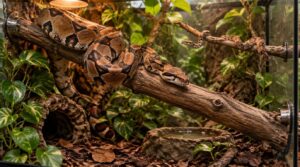
Picking the right branch size matters just as much as picking the right wood.
Your boa’s weight decides what works, so we’ll look at how juvenile and adult sizes differ and how much load a branch must carry.
Let’s get you set up so every perch feels solid under your snake.
Juvenile Versus Adult Branch Sizes
Picture a 3-foot boa on a 2-inch hardwood limb. Her coils barely wrap it, so she slips and scrambles. Now picture a 7-footer on a 1-inch twig. It bows under her.
Sizing perches to your boa is only one piece of a safe setup, so review these essential snake habitat elements too.
Match the branch diameter to your snake. Juveniles want 1 to 1.5 inches. Adults need 1.5 to 2 inches or more, and branch length should grow with the enclosure.
Branch Strength and Weight Support
Diameter matters more than most keepers realize. Load capacity climbs with the cube of thickness, so a 2-inch branch holds eight times what a 1-inch branch does. That’s your safety margin.
Aim for sturdy wood rated at two to three times your boa’s weight, since climbing adds muscle force. Check stability requirements, and keep securely anchoring every piece.
Cleaning Branches Before Tank Installation
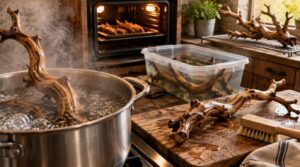
Clean every branch before it goes near your boa, because outdoor wood can hide mites, fungus, and sap you never see. Good cleaning is your first line of parasite control.
Start with a hard scrub under hot water, then pick a sterilization method. Boiling for 10 to 15 minutes kills parasites and pulls out sap. It’s the simplest option for most branches. Prefer bleach? Soak in a 3% solution for 24 hours, then rinse and flush with fresh water for 48 hours so no residue stays behind.
Oven-safe branches can bake at 250°F for 2 hours with no chemicals at all. Check every 10 minutes so nothing chars.
Let each branch dry fully, then do a quick inspection for cracks, soft spots, or lingering odor. Build this into your maintenance schedule.
Securing Boa Branches for Safe Climbing
A branch that wobbles under your boa is a safety hazard, not a decoration. Once your wood is clean and dry, you’ll want to lock it in so it holds steady every time your snake climbs. Here are the three things to get right, from hidden hardware to heater clearance.
Anchoring Branches Without Exposed Hardware
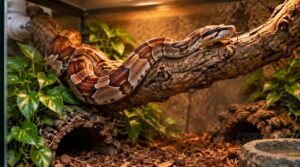
Ever watched a boa test a loose bolt? It’s not cute. Use heavyduty fasteners from the back, so nothing pokes into your snake’s space.
Pre-drill holes when securing branches, then bolt wood to internal PVC end caps. That’s safe anchoring with no rust and no sharp edges. Cover or hide every zip tie. Better enrichment starts with solid material integrity.
Creating Stable, Accessible Climbing Routes
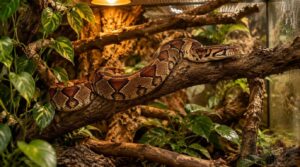
Picture your boa climbing a ladder of living wood.
Stack your vertical arrangement 6 to 12 inches apart, with 4 to 6 inch steps below high perches.
Mind placement and orientation: tilt branches 10 to 30 degrees and keep walls two inches clear. Build safety factors into branch load, aiming for 2 to 3 times body weight. Hardwood lifespan helps.
Since climbing boas shift between warm and cool spots as they move up and down, a digital terrarium thermometer hygrometer lets you confirm that higher perches stay at safe temperatures and humidity.
Maintaining Safe Distances From Heaters
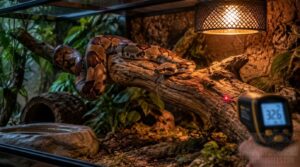
Could a perfect branch turn dangerous? Yes, if it sits too close to your heat source.
Keep basking branches at least 12 inches below basking lights, and plan your thermal gradient so heat access zones stay at one end.
- Guard every heater with mesh.
- Leave 6-inch clearance everywhere.
- Check branch surfaces with an infrared thermometer.
Smart enclosure design keeps your boa safe.
Inspecting, Cleaning, and Replacing Boa Branches
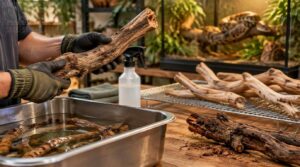
Your boa trusts its branches with every ounce of its weight. Earn that trust by inspecting them weekly during spot-cleaning. Look for discoloration, fuzzy growth, small holes, splinters, and loose bark. Sniff for musty odors too. Soft, wobbly wood has to go.
Your boa trusts its branches with its whole weight, so inspect them weekly and replace any that are soft, wobbly, or musty
Once a month, or after any illness, give them a deep cleaning. Soak them in a 10% bleach solution for 15 to 30 minutes, or use F10 at the recommended dilution. Baking at 200 to 250°F for two to four hours is another sterilization method, as long as the wood doesn’t scorch. Rinse well, then air-dry and off-gas for at least 48 hours until it’s bone dry and odorless.
Replace rotten, stained, or smelly branches. Swap everything yearly.
Frequently Asked Questions (FAQs)
Can I use branches from outside for my snake?
Yes, you can use outside branches, but untreated hardwoods like oak or maple. Skip pine and cedar. Cleaning matters: scrub, then bleach. Sterilization methods help. Inspecting for rot keeps your boa safe. Add secure locks.
Are Hobby Lobby fake plants safe for reptiles?
Hobby Lobby plants can be a reptile safe material disaster or a bargain. Choose plastic, skip fabric, and rinse everything in warm vinegar water. Check for wires, glitter, and loose bits before they touch your enclosure.
What kind of wood is safe for snakes?
Stick with nontoxic hardwoods like oak, maple, and ash. Untreated fir, aspen, and cypress work too, while mopani and manzanita hold up well in humidity. Skip pine and cedar, and try regularly rotating your branches.
What plants are safe for boa constrictors?
Picture a humid boa tank with a pothos trailing over a sturdy oak branch. Pothos, snake plant, dracaena, fittonia, peperomia and ZZ plant are your safe picks. Skip dieffenbachia, holly and milky-sap euphorbias.
How often should climbing branches be rotated?
Your branch rotation depends on age. Juveniles need swaps every 2-4 weeks, while adults can go 3-6 months. Build your maintenance schedule around cleaning frequency, and check safety factors each time. Layouts boost habitat enrichment.
Do climbing branches help reduce boa stress?
A bare tank is a waiting room with no magazines. Climbing branches change that. They deliver environmental enrichment, giving your boa mental stimulation, exercise, and choice, so stress reduction shows up as less hiding.
How does climbing benefit a boas muscles?
Climbing drives muscle development in your boa. Each pull and anchor builds strength, encouraging muscle hypertrophy, while sharper locomotor coordination and a smarter gripping strategy follow. It’s strength building you’ll see in steadier, stronger movement.
Can branches help boas regulate their body temperature?
Picture your boa coiled on a warm branch after dinner, digesting.
Yes, branches support natural thermoregulation. Placed under a basking area, they build a temperature gradient, letting you create a thermal environment your boa controls.
Why do boas need mental stimulation from branches?
A bored boa in a bare tank often just stops moving. Branches fix that. They give your snake choices, which is real mental stimulation, and that environmental enrichment keeps it curious, calmer, and acting like a boa.
Conclusion
Picture Dana’s eight-foot boa, Juniper, hauling herself up a sun-bleached oak limb that Dana skipped scrubbing. Mites hitched a ride, and the tank turned into a weeks-long cleanup.
Skip that headache. Choosing safe branches for boa constrictor tanks comes down to four habits: pick untreated wood, match thickness to your snake, scrub and bake before installing, and anchor everything so nothing shifts. Check the setup monthly. Do that, and your boa climbs with total confidence.
- https://www.beardeddragon.org/articles/safe-woods-for-bearded-dragons
- https://www.thebiodude.com/blogs/how-to-setup-a-bioactive-vivarium-terrarium-or-paludarium/20-types-of-wood-and-leaves-never-to-use-in-a-terrarium
- https://docs.google.com/document/d/1l1KCvZVK0wMNcAZWDuh2Wq236tsdh0xB_OwBxczXuQA/mobilebasic