This site is supported by our readers. We may earn a commission, at no cost to you, if you purchase through links.

A snake hook looks like a simple metal stick. Then your 5-foot boa lunges mid-lift and the load on that shaft jumps two to three times its weight. Cheap hook, bent shaft, loose snake.
Picking snake hooks for home use isn’t about grabbing the shiniest one online. A 15-inch hook suits a corn snake under 4 feet. A boa over 6 feet needs 30 to 40 inches. Steel or aluminum? Fixed or telescoping? Each choice changes how much control you get.
Here’s how to match the hook to your snake, buy from suppliers you can trust, and handle with confidence.
Table Of Contents
Key Takeaways
- Match your hook to your snake’s size and weight, from 15 inches for a corn snake under 4 feet to 30 to 40 inches for a boa over 6, and pick steel over aluminum for heavy animals since a sudden lunge can double or triple the load.
- Buy from suppliers who publish their materials and give you a real phone number, and choose smooth tips and a non-slip grip, because cheap knockoffs can bend or snap mid-lift.
- Support your snake at mid-body, about one-third back from the head, and never lift the head or tail or press on the ribs, since snakes breathe with their ribs and have no diaphragm.
- Handle only calm, nonvenomous pets, stop the moment you see stress signs like hissing, stiff coils, or open-mouth breathing, and check, clean, and tug-test your hook before every use.
Choose The Right Snake Hook for Home
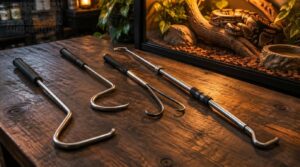
Your snake hook choice matters more than you think. Pick wrong, and you’ll fight your snake instead of guiding it. Here are four things to check before you spend a dime.
If you’re still unsure why experienced keepers rely on one, this guide to why snake owners use handling hooks explains how the right tool keeps every move calmer.
Match Length to Species and Size
Most keepers grab the wrong hook first. Don’t. Your snake size decides everything, so match hook length to the animal and the enclosure.
- Corn snake or ball python under 4 feet: 15 inches
- Hatchlings: 12 to 15 inches
- Boas over 6 feet: 30 to 40 inches
- Tall arboreal setups: 24 to 36 inches
Wrong sizing costs you control. Measure first.
Check Load Ratings and Body Support
Sizing gets the hook in your hand. Load rating decides if it holds. Check the manufacturer’s number before you buy, because load ratings assume weight spread along the shaft.
A snake coils, so weight shifts fast. Sudden movement can multiply the load two to three times.
Once the coils loosen, it helps to know how little the bite matters compared with the squeeze, which is why boa constrictor bite force and what it means for handlers is worth a look.
Support your snake’s midbody, about one-third back from the head. Never hang the whole animal from one point.
Compare Steel and Aluminum Construction
Load rating leads straight to snake hook materials. Stainless steel runs 250 to 450 grams, so it feels solid and holds firm under big constrictors. Aluminum weighs 80 to 200 grams, which saves your wrist.
But snake hook durability differs. Aluminum bends under lateral stress and may need replacing in two to three years. Steel lasts five to ten. Heavy snake? Pick steel.
Prioritize Smooth Tips and Non-Slip Grips
Material picked? Now check the business ends. Good snake hooks have smooth tips, because rough metal scrapes belly scales. Look for polished stainless or polycarbonate, which makes smooth lifting easy.
Then grab the handle. A rubberized grip stays nonslip when your snake wriggles, and beginners will notice the difference fast. Aim for 4.5 cm diameter. Your wrist will thank you. Some hooks add a second foam grip on longer sizes, and rubber and foam grips give better safety and control when your hands are wet or sweaty.
Compare Fixed, Telescoping, and Collapsible Snake Hooks
A fixed hook is the simplest tool in your kit. One rigid shaft, zero flex, nothing to wear out. The catch? It never gets shorter, so you’ll need full-length storage.
Not sure which style fits? Picture each one:
If straining or pressure ever pushes tissue out, this guide to the causes of snake prolapse explains what to watch for and why it happens.
- Fixed: one stainless steel shaft, 24 to 48 inches.
- Telescoping: nested sections that lock anywhere from 18 to 40 inches.
- Collapsible: hinged shafts, like foldable tongs, that fold to half length.
- Storage: collapsed models fit the smallest drawer.
Telescoping hooks suit beginners who want one adjustable tool, but loosened collars threaten safety. Tug-test every lock before each lift. Collapsible hooks travel best, yet their hinges deserve the same scrutiny. Fixed wins on raw strength, every time. Which one fits your home setup?
Buy Snake Hooks From Reputable Suppliers
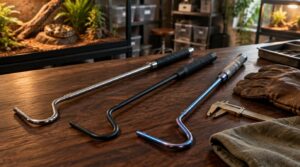
You wouldn’t buy a parachute from a guy in a parking lot. Any solid snake hook buying guide starts with the seller, not the sticker price.
Look for suppliers that publish their materials and testing standards. Forestry Suppliers, for example, lists a chrome-plated steel shaft, a stainless hook, and a non-slip grip, all USA made. Lugarti sells high quality stainless steel hooks with a powder-coated finish. Stoney goes titanium and anodized aluminum, and it skips golf-shaft shortcuts.
Check for a phone number. Stoney posts one for orders and warranty problems. Can’t reach a human? Walk away.
Treat it as professional equipment. Cheap knockoffs can bend or snap mid-handling, and your snake pays for it. Stick with expert endorsed tools.
Use Snake Hooks Safely at Home

A snake hook gives you control and distance, but only if you use it right. The four rules below cover what to handle, where to lift, what to skip, and when to quit. Get them down and your hook handling skills will keep you and your snake calm.
Handle Only Calm, Nonvenomous Pet Snakes
Think a hook makes any snake safe? Nope. Calm, nonvenomous pets only.
Snake hooks work best with docile species like corn snakes, ball pythons, and kingsnakes. Beginners, start here. Safety first.
- Pick an even-tempered species.
- Skip handling if it’s hissing or puffing.
- Use sturdy stainless steel for control.
Venomous snakes? Not your project.
Support Mid-Body Without Compressing Ribs
Picture a garden hose draped over a branch. Now picture it pinched. That’s your snake’s rib cage under the wrong pressure.
A snake’s ribs do its breathing, so pressing them with a hook is like pinching a hose and cutting off the flow
Snakes have no diaphragm, so ribs do the breathing. Use snake hooks at roughly one-third of body length, on the belly’s midline, never pressing ribs. Heavy snake? Add a second hook. Good snake hook length and ergonomic design keep your handling smooth and safe.
Avoid Head and Tail Lifting
Think of your snake hook as a mid-body support, not a crane. Lift the head or tail and you force the spine into an arch it was never built for. Snakes have no diaphragm either, so organs slide and press on the heart and lungs.
Keep snake hooks low and under the middle. Smooth lifting stays level. Always.
Stop When Your Snake Shows Stress
Your snake talks. You just have to read it.
Watch for stiff, locked coils, an S-shaped neck, hissing, or rapid thrashing. Rib cage pumping? Wheezing? Open-mouth breathing? That’s real distress.
Beginners often push through. Don’t. Set the snake down, pull the snake hooks away, and give it space. Fast relaxation afterward means the handling was the problem. Snake safety starts there.
Clean, Inspect, and Store Your Snake Hook
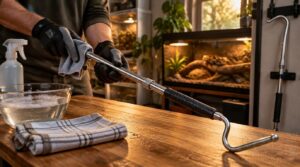
Handling’s done, but your hook isn’t. Snake hook maintenance takes five minutes and protects every future session.
Wash the shaft with mild dish soap and warm water. Skip bleach and alcohol, since they chew through finishes. After contact with a sick animal, disinfect with 70% isopropyl or a vet-grade quat solution. Then dry it completely. Trapped moisture wrecks joints.
Before each use, run a quick quality control inspection. Look for bends, dents, cracks, and burrs on the tip. Check the grip for peeling. Test telescoping locks too. Slipping joints mean dropped snakes. Spot rust or white powder? Retire or repair it.
Stainless steel and other rust resistant metal still earn a good wipe-down. Store the hook upright, dry, and away from sunlight. That’s real snake hook safety.
Frequently Asked Questions (FAQs)
Can a snake hook replace hand handling entirely?
Nope. Snake hooks don’t replace hand handling, they add to it. A hook gives only one contact point, so your snake can still rotate or slide off. Beginners need practice, and snake restraint stays limited.
How do I introduce my snake to a hook?
I once watched a keeper grab a ball python with a hook on day one. Big mistake. Snake hook training starts slow, and beginners should leave the hook in the tank for days.
Touch lightly mid-body, then offer food by hand. Stop at stress cues.
Are snake hooks legal to own everywhere?
Picture a hook in your suitcase and a border officer squinting at it. Funny, until it isn’t.
Snake hooks aren’t legal to own everywhere. Rules shift by country, state and town. Check local law first.
Can children use snake hooks with supervision?
Yes, but only with an adult in direct control. Kids 8 to 12 can assist hand over hand. Teens 13+ may manage docile snakes under watch. Anything younger? Observe only. Stainless steel hooks stay adult gear.
Do snake hooks work for relocating wild snakes?
Sure, grab a stick and play hero with a venomous stranger. Snake hooks weren’t built for that. Wild snakes thrash, strike, and slip free, so safety drops fast. Call a permitted professional with proper wildlife management equipment.
Conclusion
Think a hook is overkill for a docile pet? Even sleepy snakes startle, and a startled boa doesn’t ask permission.
Pick the right length, pair it with a smooth tip, and buy from suppliers who stand behind their gear. Then use snake hooks for home use the way they were built: support mid-body, skip the head and tail, and quit when your snake says so.
Clean it, check it, hang it up. Stay in charge.