This site is supported by our readers. We may earn a commission, at no cost to you, if you purchase through links.
A dial thermometer can read 7°F off, and your snake pays for that error with every meal. Cold digestion stalls, food rots in the gut, and the animal regurgitates.
Most keepers blame the lamp or the heat mat. The real culprit is usually the gauge itself, or where it sits. Correct placement of a temperature gauge in a snake habitat means measuring what the animal actually touches and breathes, not what glass or open air reports.
A ball python needs a basking surface near 90°F. You can’t guess that number. Here’s how to measure it accurately, from the right thermometer to the right spot.
Table Of Contents
- Key Takeaways
- Choose Accurate Thermometers for Your Snake Habitat
- Place Temperature Gauges Across Your Snake Habitat
- Position Thermostat Probes for Each Heat Source
- Verify Readings Against Species-Specific Temperature Targets
- Secure Probes and Troubleshoot Misleading Temperature Readings
- Frequently Asked Questions (FAQs)
- Where to put a temperature gauge in a snake tank?
- How hot is too hot for a snake enclosure?
- Where to put a temperature gauge?
- Where should I place the thermostat probe in my ball python tank?
- How often should I replace snake habitat thermometers?
- Do glass enclosures read differently than PVC enclosures?
- Can room temperature changes affect my gauge readings?
- Should temperature gauges be adjusted during seasonal brumation periods?
- Conclusion
Key Takeaways
- Swap analog dial thermometers—which can read 5–7°F off—for factory-calibrated digital units rated to ±1°F, and cross-check them against each other and an infrared temp gun.
- Put sensors where your snake actually touches: on the basking surface under the lamp, on the cool-side substrate at body level, and mid-level in the center away from walls and direct heat.
- Place thermostat probes by heat source type—flat on the heat mat’s surface or 2–4 inches below an overhead heater—because a probe on the wall can let the hide floor bake your snake.
- Verify every reading against species-specific targets (e.g., 88–92°F warm side for ball pythons) and secure probes with zip ties or silicone so a drifting or dislodged sensor can’t quietly mislead you.
Choose Accurate Thermometers for Your Snake Habitat
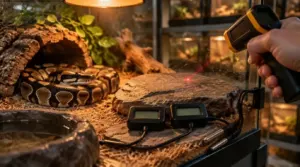
Buy digital thermometers and toss every analog dial in the trash. Dials can miss the mark by 5 to 7°F, and in a snake enclosure that gap decides whether your animal digests its meal or regurgitates it.
Cold snakes can’t digest properly either, so it’s worth knowing what happens when a snake gets too cold and why an accurate reading matters on the cool end too.
Look for factory-calibrated digital thermometers rated to ±1°F. Pair them with an infrared temp gun so you can check surface readings without disturbing your snake. Waterproof temperature probes on an external display survive humid hides, and wired units won’t drop signal the way wireless ones do in a basement rack. Infrared guns detect surface radiation, which is why they give the most accurate basking surface temperature readings, and those are almost always higher than the ambient air temperature.
Don’t trust a single unit. Run temperature calibration by placing two thermometers side by side and comparing them. If they disagree, one’s lying to you. Good temperature accuracy starts before probe placement happens.
Place Temperature Gauges Across Your Snake Habitat
You’ve picked a reliable thermometer, so now you have to put it where it tells the truth. A gauge in the wrong spot will report a comfortable number while your snake sits in a heat trap or a cold zone. Work through the four placements below, because each one answers a different question about thermal gradient integrity.
Warm-Side Basking Surface

Probe placement on the warm-side basking surface decides whether your numbers mean anything. Tape or zip-tie the sensor directly onto the substrate surface or basking branch, right under the lamp, never on glass.
Dark slate runs 10-15°F hotter than the air above it, so measure what your snake actually touches. Check the probe daily.
Cool-Side Snake-Level Air
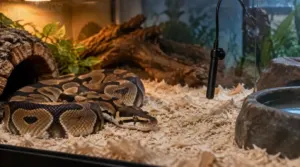
Now flip to the opposite end. The cool side tells you whether your snake can actually escape the heat, and that’s a safety question, not a comfort one.
If you’re keeping a Mandarin rat snake, this Mandarin rat snake care sheet explains how its temperature needs differ from those of other colubrids.
Set the probe on the coolside substrate, 1-2 inches above the surface, where your snake’s body rests. Keep it clear of hides and decor, and shield it from radiant heat.
Central Ambient Temperature
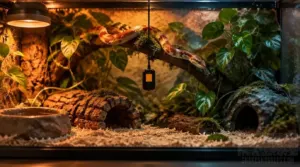
Now check the middle. Your central ambient probe belongs at mid-level in the enclosure, away from walls and direct heat sources, because those skew the reading fast.
This zone averages the warm and cool sides, and your snake crosses it constantly. For most temperate species, aim for 75-80°F during the day. Add temperature logging to confirm it holds.
Arboreal Perches and Shaded Retreats
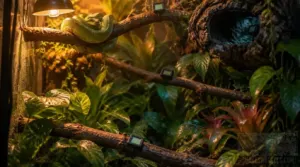
The top perch isn’t the only spot that matters in arboreal snake setups. Run temperature mapping at five points:
- Upper basking branch surface
- Middle perch
- Lower perch
- Inside the shaded retreat, at snake level
- Air beside each perch
Keep thermostat controls on separate probe placement, and compare branch and perch readings daily. Shaded retreats run cooler, so never just guess.
If your readings still disagree, this corn snake temperature control guide walks through setting up a gradient so your snake can move between warm and cool zones.
Position Thermostat Probes for Each Heat Source
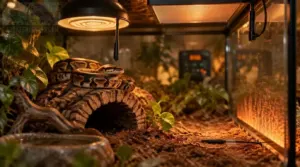
A thermostat probe isn’t a thermometer, and treating it like one is how snakes get cooked. Its job is to control your heat source, so where it sits depends on which heat source you’re running. Check what the manufacturer says for each type below, then match your probe to it.
A thermostat probe isn’t a thermometer, so place it according to your heat source’s manufacturer instructions or risk cooking your snake
Heat Mat Manufacturer Placement Instructions
Your heat mat’s manual outranks every guess. Mount the mat outside the enclosure, never inside, and tape the probe flat against its surface with foil. Good probe placement makes temperature monitoring honest, and honest readings are heat source safety.
| Check | Rule | Why |
|---|---|---|
| Mount | Exterior only | Safety |
| Probe | Touches mat | Accuracy |
| Substrate | Under 1cm | Prevents overheating |
Test the empty enclosure first.
Overhead Heater Manufacturer Placement Instructions
Say you mount a ceramic heat emitter 14 inches above a basking hide, then tape the probe to the wall. Your thermostat reads 88°F while the hide floor bakes at 105°F. That gap burns snakes.
Follow your manufacturer’s clearance specs, then:
- Check heat source placement first.
- Set the probe 2-4 inches beneath.
- Tape it onto the surface.
- Run temperature verification with a second gauge.
- Test probe calibration monthly.
Verify Readings Against Species-Specific Temperature Targets

Say your ball python’s warm-side display reads 84°F, and you figure that’s close enough. It isn’t. Ball pythons need 88–92°F on the warm side, so your snake is living in a habitat that’s too cool.
Don’t guess. Compare your temperature readings against species-specific requirements every time. Corn snakes and king snakes, for instance, want 82–88°F warm and 72–78°F cool, so a number that’s perfect for one animal is wrong for another.
Run temperature verification with both tools. Your infrared thermometer checks basking surfaces, while your digital temperature probes track air. Check the warm side, cool side, and surfaces at several times of day, with lights off at night. Consistency tells you your probe placement works. Drift means something’s wrong. Investigate.
Secure Probes and Troubleshoot Misleading Temperature Readings
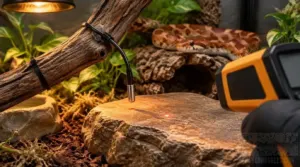
A probe that drifts is a probe that lies to your thermostat.
Good probe placement means nothing if your snake can undo it overnight. Use secure zip ties to anchor probes to branches or enclosure walls, and file down the tails so you avoid sharp edges that could scratch your animal. On heat mats, skip tape, since it can rip scales. Use hot glue or silicone instead, keeping it off the sensor tip.
Watch for these flags:
- A probe dangling in open air, which can make some thermostats regulate poorly
- Probe burial in substrate, or a sensor pressed against glass, which skews readings
- Wires pulled loose by your snake
Run daily probe checks, then verify with an infrared temperature gun.
Frequently Asked Questions (FAQs)
Where to put a temperature gauge in a snake tank?
Picture a snake draped over a sunbaked slate while your air thermometer reads a comfortable lie. Put one probe directly on the basking surface, one on the cool-side substrate, and one centrally, so you’re reading what your snake actually feels.
How hot is too hot for a snake enclosure?
Heat stress starts when ambient air passes 95°F for ball pythons, and corn snakes face real danger near 100°F. Keep basking temperature on a boa’s perch under 92°F, and watch for frantic movement.
Where to put a temperature gauge?
Put your temperature gauge on the substrate surface right under the heat source, where your snake actually rests. Run probe placement on the basking temperature spot, then add a second probe inside the warm hide.
Where should I place the thermostat probe in my ball python tank?
Put your thermostat probe where your ball python actually lives, not where the heat is loudest. Tape it flat on the substrate above the heat mat, or one to two inches below your ceramic heater.
How often should I replace snake habitat thermometers?
A keeper’s CR2032 unit died at month eight, mid-shed. Replace digital thermometers every 1–3 years, batteries every 6–12 months, and calibrate probes yearly; swap immediately when readings drift over 1 degree.
Do glass enclosures read differently than PVC enclosures?
Yes, decisively. Glass conducts heat roughly six times faster than PVC, so walls bleed warmth and probe placement misreads.
Expect temperature variance and skewed heat distribution; verify surfaces with an infrared thermometer.
PVC holds temperature zones steadier.
Can room temperature changes affect my gauge readings?
Your gauge reads the room as much as the heat source, so yes, room temperature changes absolutely shift your readings. Winter drops below 65°F demand supplemental heating; mind airflow, drafts, and ambient temperature fluctuations.
Should temperature gauges be adjusted during seasonal brumation periods?
A keeper’s California Kingsnake crashed when autumn room temps fell unnoticed. Yes, adjust gauges and thermostats to seasonal setpoint targets. Reset your temperature gradient, then watch behavioral indicators. Temperature monitoring during brumation isn’t optional; verify every reading.
Conclusion
A keeper once trusted a stick-on dial reading 88°F until his python regurgitated twice in a week. A probe on the basking surface told the truth: 79°F.
Correct placement of temperature gauge in snake habitat means the sensor touches what the snake touches. Verify every reading against your species’ target. Your snake can’t report a cold gut. Your gauge must.