This site is supported by our readers. We may earn a commission, at no cost to you, if you purchase through links.

Corn snakes rank among the most forgiving reptiles a new keeper can own, but forgiving doesn’t mean bulletproof. A poorly designed enclosure—wrong size, bad temps, no secure lid—turns a healthy snake into a stressed one fast, and stress in snakes shows up as refused meals, failed sheds, and escape attempts at 2 a.m.
The good news is that getting the setup right isn’t complicated once you understand what a corn snake actually needs versus what looks good on a shelf. Every decision, from substrate depth to heat mat placement, connects directly to how well your snake eats, moves, and thrives.
Table Of Contents
- Key Takeaways
- Choosing The Right Corn Snake Enclosure
- Creating Ideal Temperature and Humidity
- Selecting Safe Substrates and Decor
- Essential Maintenance and Cleaning Schedule
- Top Products for Corn Snake Enclosure Setup
- 1. Niteangel Reptile Hammock Lounger
- 2. Prevue Birdie Basics Wood Ladder
- 3. JW Pet Hol EE Roller Dog Toy
- 4. SuperMoss Bungalow Birdhouse
- 5. Natural Hummingbird Grass Bird House
- 6. Repti Zoo Glass Reptile Terrarium Tank
- 7. Repti Zoo Glass Terrarium Tank
- 8. Zoo Med Forest Floor Bedding
- 9. Aiicioo Reptile Heat Mat Thermostat
- Frequently Asked Questions (FAQs)
- What is the proper corn snake tank setup?
- What do corn snakes like in their cage?
- Do corn snakes like heat mats or lamps?
- What is the perfect corn snake terrarium?
- Can corn snakes escape their enclosure easily?
- How often should I handle my snake?
- What signs indicate a stressed corn snake?
- Do corn snakes need live or frozen prey?
- When should I upgrade my snakes tank?
- Can corn snakes live together in one enclosure?
- Conclusion
Key Takeaways
- Start with the right enclosure size for your snake’s age — 10 gallons for hatchlings, 20 for juveniles, and at least 40 gallons for adults — and upgrade before your snake runs out of room to stretch.
- A proper temperature gradient, with a warm side between 85–88°F and a cool side at 75–78°F, is non-negotiable for healthy digestion, shedding, and overall wellbeing.
- Corn snakes can push through gaps barely wider than a pencil, so every latch, lid, and cable hole needs to be sealed tight before your snake ever moves in.
- Safe substrate like loose aspen or coconut husk at 2–4 inches deep, at least two snug hides, and a daily maintenance routine are what separate a snake that just survives from one that genuinely thrives.
Choosing The Right Corn Snake Enclosure
Picking the right enclosure is one of the first real decisions you’ll make as a corn snake keeper, and it affects everything that comes after.
Getting it right from the start makes everything easier, so it’s worth checking out this guide to indoor snake habitats for corn snakes before you buy anything.
The size, material, and layout you choose will shape how well your snake eats, hides, and stays healthy.
Here’s what to think about before you buy.
Recommended Enclosure Sizes by Age
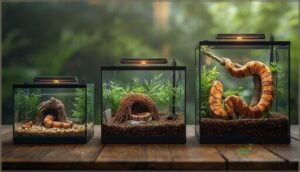
Size is everything in corn snake enclosure setup. Hatchlings do best in a 10-gallon terrarium, roughly 20 by 10 inches, where prey is easy to find and snake safety stays high.
Juvenile growth calls for a 20-gallon upgrade around 24 inches long.
Adult housing means a minimum 40-gallon enclosure, and timely enclosure upgrades keep your corn snake thriving at every stage.
Glass Vs. PVC Enclosures
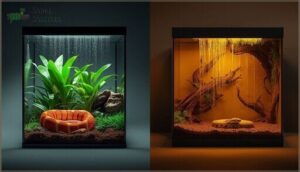
Once you’ve nailed the right size, your next call is picking the material. Glass tanks offer clear visibility and cost less upfront, but they lose heat fast and dry out quickly. PVC enclosures cost more initially, yet their exceptional insulation methods and humidity control make them far more energy efficient long-term.
- Heat retention: PVC’s enclosure materials hold warmth far better than glass.
- Humidity control: Sealed PVC panels slow evaporation, keeping your snake’s shed cycle smooth.
- Weight: PVC reptile enclosure design is lighter, making cleaning and repositioning easier.
Importance of Ventilation and Security
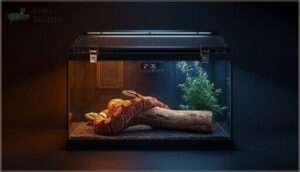
Good material choices mean nothing if Airflow and Security fall short. Proper Airflow Management keeps carbon dioxide and bacteria from building up, directly supporting your snake’s respiratory health. Poor Ventilation Systems trap humid, stale air that leads to wheezing or infection over time.
Reptile Enclosure Design should always balance Humidity Control with Escape Prevention, since a secure enclosure that breathes well protects your snake on every level.
| Feature | Good Setup | Poor Setup |
|---|---|---|
| Airflow | Cross-ventilation, mesh top | Sealed glass, no vents |
| Humidity Control | 40–60%, stable | Stagnant, over 70% |
| Enclosure Security | Locking latches, tight screens | Loose lids, open gaps |
| Snake Enclosure Smell | Fresh, neutral | Musty, ammonia-heavy |
| Secure Enclosures | No escape routes | Cable holes unsealed |
Escape-proofing Your Setup
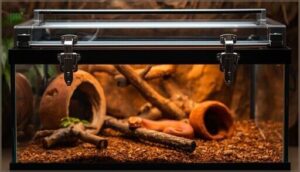
Even with solid ventilation covered, enclosure security and safety comes down to the details. Corn snakes can push through gaps barely wider than a pencil, so seal gaps around cables with rubber grommets and use locking latches on every access point. Secure lids should overlap the rim by at least 1–2 centimeters.
Corn snakes escape through gaps barely wider than a pencil, so every latch, lid, and cable hole must be sealed tight
Smart decor placement matters too:
- Keep branches and hides away from the lid to remove climbing leverage
- Use metal clips instead of plastic ones, which crack over time
- Install two locking points on opposite sides to prevent bowing
- Build a closing routine after every feeding to prevent human error
Creating Ideal Temperature and Humidity
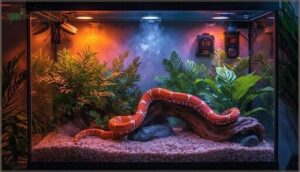
Getting the temperature and humidity right is one of the most important things you can do for your corn snake’s health. Too warm, too cold, or too dry, and you’ll start seeing problems that are completely avoidable.
Here’s what you need to know to get both dialed in correctly.
Setting Up a Temperature Gradient
A proper thermogradient gives your corn snake control over its own body temperature — and that matters more than people realize. Aim for 85 to 88°F on the warm side and 75 to 78°F on the cool side, measured at floor level.
Position heat sources at one end only, leaving the opposite end completely free. This temperature gradient lets your snake move between zones as needed.
Choosing and Using Heating Equipment
Three heat source options work well for corn snakes: under-tank heat mats, overhead lamps, and ceramic heat emitters. Each enhances your temperature gradient differently, but none are safe without a thermostat. Heating safety starts here.
A stable heat setup also makes shedding easier—check out these corn snake shedding tips and safe skin removal techniques to keep the whole process stress-free.
- Heat mat placement — Cover one-third of the floor, outside the enclosure, with substrate above it.
- Thermostat settings — Set to 85°F at the basking surface.
- Ceramic emitters — Best for nighttime warmth without disrupting the thermogradient.
Monitoring and Maintaining Humidity
Humidity control works hand in hand with temperature control to keep your corn snake healthy. Aim for 40 to 60 percent humidity, nudging it closer to 65 to 70 percent during shedding for better shedding assistance.
Water bowl management matters too — a wide bowl naturally raises humidity levels. A humid hide creation using damp sphagnum moss gives your snake extra moisture whenever it needs it.
Placement of Thermometers and Hygrometers
Where you place your sensors matters just as much as having them. A thermometer on the wrong surface gives you false confidence while your snake quietly sits in the wrong temperatures.
- Warm-side probe resting on the hide floor, not the mat itself
- Cool-side sensor away from windows and heat sources, at substrate level
- Hygrometer probe mid-enclosure, clear of misting spray for accurate humidity monitoring
Secure every sensor with zip ties or adhesive clips — sensor security prevents your snake from nudging probes and skewing your temperature gradient readings.
Selecting Safe Substrates and Decor
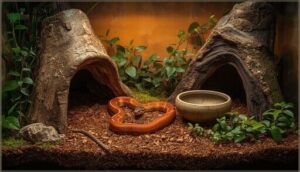
What’s on the floor of your corn snake’s enclosure matters more than most people realize, and so does everything else inside it.
The substrate you choose, the hides you place, and where you set the water bowl all shape how safe and comfortable your snake feels every day. Here’s what to look for in each of these areas.
Best Substrate Options and Depth
Choosing the right substrate shapes everything from burrowing behavior to Humidity Control. For substrate selection, loose aspen shavings work well at 1–3 inches deep, while Soil Mixes using coconut husk and organic topsoil support better Moisture Management at 3–4 inches.
Here’s a quick comparison:
| Substrate Materials | Burrowing Depth |
|---|---|
| Loose Aspen | 1–3 inches |
| Bioactive Soil Mixes | 3–4 inches |
Both support a healthy reptile habitat for your Corn Snake.
Substrate Safety: What to Avoid
Some substrates look fine on the shelf but cause real harm inside a corn snake’s enclosure. Cedar and pine release aromatic oils that irritate your snake’s respiratory system over time.
Sand and gravel can cause impaction if swallowed, and reptile carpet traps bacteria in its fibers. Smart substrate selection is a cornerstone of responsible reptile care — your snake habitat depends on it.
Adding Hides, Branches, and Enrichment
Once your substrate is sorted, it’s time to think about what goes inside the snake enclosure. Hide placement matters more than most people expect — your corn snake needs at least two snug hides, one on each side of the temperature gradient.
Strong enrichment items and layout clutter complete the setup:
- Cork tubes and climbing structures encourage natural movement
- Hides and decorations should feel tight, not spacious
- Rotating enrichment items every few weeks keeps exploration fresh
- Visual barriers from branches improve enclosure security and daily activity
Safe Water Bowl Size and Placement
Your corn snake’s water bowl should be large enough to soak in — about 6 to 8 inches across for adults — but kept to 1 to 2 inches deep for safe entry and exit.
Follow bowl placement strategies by keeping it on the cool side to control humidity levels and reduce evaporation. Refill daily and scrub every few days for proper water quality and management.
Essential Maintenance and Cleaning Schedule
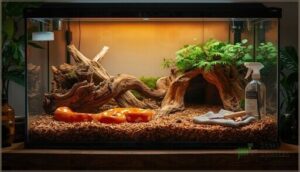
A clean enclosure isn’t just about appearances — it directly affects your snake’s health and stress levels.
Staying on top of maintenance is easier when you break it into daily, weekly, and monthly tasks rather than letting things pile up.
Here’s exactly what your cleaning routine should look like.
Daily and Weekly Enclosure Tasks
Every day, run through a quick checklist: confirm your temperature control readings hit 75–82°F on the cool side and 85–90°F on the warm side, check humidity levels stay between 40–60%, and scan for waste to spot-clean immediately.
Weekly, stir substrate, inspect hides, scrub the water bowl, and log feeding schedule and shed dates. Consistent enclosure maintenance keeps snake health checks simple and problems rare.
Deep Cleaning Frequency and Methods
Beyond daily upkeep, your corn snake’s enclosure needs a full deep cleaning every 4 to 8 weeks. Spot cleaning takes care of the small stuff, but a complete sanitizing method — removing all substrate, scrubbing every surface, and letting everything dry fully — resets the whole space.
Bioactive setups follow a looser maintenance schedule, needing full bioactive cleaning only a few times yearly.
Disinfecting Surfaces and Accessories
For proper reptile hygiene, dilute chlorhexidine at about 1 ounce per gallon of water, or mix F10SC at 1 to 250 for routine surface sanitizing. Accessory cleaning follows the same logic — soak hides and decor for the full contact time. Smart chemical handling means wearing gloves, avoiding ammonia-based sprays, and only returning your snake once every disinfectant smell is completely gone.
Monitoring for Mold and Bacteria
Mold prevention starts with your eyes and nose. When you first open the enclosure, a musty smell is often your earliest warning before any visible growth appears.
Check wood, cork, and substrate contact points regularly for white, green, or gray fuzzy patches. In a bioactive setup, healthy springtail populations handle surface fungal monitoring, but watch humidity levels and airflow closely for solid bacterial control and long-term reptile health and wellness.
Top Products for Corn Snake Enclosure Setup
Finding the right products makes the whole setup process a lot easier. The options below cover everything from enclosures and bedding to heating and enrichment, so you’re not left guessing what actually works.
Here’s what’s worth considering for your corn snake’s home.
1. Niteangel Reptile Hammock Lounger
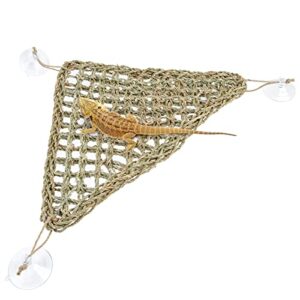
The Niteangel Reptile Hammock Lounger is one of those simple additions that genuinely changes how your corn snake uses its enclosure. Made from breathable synthetic mesh, it mounts to glass walls using suction cups and creates an elevated resting spot your snake can actually lounge across.
The open design lets warm air flow through instead of trapping heat, and because waste sits on the surface rather than soaking in, cleanup is quick with a reptile-safe disinfectant. Each package includes two hammocks, so you can rotate them during cleaning without any downtime.
| Best For | Reptile owners looking to add climbing space and a cozy resting spot for bearded dragons, geckos, chameleons, lizards, or snakes. |
|---|---|
| Material | Seaweed |
| Primary Color | Tan |
| Weight | 6.5 oz |
| Easy to Clean | Yes |
| Indoor Use | Yes |
| Animal Suitability | Reptiles/Snakes |
| Additional Features |
|
- Made from seaweed, so it’s got a natural rough texture that actually helps reptiles shed their skin more easily.
- Doubles as both a hammock and lounger, giving your reptile a comfortable elevated spot to hang out and survey their kingdom.
- Comes with strong suction cups and leather strings, so it stays put without you constantly reattaching it.
- Needs regular cleaning to keep bacteria from building up — it’s not a set-it-and-forget-it kind of accessory.
- Not great for juvenile or smaller reptiles since there’s a real risk of them getting trapped or stuck.
- You’ll want to keep your reptile’s nails trimmed, otherwise they can snag on the material and get stuck.
2. Prevue Birdie Basics Wood Ladder
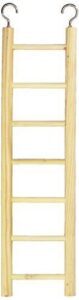
The Prevue Birdie Basics Wood Ladder does something most decorative accessories can’t — it adds a functional climbing route without eating up floor space. At just under 3 inches wide and about 11 inches tall, the 7-rung design fits neatly along a enclosure wall, connecting lower hides to elevated spots your snake can explore.
The unvarnished pine gives scales something to grip, and cleanup is simple with a damp cloth. Just let it dry fully before putting it back in.
| Best For | Small birds like parakeets or finches who need a fun way to climb, play, and build confidence around their bath or toys. |
|---|---|
| Material | Wood |
| Primary Color | Natural Wood |
| Weight | 1.44 oz |
| Easy to Clean | Yes |
| Indoor Use | Yes |
| Animal Suitability | Birds |
| Additional Features |
|
- All-natural wood gives birds a satisfying grip and a safe surface to perch and chew on
- The 7-step design is versatile — use it as a ladder, bridge, or even a little monkey bar setup
- Easy to install and clean, which makes day-to-day cage maintenance a lot less annoying
- Determined chewers can go through it pretty fast, so it may not last long with heavy chewers
- Not a great fit for larger birds like cockatiels — it’s just too small for them
- At least one customer got a unit with a slanted hook, which raises some questions about overall build consistency
3. JW Pet Hol EE Roller Dog Toy
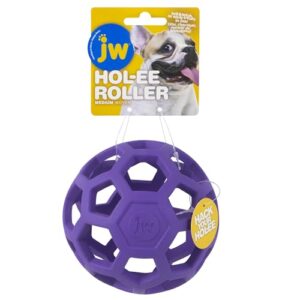
Not everything in your enclosure has to be labeled “reptile” to work. The JW Pet Hol-ee Roller is a medium-sized natural rubber toy, about 4.5 inches across, and its open honeycomb structure gives your corn snake something genuinely interesting to investigate and push around.
The flexible lattice holds its shape under pressure, and the smooth rubber is easy to wipe clean. It’s a low-cost way to add ground-level enrichment and keep your snake mentally active between feeding days.
| Best For | Corn snake owners looking for an affordable, easy-to-clean enrichment toy that encourages natural exploration behavior. |
|---|---|
| Material | Natural Rubber |
| Primary Color | Varies |
| Weight | 0.28 lbs |
| Easy to Clean | Yes |
| Indoor Use | Yes |
| Animal Suitability | Dogs |
| Additional Features |
|
- The open honeycomb design gives snakes something interesting to push around and investigate, keeping them mentally engaged.
- Made from natural rubber, so it’s flexible, durable, and easy to wipe down after use.
- Works great as low-cost ground-level enrichment without needing any special “reptile” branding.
- Not built for aggressive chewers, so if your snake is particularly rough with toys, it may not hold up long-term.
- May contain lead, which is worth knowing if you’re cautious about materials in your pet’s environment.
- Not designed as a standalone chew toy, so its use case is pretty specific to exploration and enrichment only.
4. SuperMoss Bungalow Birdhouse
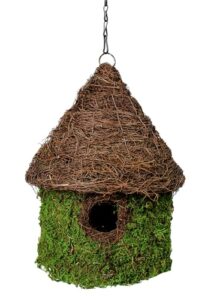
The SuperMoss Bungalow Birdhouse might surprise you — it’s actually a solid hide option for corn snakes. Hand-woven from natural moss vine, it measures about 10 x 10 x 14 inches, giving your snake a snug, enclosed space to retreat into.
The thick moss exterior buffers temperature swings slightly, and the natural materials are untreated and safe. It blends well into bioactive or naturalistic setups, adding visual texture while serving a real functional purpose your snake will actually use.
| Best For | Snake keepers who want a naturalistic hide that fits seamlessly into a bioactive or moss-themed enclosure. |
|---|---|
| Material | Sphagnum Moss |
| Primary Color | Green |
| Weight | 5.6 oz |
| Easy to Clean | Requires Maintenance |
| Indoor Use | Yes |
| Animal Suitability | Reptiles/Amphibians |
| Additional Features |
|
- Hand-woven from natural moss vine, so it looks great in naturalistic or bioactive setups
- At 10 x 10 x 14 inches, it gives corn snakes a genuinely snug space to hide and feel secure
- The thick moss exterior offers a little thermal buffering and the materials are untreated and safe
- The bottom can detach or fail to latch properly, which is a problem if your snake likes to push against things
- Moss sheds over time and it’s not waterproof, so humidity in the enclosure could shorten its lifespan
- The top can be see-through, meaning your snake may not feel as hidden as it needs to feel comfortable
5. Natural Hummingbird Grass Bird House
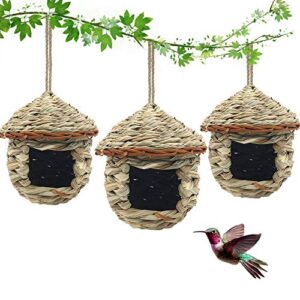
Another natural option worth considering is the Natural Hummingbird Grass Bird House. Hand-woven from dried hibiscus grass, it measures 6.6 x 6 x 1 inches — compact enough to tuck into a corner as a secondary hide or enrichment piece.
The rough woven surface gives your snake something to rub against, which can actually help during shed. Just inspect it regularly, since some units have frayed edges, and replace it once the fibers start breaking down.
| Best For | Bird lovers who want a natural, eco-friendly shelter option for small birds like hummingbirds, finches, or canaries. |
|---|---|
| Material | SuperMoss Vine |
| Primary Color | Fresh Green |
| Weight | 1.68 lbs |
| Easy to Clean | Difficult |
| Indoor Use | Yes |
| Animal Suitability | Birds |
| Additional Features |
|
- Made from natural dried hibiscus grass, so it’s biodegradable and looks great in any garden
- Comes in a pack of three, giving you more spots to attract birds or swap one out when it wears down
- The rough woven surface and built-in drainage make it a functional, nature-friendly choice
- Some units arrive frayed or splintery, which can make them tricky to handle and hard to clean
- Not the most durable option — a few buyers found theirs fell apart faster than expected
- Birds may not always take to them, so there’s no guarantee you’ll get any feathered tenants
6. Repti Zoo Glass Reptile Terrarium Tank
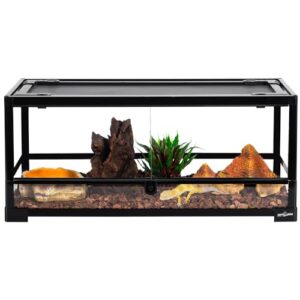
When you need the full package in one tank, the Repti Zoo Glass Reptile Terrarium Tank delivers. The 20-gallon model measures 30 x 12 x 12 inches and features front-opening doors with a security buckle, so a curious corn snake can’t push its way out.
The tempered glass panels hold up to daily handling and disinfecting without clouding. The raised base also fits a heat mat underneath cleanly, which makes building that warm-side belly zone much easier from the start.
| Best For | Reptile owners who want a sturdy, easy-access tank that works for everything from geckos to small snakes. |
|---|---|
| Material | Dried Hibiscus Grass |
| Primary Color | Natural |
| Weight | 0.22 kg |
| Easy to Clean | Difficult |
| Indoor Use | Yes |
| Animal Suitability | Small Birds |
| Additional Features |
|
- Front-opening doors make feeding and cleaning way less of a hassle
- Tempered glass holds up well to daily use and disinfecting
- Works for both desert and rainforest setups, so it’s pretty versatile
- Cord holes are big enough for tiny baby reptiles to squeeze through
- The glass doors have no handles, which gets annoying fast
- Corners are tough to clean, and instructions can be hit or miss
7. Repti Zoo Glass Terrarium Tank
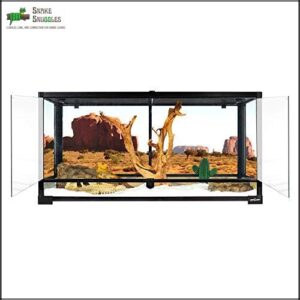
If your corn snake is full-grown and needs more room to roam, the Repti Zoo Glass Terrarium Tank steps up to 50 gallons with a 36 x 18 x 18-inch footprint — enough horizontal space for an adult to stretch out and explore comfortably.
The dual front-opening doors let you access each side independently, so feeding and spot cleaning don’t turn into a chase. The waterproof base accommodates damp substrate mixes without leaking, and the raised bottom fits a heat mat underneath without issue.
| Best For | Adult corn snake owners who need a spacious, easy-access enclosure that works for both desert and rainforest setups. |
|---|---|
| Material | Glass |
| Primary Color | Black/Clear |
| Weight | 25 lbs |
| Easy to Clean | Yes |
| Indoor Use | Yes |
| Animal Suitability | Reptiles/Amphibians |
| Additional Features |
|
- The dual front doors open independently, making feeding and cleaning way less stressful for both you and your snake.
- A waterproof base means you can use damp substrate mixes without worrying about leaks or water damage.
- At 50 gallons with a 36-inch length, there’s plenty of room for a full-grown adult to actually move around.
- The side screen panels can make it tough to hold humidity if your setup needs it high.
- The locking mechanism might not cut it for snakes that are serious about escaping.
- A few buyers have reported broken plastic corners arriving out of the box, so inspect it carefully when it shows up.
8. Zoo Med Forest Floor Bedding
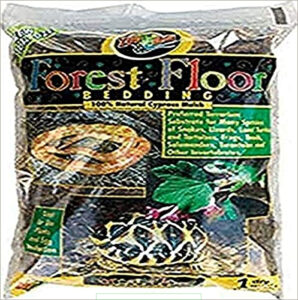
Once you’ve got your tank sorted, what goes inside matters just as much. Forest Floor Bedding gives your corn snake a naturalistic cypress mulch base that actually works — it holds moisture well enough to keep humidity between 40 and 60 percent without constant misting.
The splinter-free chips let your snake burrow comfortably, and at 2 to 3 inches deep, it stays functional. Spot clean regularly and do a full swap every 2 to 4 months.
| Best For | Corn snake owners who want a natural-looking setup that keeps humidity steady without a lot of extra effort. |
|---|---|
| Material | Glass |
| Primary Color | Black |
| Weight | Not Listed |
| Easy to Clean | Yes |
| Indoor Use | Yes |
| Animal Suitability | Reptiles/Amphibians |
| Additional Features |
|
- Holds moisture well, making it easy to keep humidity in that 40–60% sweet spot
- Cypress mulch looks great and gives your snake a natural, forest-floor feel
- Works for a ton of other reptiles and amphibians too, so it’s versatile if you have multiple tanks
- Can get pricey if you have a large enclosure and need a lot of it
- Spotting waste is tricky — it kind of blends in with the mulch
- Some bags have larger chunks that you’ll want to pick out before putting it in the tank
9. Aiicioo Reptile Heat Mat Thermostat
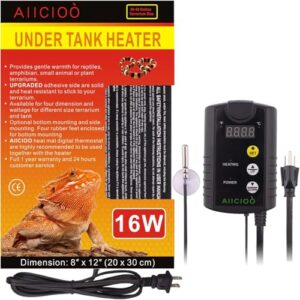
Temperature control can make or break your snake’s health, and the Aiicioo Heat Mat and Thermostat combo performs that job reliably. The 8×12 inch mat mounts under the glass, while the digital thermostat holds your warm side steady in the low-to-mid 80s Fahrenheit — right where corn snakes need it.
Set the probe inside near the warm hide, not on the mat itself. Pair it with a separate thermometer to verify readings, and you’re set.
| Best For | Snake and reptile owners who want reliable temperature control without spending a lot. |
|---|---|
| Material | Cypress Mulch |
| Primary Color | Natural Brown |
| Weight | 10.6 lbs |
| Easy to Clean | Moderate |
| Indoor Use | Yes |
| Animal Suitability | Reptiles/Amphibians |
| Additional Features |
|
- Digital thermostat keeps temps accurate and steady — no guessing
- Flexible mounting options (bottom or side) make it easy to fit different tank setups
- Works for more than just reptiles — great for seedlings too
- Skip it if you have a plastic or acrylic tank — it’s not compatible
- The thermostat clicks when it cycles, which some people find annoying
- Might not put out enough heat for larger tanks or cold rooms
Frequently Asked Questions (FAQs)
What is the proper corn snake tank setup?
A proper setup gives your corn snake a secure enclosure with a temperature gradient from 88–90°F on the warm side to 75–82°F on the cool side, safe substrate, snug hides, and stable humidity around 50–70 percent.
What do corn snakes like in their cage?
Corn snakes seem simple, but they need more than just space. They like snug hides, climbing branches, a stable water bowl, and a warm basking spot around 90°F to feel truly secure.
Do corn snakes like heat mats or lamps?
Both work well as long as temperatures stay correct. Heat mats deliver steady belly warmth, while overhead lamps create a more natural basking area.
Either option keeps your snake comfortable when paired with a thermostat.
What is the perfect corn snake terrarium?
The perfect corn snake terrarium isn’t one thing — it’s a balance. You need the right size, a stable temperature gradient, safe substrate, secure hides, and proper ventilation working together consistently.
Can corn snakes escape their enclosure easily?
Yes, they can. Corn snakes are natural escape artists that test every gap and edge of their enclosure, so a secure lid with clips isn’t optional — it’s essential.
How often should I handle my snake?
How often is too often? Aim for 2 to 4 sessions per week, keeping each one around 15 to 20 minutes. Skip handling for 48 hours after feeding.
What signs indicate a stressed corn snake?
Tight S-coils, hissing, glass surfing, and food refusal are the clearest stress signals. You might also notice musking, constant hiding, or rigid, jerky movements during handling — all signs something’s off.
Do corn snakes need live or frozen prey?
Frozen thawed mice are the go-to choice for corn snakes — safer, more convenient, and nearly always accepted.
Save live prey as a last resort if your snake refuses frozen options entirely.
When should I upgrade my snakes tank?
Upgrade your corn snake’s tank once its body length matches or exceeds the enclosure’s floor space. A snake that can’t fully stretch out needs more room immediately.
Can corn snakes live together in one enclosure?
Corn snakes are solitary by nature and do best living alone.
Cohabitation raises stress, spreads disease, and risks injury, so separate enclosures are always the safer, smarter choice for your snake.
Conclusion
The simpler you keep the best corn snake enclosure setup, the more complex and rewarding your snake’s behavior becomes. Strip away the guesswork—dial in your temperatures, lock down your lid, layer your substrate deep enough to burrow—and what you get isn’t just a snake that survives, but one that actually lives.
Every detail you control inside that enclosure directly shapes what you see outside of it: a calm, feeding, thriving animal.
- https://reptifiles.com/corn-snake-care-guide/corn-snake-terrarium-size/
- https://www.happydragons.com/buying-guides/corn-snake-deluxe-buying-guide
- https://www.thebiodude.com/blogs/snake-caresheets/care-guidelines-for-corn-snakes
- https://reptilesmagazine.com/uromastyx-care-sheet/
- https://www.herps-and-inverts.com/bioactive-enclosure-for-corn-snakes/