This site is supported by our readers. We may earn a commission, at no cost to you, if you purchase through links.
Your kingsnake’s hygrometer says 62 percent at midnight and 41 at noon. Panic? Nope. That swing is normal, and it’s exactly why proper humidity levels for king snake care trip up so many keepers.
Aim for a 50 percent baseline, somewhere between 40 and 60. Drift too far either way and you’ll see patchy sheds, cloudy eyecaps, or gray, swollen belly scales that point to scale rot. Those problems build quietly, then show up all at once.
You can prevent every one of them. You’ll learn how to read your gauge accurately, nudge humidity up or down, and spot trouble early.
Table Of Contents
- Key Takeaways
- Ideal Kingsnake Humidity: Daily Range and When to Adjust It
- How to Measure Humidity in a Kingsnake Enclosure
- How to Raise or Lower Kingsnake Humidity
- Using Substrate, Humid Hides, and Ventilation to Control Humidity
- Signs of Humidity Problems in Kingsnakes and What to Do
- Frequently Asked Questions (FAQs)
- How humid should a King snake tank be?
- Is 70% humidity too high for a ball python?
- What is the best bedding for kingsnakes?
- What temperatures do king snakes like?
- What should the humidity be for a kingsnake?
- What if humidity is too high for snake?
- What is the best habitat for a king snake?
- How much humidity should be in a snake tank?
- How often clean water bowls for king snakes?
- Can king snakes thrive in low humidity areas?
- Conclusion
Key Takeaways
- You’ll want to keep your kingsnake’s humidity near 50 percent, anywhere from 40 to 60, and treat daily swings as normal unless readings stay out of range for days.
- You’ll get trustworthy numbers from a calibrated digital hygrometer mounted mid-height and away from water, heat, and vents, ideally with a second sensor in the humid hide and a monthly salt-test accuracy check.
- You can raise humidity with a damp sphagnum hide, light misting, or moisture-holding substrate, and lower it with drier bedding, more ventilation, or a dehumidifier, changing it by only 5 to 10 percent at a time.
- You’ll catch problems early by watching your snake’s shed, since patchy shed and cloudy eyecaps mean too dry, while gray, swollen belly scales or wheezing mean too damp and call for drying things out and seeing a reptile vet if it persists.
Ideal Kingsnake Humidity: Daily Range and When to Adjust It
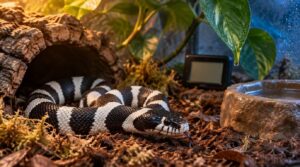
Aim for an ideal humidity range of 40 to 60 percent, and you’ll want to keep your baseline close to 50. Humidity and kingsnake health are tightly linked. Air that’s too damp invites scale rot and mucus buildup, while air that’s too dry leads to stuck shed.
A reliable hygrometer and a humid hide make it easier to hold that range, and this kingsnake care sheet overview covers setup details worth reviewing.
Expect daily humidity fluctuations. Readings usually climb overnight and dip when the room warms, and small swings are normal. Worry only when numbers stay outside your range for days.
Plan on adjusting humidity levels seasonally, since winter heating dries the air and summer can turn it muggy. Change things gradually, by 5 to 10 percent per week, so your snake isn’t shocked. Keep monitoring temperature and humidity together, because one shifts the other.
How to Measure Humidity in a Kingsnake Enclosure
Those daily swings only make sense if you’re measuring humidity accurately, so start with a calibrated digital hygrometer. Skip the cheap dial gauges, since they drift and you can’t trust them.
Mount the probe at mid-height in the enclosure, away from water bowls, heat sources, and vents. Then follow these habits:
- Use two sensors, one in the open and one inside the humid hide.
- Log the 24-hour high and low, plus when each hits.
- Check accuracy monthly with a salt test, and replace any unit that’s off by more than 5 percent.
- Compare your enclosure to the room’s reading to spot outside influence.
Consistent humidity monitoring turns guesswork into data, and it shows whether your humidity levels stay in range.
If you’re deciding which meter to trust with your basement, this guide to the best humidity gauges for basements compares accuracy, alerts, and placement so you can pick with confidence.
How to Raise or Lower Kingsnake Humidity
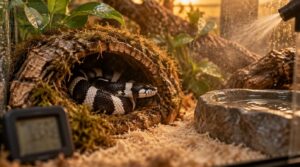
Once you’ve checked your hygrometer readings, you’ll know whether your kingsnake’s enclosure needs a nudge up or down. The good news is that most fixes are small, cheap, and easy to undo if you overshoot, right? Below, you’ll find two simple adjustments to try, starting with what to do when the air runs too dry.
Raising Low Humidity
Say your hygrometer reads 35% and your kingsnake’s shed comes off in patches. You’ll want gradual changes here, so try these:
If your readings keep swinging between dry and damp, this guide on why snake tank humidity fluctuates can help you steady things before the next shed.
| Fix | How | Boost |
|---|---|---|
| Humid hide | Damp sphagnum | 70–90% inside |
| Misting system | Light mist | Brief rise |
| Water dish | Near cool end | 5–15% |
Raise humidity levels 5–10% at a time, giving the enclosure a 1–2 hour dry-down between mists. Recheck twice.
A fine-mist reptile spray bottle lets you add moisture in small, controlled bursts, which makes those 5–10% increases much easier to manage.
Reducing Excess Humidity
Overshot the other way? If readings sit above 65% for 72 hours, act before mold shows up. Try these:
If your terrarium stays damp after a few foggy mornings, these practical ways to reduce humidity in a terrarium can help you improve airflow and bring readings back to a safe range.
- Swap in a drier substrate.
- Open vents for ventilation twice daily.
- Run a small dehumidifier nearby.
- Use airflow optimization: add a quiet fan.
- Shrink the water dish for condensation prevention.
You’ll recheck twice daily; humidity fluctuation under 15 points is fine.
Using Substrate, Humid Hides, and Ventilation to Control Humidity
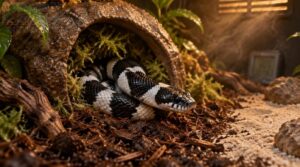
Start with your substrate, because it sets your enclosure’s baseline. Cypress mulch or coconut fiber holds moisture longer, so you’ll see humidity climb 5 to 15% when it’s dampened. Dry sand or calcium-based options pull humidity down, which suits a kingsnake that doesn’t need a swamp.
Build a humid hide next. Pack lightly damp sphagnum into a snug, semi-closed cavity your snake can fully fit inside, and you’ll lift that chamber by 8 to 20% without soaking everything else. Replace the moss monthly so it doesn’t mold or sour.
Adjust ventilation last. Close upper vents during stubborn humid spells, and keep cross-ventilation open so air never stagnates. Together, these steps make creating humid microclimates simple, all while maintaining ideal humidity.
Signs of Humidity Problems in Kingsnakes and What to Do
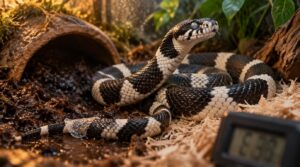
Shed cycles tell you more about humidity levels than any gauge does. Recognizing signs of humidity imbalance early keeps small fixes from turning into vet visits.
Your kingsnake’s shed tells you more about its humidity than any gauge, so catch imbalances early and skip the vet visit
Too dry, and you’ll see shedding problems: cloudy eyecaps that won’t clear, shed that comes off in patches, or old skin clinging to the tail tip and toes. Dull, flaky scales point the same way.
Too damp, and you’ll notice gray, swollen skin, especially on the belly or near the humid hide. That’s your cue for scale rot prevention: dry the substrate, boost ventilation, and spot-clean wet areas.
Wheezing or open-mouth breathing means respiratory issues may be brewing, so check your readings and call a reptile vet if it persists, since early treatment matters.
Frequently Asked Questions (FAQs)
How humid should a King snake tank be?
Think of your tank as a desert, not a rainforest. Proper humidity levels run 30–50%, and you’ll raise them to 60% during the humidity and shedding process.
A digital hygrometer helps with maintaining ideal humidity.
Is 70% humidity too high for a ball python?
It’s not the end of the world! Brief spikes to 70% relative humidity while shedding are fine, but sustained 70% readings invite infections.
Check your hygrometer, boost ventilation, and lower humidity levels in your enclosure.
What is the best bedding for kingsnakes?
Aspen is your best bet. In your substrate selection, skip pine, since its resin irritates lungs. Aspen’s dust-free and burrow-friendly, but its low moisture retention means misting lightly, checking your hygrometer, and keeping ventilation good.
What temperatures do king snakes like?
Wondering what temperatures king snakes like? Aim for 75–85°F by day, with a basking spot near 90–95°F. Nights can drop to 65–75°F.
Your enclosure setup needs a temperature gradient, a 10–15°F thermal gradient, for thermoregulation.
What should the humidity be for a kingsnake?
Say your hygrometer reads 52%, and you’re set.
That’s the ideal environment: relative humidity between 40 and 60%. Those proper humidity levels keep your kingsnake healthy, and you’ll nudge humidity levels up only before shedding.
What if humidity is too high for snake?
Humidity above 70% for a full day can start mold growing. You’ll risk respiratory issues, scale rot, and bacterial growth, so boost airflow fast, remove damp substrate, and keep your enclosure dry for fungal prevention.
What is the best habitat for a king snake?
Picture your tank as a tiny woodland home. You’ll want smart habitat design: a 20-gallon tank or larger, cypress substrate, snug hides, and a warm-to-cool gradient.
Keep proper humidity levels near 40-60% throughout the day.
How much humidity should be in a snake tank?
Yes, different snakes want different numbers, but for kingsnakes you’ll aim for 40-60% relative humidity.
Check humidity levels with a hygrometer inside the enclosure, and don’t guess. Bump it toward 60% with misting during shedding.
How often clean water bowls for king snakes?
Is a daily swap overkill? Nope. Scrub your water bowl daily, since warm enclosures spoil water fast.
Add cleaning to your maintenance schedule, and redo soiled bowls immediately for steady hydration balance and reptile care.
Can king snakes thrive in low humidity areas?
You can keep king snakes in drier areas, within limits. They tolerate humidity levels of 35 to 60%, though below 30% harms shedding.
Track your enclosure with a hygrometer, add misting, and keep ventilation steady.
Conclusion
Think of your enclosure as a kitchen where the recipe only works if you keep tasting. Hitting proper humidity levels for king snake care isn’t a one-time setup, it’s a habit you’ll build with a reliable gauge, a damp hide, and a quick daily glance.
Watch for stuck shed and cloudy eyecaps, then adjust early. Small nudges beat big fixes. Keep humidity near 50 percent, and your snake will shed clean, eat well, and thrive.