This site is supported by our readers. We may earn a commission, at no cost to you, if you purchase through links.

Picture a snake that mimics a rattlesnake’s hiss and coils like it means business, then settles into your palm calmer than a Labrador after a long walk. That’s the gopher snake — bluff artist by nature, gentle companion by temperament, and one of the most forgiving species you’ll ever house in a glass tank.
Adults stretch past four feet, live well into their teens, and demand permits in states like California and Florida before you bring one home. Gopher snake pet care rewards owners who respect the details: proper enclosure dimensions, precise thermal gradients, documented captive-bred lineage.
Get the setup right from day one, and you’re looking at a decade-plus partnership built on trust rather than guesswork.
Table Of Contents
- Key Takeaways
- Choose The Right Pet Gopher Snake
- Set Up a Secure Gopher Snake Enclosure
- Establish Proper Heating, Humidity, and Lighting
- Feed and Handle Your Gopher Snake Safely
- Maintain Health and Enclosure Hygiene
- Frequently Asked Questions (FAQs)
- Are gopher snakes easy to take care of?
- What is the lifespan of a gopher snake?
- Can I have a gopher snake as a pet?
- Will a gopher snake hurt a dog?
- Are gopher snakes good pets?
- How do you care for a gopher snake?
- How do you house a gopher snake?
- Should you bring a gopher snake home?
- Do gopher snakes need to be bathed?
- Can gopher snakes be housed together safely?
- Conclusion
Key Takeaways
- Your gopher snake’s enclosure needs to hit specific benchmarks—48x24x24 inches minimum, a 90–95°F basking spot sloping to 75–80°F cool zone, and 40–60% humidity—to keep your snake healthy and stress-free.
- Buying captive-bred stock with documented health screenings and verified lineage protects you from hereditary issues and gives you a much sturdier start than a wild-caught or unverified snake.
- Feeding size and frequency should scale with your snake’s age, moving from pinkie mice every 5 days as a hatchling to appropriately sized rodents every 14 days once it reaches adulthood.
- Owning a gopher snake is a serious long-term commitment—often 15 to 25 years or more—so you’ll want to check your state’s permit requirements and be ready for consistent daily care before bringing one home.
Choose The Right Pet Gopher Snake
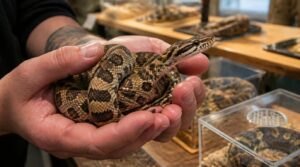
Picking a gopher snake isn’t just about grabbing the first hatchling that catches your eye at a reptile expo.
Since these snakes are known for their energy and bold personalities, it helps to review essential snake care fundamentals before committing to one.
You’re choosing a companion that might outlive your car, your first apartment, maybe even a couple of jobs, so the decision deserves some real thought.
A gopher snake may outlast your car, your apartment, even a couple of jobs—so choose wisely
Before you bring one home, walk through these five key considerations with me.
Subspecies and Adult Size
A shapeshifter with scales, the gopher snake wears different sizes depending on subspecies. Pituophis catenifer sayi grows longer than the coastal Pacific gopher snake (P. catenifer catenifer), a habitat size correlation tied to open plains versus cluttered terrain.
- Adults over four feet are common
- Girth varies by subspecies
- Growth rates differ genetically
- Legal subspecies regulations affect trade
- Identification guides enclosure planning
Temperament and Defensive Behaviors
Size aside, what really shapes daily life with this species is temperament—and gopher snakes generally earn their reputation as calm, tolerant companions.
Expect defensive hissing, tail vibration, or an S-coiled bluff when startled, followed by quiet retreat. Regular handling frequency (1–2 sessions weekly), gentle techniques, and behavioral monitoring build trust while easing stress—turning a jumpy hatchling into a steady, predictable handful.
Captive-Bred Sourcing and Health Checks
Where you buy matters as much as how you handle. Choose captive bred stock only—breeders documenting lineage, health screenings (respiratory, mite checks), and quarantine history.
- Request health certificates and studbook records
- Verify certification numbers with issuing bodies
- Confirm post-purchase support and return policies
Genetic lineage tracking flags hereditary risks; annual exams, fecal analysis, and blood panels ($100–$250) should follow regardless of source.
Local Ownership Laws and Permits
A perfect health certificate means nothing if you’re breaking local laws. Snake regulations vary wildly by state—California demands a Class B permit ($55, biennial renewal); Florida requires Class III status ($100 annually) plus microchip registration; Arizona levies $200 fines for unpermitted exotic pet ownership.
Research your state’s permit application process, inspection compliance standards, and penalty enforcement guidelines before purchasing. Ignorance won’t shield you from seizure or fines.
Lifespan and Care Commitment
Before signing paperwork, ask yourself: can you commit to a companion that outlives your car? Gopher snakes commonly reach 12–15 years, sometimes 20+. Longevity depends on:
- Dietary Impact and prey quality
- Habitat Maintenance consistency
- Stress Management
- Routine veterinary examination
Discuss longevity expectations with your vet before adoption—breeding considerations and captive care standards shape lifelong reptile health.
Ask your vet about accurate probe placement too, since this guide to maintaining proper heat in a reptile habitat walks through calibrating both basking and cool-end temperatures correctly.
Set Up a Secure Gopher Snake Enclosure
Think of your gopher snake’s enclosure as its whole world, so every inch and every latch matters more than you might expect. A snake this strong and this curious will test weak spots you didn’t even know existed, turning a so-so setup into an escape story you’d rather not tell.
Here’s what your enclosure actually needs to keep this houdini-in-scales safe, secure, and genuinely at home.
Adult Enclosure Size Requirements
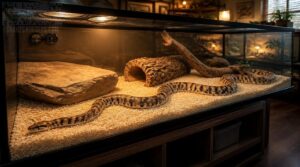
Ever watched a five-foot snake try to turn around in a two-foot box? It isn’t pretty.
Minimum Length Guidelines call for enclosure dimensions of 48 x 24 x 24 for average adults, while animals topping four feet need 60–72 inches of length. Width Recommendations sit at 2–3 feet; Height Considerations run 12–18 inches. That’s the Space Calculations behind sound housing.
For proper compliance, consult the exotic animal housing guidelines.
Escape-Proof Locks and Ventilation
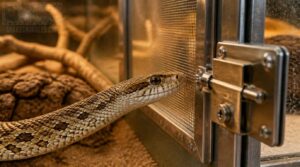
Gopher snakes are quiet escape artists, testing every gap with a probing snout. Choose stainless-steel Lock Material Choices and Double Locking Systems requiring two motions to open.
Fine-gauge Ventilation Mesh Design blocks passage while airflow continues. Run Seal Integrity Testing on doors and consider Door Alarm Connection—cheap insurance for reptile safety regardless of enclosure size.
Aspen or Soil-Sand Substrates
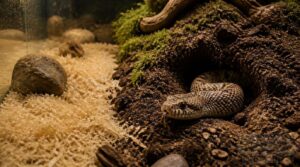
What’s underfoot matters as much as what’s overhead. Aspen bedding offers low dust and easy spot-cleaning, though its aspen moisture retention runs low—expect regular misting.
A soil sand mix holds humidity near 50–60%, aids dust particle control, and suits burrow depth options of 4–6 inches. Either works with a bioactive enclosure; thoughtful substrate selection hinges on your climate and cleaning routine.
Hides, Branches, and Burrowing Enrichment

A snake denied a proper hideout is a snake living in fight-or-flight mode. Provide multi-chamber hides at both thermal zones, sized to fully conceal the body with just the head peeking out.
For burrows, maintain 4–6 inch tunnel depth with reconfigurable entrances. Anchor branches at varied angles for muscle development.
- Reduced stress
- Injury prevention
- Natural burrowing instincts fulfilled
Rotate enrichment every few weeks to prevent habituation.
Bioactive Setup Considerations

A living carpet of isopods and springtails does more work than any spot-clean ever will. A bioactive gopher snake enclosure blends soil, sand, and leaf litter 6–8 inches deep, sustaining substrate microfauna balance while supporting the temperature gradient and humidity control your snake depends on.
Follow strict quarantine component procedures for new organisms, monitor moisture protocols weekly, and keep a contingency substrate replacement plan ready.
Establish Proper Heating, Humidity, and Lighting
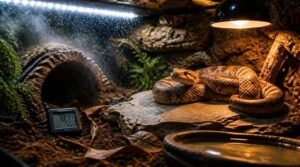
Think of your gopher snake as an ectothermic sunbather who can’t turn up its own internal thermostat—every degree, every percentage point of humidity, and every hour of light comes from choices you make. Get these variables wrong and you’re looking at respiratory infections, failed sheds, or a snake that simply won’t thrive.
Here’s exactly what your setup needs to get right, piece by piece.
Basking and Cool-Zone Temperatures
Think of your enclosure as a desert at scale: one end blazes, the other stays shaded. Aim for a 90–95°F basking spot on tile or cork bark, sloping to 75–80°F in the cool zone. That’s your temperature gradient.
Verify both ends daily with digital thermometers—drift of even a few degrees signals trouble before you see it in behavior.
Thermostats and Safe Heater Placement
That gradient only holds if your thermostat’s probe sits correctly—taped near the basking spot, never buried under substrate.
- Use a proportional or pulse-proportional thermostat, not a simple on/off model
- Keep heat mat cords away from moisture and foot traffic
- Set temperature alerts for swings beyond your target range
- Maintain 3 feet clearance around external heaters
- Cross-check thermostat readings against digital thermometers weekly
Humidity Targets and Humid Hides
Once your thermostat’s dialed in, humidity control becomes the next variable worth respecting. Keep enclosure RH between 40 and 60 percent, checked via a digital hygrometer near the humid hide and another at the basking zone.
During shedding, that humid hide box (lined with damp sphagnum moss) should climb to 70–90 percent. Adjust seasonally—winter heating dries air fast.
UVB Strength and Positioning
Moisture handled, light comes next. Gopher snakes need 5–6% T5 HO UVB lighting—try the Zoo Med Reptisun 50 or Arcadia Forest 6—positioned 12–18 inches above basking spots.
- Match UVB spectrum balance to enclosure height
- Verify output using a UVB meter, not guesswork
- Replace bulbs every 6–12 months
- Shield glass regularly to prevent attenuation
Seasonal Photoperiod and Monitoring
Seasons speak to snakes through light. Photoperiod adjustments—14 hours summer, 10 hours winter—shift gradually over 1–2 weeks, never abruptly.
Precise light cycle timing via timers prevents drift; recalibrate promptly. Track humidity response monitoring and appetite with your Bio Dude Digital Thermometer Hygrometer during seasonal light transitions.
Health indicator tracking—weight, shedding, fecal analysis—flags problems early, keeping your Reptisun 50 or Arcadia Forest 6 UVB lighting schedule truly beneficial.
Feed and Handle Your Gopher Snake Safely
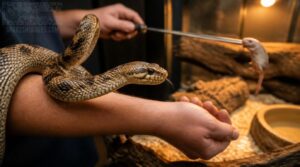
Feeding and handling look simple from the outside, but timing and technique matter more than most owners expect. Get the size, schedule, or approach wrong, and you risk regurgitation, aggression, or a snake that associates your hands with dinner. Here’s what you need to know before the next feeding rolls around.
Nutritional completeness starts with prey selection, and feeding guidelines for juvenile snakes explain why frozen-thawed whole prey consistently outperforms alternatives for growing animals.
Prey Sizes by Life Stage
Think of prey size as a snake’s fitted wardrobe—too tight or too loose invites trouble.
- Hatchling Prey Size: pinkie mice, 2–4 inches
- Juvenile Growth Diet: 5–8 inch prey
- Subadult Change Meals: 8–12 inches
- Adult Feeding Guidelines: 12–24 inch rodents
Prey Size Limits cap at 1.5 times girth—matching feeding strikes to jaw capacity keeps frozen rodents and dietary requirements aligned with safe digestion.
Age-Based Feeding Schedules
A hatchling’s clock runs fast: pinkie mice every 5 days fuel rapid growth.
Juveniles stretch to 7-day intervals as metabolism steadies, needing 30% protein for tissue development.
Subadults settle into a 10-day rhythm.
At 2 years, the Adult Change Plan kicks in—4 weeks at 10 days before locking into a permanent 14-day schedule, with weight-based portion control guiding each strike.
Thawing and Offering Frozen Rodents
Thaw frozen prey overnight in the fridge, then finish with a warm water bath near mid-30s°C for 10–15 minutes—never hot tap water or microwaves.
- Check pliability before offering
- Wear gloves during thawing
- Match prey size to girth
- Feed at the basking dish
Discard uneaten pinkie mice promptly to protect your feeding schedule’s hygiene.
Fresh Water and Feeding Records
Water seems simple until you realize it’s doing half the work behind healthy shedding. Keep a nonchlorinated, shallow bowl fresh daily, and log it:
| Date | Bowl Refilled | Notes |
|---|---|---|
| 7/21 | Yes | Soaked post-feeding |
| 7/24 | Yes | Normal |
Pair hydration observation with prey size documentation each feeding—your snake diet log reveals patterns thermometers alone can’t.
Handling Timing and Stress Reduction
Why does your new gopher snake need a full day alone before you touch it? Because stress hormones need time to settle. Follow Acclimation Period Guidelines: wait 24 hours minimum.
- Low Activity Moves during dim hours
- Brief sessions, expanding gradually
- Stress Sign Monitoring for tongue-flicking, flattening
Speak softly; steady hands support reptile welfare and calmer handling long-term.
Maintain Health and Enclosure Hygiene
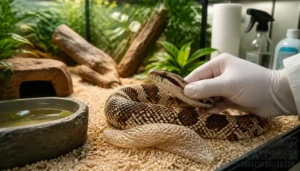
A clean enclosure isn’t just about appearances—it’s your first line of defense against illness in an animal that can’t tell you it’s sick.
Health maintenance for your gopher snake comes down to five interlocking habits: cleaning schedules, shedding care, symptom awareness, growth tracking, and knowing when to call in professional help.
Here’s what each of those actually looks like in practice.
Daily, Weekly, and Monthly Cleaning
Rarely does hygiene make or break a captive snake’s health quite like it does in gopher snake husbandry. Daily spot cleaning removes waste and refreshes water; a weekly disinfection routine grips surfaces and dishes; monthly deep sanitize sessions overhaul substrate entirely.
| Frequency | Key Task |
|---|---|
| Daily | Spot clean, refill water |
| Weekly | Disinfect, check substrate moisture |
| Monthly | Full substrate change |
| Ongoing | Health observation logs |
Healthy Shedding and Skin Care
Sanitation habits set the stage, but shedding reveals whether your husbandry actually works. Dull, opaque skin signals the cycle’s start—juveniles shed every 3–4 weeks, adults every 6–8. Keep humidity at 45–65%, spiking to 80% near completion. Offer soaks and a moss-filled humid hide.
Afterward, check eye caps gently; retained caps demand veterinary attention.
Common Illness Warning Signs
Retained eye caps aren’t the only red flag worth knowing. Watch for bubbly nasal discharge or an elevated breathing rate past 30 breaths per minute—both point to respiratory trouble, likely from humidity parameters drifting outside 45–65%.
Regurgitation after feeding, tiny mite scale specks, or unexplained lethargy warrant annual blood panels and a vet visit before minor stress management issues become emergencies.
Growth, Weight, and Behavior Tracking
Numbers tell the story symptoms miss. Monthly weight logs and length checks build a growth chart revealing ontogenetic patterns—hatchlings gaining fastest, adults plateauing by year four.
Calculate BMI periodically, correlate shedding cycles with growth velocity, and log behavior notes: feeding strikes, activity, coiling. Flag readings beyond two standard deviations for blood panels before your next exam.
Veterinary Exams and Emergency Care
Since your gopher snake can’t tell you it hurts, Annual Veterinary Exams catch what growth charts miss—eye caps, blood panels, fecal checks.
Diagnostic Imaging Techniques locate impactions when radiographs seem warranted.
Emergencies happen fast:
- Burns get cooled saline gauze
- Falls need splinting
- Distress needs oxygen
- Post-exam quarantine runs 30 days
Follow the medication administration protocol precisely—every 12 hours, full course.
Frequently Asked Questions (FAQs)
Are gopher snakes easy to take care of?
Easy as pie, if you respect the basics: beginner suitability is high thanks to their calm nature, but thermal gradients, basking spots, and humidity control still demand weekly diligence and honest feeding-frequency tracking for 15–25 year longevity.
What is the lifespan of a gopher snake?
Wild vs captive tells the whole story here: 12 to 15 years roaming free versus 20 to 30 years under your roof. Genetics, subspecies, and consistent veterinary care push some captives past the 30-year mark.
Can I have a gopher snake as a pet?
Funny thing about a snake nicknamed for scaring people off—it’s actually one of the calmest reptile companions you’ll find. Yes, with a legal permit check and solid husbandry, you can absolutely keep one.
Will a gopher snake hurt a dog?
Yes, if provoked — a nonvenomous defensive strike can leave shallow puncture wounds. Small dogs face higher infection risk. Legal responsibility falls on owners, so secure locks, distance from sleeping areas, and leash training prevent nearly all bite incidents.
Are gopher snakes good pets?
Calm as a desert wanderer at dusk, gopher snakes make excellent beginner pets: hardy, nonvenomous, and tolerant of consistent handling techniques, offering novice keepers a manageable entry into gopher snake pet care with predictable, docile temperaments once acclimated.
How do you care for a gopher snake?
Success hinges on a well-planned temperature gradient design: 85°F basking, 70–75°F cool zone, humidity under 60%, thermostats regulating heat sources, proper UVB, and a feeding schedule matched to age, plus routine veterinary cost planning for lifelong wellness.
How do you house a gopher snake?
Like building a fortress for a shy tenant, housing means balancing escape-proof security with comfort: a 4x2x2-foot enclosure, aspen substrate, gradient heating, humid hides, and screened ventilation—precision, not improvisation, keeps your snake thriving.
Should you bring a gopher snake home?
A captive-bred gopher snake can live 15–25 years, so weigh time commitment, housing costs, and family readiness first. Reptile husbandry demands consistency—daily monitoring, feeding schedules, and long-term veterinary care—before welcoming one home.
Do gopher snakes need to be bathed?
Routine baths aren’t necessary: fresh water and proper humidity control handle hydration and shedding naturally. Reserve soaks for stuck shedding or vet-directed health bath indications, always shallow, warm, and supervised for safety.
Can gopher snakes be housed together safely?
Roommates rarely work out in a snake’s world. Territorial overlap breeds stress, disrupted feeding patterns, and cannibalism risk—even in spacious tanks.
House gopher snakes individually, using quarantine procedures for any newcomers, and watch closely for stress indicators like refusal to feed.
Conclusion
That first hiss fooled you—all bluster, no bite—yet within weeks your snake uncoils calmly across your forearm, trusting you the way it once trusted a burrow’s darkness. That transformation is the whole point.
Gopher snake pet care isn’t about mastering a checklist; it’s about honoring an animal’s biology closely enough that fear turns into familiarity. Get the thermal gradient right, the enclosure secure, the feeding schedule steady, and you’ll have a decade-long companion who rewards patience with quiet, meaningful trust.