This site is supported by our readers. We may earn a commission, at no cost to you, if you purchase through links.

A hatchling ball python weighs about as much as a AA battery. Its first meal is a pinky mouse barely wider than your thumbnail. Get that meal wrong, and it may refuse food for weeks.
You want the best snake food for hatchlings, and you want your snake to thrive. That starts with three choices: the right prey for the species, the right size for the body, and a safe format that keeps hunting instincts sharp.
You’ll learn which foods to buy, how wide to size each meal, and how often to feed.
Table Of Contents
- Key Takeaways
- How to Choose The Best Food for Your Hatchling Snake’s Species
- Best Prey Options for Hatchling Snakes
- Choosing The Right Prey Size and Nutrition
- How Often to Feed a Hatchling Snake
- Safe Feeding Tips and What to Do When a Hatchling Won’t Eat
- Frequently Asked Questions (FAQs)
- What should I feed hatchling snakes?
- What to feed a newborn snake?
- How often should a baby snake be fed?
- How do you feed a hatchling snake?
- How do you feed a corn snake?
- What do baby corn snakes eat?
- What do Baby hognose snakes eat?
- Do hatchling snakes eat mice?
- How do you feed a snake in a tank?
- How Can You Tell the Age of a Baby Snake?
- Conclusion
Key Takeaways
- You’ll get the best results by matching prey to your hatchling’s species and sizing each meal to about half to two-thirds the width of its widest midbody point.
- You should feed frozen-thawed whole prey like pinky mice, fully thawed in the fridge and warmed to body temperature, because it gives your snake complete nutrition and a strong feeding cue.
- You’ll want to feed most hatchlings every 5 to 7 days, stretch to every 7 to 10 days as they grow, and weigh them weekly to confirm steady gain.
- If your hatchling refuses a meal, you should check the shed, temperature, hydration, and prey size one at a time, then retry later and call a vet if you see regurgitation or open-mouth breathing.
How to Choose The Best Food for Your Hatchling Snake’s Species

Your hatchling’s first meals set the pace for its growth, so you’ll want to get them right. Four choices shape that decision: the prey that fits your snake’s species, the size, the type of prey, and the format. Let’s walk through each one below.
Since insect eaters often start feeding within a day or two of hatching, this guide to the best food for baby snakes can help you match prey to your hatchling’s species.
Match Prey To Species
Matching prey selection to your snake’s species is the first call you’ll make. Ambush feeders like pythons take compact rodents. Arboreal colubrids often prefer lizards or frogs. Check species-specific needs before you buy anything.
Expect an ontogenetic diet shift too. Hatchlings may start on soft invertebrates, then move to sturdier vertebrates. Change prey gradually.
Choose The Right Size
Once you’ve settled on a species, size is your next call. Offer prey that’s half to two-thirds the width of your snake’s widest midbody point. Start neonates at half width.
For many hatchlings, pinky mice fit that range. Prey should take 30 to 60 seconds to subdue. Check species specific needs, since colubrids handle slightly larger meals.
Prefer Whole Prey
Size gets you the right meal. Whole prey makes it a complete one.
Whole pinky mice give your hatchling snake nutrition that processed feeds can’t match. You’ll get these benefits:
- Intact skeleton for calcium and bone minerals
- Organs and skin for natural micronutrients
- A real hunting cue, which helps maintain steady feeding frequency
Keep prey size in range. Offer it whole.
A corn snake feeding chart can help you match prey to your snake’s age and weight, so every meal stays safe and easy to swallow.
Select Safe Prey Formats
Whole prey only works if the format is safe. Stick with frozen-thawed pinkies, thawed fully in the fridge for 12 to 24 hours, then fed at room temperature.
Skip ground or minced options. They strip away feeding cues.
Insects and earthworms suit some species, but check species-specific needs first. Gut-load them, keep prey size modest, and follow safe feeding practices.
Best Prey Options for Hatchling Snakes
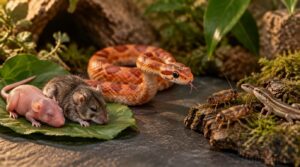
You’ve got two main groups of prey to think about for your hatchling. The right pick depends on your snake’s species and how well it eats. Here are the best prey options to choose from.
Frozen-Thawed Rodents
are your safest bet for hatchlings. They’re clean, convenient, and they won’t bite back.
Start with pinky mice. Match the Prey Size to your snake’s girth at its widest point. Thaw fully in the fridge, then warm the prey to body temperature before offering it. Warm prey smells right, and your hatchling will strike more readily.
Stick to a steady Feeding Schedule.
Earthworms, Insects, and Other Specialist Prey
Earthworms suit some hatchlings, but they’re specialist prey. Insects work too. Match prey size to your snake:
- Offer one or two small earthworms.
- Choose soft-bodied insects.
- Skip hard-shelled beetles.
- Place prey on a smooth surface.
- Keep feeding frequency steady.
Nymph roaches and crickets are common choices, usually four to six per feeding. Gut-load them first. You’ll boost your hatchling’s nutrition.
Choosing The Right Prey Size and Nutrition
You’ll feed your hatchling best when you get prey size and nutrition right. Three points below cover what matters most: matching prey to your snake’s species, keeping the size safe, and choosing whole prey. Work through each one and you’ll feed with confidence.
Species-Appropriate Prey

Your snake’s wild diet is your guide. Species-specific needs decide everything. Arboreal hatchlings want small vertebrates. Terrestrial ones take seasonal invertebrates. Offer prey variety within that range for a balanced diet, and use growth tracking to adjust prey size.
| Type | Prey |
|---|---|
| Arboreal | Small lizards |
| Terrestrial | Earthworms |
| Mollusk eaters | Snails |
Skip prey missing from the wild diet. It risks digestion problems.
Safe Prey Size
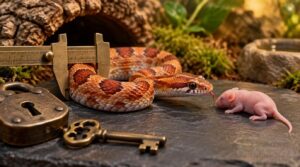
Prey size is like a key in a lock: it either fits or it jams. Keep prey width at 0.6 to 0.9x body width for your hatchling snake. A pair of digital calipers for measuring takes the guesswork out of finding your hatchling’s widest point and the prey’s thickness.
Prey size is like a key in a lock, so match it to your hatchling snake’s width, about 0.6 to 0.9 times its body
Measure the widest point, then match it. Pinky mice make smart prey selection early on. Corn snakes prefer 0.6 to 0.8x.
If regurgitation happens twice in a row, size down. Don’t wait.
Whole-Prey Nutrition
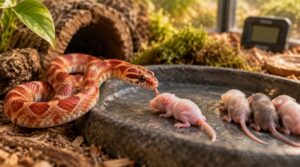
Why does a hatchling thrive on whole prey but struggle with a plain muscle cut? Because whole prey delivers everything at once. You’re feeding a growing body, so every bite matters.
- Calcium and phosphorus from intact bone
- Taurine from fresh organs
- Fat-soluble vitamins for steady growth rates
- Rotation to cover nutrient gaps
Match prey size to species specific needs.
How Often to Feed a Hatchling Snake
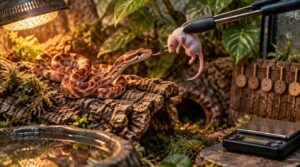
Feeding frequency decides how well your hatchling snake grows. You’ll start with a meal every 5 to 7 days during the first 2 to 3 weeks. That’s your baseline feeding schedule.
Once growth rates look strong, stretch the gap to every 7 to 10 days around weeks 4 to 6. Adjust based on these essentials:
- Smaller species need meals every 5 to 7 days.
- Larger species can wait 7 to 10 days.
- Wild-caught hatchlings get smaller, more frequent meals.
Weight gain tracking keeps you honest. Weigh weekly and aim for 5 to 12% gain. If growth stalls, tighten your feeding frequency. If weight drops more than 5%, review your husbandry. Pause during shedding, then resume your normal feeding schedule afterward.
Safe Feeding Tips and What to Do When a Hatchling Won’t Eat
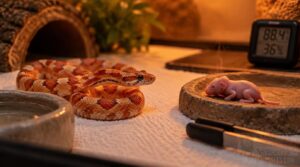
Even a perfect feeding schedule hits a snag now and then. When it does, stay calm and work through it.
Start with safety. Offer thawed, warmed prey in a secure space, with dim light and little handling. Never force the mouth open or push prey into the throat. That risks aspiration. A pair of long feeding tongs for snakes lets you dangle warmed prey gently from a distance, keeping your hands clear and handling minimal.
If you’re facing feeding refusal, check these three things in order:
- Confirm the shed is fully finished and the skin is clear.
- Check warmth and hydration, since a cold or thirsty snake won’t swallow.
- Review prey size and match it to your species-specific needs.
Change one variable at a time. Stop after repeated misses and retry later. If you see gaping, open-mouth breathing, or regurgitation, call a vet promptly.
Frequently Asked Questions (FAQs)
What should I feed hatchling snakes?
You’ll start with pinkie mice for most species, fully thawed. Some hatchlings need lizards, frogs, or insects. Match prey size to the midbody and keep feeding frequency steady. A balanced diet drives hatchling snake nutrition.
What to feed a newborn snake?
Most newborn corn snakes take their first meal within a week of shedding.
You’ll offer frozen-thawed pinky mice, matched to prey size and species-specific needs. Keep a steady weekly feeding schedule for a balanced diet.
How often should a baby snake be fed?
You’ll feed a hatchling snake every 5 to 7 days in most cases.
Stick to a steady feeding schedule, match prey size to your species, and offer a balanced diet that meets its nutritional requirements.
How do you feed a hatchling snake?
You’ll offer hatchlings frozen-thawed pinkie mice every 5 to 7 days, sized to half the snake’s girth. Warm the prey to body temperature, keep the enclosure setup secure and stable, and handle gently.
How do you feed a corn snake?
Picture a pencil-thin orange coil, tongue flicking at the air. Your corn snake hatchling wants frozenthawed pinky mice, fully warmed.
Match prey size to its widest girth. Keep the feeding schedule at every 5-7 days.
What do baby corn snakes eat?
Wondering what your baby corn snakes should eat? Start with frozenthawed prey. Pinky mice are the usual first meal, then hoppers as your snake grows. Match prey size to girth, and stick to your feeding schedule.
What do Baby hognose snakes eat?
What does a tiny hognose actually eat? Your hatchling baby snakes take pinky mice, fuzzies, small lizards, and earthworms. Keep the baby hognose snake diet species-specific, sized to your snake’s head, and stick to a steady feeding schedule.
Do hatchling snakes eat mice?
Yes, many can. Your hatchling snake will often take pinky mice as a first meal, but species-specific needs matter. Check a snake nutrition guide, then set a feeding schedule. Some species still refuse rodents entirely.
How do you feed a snake in a tank?
Ready to feed your hatchling the right way? Warm the thawed prey to body temperature, grip it with tongs, and wiggle it near the snake’s head at the front of the tank. Let the strike trigger feeding response.
How Can You Tell the Age of a Baby Snake?
Can length and weight reveal age? Not exactly. Every hatchling snake grows differently, so baby snake care needs context.
Use weight tracking, growth milestones, and shed counts; ask a reptile vet before feeding schedule adjustment.
Conclusion
Worried that feeding a tiny snake is too complicated? It isn’t. The best snake food for hatchlings comes down to three habits: match the prey to the species, size it no wider than the thickest part of the body, and offer frozen-thawed whole prey on a steady schedule.
Stay patient when a hatchling refuses a meal. Check the temperatures, give it about a week, and try again. Calm, consistent feeding builds a strong, healthy snake.