This site is supported by our readers. We may earn a commission, at no cost to you, if you purchase through links.

Most ball pythons aren’t aggressive—they’re scared. That tight coil, the sudden strike, the smeared musk across your hand: none of it is attitude. It’s a stress response, and missing that distinction costs you trust you’ll spend months rebuilding.
Ball python body language stress follows predictable patterns once you know what to look for, but those signals are easy to misread when you’re new to the species.
A snake refusing food looks stubborn; it’s usually overwhelmed. One pressing endlessly against the glass looks curious; it’s often telling you something’s wrong in the enclosure.
Understanding what your python is actually communicating—and why—puts you back in control.
Table Of Contents
Key Takeaways
- Ball python stress isn’t attitude—tight coiling, striking, and musking are defensive responses to fear, and misreading them as aggression sets back trust-building by months.
- Environmental problems like wrong temperatures, poor hide placement, and household vibrations cause most stress, so fix the enclosure before assuming a handling issue.
- Behavior crossing into open-mouth breathing, persistent food refusal, or abnormal shedding isn’t a patience problem—it’s a vet call.
- Your snake maps its world through scent and routine, so inconsistent handling schedules and enclosure changes are silent stressors that compound quickly.
Key Stress Signals in Ball Pythons
Ball pythons can’t tell you when something’s wrong — but their bodies do. Once you know what to look for, signals are hard to miss.
Spotting early red flags — like constant hiding or glass surfing — is easier once you understand the signs your ball python feels insecure in its enclosure.
Here are the key stress signs every owner should recognize.
Defensive Balling and Coiling
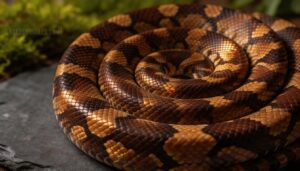
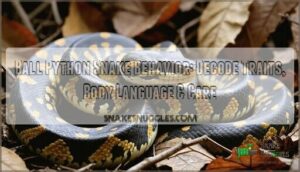
When a ball python pulls into a tight ball, it’s not being dramatic — it’s executing its most reliable defense. Head shielding mechanics kick in immediately: thick muscle coils protect the eyes, jaw, and neck from any perceived threat. Looming threat triggers, such as fast overhead movement or sudden handling, accelerate this response.
Give space. Forcing the snake open only drives ball python stress escalation higher.
Hissing, Musking, and Striking
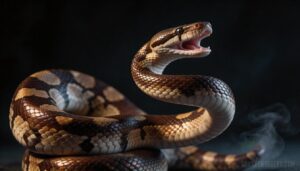
When coiling fails to deter you, three signals escalate fast:
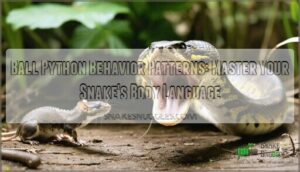
- Hissing — glottis airflow forced out sharply; a warning sound mechanism designed to say back off, not bite.
- Musking — cloacal secretion released near the tail; chemical deterrence, pure and simple.
- Striking — the S-shaped coil locks, then lunges.
Each is a defensive signal timing your response. Respect it early.
Rapid Movements and Glass Surfing

Glass surfing — repetitive wall-pressing, often looping side to side — sits a rung above musking on the stress escalation ladder. It peaks during nighttime activity peaks, when your snake is naturally alert.
Inadequate visual barriers, harsh lighting levels, or substrate texture mismatches can all trigger it. Keep a behavior log.
Rapid tongue flicking alongside this movement signals the environment needs adjusting now. An unfamiliar enclosure stress can trigger this behavior.
Refusal to Eat and Weight Loss
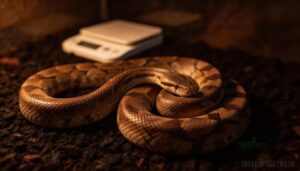
Refusal to eat often follows the same stress cascade you just saw on the glass. A single missed meal isn’t alarming — a downward trend is.
Watch for:
- Shrinking midbody width — early body condition monitoring catches nutritional deficit before it compounds.
- Measurable weight loss across consecutive weigh-ins — weight tracking methods reveal what eyes miss.
- Refeeding protocols become necessary after prolonged refusal, carrying real metabolic impact.
Decoding Ball Python Body Language
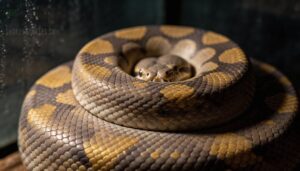
ball python can’t tell you when something’s wrong — but its body already is. Every posture, every flick of the tongue, every color shift carries real information if you know how to read it.
Once you learn to read those signals, it also helps to know that ball python morph temperament variations can influence how your snake expresses stress or curiosity in the first place.
Here’s what to watch for.
Relaxed Vs. Tense Posture
Your python’s posture tells you everything — if you know what to look for. A relaxed ball python shows loose muscle tension, fluid body firmness, and slow relaxed movements, often stretching out or curving gently.
Stress signals flip that picture fast: tight coiling, rigid head alignment, labored breathing patterns, and stiff defensive posture replace that ease. Body firmness and movement speed are your clearest real-time reads.
Tongue Flicking and Head Movement
Tongue flicking isn’t random — it’s your snake actively reading the room. Through vomeronasal integration, each flick delivers chemical gradient tracking data directly to the brain’s scent-analysis center.
Watch for these cues:
- Rapid flick frequency cues signal stress or unfamiliar stimuli
- Head angling dynamics help the snake triangulate scent direction
- Snout proximity sampling increases near surfaces or your hand
- Head-weaving paired with flicking often precedes defensive behaviors
- Calm, steady flicks mean curiosity — not a threat
Changes in Color and Shedding Behavior
Color tells you a lot before behavior does. A pre-shed color shift — dull, milky skin replacing that glossy sheen — is normal.
Eye clouding indicators, like that foggy blue tint, signal that ecdysis is starting.
But stress accelerates shedding complications: low humidity impacts shedding quality directly, leaving dull patches of skin or retained fragments.
Poor shed quality assessment reveals chronic husbandry problems, not bad luck.
Excessive Hiding or Avoidance
Hiding is normal — excessive hiding isn’t. difference lies in pattern.
Watch for Hide Preference Patterns: the snake always picks the same hide, never rotates zones. Entrance Retreat Timing — it surfaces briefly, then vanishes the moment you approach.
Edge-Only Movement, Feeding Concealment, and rising Startle Retreat Frequency are escalating stress signals on the ball python stress escalation ladder.
Don’t ignore them.
Environmental Causes of Stress
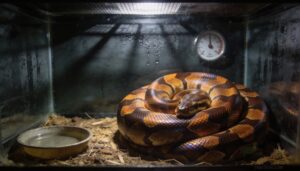
Most ball python stress isn’t random — it traces back to something specific in the enclosure. Get environment wrong, and no amount of careful handling will fix the problem.
Here are the four most common environmental triggers to check first.
Temperature and Humidity Issues
Your enclosure is basically a thermostat with consequences. Gradient stability matters because a hot spot running too high forces your snake away from it entirely — wrecking digestion and triggering pacing. Nighttime cooling below 75°F compounds this fast.
Humidity spikes from poor ventilation balance leave substrate wet, not humid. Aim for 50–60% with consistent airflow. Temperature and humidity management isn’t optional — it’s baseline care.
Inadequate Hides and Enclosure Size
Think of your enclosure layout as a map your snake mentally memorizes. Without adequate hide quantity — at minimum one warm-side and one cool-side hide with proper overhead cover — stress indicators appear quickly.
Hide placement matters equally; a hide blocked by substrate or clutter effectively doesn’t exist.
Small enclosure footprints eliminate escape pathways between refuges, forcing repeated crossings through open space.
Vertical cover and multiple hiding spots aren’t extras. They’re requirements.
Noise, Vibration, and Household Activity
Ball pythons sense the world through vibration — their jaw and belly scales act as ground-based seismographs. Footstep impulse noise, appliance vibration effects from spin cycles, and bass speaker disturbance all register as environmental stressors before you hear a thing.
Ball pythons feel your footsteps before you make a sound
Four common noise-induced stress triggers:
- Washing machine spin cycles transmitting through enclosure stands
- Door slam startles causing sudden defensive coiling
- Ceiling fan airflow disrupting preferred microclimates
- Subwoofer bass rattling enclosure surfaces continuously
Frequent Handling and Enclosure Changes
Your snake doesn’t reset like a device — it maps its world through scent, routine, and thermal familiarity. Frequent handling outside predictable handling times disrupts digestion and rest cycles, triggering defensive body language fast.
Enclosure changes compound this: swapping hides, replacing substrate, or relocating the setup break scent retention strategies the snake relies on for security. Schedule consistency and minimal substrate disruption aren’t optional — they’re baseline care.
Handling Techniques to Reduce Stress
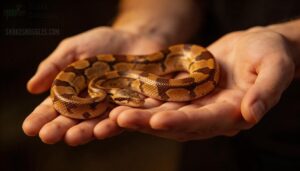
How you pick up and hold your ball python matters more than most people realize. Poor technique is one of the fastest ways to undo weeks of careful trust-building.
Here’s what to get right.
Safe Support and Grip Methods
How you hold your python matters as much as when you hold it.
Use Full Body Contact — support the midsection, never the neck or tail alone. Keep a Wrist Neutral Position with Hooked Thumb Support to avoid over-gripping. Friction Management means dry hands, steady surfaces. Steady Motion prevents defensive reflexes. Proper support techniques when holding snakes build trust — don’t hold your ball python too tight.
Handling Duration and Frequency
Once your grip is solid, the next variable is time. Session Length Guidelines matter more than most keepers expect — start at 15–30 minutes, maximum. Recovery Interval Timing is equally important; give your snake a full day between sessions.
Cut frequency during Pre-shed Handling Limits and honor the Post-feeding Rest Period of 48–72 hours. Overhandling compounds stress fast.
Frequency Adjustment Strategies mean reading your snake’s signals across multiple sessions, not just one.
Signs to Stop Handling Immediately
Some signals aren’t subtle — they’re your snake telling you to stop right now.
Mouth gaping, hissing, musking, and a defensive striking posture mean handling is over.
Tail shaking, rapid escape attempts, and cloudy eyes — especially near shed — signal serious distress.
A sharp bite attempt isn’t aggression for no reason.
Read it as communication, return the snake immediately, and reassess.
Gradual Acclimation and Bonding Tips
Bonding with your ball python isn’t forced — it’s earned through patience.
Start with a Quiet Approach: no sudden overhead hands, no prolonged staring.
Let choice interaction guide you.
- Give 24 hours of undisturbed quiet after arrival
- Follow a Predictable Schedule with Consistent Feeding times
- Always leave an Escape Route inside the enclosure
Gradual acclimation and socialization of new snakes builds trust — not speed.
When Stress Signals Mean Health Risks

Some stress signals are just that—stress.
But others are your snake’s way of telling you something is medically wrong.
Here’s what to watch for when behavior crosses the line into a health concern.
Respiratory Signs and Open-mouth Breathing
Open-mouth breathing isn’t dramatic until it is.
When your ball python shifts from steady breathing to visible gasping episodes, labored breathing signs, or respiratory noise indicators like wheezing — that’s a respiratory infection in reptiles unfolding in real time.
Mucus discharge signs around the mouth confirm it.
Mouth breathing patterns and labored effort during rest aren’t stress signals to monitor — they’re emergencies.
Call your reptile vet immediately.
Persistent Refusal to Eat
Skipping a meal isn’t always a red flag — but skipping several is.
Watch for these stress signals that make refusal serious:
- Prey Size Mismatch or wrong Prey Temperature triggers immediate rejection
- Enclosure Scent Changes disrupt feeding cues and familiarity
- Feeding Schedule Timing misalignment suppress appetite
- Water Availability issues compound weakness alongside refusal
Progressive weight loss alongside consistent refusal? That’s a sign of health problems in ball pythons requiring veterinary evaluation — not patience.
Abnormal Shedding or Coloration
Your snake’s skin is a health report — read it.
Stress signals often surface in the shed. Patchy shedding, excessive flaking, and color darkening aren’t cosmetic quirks; they’re diagnostic clues worth tracking.
| Sign | Likely Cause | Action |
|---|---|---|
| Dull patch of skin post-shed | Low humidity | Raise to 75% during shed |
| Red spots or dark marks | Substrate irritation | Check hide texture and substrate |
| Pattern clarity loss | Repeated incomplete sheds | Warm soak; vet eval if recurring |
Interpreting ball python body language through shedding complications means connecting skin changes to environment — not treating each issue in isolation. Persistent shedding problems signal chronic stress, not bad luck.
When to Consult a Reptile Vet
Some signs don’t wait for a scheduled visit. Book a veterinarian consultation immediately if you notice active bleeding, swollen jaw, nasal discharge, or eye discharge — these are emergency indicators requiring veterinary care, not a watch-and-see situation.
Prolonged lethargy, persistent refusal to eat, or open-mouth breathing carry the same urgency.
Don’t second-guess early stress signs; identifying stress behaviors in ball pythons early keeps manageable problems from becoming emergencies.
Frequently Asked Questions (FAQs)
How can you tell when a ball python is stressed?
Your ball python tells you everything — you just have to learn the language.
Watch for early stress signals like Eye Cloudiness, Activity Rhythm Shift, Skin Color Dullness, Mucus Discharge, and behavioral cues that break its normal routine.
How do I know if my ball python is angry?
Tight coiling, hissing, musking, striking — these are your clearest signals. Defensive postures and elevated breathing rate confirm it. An "angry" ball python is a stressed one. Recognize it fast.
Can ball pythons recognize their owners scent?
Yes — through olfactory memory and scent conditioning.
Your ball python uses tongue-flicking to transfer airborne molecules to the Jacobson’s organ (vomeronasal organ), building keeper scent familiarity over repeated exposure. Scent bonding, not recognition in the human sense.
Do ball pythons show stress during breeding season?
Absolutely. Hormonal fluctuations during breeding season can trigger real stress signals — defensive coiling, hissing, refusal to eat.
Recognizing ball python body language during this period is essential for smart stress reduction strategies.
How does age affect a ball pythons stress tolerance?
Age shapes how a ball python manages stress at every stage.
Juvenile stress response is sharper and more reactive.
Adult adaptation builds with routine.
Senior resilience fades — age-related appetite shifts and age-driven shedding sensitivity rise.
Can cohabitation with other snakes increase stress levels?
Cohabitation almost always raises stress.
Space Competition, Heat Spot Conflict, and Hide Competition force one snake into a constant subordinate state — triggering defensive body language, Feeding Interference, and Parasite Transmission risks that no solitary species needs.
Conclusion
Investigate the truth of a stressed ball python’s behavior, and you’ll find it’s not attitude, but a cry for help. Recognizing ball python body language stress signals enables you to address issues before they escalate.
By tuning into your python’s subtle cues, you can create a safer, more nurturing environment. This understanding fosters trust, allowing your python to thrive.
With patience and attention, you can transform stress into a harmonious bond, enriching both your lives.
- https://www.beabetterhitter.com/coiling-and-uncoiling/
- http://www.smuggled.com/BalDef1.htm
- https://www.grassrootscoaching.com/uefa-coaching-coach-defensive-compactness/
- https://repository.up.ac.za/server/api/core/bitstreams/927f2d51-4d9a-4c75-9da0-0ee0444ac591/content
- https://www.ncl.ac.uk/academic-skills-kit/assessment/assignment-types/structuring-a-science-report/