This site is supported by our readers. We may earn a commission, at no cost to you, if you purchase through links.

Most people picture snakes as coiled threats, ready to strike at the slightest disturbance. Ball pythons couldn’t be further from that image.
A healthy adult will spend most of its day tucked inside a hide, breathing slowly, completely unbothered by the world outside. When something does startle them, their first instinct isn’t aggression—it’s to curl into a tight, armored ball with their head tucked safely at the center.
That defensive move alone tells you a lot about their character. Understanding ball python’s peaceful nature means looking at the biology, behavior, and environment that keep these snakes so consistently calm.
Table Of Contents
- Key Takeaways
- Why Ball Pythons Feel So Calm
- Natural Behaviors Behind Their Peacefulness
- Body Language of a Relaxed Snake
- Handling Habits That Build Trust
- Enclosure Setup for Steady Temperament
- Causes of Defensive Ball Python Behavior
- Top 10 Snake Books and Products
- 1. Ball Python Care Guide for Beginners
- 2. Ball Python Manual CompanionHouse Guide
- 3. Ball Python Owners Guide Complete Caring Breeding
- 4. Ball Python Care Logbook
- 5. Ball Python Care and Raising Guide
- 6. Ball Python Owner Manual
- 7. Ball Python Captivity Guide
- 8. Königlicher Python Handbuch für Anfänger und Experten
- 9. Coastal Taipan Pet Snake Guide
- 10. ANABIUP Realistic Fake Snake Prank Set
- Frequently Asked Questions (FAQs)
- Conclusion
Key Takeaways
- Ball pythons curl into a tight ball when stressed instead of striking, which tells you their first instinct is always self-protection, not aggression.
- Your snake’s enclosure does most of the work — proper temperature zones, humidity between 50–60%, and a snug hide in each zone — keep stress low before you ever pick it up.
- Short, consistent handling sessions of 5–10 minutes, two to three times a week, build more trust than long or frequent ones ever will.
- Watch for loose coils, slow breathing, and calm tongue flicks — these tell you your snake is comfortable, while tight balling, hissing, or musky scent mean it’s time to back off.
Why Ball Pythons Feel So Calm
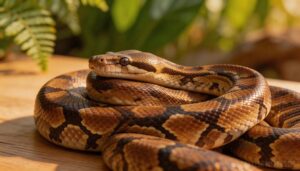
Ball pythons have a reputation for being genuinely easy to be around, and that reputation is well earned. Their calm nature comes from a mix of instinct, biology, and how they’re wired to respond to the world.
Their easygoing temperament is part of why so many first-time owners fall in love with them—and it’s well worth understanding what makes ball pythons so easy to handle before bringing one home.
Here’s what actually makes them so peaceful.
Naturally Docile and Slow-moving Demeanor
Ball pythons aren’t lazy — they’re just built for calm. Their metabolic efficiency means they conserve energy naturally, resulting in slow, deliberate movement.
Combine that with strong stress resilience and territorial minimalism, and you’ve got a snake that rarely feels threatened.
- Adults rest quietly for hours without distress
- Sensory perception stays measured, not reactive
- Hormonal regulation keeps mood steady
- Docile nature shows in unhurried movement
- Placid temperament improves with age
Curling Into a Ball Instead of Striking
That calm nature goes even further when stress hits. Instead of striking, a ball python defaults to coiling into a tight defensive ball — tucking its head safely inside.
When stress strikes, a ball python’s instinct isn’t to fight — it’s to curl inward, head tucked safely inside a tight defensive ball
It’s a smart evolutionary adaptation, using muscle activation patterns to form a compact shield. This predator deterrence mechanism conserves energy and triggers a sensory focus shift inward.
That docile nature holds even under pressure.
Low Bite Propensity Under Normal Conditions
Even under pressure, biting is rarely on the table for a healthy ball python. Their nonaggressive, docile nature means they rely on calm body language — still posture, averted gaze, minimal tongue flicking — rather than teeth.
What keeps them this way?
- Gentle human presence lowers their threat perception naturally
- Predictable environmental cues support stable hormonal balance
- Consistent routines signal safety, not danger
- Gentle handling techniques reinforce calm temperament over time
Solitary Instincts That Avoid Confrontation
Their solitary nature runs deep. Ball pythons don’t mark territory or seek company — they rely on Solo Foraging Strategy, quiet Low Activity Patterns, and Camouflage Utilization to stay safe.
Passive Communication replaces confrontation entirely. That nonaggressive, docile temperament isn’t trained; it’s wired in.
This stress reduction through avoidance is exactly what makes ball python temperament so reliably calm.
Natural Behaviors Behind Their Peacefulness
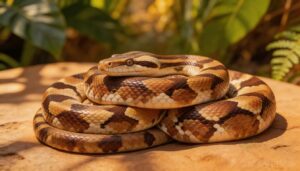
Ball pythons aren’t calm by accident — it’s built into how they naturally live. daily habits, instincts, and personality quirks all work together to keep them peaceful.
Here’s a closer look at the behaviors that make them such easygoing snakes.
Nocturnal Activity and Quiet Daytime Resting
Your ball python isn’t being lazy during the day — it’s following its natural circadian rhythm. These peaceful reptiles are nocturnal, conserving daytime energy and peaking in nighttime activity. Their low light vision and infrared sensing make them expert nocturnal foragers after dark.
- Activity spikes at dusk, then settles
- Daytime means rest, not illness
- Nighttime exploration is completely normal
- Low light vision guides their movement
- Docile and calm days follow active nights
Preference for Hiding in Secure Spaces
Hiding isn’t avoidance — it’s instinct. Your ball python craves secure hide spots the way you crave a quiet room after a long day. A solid Hide Placement Strategy makes all the difference.
| Hide Feature | Why It Matters | Best Practice |
|---|---|---|
| Hide Access Design | Allows full-body curl without constriction | Match hide width to snake’s girth |
| Thermal Hide Preference | Facilitates thermoregulation and calm temperament | Place warm hide at 29–32°C zone |
| Substrate Moisture Levels | Eases shedding, reduces irritability | Use damp coconut husk underneath |
Visual Barrier Benefits reduce perceived threats, reinforcing that docile temperament owners love. Environmental enrichment through properly placed hiding spots keeps stress low and appetite steady.
Calm Behavior When Left Undisturbed
Watch a ball python during the day and you’ll see the definition of Low Movement Frequency — barely a shift. Their Evening Activity Rhythm means daylight hours belong to deep rest. That calm and docile, couch potatoes’ reputation is well-earned.
Signs your snake is truly at ease:
- Steady breathing with no rapid chest movement
- Loose coil near hiding spots
- Minimal tongue flicks when undisturbed
- Human Presence Tolerance — staying still even when you’re nearby
Personality Differences From Shy to Curious
Not every ball python has the same personality — some are natural couch potatoes, others have a curious yet gentle nature.
| Trait | Shy | Curious |
|---|---|---|
| Tongue Flick Frequency | Low | High |
| Novel Object Reaction | Retreats | Investigates |
| Exploration Motivation | Minimal | Active |
| Enrichment Preference | Hides | Open space |
| Social Tolerance | Low | Moderate |
Genetics shape a lot of this ball python’s temperament from the start.
Pairing those natural tendencies with a well-matched environment makes all the difference, so brushing up on ball python housing basics helps you set the stage for a calmer, more confident snake.
Body Language of a Relaxed Snake
Reading ball python’s body language is one of the most useful skills you can build as an owner. A relaxed snake sends clear, consistent signals — you just need to know what to look for.
Here are the key signs that tell you your python is comfortable and content.
Loose Coils and Smooth, Flat Scales
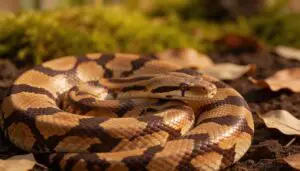
One of the clearest relaxed posture signs is how your ball python arranges itself at rest. Loose coil indicators include coils that settle into a soft, rounded heap — no tension, no tight spirals.
Smooth flat scales lie evenly across the body, reflecting your snake’s calm body rhythm and docile nature. That flat scale texture signals genuine comfort.
Loose coil position means your ball python temperament is exactly where it should be.
Slow, Steady Breathing and Stable Posture

Breathing tells you everything. A calm ball python breathes slowly — you’ll see gentle throat and belly movement, nothing rapid or forced.
That respiratory calm pairs with posture stability: the body holds a smooth curve, head resting close without restless repositioning. Body stillness between small natural adjustments signals genuine breath harmony.
This steady breathing and loose coil position confirm your ball python’s temperament is right where it should be.
Regular Feeding and Gentle Enclosure Exploration

A steady feeding schedule tells you a lot. When your ball python accepts warmed prey every 7 to 14 days without hesitation, that’s a genuinely relaxed snake.
After eating, give it a full digestive rest period — no handling, no disturbance.
On calm evenings, you’ll notice gentle enclosure exploration, slow deliberate head movements, checking familiar enrichment zones. That curiosity is pure contentment.
Early Stress Signs Owners Should Notice
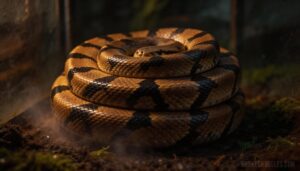
But not every evening looks that peaceful.
Watch for tight balling that happens sooner than usual, rapid breathing, or air clicking during handling — these are clear stress signs. Rubbing substrate repeatedly or releasing a musky scent signals real discomfort.
Recognizing stress indicators in snakes early means you can adjust before defensive behavior becomes a pattern.
Handling Habits That Build Trust
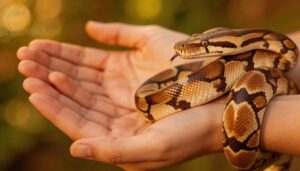
Building trust with a ball python comes down to how you handle them, not just how often. few simple habits make a big difference in how relaxed your snake feels around you.
Here’s what actually works.
Approaching From The Side With Slow Movements
When you’re ready to pick up your ball python, think of it like approaching a cat that doesn’t know you yet — slow, non-threatening win every time.
- Use Side Angle Entry: come from the side, never straight overhead
- Apply Gentle Hand Motion to avoid startle responses
- Practice Visual Cue Management by staying low and steady
- Focus on Air Disturbance Minimization — fast hands = defensive coiling
- Use Warm Hand Contact to reduce temperature shock
This low-stress handling approach builds real trust over time.
Supporting The Full Body Without Squeezing
Once you’re close, how you hold matters just as much as how you approach. Place one hand under the mid-body and use your other hand to steady the front third. This belly pressure distribution keeps the weight even — no single spot bears all the stress.
| What to Do | Why It Helps |
|---|---|
| Mid-body support first | Prevents spine-unfriendly twisting |
| Open palms, no gripping | Gradual grip adjustment reduces defensive coiling |
| Support along belly scales | Even weight distribution calms muscle tension |
Spine-friendly hand placement is the heart of gentle handling techniques for beginner snake owners.
Keeping Sessions Short and Consistent Each Week
Consistency matters more than duration. A Weekly Handling Schedule — same Fixed Session Time, same calm pace — teaches your ball python what to expect. Start with Session Duration Limits of 5–10 minutes, two to three times weekly.
A solid Pre Session Check builds trust fast:
- Confirm the snake isn’t in a shed
- Verify it hasn’t eaten within 48 hours
- Check for calm, loose body posture
- Warm your hands first
- Move slowly from the side
Your Post Session Routine — returning the snake to its favorite hide — helps it re-settle quickly, reinforcing Gentle handling techniques for beginner snake owners.
Avoiding Handling After Meals or During Shedding
After your ball python eats, give it a full 48-hour Post-Meal Rest before any handling. Picking it up sooner risks regurgitation — and that’s hard on the snake’s body.
During the Molting Period Caution applies too: cloudy eyes and loose skin mean hands-off time. Observation Over Interaction works best here. Watch from a distance, keep things quiet, and let the shedding process in pythons complete naturally.
Stopping When Hissing, Tight Coiling, or Escape Attempts Appear
Your snake doesn’t lie — when hissing, tight coiling, or escape attempts appear, that’s Signal Recognition in action. Stop immediately.
- Immediate Release — return it gently to the enclosure
- Gentle Repositioning — guide, never force or unwrap
- Stress Mitigation — let it choose its own hide
- Handler Patience — wait before trying again
Consistent stopping builds real trust over time.
Enclosure Setup for Steady Temperament
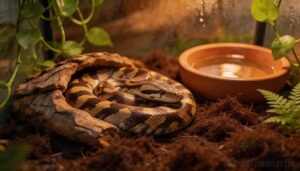
Your ball python’s calm personality starts long before you ever pick it up. The right enclosure does a lot of the heavy lifting — keeping stress low and confidence high.
Here’s what your setup needs to get right.
Warm and Cool Zones for Proper Thermoregulation
Think of your enclosure as a two-room apartment — one warm, one cool. That’s Temperature Gradient Design in action.
| Zone | Temperature |
|---|---|
| Basking Spot Placement | 31–34°C |
| Warm Side Ambient | 28–31°C |
| Cool Side | 24–28°C |
| Nighttime Temperature Drop | 3–5°C lower |
| Thermostat calibration check | ±1–2°C accuracy |
Proper Heat Source Types — ceramic emitters or heat mats — keep your snake moving naturally between zones.
Humidity Levels That Support Comfort and Shedding
Humidity is easy to overlook — until your snake struggles through a shed.
Keep your Ideal Humidity Range at 50–60% daily. When eyes turn cloudy, give a Shedding Humidity Bump to around 70%.
A Microclimate Shed Box with moist substrate helps without soaking the whole enclosure.
Water Bowl Evaporation naturally raises levels, while Ventilation Humidity Balance keeps things from turning swampy.
Multiple Hides to Reduce Anxiety and Defensiveness
A secure hide isn’t optional — it’s your snake’s entire sense of safety.
- Hide Placement: Put one hide in the warm zone and one in the cool zone
- Hide Size: It should fit snugly, with its body touching all sides
- Hide Entrance: Smaller openings encourage full retreat and reduce exposed body length
- Hide Quantity: More hiding spots mean less stress when minor disturbances happen
Quiet Lighting Cycles and Low-noise Surroundings
Beyond hides, your lighting and noise setup matter more than most people realize.
Use a 12-hour Light Cycle Timing schedule with Gradual Light Fade transitions — about 15 to 30 minutes — to avoid startling your ball python. Diffused Overhead Lighting keeps shadows soft and steady.
For Ambient Sound Dampening, place the enclosure away from foot traffic and use Quiet Water Pumps. Consistent, calm surroundings are solid stress reduction strategies for any captive reptile.
Secure, Escape-proof Housing With Suitable Substrate
Your enclosure is only as calm as it’s secure. Locking latches and escape-proof seals keep your ball python safely inside, while mesh ventilation maintains steady airflow.
For substrate selection for ball pythons, cypress mulch or coconut fiber work well — both are inert bedding options that retain moisture without growing mold. Proper ball python husbandry starts with getting these basics right.
Causes of Defensive Ball Python Behavior

Even the calmest ball python can shift into defensive mode when something feels off in its world. Several common triggers — from temperature problems to genetics — can turn a relaxed snake into a tight, hissing ball.
Here’s what actually causes that behavior.
Improper Heat or Humidity Creating Stress
When the heat or humidity is off, your ball python feels it quickly. Temperature fluctuations from unregulated heat sources create thermal gradient instability, forcing constant repositioning.
Hot spot risks push stress even higher.
Humidity imbalance — too dry or too wet — disrupts shedding and damps bedding, raising stress indicators in snakes.
Poor ventilation issues trap warm, moist air, worsening moldy substrate and skin irritation.
Excessive Handling or Sudden Enclosure Changes
Too much handling piles up stress fast. Handling frequency impact is real — ball pythons need time to settle between sessions. Overhandling disrupts their rest cycles and triggers repeated defensive responses.
Sudden substrate scent disruption, temperature shift stress, or lighting disturbance effects hit just as hard.
Even relocation acclimation challenges from rearranging hides can spike stress signs. Keep changes gradual and handling frequency recommendations modest.
Illness, Dehydration, or Shedding Discomfort
When your ball python suddenly turns defensive, illness or discomfort may be the real culprit. Respiratory infection signs — nasal discharge, open-mouth breathing, appetite decline — signal something’s wrong.
Watch for dehydration symptoms like dry skin and urine color changes. During the shedding blue phase, cloudy eyes reduce vision, so hiding and food refusal are normal.
Consistent temperature and humidity control, health monitoring, and dehydration prevention keep shedding issues and stress indicators in check.
Juvenile Energy Versus Calmer Adult Behavior
Young ball pythons bring a burst of Juvenile Play Behavior and active exploration to every interaction — their higher metabolic rate keeps them curious and quick. As Hormonal Maturation Effects settle in, Adult Resting Duration grows longer and movement slows.
Building trust and bonding with reptile pets works better when you match your handling style to their age.
Genetics and Captive Bloodlines Affecting Temperament
Some ball pythons are just born calmer than others — and that comes down to Genetic Temperament and Bloodline Genetics. Through Selective Breeding, captive lines have developed Heritable Calmness that shapes how they respond to handling.
- Lineage Variation affects stress reactivity and exploration style
- Genetic influence on temperament interacts with early handling experiences
- Breeding effects on temperament of ball pythons can reduce defensive responses
- Behavioral differences among ball python morphs reflect genetic traits related to snake friendliness
Top 10 Snake Books and Products
If you want to go deeper with your ball python care, a good book or two goes a long way. The right resources cover everything from daily handling to long-term health, all in one place.
Here are ten books and products worth checking out.
1. Ball Python Care Guide for Beginners
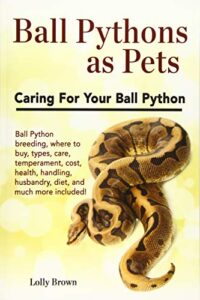
If you’re just starting out, this 132-page guide from NRB Publishing is worth keeping nearby. It walks you through the basics — temperament, handling, diet, health, and housing — in plain language that doesn’t overwhelm you. It’s compact and beginner-friendly, covering what most new owners actually need to know.
Just keep in mind that it stays at an introductory level, so experienced keepers may find it thin on detail. For a first snake, though, it’s a solid, practical starting point.
| Best For | New snake owners — especially first-timers who want a friendly, no-fluff intro to keeping a ball python happy and healthy. |
|---|---|
| Format | Paperback |
| Language | English |
| Publisher | NRB Publishing |
| Target Audience | Beginners |
| Price Range | Mid-range |
| Snake Focus | Ball Python |
| Additional Features |
|
- Covers all the basics in one place — diet, handling, temperament, and housing
- Easy to read, even if you’ve never owned a reptile before
- Compact enough to flip through quickly when you need a fast answer
- Stays pretty surface-level, so seasoned keepers won’t find much new here
- A few editing issues reported, like typos and missing words
- Most of the info is available free online if you’re willing to dig for it
2. Ball Python Manual CompanionHouse Guide
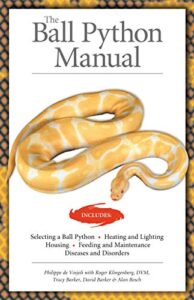
This slim 88-page guide from CompanionHouse Books covers the essentials without overwhelming you. Written by experienced herpetologists, it walks through selection, acclimation, handling, housing, and morphs — everything a new owner genuinely needs.
It’s practical, focused, and easy to read in an afternoon. That said, it doesn’t go deep on shedding or specialized health topics, so experienced keepers may want something more.
For beginners, though, it’s a reliable introduction that covers the ground-level knowledge you’ll actually use.
| Best For | New ball python owners who want a clear, no-fluff introduction to caring for their first snake. |
|---|---|
| Format | Paperback |
| Language | English |
| Publisher | CompanionHouse Books |
| Target Audience | Beginners |
| Price Range | Budget |
| Snake Focus | Ball Python |
| Additional Features |
|
- Written by real herpetologists, so the advice is solid and trustworthy
- Covers all the basics — selection, housing, handling, and morphs — in one place
- Short enough to read in an afternoon without feeling like homework
- No information on shedding, which is a pretty common concern for new owners
- Health care coverage is thin, so you’ll likely need a second resource
- Too basic for experienced keepers who want deeper, more technical guidance
3. Ball Python Owners Guide Complete Caring Breeding

At just 56 pages and $12.97, this paperback punches above its weight for first-time owners. It covers the core bases — housing, diet, handling, health, and basic breeding — in plain language that doesn’t require a biology degree.
Short chapters with end-of-chapter summaries make it easy to revisit specific topics.
It won’t satisfy experienced keepers looking for deep dives, but if you’re just starting out and want a reliable, no-fuss reference, it’s worth keeping on the shelf.
| Best For | First-time ball python owners who want a simple, no-nonsense starting point before diving into deeper resources. |
|---|---|
| Format | Paperback |
| Language | English |
| Publisher | CreateSpace |
| Target Audience | Beginners |
| Price Range | Budget |
| Snake Focus | Ball Python |
| Additional Features |
|
- Covers all the basics — housing, diet, health, and breeding — in plain, easy-to-follow language
- Short chapters with summaries make it quick to flip back to what you need
- Lightweight and affordable at $12.97, easy to keep handy during enclosure setup
- At 56 pages, it skims over some topics that deserve more detail
- A few facts (like minimum tank size) have drawn pushback from experienced keepers
- Typos and grammar issues pop up here and there, which can break the flow
4. Ball Python Care Logbook

Books give you knowledge, but day-to-day care is where it really counts. That’s where this 120-page logbook earns its place.
It’s built specifically for ball python owners — with sections for feeding records, weight tracking, shed notes, medication history, and expense logs.
The 6×9 paperback fits easily on a shelf or beside the enclosure.
If you’ve ever forgotten when your snake last ate or shed, this keeps everything in one spot, no guesswork needed.
| Best For | Ball python owners who want a simple, all-in-one way to track their snake’s health, feeding, and care history. |
|---|---|
| Format | Paperback |
| Language | English |
| Publisher | Independent |
| Target Audience | All owners |
| Price Range | Budget |
| Snake Focus | Ball Python |
| Additional Features |
|
- Covers everything in one place — feeding, weight, sheds, meds, and expenses
- Compact 6×9 size is easy to keep right next to the enclosure
- Works for beginners and experienced keepers alike
- 120 pages may run out fast if you’re a detailed note-taker
- English only, so it won’t work for everyone
- No care guidance included — it’s a logbook, not a care guide
5. Ball Python Care and Raising Guide
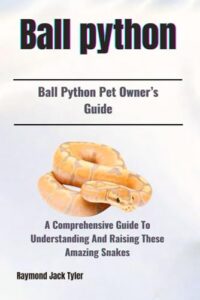
Once you’ve got the daily tracking down, it helps to have a solid care reference nearby. This guide covers the full picture — enclosure setup, feeding schedules, handling tips, and basic health monitoring.
It’s the kind of book that answers the question before you even think of searching online. At 82 pages and under $10, it’s compact enough to actually read cover to cover. New owners especially find it useful for getting the fundamentals right from day one.
| Best For | First-time ball python owners who want a straightforward, no-fluff guide to get their setup right from the start. |
|---|---|
| Format | Paperback |
| Language | English |
| Publisher | Independent |
| Target Audience | Beginners |
| Price Range | Budget |
| Snake Focus | Ball Python |
| Additional Features |
|
- Covers all the essentials in one place — enclosure, feeding, handling, and health — so you’re not hunting across a dozen websites
- At 82 pages and under $10, it’s easy to read start to finish without feeling overwhelmed
- Practical handling and body-language tips make a real difference in keeping both you and your snake comfortable
- 82 pages means advanced topics like detailed veterinary care or serious breeding programs won’t get much depth
- Self-published with no mention of photos or diagrams, which can make some concepts harder to visualize
- Doesn’t touch on regional regulations or local climate factors that might affect how you set things up
6. Ball Python Owner Manual

Another useful pick is the Ball Python Owner Manual. Where the previous guide keeps things compact, this one leans into hands-on ownership — covering temperament, feeding routines, handling habits, and what healthy behavior actually looks like day to day.
It reads like advice from someone who’s kept these snakes for years, not a textbook. If you’re still building confidence with your snake, this kind of practical walkthrough can make a real difference in how you approach each interaction.
| Best For | New snake owners who want practical, day-to-day guidance on caring for a ball python — and experienced keepers looking to fine-tune their setup. |
|---|---|
| Format | Paperback |
| Language | English |
| Publisher | Independent |
| Target Audience | All owners |
| Price Range | Budget |
| Snake Focus | Ball Python |
| Additional Features |
|
- Covers everything from feeding schedules to handling habits, so you’re not piecing advice together from a dozen different sources
- Written in a way that actually feels approachable — more like tips from a seasoned keeper than a dry care manual
- At $10 for 162 pages, it’s a solid reference without breaking the bank
- Focused purely on ball pythons, so if you keep other reptiles, you’ll need to look elsewhere
- Some health situations will still need a vet — this isn’t a substitute for professional advice
- The binding may not hold up well if you’re flipping through it constantly or tossing it in a bag
7. Ball Python Captivity Guide
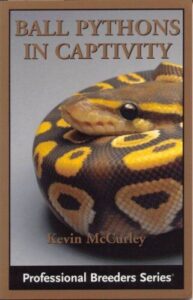
If hands-on tips are what you’re after, the Ball Python Captivity Guide takes a focused look at daily care from inside the enclosure out. It walks you through setting up proper temperature gradients, managing humidity, and understanding what calm versus stressed behavior actually looks like.
Think of it as a field manual for your snake’s living space.
At a budget-friendly price, it’s a solid starting point — especially if you’re still figuring out why your snake keeps hiding all day.
| Best For | New ball python owners who want a practical, easy-to-follow guide for setting up and maintaining a healthy enclosure without getting overwhelmed. |
|---|---|
| Format | Paperback |
| Language | English |
| Publisher | ECO/Serpent’s Tale |
| Target Audience | Beginners |
| Price Range | Budget |
| Snake Focus | Ball Python |
| Additional Features |
|
- 114 full-color photos make it easy to spot husbandry issues at a glance
- Covers all the basics — housing, diet, heating, and beginner breeding — in just 101 pages
- At $6.27, it’s a low-risk way to get solid foundational knowledge
- Skips the deeper stuff like humidity management and morph genetics
- Some sections feel disorganized and have typo issues
- It’s a used copy, so wear and tear may go beyond what "good condition" suggests
8. Königlicher Python Handbuch für Anfänger und Experten

If you read German, this one’s worth a look. The Königlicher Python Handbuch für Anfänger und Experten packs 251 pages of practical care into a single paperback — covering enclosure setup, feeding schedules, breeding, and health basics.
At $20.17, it’s reasonably priced for what you get.
Just know that some readers flag translation inconsistencies and gaps in morph coverage.
It’s best used as a broad starting reference rather than your only guide.
| Best For | German-speaking reptile keepers — beginners setting up their first enclosure or experienced hobbyists wanting a solid all-in-one reference for ball python care and breeding. |
|---|---|
| Format | Paperback |
| Language | German |
| Publisher | Independent |
| Target Audience | All owners |
| Price Range | Mid-range |
| Snake Focus | Ball Python |
| Additional Features |
|
- Covers all the essentials in one place — feeding, enclosure setup, temperature, humidity, and handling
- Includes breeding guidance from pairing all the way through neonate care
- Helps you spot health issues early, which can save you real money on vet visits
- Only available in German, so it’s a non-starter if you don’t read the language
- Some readers have flagged translation inconsistencies and incomplete morph coverage
- Paperback format can wear out fast if you’re flipping through it constantly
9. Coastal Taipan Pet Snake Guide
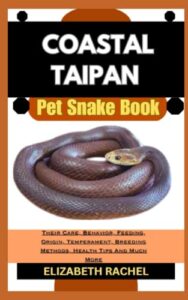
This one’s a different kind of book — the Coastal Taipan Pet Snake Guide covers one of Australia’s most venomous snakes, not ball pythons. At just $7.96 for 68 pages, it’s a compact reference on taipan care, feeding, enclosure setup, and breeding basics.
It won’t help you with your ball python directly, but if you’re curious about specialized snake husbandry or plan to expand your collection someday, it’s a low-cost peek into a more demanding world.
| Best For | Experienced reptile keepers and licensed handlers who already own or plan to keep a Coastal Taipan and want a quick, practical reference guide. |
|---|---|
| Format | Paperback |
| Language | English |
| Publisher | Independent |
| Target Audience | Advanced owners |
| Price Range | Budget |
| Snake Focus | Coastal Taipan |
| Additional Features |
|
- Covers everything from enclosure setup to breeding in one tidy, affordable package
- Safety protocols are a real bonus when you’re dealing with a highly venomous species
- At $7.96, it’s a low-risk way to get species-specific guidance
- 68 pages means some topics — like advanced venom handling or vet care — won’t get deep coverage
- Only useful for Coastal Taipans; nothing here transfers to other snakes
- Not a substitute for hands-on training or professional veterinary advice
10. ANABIUP Realistic Fake Snake Prank Set
Not every snake product is about care — sometimes it’s about laughs.
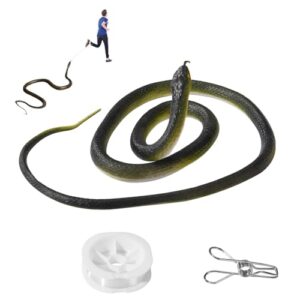
The ANABIUP Realistic Fake Snake Prank Set gives you a 1.2 m rubber snake, 50 m of clear rope, and a metal clip for just $9.99. Pose it near a plant pot, tuck it under a rug, or dangle it from a doorway.
The flexible, odorless rubber holds its shape well. It’s harmless fun, though keep it away from kids and anyone with a genuine snake phobia.
| Best For | Anyone who loves a good prank — friends who want to mess with coworkers, Halloween enthusiasts, or anyone looking for a cheap, reusable gag that gets a reaction. |
|---|---|
| Format | Physical Product |
| Language | N/A |
| Publisher | ANABIUP |
| Target Audience | Adults |
| Price Range | Budget |
| Snake Focus | Fake Snake |
| Additional Features |
|
- At $9.99 with 50 m of clear rope included, it’s a lot of prank for very little money
- The flexible rubber holds a pose well, so you can set it up in a plant, under a door, or dangling from a shelf
- No assembly needed — clip the rope, hide the snake, and wait
- The metal clip feels cheap and may need replacing if you use it often
- There’s no built-in attachment point on the snake, so the rope can slip if you’re not careful with the knot
- It’s on the smaller side, so in a big open space the effect might not land as hard as you’d hope
Frequently Asked Questions (FAQs)
How to know if a ball python is calm?
A relaxed ball python moves slowly, keeps its head low, and breathes steadily. Its coils stay loose, it explores calmly, and it doesn’t hiss, strike, or frantically search for escape.
Do ball pythons recognize their owners over time?
Yes, ball pythons do recognize their owners — mainly through scent. Your snake samples the air with its tongue and learns your smell over time, making it calmer around you.
The vomeronasal organ detection is necessary for scent-based recognition.
How long do ball pythons typically live in captivity?
Ball pythons usually live 20 to 30 years in captivity. With excellent care, some reach 40 or even 60 years. That’s a real long-term commitment worth planning for before you bring one home.
Can ball pythons coexist peacefully with other pets?
Generally, yes — but with boundaries.
Ball pythons can share a home with other pets safely if you keep enclosures secure, supervise all contact, and never allow direct interaction with small animals.
Are female ball pythons calmer than male ones?
Honestly, not really. Females tend to stay slightly calmer during handling, but the difference is small. Your snake’s individual history and how you handle it matter far more than sex.
Conclusion
What makes ball pythons such gentle companions? Their peaceful nature stems from a mix of biology, behavior, and environment.
By understanding their calm demeanor, you can build trust and create a harmonious relationship. A ball python’s peaceful nature shines through when their needs are met and they’re handled with care.
With patience and attention, you can forge a deeper connection with these snakes and appreciate their unique personalities, rooted in their ball python peaceful nature.