This site is supported by our readers. We may earn a commission, at no cost to you, if you purchase through links.

A corn snake can compress its body to slip through a gap the width of a pencil. A ball python will push against every panel edge until something gives. Snakes are methodical escape artists, and a tank that "looks secure" often isn’t.
Before you bring a snake home, look at secure reptile terrariums for corn snakes with tight-fitting lids and locking latches that leave no gap to exploit.
Snake housing for beginners trips up most people not because information is hard to find, but because the important setup decisions aren’t obvious. Enclosure size, temperature gradients, humidity, substrate depth. None of these are optional. They’re the foundation your snake’s health depends on.
Getting each piece right from the start is far easier than fixing problems later.
Table Of Contents
- Key Takeaways
- Choose The Right Snake Enclosure Size and Type
- Make The Snake Enclosure Secure and Escape-Proof
- Set Up Heating, Humidity, Lighting, and Ventilation
- Add Safe Substrate, Hides, Water, and Enrichment
- Clean, Monitor, and Adjust The Snake Habitat
- Frequently Asked Questions (FAQs)
- How do I bring a snake home?
- How do I choose a snake housing?
- How do you choose a snake enclosure?
- How do I choose a snake habitat?
- What is snake housing?
- Where can I buy a snake enclosure?
- What does a snake need in their enclosure?
- What to put in the bottom of a snake tank?
- What is the best housing for snakes?
- What to do when you first bring a snake home?
- Conclusion
Key Takeaways
- Size the enclosure for your snake’s adult length (1–1.5 body lengths squared, plus a 15–20% buffer) rather than buying a starter tank you’ll outgrow within a year.
- Escape-proofing is critical: use locking lids on both sides, keep door gaps under 2 mm, choose glass panels at least 4 mm thick, and inspect latches and seals weekly.
- Heat is the biggest danger to pet snakes, so use thermostatted undertank heaters with a secure probe, maintain an 8–12°C gradient between warm and cool zones, and verify probe accuracy regularly.
- Species-appropriate humidity (50–60% temperate, 60–80% tropical) paired with corner-placed ventilation, plus hides in both temperature zones and 2–5 cm of substrate, keeps your snake healthy and stress-free.
Choose The Right Snake Enclosure Size and Type
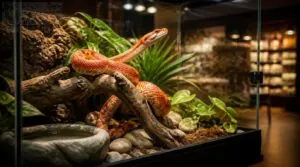
Choosing the right enclosure is one of the most important decisions you’ll make for your snake. The size and type you choose directly affect your snake’s health, comfort, and behavior. Here are the key factors to think about before you buy.
Getting familiar with essential snake habitat requirements can help you avoid common setup mistakes that stress or harm your snake long-term.
Adult Size Planning
Before you choose an enclosure, research your snake’s adult size. Most adults need 1–1.5 body lengths squared of floor space. A 4-foot snake, for example, needs at least 4–6 square feet minimum.
If you’re not sure how those measurements scale for bigger species, this detailed snake enclosure dimensions guide breaks down exact sizing by length and girth.
Build in a 15–20% size buffer beyond that. Compact starter tanks often fail within a year, so plan ahead and buy for the full adult, not the hatchling.
Species Habitat Needs
Species habitat needs go beyond floor space. A corn snake does well in a simple terrestrial setup with a temperature gradient of 28–30°C warm to 22–24°C cool, but a green tree python doesn’t need floor area. It needs vertical height and secure climbing perches.
Match your substrate depth and hide boxes to the species too. A secure lid is non-negotiable.
Make The Snake Enclosure Secure and Escape-Proof
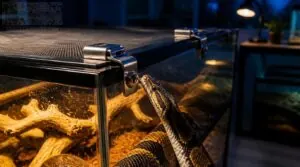
Once you’ve settled on the right enclosure, security is your next priority. Snakes are deceptively strong. They’ll probe every gap, seam, and latch until they find a weakness.
Even a small gap can become an escape route, so reviewing a complete snake enclosure security checklist before finalizing your setup can save you a stressful surprise.
Escape-proof lids are non-negotiable. Screen tops need secure locking mechanisms on both sides, with clips requiring two hands to open. Keep door gaps under 2 mm; constrictors need very little room to push through.
Glass thickness standards matter more than you’d think. Panels under 4 mm flex under pressure, creating pry points along the frame. Look for snap-fit corners and silicone gasket seals.
For ventilation security, use hooded or recessed vents. They maintain airflow without creating openings large enough for a snout or tail to exploit. Check latches and seals every week.
Set Up Heating, Humidity, Lighting, and Ventilation
Getting the climate right is where your setup goes from adequate to excellent. Snakes depend entirely on their environment to regulate body temperature, hydration, and sleep cycles, so this stage deserves your full attention.
In this section, you’ll learn how to choose safe heating equipment, monitor a proper thermal gradient, balance humidity with airflow, and establish a healthy lighting schedule.
Safe Heating Systems
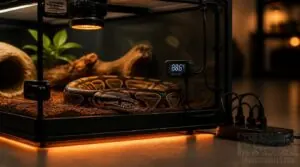
Heat kills more pet snakes than cold ever will. That’s why your heating system deserves the most careful planning in your entire setup.
Heat claims more pet snakes than cold ever will, so plan your heating system first and plan it carefully
Build your heat around these essentials:
- Thermostatted undertank heaters mounted beneath one end
- A ceramic heater backup for stable ambient warmth
- No heat cables touching substrate directly
- A surge protector on a dedicated grounded circuit
Place your thermostat probe just above the substrate. Secure it firmly. A loose probe means uncontrolled heat. Check cords monthly for cracks, and replace damaged cables immediately. Keep all electrical components elevated away from moisture.
Thermal Gradient Monitoring
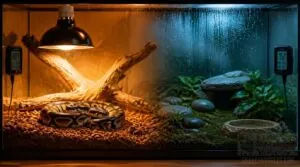
A proper temperature gradient is the backbone of your setup. Aim for an 8–12°C spread between the basking spot and cool zone. Place digital probes at both ends and check them daily for two weeks. Verify accuracy with a known-temperature bath, keeping readings within ±0.5°C. Use infrared thermometers for surface checks.
Watch for plateaus; they signal poor gradient formation.
Humidity and Ventilation
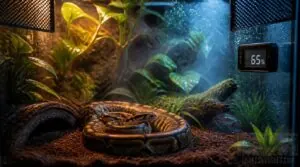
Because humidity drives shedding and respiratory health, you must dial it in from day one. Target 50–60% for temperate species, 60–80% for tropicals, with a 5–15% night-time drop. Mount your hygrometer at snake head height, farthest from heat. Pair deep, damp substrate with tiered ventilation, keeping vents in opposite corners. This balance prevents mold while preserving moisture.
Remember three things:
- Humidity pockets beat soaked cages
- Airflow protects lungs
- A secure lid keeps moisture in check
Lighting and Photoperiod
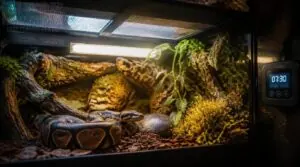
While snakes don’t bask like lizards, many still benefit from a consistent day-night cycle. Provide 10–12 hours of light daily using a timer. For diurnal species, add a UVB fluorescent tube across the basking spot setup. Keep fixtures guarded and replace UVB lamps every 6–12 months, since output decays. Match your natural photoperiod to seasonal changes for healthy behavior.
Add Safe Substrate, Hides, Water, and Enrichment
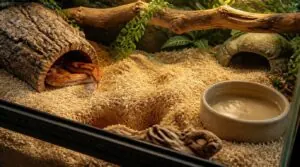
Your snake’s furniture matters more than you’d think. A bare enclosure is a stressed snake waiting to happen.
Start with substrate depth of 2–5 cm. Use fine-grain particle substrate like coarse sand or aspen bedding; it helps burrow tunnels and resists compaction. Add hide boxes in multiple sizes and materials, placed at both warm and cool zones so your snake can thermoregulate while feeling secure. Check that entry points don’t force scraping, and seal any gaps wider than 0.5 cm.
Provide a shallow water bowl large enough for full-body soaking, replaced daily. Add climbing branches or ledges for Enrichment, spacing them to prevent falls. Rotate elements weekly for novelty.
Clean, Monitor, and Adjust The Snake Habitat
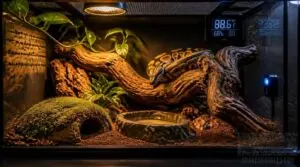
A clean habitat is a healthy habitat — and regular maintenance is your best diagnostic tool.
After each feeding or enclosure access, check corners for waste and debris within 12–24 hours. Spot-clean immediately rather than waiting for a scheduled deep clean.
Install digital sensors in both warm and cool zones to log temperature gradient stability continuously. If readings shift more than 2°C within two hours, investigate before adjusting.
Weekly, inspect cables, thermometer probes, and ventilation grills for displacement or blockages. Log every anomaly — date, measured values, your snake’s behavior — and apply adjustments incrementally: minor first, moderate only if needed.
That documentation becomes your roadmap. Over time, it tells you exactly what your snake needs before problems develop.
Frequently Asked Questions (FAQs)
How do I bring a snake home?
Like a trusted vessel, your ready enclosure is the very first gift you’ll give your snake. Warm the hide, check the temperature gradient, set correct humidity, and latch the secure lid before pickup day arrives.
How do I choose a snake housing?
Choosing snake housing starts with adult size: give 5– times your snake’s length in linear space. Pick glass or PVC with a secure lid and latches. Match the enclosure to your species’ habits—terrestrial snakes need floor space, arboreal ones need height.
How do you choose a snake enclosure?
Your snake is a tiny escape artist with a PhD in hide-and-seek. Choose a secure, well-ventilated enclosure sized for adult length, offering a temperature gradient, substrate, hides, and water bowl.
How do I choose a snake habitat?
Start with your snake’s adult size, then pick an enclosure at least 10x their girth. Meet Species Specific Needs for climbing or burrowing. Add a Temperature Gradient, secure hides, easy-clean Substrate, and prioritize Escape Prevention. A comfortable snake stays put.
What is snake housing?
Snake housing is your pet’s whole world in miniature. It’s a secure, species-appropriate enclosure with controlled temperature gradient, humidity, substrate, and hiding spots that keeps your snake safe, healthy, and stress-free.
Where can I buy a snake enclosure?
You can buy a reptile enclosure at pet stores, specialty reptile shops, or online retailers like Amazon. Compare sizes, locking mechanisms, and escape-proof lids before purchasing. Check seller ratings and return policies carefully.
What does a snake need in their enclosure?
A snake needs a secure enclosure with proper substrate, temperature gradient, and humidity, plus a basking spot, hiding spots, a sturdy water bowl, and climbing enrichment. Together, these create a safe, comfortable habitat.
What to put in the bottom of a snake tank?
A strong foundation makes a safe home. Use moisture-retentive substrate like cypress mulch, 2–4 inches deep. Simpler options work too: newspaper, paper towels, or reptile carpet. Avoid cedar and pine entirely.
What is the best housing for snakes?
What is the best housing for snakes? You’ll need a secure, well-ventilated enclosure sized for your adult snake, with proper temperature gradient, correct humidity levels, safe substrate, hiding spots, and a basking spot.
If you’re unsure where to start, our guide to snake habitat essentials walks through each of these elements in detail.
What to do when you first bring a snake home?
Before your snake arrives, prepare a secure enclosure with escape-proof lids, a proper temperature gradient, and two hiding spots. Then quarantine it, avoid handling for 48–72 hours, and watch feeding closely.
Most early health issues stem from setup, feeding, or handling mistakes, so reviewing snake care basics before day one can save you a lot of trouble.
Conclusion
Some keepers believe a perfect setup exists once and stays that way. Test that theory and you’ll find the truth: habitats are living systems that shift with seasons, age, and your snake’s behavior.
Snake housing for beginners rewards attention, not flawlessness. Check your temperatures weekly. Watch how your snake moves. Each small adjustment deepens your understanding. Build it right, then keep learning. Your snake’s health will tell you when you’ve succeeded.