This site is supported by our readers. We may earn a commission, at no cost to you, if you purchase through links.

ball python can squeeze through a gap smaller than its own head—and if you’ve ever come home to an empty enclosure, you already know that gap doesn’t have to be large.
relentless, methodical explorers; they test every seam, edge, and hinge until something gives.
Most escapes don’t happen because keepers are careless—they happen because the enclosure was never built with escape in mind. snake escape-proof enclosures means thinking like your animal: treating every material choice, every joint, and every latch as a potential failure point before your snake finds it first.
Table Of Contents
- Key Takeaways
- Choosing Escape-Proof Materials for Snake Enclosures
- Designing Secure Enclosures for Your Snake Species
- Building Escape-Proof Lids, Doors, and Joints
- Ventilation and Climate Control Without Escape Risks
- Step-by-Step Assembly, Sealing, and Maintenance
- Frequently Asked Questions (FAQs)
- Is it cheaper to build or buy a reptile enclosure?
- Can snakes sense vibrations through enclosure walls?
- How often should locking mechanisms be tested?
- What substrate materials prevent digging and escape?
- Do ultraviolet lights affect enclosure material integrity?
- Should backup heating systems be installed for emergencies?
- How often should snakes receive veterinary checkups?
- What substrates are safest for different snake species?
- How do you reduce stress in captive snakes?
- What are signs of a respiratory infection in snakes?
- Conclusion
Key Takeaways
- Snakes can squeeze through tiny gaps, so every seam, latch, and joint in your enclosure needs careful sealing and escape-proof hardware.
- Materials like PVC, sealed hardwood, melamine, and tempered glass offer the best balance of durability, humidity resistance, and safety for snake habitats.
- Proper enclosure dimensions and layout must match your snake’s size and behavior, with growth buffers and secure climbing or hiding spaces built in.
- Routine inspections, lock audits, and maintenance logs are essential to catch weak points early and keep your snake safe from escape risks.
Choosing Escape-Proof Materials for Snake Enclosures
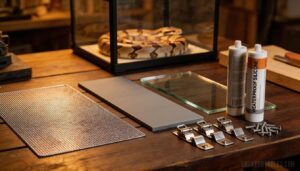
material you build with matters more than most keepers realize — it’s the difference between a snake that stays put and one that finds every flaw in your setup. Some materials handle humidity, heat, and daily wear far better than others, and choosing wrong can compromise both safety and your snake’s health.
For a deeper look at how different enclosure materials stack up in real-world conditions, comparing top-rated snake terrariums by material and build quality can save you a costly mistake down the line.
Here’s what actually holds up.
Moisture-Resistant Woods and Safe Alternatives
When wood is your framing choice, species selection makes or breaks long-term enclosure integrity.
Ipe wood benefits include a density near 1,050 kg/m³ and natural moisture resistance lasting decades untreated. Teak oil finish penetrates deeply, shielding humid interiors without harsh chemicals. Cedar natural preservatives deter decay, though avoid cedar contact surfaces due to phenolic toxicity. White oak grain limits water absorption, while redwood warp resistance keeps joints aligned in moisture-rich reptile habitats.
Benefits of PVC, Melamine, and Tempered Glass
Beyond wood, three materials give you a real edge in escape prevention strategies: PVC sheets, melamine coated board, and glass terrarium panels.
- PVC sheets — lightweight rigidity makes assembly simple, while impact resistance and easy cleaning keep maintenance fast.
- Melamine coated board — smooth, non-porous surface helps mold prevention even in high-humidity setups.
- Tempered glass — delivers clear visibility with material corrosion resistance and easy wiping.
- All three — seal cleanly, closing gaps that snakes exploit.
Materials to Avoid for Snake Safety
Not every material that looks sturdy belongs inside a snake enclosure. Cedar Shavings release phenols that damage respiratory tissue — even brief exposure causes wheezing. Pine Bedding carries aromatic hydrocarbons linked to liver stress. MDF Boards off-gas formaldehyde, and Oil-Based Paint emits fumes during curing. Zinc Alloy Hardware corrodes under humidity, leaching toxic salts.
PVC enclosures retain heat efficiently and are a safe choice for snake habitats.
| Material | Risk |
|---|---|
| Cedar Shavings | Phenol-induced respiratory damage |
| Pine Bedding | Liver and kidney stress |
| MDF Boards | Formaldehyde off-gassing |
| Zinc Alloy Hardware | Toxic salt leaching |
| Oil-Based Paint | VOC fume exposure |
Stick with PVC, sealed hardwood, or polyurethane sealant-finished surfaces. High-pressure particleboard with intact laminate coating stays safer than raw chipboard — but once that surface chips, replace it immediately. Preventing toxicity in reptile enclosures starts with material selection, not damage control.
For deeper guidance on pairing the right materials with proper hide design, safe snake hide materials and construction tips walks through what to look for before you build or buy.
Designing Secure Enclosures for Your Snake Species
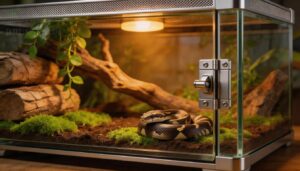
Getting the design right starts with knowing your snake — its size, behavior, and how it’ll grow over time. A ball python’s needs look nothing like a corn snake’s, and your enclosure should reflect that from day one.
Here are the key design principles to build around.
Selecting Proper Enclosure Dimensions by Species
Getting dimensions wrong is one of the most common — and costly — mistakes in snake habitat design. Species Size Guidelines exist for a reason: a ball python needs at minimum 4×2×2 feet, while a rosy boa can thrive in 3×1.5×1.5 feet.
Follow these enclosure size guidelines:
- Ground Dwelling Ratio: Maintain a 2:1 length-to-width ratio for thermal gradient volume.
- Arboreal Space Requirements: Vertical height must reach 1.2× the snake’s adult length.
- Growth Buffer Calculations: Add 20–30% beyond current size for species-specific needs.
Customizing Layout for Growth and Behavior
Once you’ve nailed your dimensions, the real work begins: shaping a layout that grows with your snake.
Vertical Enrichment — climbing branches placed 6–12 inches above the substrate — drives natural behavior in arboreal species.
Modular Microhabitats let you rotate 2–3 elements every three weeks through Flexible Zone Rotation, keeping your custom snake habitat design stimulating.
Hidden Retreats and Behavioral Pathways to create 4–6 defined exploration routes throughout your multilevel reptile enclosure.
Balancing Accessibility and Escape Prevention
Accessibility and escape prevention aren’t opposing goals — they’re two sides of the same design decision. Quick-Release Latches paired with secondary door locks let you open panels fast without sacrificing security.
Consider these non-negotiables:
- Removable Tray Design for clean substrate swaps without disturbing the enclosure structure
- Sliding Lid Mechanism with a secure latch and Ergonomic Door Grips for confident, one-handed operation
- Flexible Maintenance Ports that support regular inspections without creating escape gaps
Building Escape-Proof Lids, Doors, and Joints
A snake that escapes isn’t just a headache — it’s a real safety risk that could have been prevented at the design stage.
The lid, doors, and joints are where most enclosures fail, and getting them right comes down to choosing the correct hardware and sealing every potential weak point.
Here’s what you need to focus on to keep your build truly escape-proof.
Reliable Locking Mechanisms for Snake Enclosures
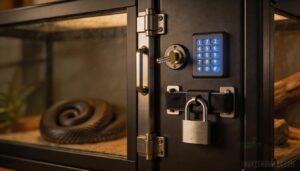
A lock is your last line of defense. Sliding bolt locks work well for larger enclosures — slide bolts that run the full door height resist prying from even a determined ball python.
Cam lock enclosures add key-required rotation, preventing accidental openings.
For maximum control, electronic keypad locks log access automatically.
Magnetic latch locks suit lighter builds, while a padlock hasp system secures high-risk species reliably.
Eliminating Gaps, Seams, and Weak Points
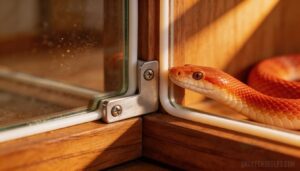
Even a 2mm gap is an open door for a determined corn snake.
Start with Joint Reinforcement at every seam — press-clamp panels during curing to eliminate micro gaps. Sealant Application using 100% silicone caulk seals edges thoroughly.
Corner Shield Installation blocks prying points, while Material Expansion Matching prevents thermal gaps.
Schedule Fastener Torque Checks quarterly, and conduct regular inspections every six months — enclosure design flaws rarely announce themselves.
Safe Hinges, Access Panels, and Sealing Techniques

A continuous piano hinge running the full door length distributes load across dozens of screws — far more reliable than two hinge points ever could be.
- 304 or 316 stainless for Security Pin Locks and hinge pins in humid builds
- Compression Gasket Selection: use closed-cell EPDM, compressed 25–40% for a reliable seal
- Neutral Cure Silicone cures without acetic acid — safer on interior animal-contact surfaces
- Captive Screw Systems keep hardware attached during cleaning, preventing lost fasteners
- Installing Hinges and Latches for Secure Enclosure Access: mount continuous piano hinges externally to eliminate interior snag points
Ventilation and Climate Control Without Escape Risks
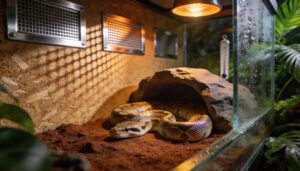
Getting ventilation right is one of the trickier balancing acts in enclosure design — too little airflow, and you’re inviting respiratory problems; too much, and you’re handing your snake a potential exit. The good news is that secure venting is absolutely achievable with the right placement and materials.
Too little airflow invites disease; too much hands your snake an exit — but secure venting makes both risks manageable
Here’s what you need to know across three key areas.
Secure Vent Placement and Cover Options
Vent placement is half the battle.
Position High Corner Vents near the top of your enclosure — warm air rises, so snakes won’t naturally gravitate there.
Dome Vent Positioning further deflects probing.
Use a Louvered Airflow Design to control directional airflow without creating exploitable gaps.
Secure every cover with Snap Closure hardware or Magnetic Vent Latches, and always back mesh panels with a double-layered screen top.
Maintaining Humidity Without Creating Gaps
Getting humidity right means managing where moisture travels, not just how much you add.
Vapor Barrier Placement under substrates stops Capillary Action Prevention from wicking into wooden walls — a 6 mil polyethylene sheet addresses this cleanly.
Practice Microclimate Zoning by concentrating moisture near water features, away from seams. Always confirm Sealant Compatibility Testing before applying silicone caulk, and use ventilation grids to balance Humidity Gradient Management without gaps forming.
Common Ventilation Mistakes to Avoid
Three mistakes collapse an otherwise solid ventilation system fast: Improper Duct Sizing creates drafts that stress your snake or starve airflow entirely; Unbalanced Intake Exhaust pulls dirty air through seams you thought were sealed; and Basking Draft Exposure drops temps unpredictably near heat zones.
Always install a Missing Flow Indicator to verify circulation, and keep Oversized Vent Openings off your build — they’re escape invitations.
Step-by-Step Assembly, Sealing, and Maintenance
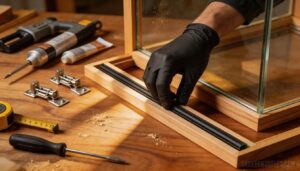
Getting the build right comes down to having the right tools, following the right sequence, and staying on top of maintenance once the enclosure is in use.
Each of those three areas has specific steps that, if skipped, can create escape risks you won’t notice until it’s too late. Here’s what you need to cover.
Tools and Hardware Checklist for DIY Builds
Before you cut a single panel, make sure your toolbox covers these essentials:
- Measuring Instruments — a locking tape measure, combination square, and caliper for precise hinge and hook-and-eye latch placement.
- Cutting and Fastening — a circular saw for straight panel cuts, a drill for pilot holes, and stainless‑steel screws with Fasteners Selection matched to your material.
- Sealing and Safety Gear — silicone caulk, construction‑grade Adhesive Types, and Clamping Techniques to hold joints square while curing; safety glasses and a respirator are non‑negotiable.
Construction and Waterproofing Techniques
With your tools ready, assembly moves fast if you follow the right sequence. Dry-fit all panels first, then secure joints with stainless screws and silicone caulk along every interior seam.
For water-resistant wooden vivariums and PVC sheets, liquid applied membranes or crystalline sealant systems outperform basic paint. Apply sealant application in thin, overlapping layers — let each cure fully before adding substrate or heat equipment.
Routine Inspections and Security Upgrades
Every week, run your Inspection Checklist — latches, hinges, seams, and gaps down to 1 mm for smaller species. Combine this with Lock Audits and Seal Integrity Testing to catch failures before your snake does.
Log everything in your Maintenance Log Review, and schedule quarterly Emergency Drill Protocols so your team responds quickly. Secure latch mechanisms, door locks, and escape detection sensors aren’t optional — they’re your last line of defense.
Frequently Asked Questions (FAQs)
Is it cheaper to build or buy a reptile enclosure?
DIY builds generally cost $150–$350 in materials, while comparable pre-made enclosures run $300–$1,
Material cost analysis favors building, but labor expense impact and long-term maintenance savings depend on your skill level and time.
Can snakes sense vibrations through enclosure walls?
Yes — snakes detect vibrations through bone conduction, not ears.
Rigid walls like glass or metal transmit low-frequency signals directly, triggering behavioral responses. Substrate coupling and enclosure material both influence how much vibration reaches your snake.
How often should locking mechanisms be tested?
Test secure locking mechanisms quarterly at minimum. Humidity above 70% demands monthly checks. Log every inspection date and result — those compliance records aren’t optional. Any play over 5mm means immediate replacement.
What substrate materials prevent digging and escape?
A concrete base below the enclosure, paired with underfloor mesh and heavy-duty flooring, stops most digging attempts cold.
Layered substrate of coconut fiber or aspen shavings over a nonporous vault completes your substrate barrier.
Do ultraviolet lights affect enclosure material integrity?
UV light triggers polymer chain scission in acrylic, causing acrylic UV brittleness over time.
UV-accelerated wood fading and seal breakdown follow prolonged UVB exposure, so UV protective coatings on all reptile housing surfaces are non-negotiable.
Should backup heating systems be installed for emergencies?
Yes — emergency heat redundancy isn’t optional. Battery backup heaters, temperature sensor alarms, and fire safety circuits protect your snake when the grid fails.
Stick to a maintenance schedule and your thermostat control won’t let you down.
How often should snakes receive veterinary checkups?
Annual exams are the baseline for pet snake care, though many reptile vets recommend twice yearly.
Growth monitoring, parasite screening, blood work, and illness triggers like appetite loss all shape your reptile health assessment schedule.
What substrates are safest for different snake species?
Aspen shavings suit dry-climate snakes well, while coconut fiber helps tropical species needing higher humidity.
Use cypress mulch for corn snakes, paper towel during quarantine, and soil substrate for burrowers like sand boas.
How do you reduce stress in captive snakes?
Think of your snake as a creature that thrives on predictability.
Stable substrate, consistent hide placement, routine feeding, and limited handling form the foundation of stress reduction in reptiles — keep those four steady, and your snake stays calm.
What are signs of a respiratory infection in snakes?
Watch for wheezing sounds, nasal discharge, open-mouth breathing, nasal swelling, and reduced activity.
Poor temperature regulation and humidity levels — monitor both with a hygrometer and maintain a proper thermal gradient — worsen snake health fast.
Conclusion
As you seal the final seam, imagine your snake’s curious gaze scanning for weaknesses. With these guidelines, you’ve transformed a potential Houdini act into a secure sanctuary.
Building snake escape-proof enclosures requires diligence, but the peace of mind is priceless.
By prioritizing escape prevention in your design, you’re not just building a habitat—you’re crafting a safe haven.
Now, breathe easy knowing your slithery friend is secure, thanks to your mastery of building snake escape-proof enclosures.
- https://www.youtube.com/watch?v=40QGB_Q09b0
- http://petdiys.com/diy-reed-mat-reptile-decor/
- https://www.instructables.com/DIY-Snake-Cage/
- https://vcahospitals.com/know-your-pet/veterinary-care-new-reptile-visit
- https://pet-health-advisor.com/reptiles-amphibians/health-wellness-reptiles-amphibians/10-tips-for-routine-snake-veterinary-visits/