This site is supported by our readers. We may earn a commission, at no cost to you, if you purchase through links.
A dirty snake enclosure isn’t just unsightly—it’s a direct threat to your pet’s health. Bacteria multiply rapidly in warm, moist environments, and snakes living in poorly maintained habitats face elevated risks of respiratory infections, scale rot, and dangerous pathogen exposure.
The good news? Keeping your snake’s home clean doesn’t require expensive equipment or hours of work. A consistent routine combining daily spot checks with periodic deep cleaning protects your snake from preventable illness while extending the life of substrate and décor.
The key lies in using the right products and techniques that eliminate harmful microbes without stressing your animal or leaving toxic residues behind.
Table Of Contents
- Key Takeaways
- Daily Spot Cleaning for Snake Enclosures
- Deep Cleaning Your Snake Enclosure
- Top 3 Products for Snake Enclosure Cleaning
- Safe Disinfectants and Cleaning Solutions
- Preventing Illness Through Proper Enclosure Hygiene
- Frequently Asked Questions (FAQs)
- How to clean a snake’s enclosure?
- How do you clean a snake’s house?
- How often should you clean a snake enclosure?
- How do you clean a snake cage?
- How often should I clean feeding dishes?
- Can I use paper towels as temporary substrate?
- What temperature should cleaning water be?
- Should I wear gloves while spot cleaning?
- How do I sanitize climbing branches safely?
- Conclusion
Key Takeaways
- Daily spot cleaning—removing waste within 1-2 days and scrubbing water bowls every 24 hours—prevents bacterial growth and biofilm formation that threaten your snake’s health, especially given the 63% Salmonella prevalence in captive snakes.
- Deep cleaning every 2-4 months with reptile-safe disinfectants like F10 (1:250 dilution) or diluted bleach (1:32 ratio) eliminates pathogens without leaving toxic residues, provided you rinse thoroughly and allow complete drying before reintroducing your snake.
- Monitoring substrate daily for moisture and odor catches problems like mold growth and excess humidity before they escalate into respiratory infections or scale rot, maintaining the wrung-out-sponge texture that keeps your snake safe.
- Proper hand hygiene after every enclosure interaction—scrubbing for 20 seconds with soap and warm water—protects you and your household from Salmonella transmission, which poses significant zoonotic risk from infected reptiles.
Daily Spot Cleaning for Snake Enclosures
Daily spot cleaning keeps your snake’s enclosure safe and prevents bacteria from taking hold. You don’t need to dismantle the entire setup—just focus on removing visible waste and maintaining fresh water.
Here’s what you should do each day to create a clean, healthy space for your snake.
Removing Waste and Soiled Bedding Promptly
Check your snake’s enclosure daily for feces and urates—remove them within 1-2 days to prevent bacterial growth and odor control. With snakes showing 63.1% Salmonella prevalence, prompt waste management protects both your pet and household.
Daily spot cleaning extends the time between deep cleaning sessions while maintaining enclosure hygiene:
- Scoop visible waste using dedicated tools
- Replace soiled bedding in affected areas
- Monitor substrate for moisture buildup.
Regular cleaning is part of proper snake care to guarantee a healthy environment.
Cleaning and Refilling Water Bowls Safely
Beyond removing waste, your snake’s water bowl demands attention every 24 hours to prevent biofilm—that slippery bacterial layer coating the surface. Scrub the bowl with warm water and reptile-safe disinfectants like F10 (1:100 dilution) or mild soap, rinse thoroughly, and refill with fresh water. Daily spot cleaning beats weekly neglect: biofilm forms on all bowl materials, turning stagnant water into a bacterial breeding ground that threatens both enclosure hygiene and your snake’s health. When choosing cleaning products, consider using reptile safe cleaners to guarantee the well-being of your pet.
| Bowl Material | Cleaning Frequency | Biofilm Removal Method |
|---|---|---|
| Stainless steel | Daily (every 24 hours) | Scrub with F10 or soap |
| Glazed ceramic | Daily (every 24 hours) | Hot water + mild detergent |
| Smooth plastic | Daily (every 24 hours) | Replace if scratched |
| Cracked bowls | Replace immediately | Discard—harbors bacteria |
| All materials | Weekly deep cleaning | 3% bleach solution rinse |
Checking Substrate for Moisture and Odor
After refilling the water bowl, run your fingers through the substrate daily—it should feel like a wrung-out sponge, not soggy or bone-dry.
Sniff for musty, mildew-like odors signaling bacterial decomposition or mold growth. Look for fuzzy black or white patches and condensation on tank walls, indicators humidity levels have crept too high.
This daily spot-cleaning habit catches moisture control problems before they escalate into respiratory infections or scale rot.
Deep Cleaning Your Snake Enclosure
While daily spot cleaning keeps things manageable, a full deep clean every 2-4 months is essential for controlling bacteria and keeping your snake healthy. This process requires removing your snake, emptying the entire enclosure, and sanitizing every surface and accessory.
Here’s how to tackle each step safely and effectively.
Safely Removing and Securing Your Snake
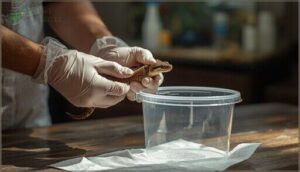
Before you lift your snake, scan its body for wheezing, mites, or odd posture—68% of keepers do this simple check before every handling session.
Then follow these snake safety precautions:
- Use two hands to support the body horizontally, never let it dangle
- Place it in a secure container like a ventilated tub with a tight lid
- Add one handler per 1.5 meters for larger constrictors to prevent escape
Emptying and Disinfecting The Entire Tank
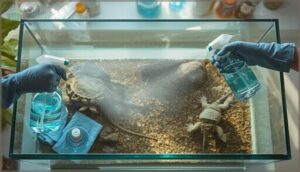
Success in tank disinfection depends on three phases: pre-cleaning, chemical contact, and thorough rinsing. Strip out all substrate and loose debris—organic matter cuts disinfectant power by half.
Apply reptile-safe disinfectants like F10 at 1:250 or 1:32 bleach, keeping surfaces wet for ten minutes. Rinse completely until no odor remains, then air-dry fully before reassembly.
These deep cleaning techniques protect biosecurity measures and reptile safety.
Cleaning Hides, Decorations, and Accessories Thoroughly
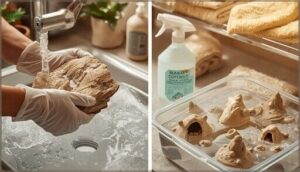
Hides and decorations harbor pathogens even when they look clean. Scrub each piece with warm, soapy water to remove organic residue—material safety matters, so test porous wood before soaking.
Apply reptile-safe disinfectants like F10 at 1:500 or chlorhexidine at manufacturer dilution, keeping surfaces wet for ten minutes. Rinse until odorless, then air-dry completely before returning items to the enclosure.
Replacing Substrate and Reassembling The Habitat
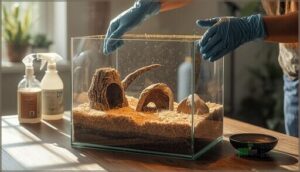
Refill your snake enclosure with 5–10 cm of fresh substrate—enough for burrowing without trapping excess moisture. Bioactive systems need deeper layers, around 15–30 cm, to support microclimate control and clean-up crews. Before reintroducing your snake, verify substrate depth matches your species’ humidity needs and thermal requirements.
Replace hides in familiar locations to preserve scent cues and prevent stress-related feeding refusals.
Top 3 Products for Snake Enclosure Cleaning
You don’t need expensive specialty products to keep your snake’s enclosure clean and safe. A few reliable basics will handle everything from daily spot cleaning to full disinfection.
Here are three essential products that make the job easier and protect both you and your snake.
1. Natural Unscented Hand Soap Bulk
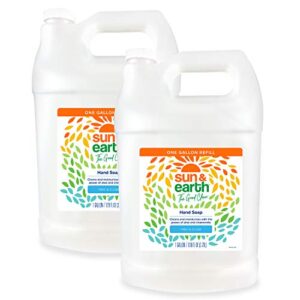
You’ll wash your hands dozens of times during daily spot cleaning and deep cleaning cycles, so stocking natural unscented hand soap in bulk makes practical sense. Choose biodegradable formulas with simple soap ingredients—coconut, olive, or palm kernel oils—that won’t irritate your skin or introduce harsh fragrances near your snake enclosure.
These eco-friendly options support hand hygiene protocols that reduce Salmonella transmission, and they’re gentle enough to scrub water bowls and hides when you need a quick, reptile-safe disinfectants alternative for routine reptile care tasks.
Best For: Snake keepers who perform frequent enclosure maintenance and want a cost-effective, skin-safe soap that supports hygiene protocols without leaving strong scents around their reptiles.
- Biodegradable plant-based formulas are gentle on skin during repeated handwashing and safe for rinsing water bowls and décor items.
- Buying in bulk cuts costs significantly—wholesale prices can drop from around $6.49 to $4.99 per unit when purchasing larger quantities.
- Unscented versions avoid fragrance residues that could interfere with your snake’s scent detection and feeding behavior.
- Some natural soaps still contain sodium lauryl sulfate (SLS), which certain users prefer to avoid despite the “natural” label.
- Refill options can be limited compared to conventional brands, and stockouts may disrupt your cleaning routine.
- You’ll need to confirm that any soap used near enclosures is thoroughly rinsed, since even gentle surfactants can irritate mucous membranes if residue remains.
2. Pet Disinfectant And Deodorizer Solution
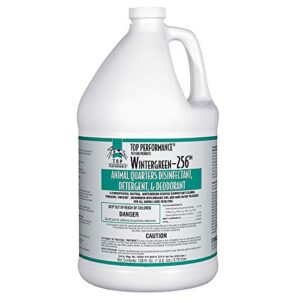
When hospital-grade disinfectants meet everyday reptile care, you gain tools that tackle Salmonella and Pseudomonas without compromising pet safety. F10 disinfectant eliminates pathogens at 1:250 dilution, while Chlorhexidine at 1:30 ratios provides non-irritating sanitizing methods for glass and hides.
These reptile-safe disinfectants outperform chemical alternatives like bleach by avoiding harsh fumes, and they work alongside a simple vinegar-water mix for lighter maintenance.
Choose concentrated formulas that let you control dilution ratios—your reptile hygiene protocol stays consistent, and you’ll cut costs while maintaining veterinary-level disinfectant types in your routine.
Best For: Reptile owners who need veterinary-grade disinfection against Salmonella, Pseudomonas, and fungal pathogens without risking pet health through harsh chemical fumes.
- Concentrated formulas like F10SC stretch a single gallon into 256 gallons of solution, cutting long-term costs while maintaining hospital-level pathogen control.
- Works at safe dilution ratios (1:250 for general use, 1:30 for Chlorhexidine) that eliminate bacteria in minutes without leaving irritating residue after proper drying.
- Targets tough reptile-specific threats like snake fungal disease and Cryptosporidium that standard household cleaners miss entirely.
- Requires precise dilution math and measuring tools—grabbing the wrong ratio means wasted product or ineffective disinfection.
- Demands complete drying time and ventilation before reintroducing reptiles, which extends your cleaning routine compared to quick wipe-downs.
- Initial cost for concentrated veterinary disinfectants runs higher than drugstore sprays, even though per-use pricing drops dramatically.
3. Nitrile Exam Gloves For Protection
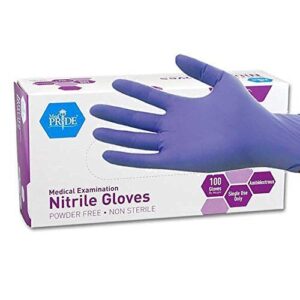
You’ll shield your hands from pathogens and harsh chemicals with nitrile exam gloves—an essential barrier during every snake enclosure cleaning session. Nitrile benefits include 10-fold higher puncture resistance than latex, vital when handling sharp décor or scrubbing rough surfaces.
This glove material resists reptile-safe disinfectants, bleach solutions, and vinegar mixes for up to two hours without degrading. Chemical safety matters in reptile husbandry: nitrile protects against Salmonella transmission while maintaining tactile sensitivity for animal health and hygiene tasks.
Choose powder-free options to avoid respiratory irritation during snake health maintenance routines.
Best For: Snake owners and reptile keepers who need reliable hand protection during enclosure cleaning, especially if you’re concerned about Salmonella exposure or have latex sensitivities.
- Ten times more puncture-resistant than latex gloves, so they hold up better when you’re scrubbing rough surfaces or handling sharp cage décor
- Resist harsh cleaning chemicals like bleach and disinfectants for up to two hours without breaking down
- Powder-free design won’t irritate your lungs, and the textured fingertips give you enough grip to handle your snake safely
- Some users find them too thin and report they tear more easily than expected
- Sizing can be inconsistent—gloves that should fit medium sometimes run small
- More expensive than basic disposable gloves, which adds up if you’re cleaning multiple enclosures regularly
Safe Disinfectants and Cleaning Solutions
Not all cleaning products are safe for your snake, and choosing the wrong one can cause serious harm. You need disinfectants that kill bacteria without leaving toxic residues behind.
Here are three proven options that balance effectiveness with safety.
Reptile-safe Disinfectants Like Chlorhexidine and F10
For reptile-safe disinfectants, chlorhexidine and F10 deliver proven results without harsh residues. Chlorhexidine at 0.05–0.1% concentration achieves over 99.99% bacterial reduction in under five minutes, while F10 at 1:500 dilution manages bacteria, fungi, and viruses effectively.
Both products minimize irritation when surfaces dry completely before reintroducing your snake, supporting long-term reptile health and enclosure hygiene.
Using Diluted Bleach Solution for Deep Cleaning
For deep cleaning, a 1:32 dilution of household bleach (approximately 0.26% sodium hypochlorite) provides effective disinfection without excessive residue. This bleach concentration targets Salmonella and other pathogens during full enclosure maintenance.
Follow these cleaning protocols:
- Remove your snake and secure it in a temporary container
- Apply diluted bleach to all surfaces, ensuring proper contact time
- Rinse thoroughly with multiple water cycles until no odor remains
- Allow complete air-drying before reassembling
- Never mix bleach with other disinfectants
Complete residue removal protects your snake from respiratory irritation.
Chemical-free Alternatives With Vinegar and Water
Beyond bleach, a 1:1 vinegar-water mix offers an eco-friendly option for daily spot cleaning. The 2.5% acetic acid removes soil and mineral deposits without harsh residues—but it won’t match registered reptile-safe disinfectants for pathogen control. Use it between deep cleaning cycles. Always rinse surfaces until no vinegar scent lingers, since snakes navigate by smell.
| Vinegar Safety Aspect | Key Consideration |
|---|---|
| Concentration | 1:1 dilution (≈2.5% acetic acid) |
| Contact time | 5–10 minutes for bacterial reduction |
| Rinsing requirement | Multiple hot-water rinses until odorless |
| Pathogen efficacy | Modest; inferior to chlorhexidine or F10 |
| Natural cleaners benefit | Non-toxic, biodegradable green alternative |
Preventing Illness Through Proper Enclosure Hygiene
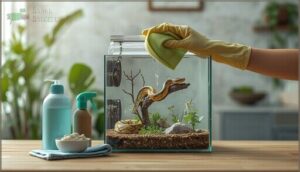
Keeping your snake healthy starts with keeping its home clean. A dirty enclosure doesn’t just look bad—it creates real health risks like Salmonella and respiratory infections.
Here’s how to protect your snake through smart cleaning habits.
Reducing Salmonella and Bacterial Risks
Snakes carry Salmonella at remarkably high rates—over 63% in captivity—making bacterial control a cornerstone of disease management. Your daily spot cleaning and regular enclosure sanitizing with reptile-safe disinfectants like Chlorhexidine directly combat this risk.
With over 63% of captive snakes carrying Salmonella, daily spot cleaning and reptile-safe disinfectants are essential for disease control
- Remove waste immediately to stop bacterial growth before it starts
- Disinfect water bowls and hides weekly using reptile-safe cleaners
- Wash your hands thoroughly after every enclosure interaction to protect yourself and your household
Maintaining Optimal Humidity During Cleaning
Humidity control separates thoughtful keepers from those who inadvertently harm their animals. When you open your snake enclosure for deep cleaning or daily spot cleaning, moisture escapes fast—hygrometer calibration before and after helps you track losses.
Position a water bowl on the warm end to boost evaporation, and use misting techniques or fogger usage to restore species-specific ranges within hours, safeguarding your reptile habitat management and preventing respiratory complications.
Minimizing Stress During The Cleaning Process
Disturbance during cleaning triggers defensive posturing and escape attempts—two hallmarks of stress in captive snakes. You can safeguard animal welfare by using predictable routines, gentle transfers with full body support, and temporary housing with hide boxes.
Stress reduction depends on:
- Moving your snake only once per session
- Cleaning during its inactive hours
- Keeping environmental cues like temperature stable
- Returning hides to familiar locations
- Completing tasks quickly and quietly
Target training lets your snake enter a holding tub voluntarily, cutting forced restraint.
Hand Washing Protocols After Enclosure Maintenance
Immediately after every enclosure session, scrub your hands with soap under warm running water for at least 20 seconds—front, back, between fingers, under nails. Skin protection matters: soap usage beats sanitizer efficacy when organic debris is present.
Alcohol-based gel works in a pinch, but full hand hygiene with water temperature above lukewarm remains your best defense against Salmonella and bacterial risks.
Frequently Asked Questions (FAQs)
How to clean a snake’s enclosure?
You’ll need to spot-clean daily—removing waste and replacing water—then deep clean every 1-3 months with reptile-safe disinfectants, replacing substrate and sanitizing all surfaces to protect your snake’s health.
How do you clean a snake’s house?
You clean your snake’s house through daily spot checks—removing waste and replacing water—plus deep cleaning every 1-3 months using reptile-safe disinfectants like F
Ensuring proper tank cleaning and maintenance protects reptile health.
How often should you clean a snake enclosure?
Your pet snake won’t thank you for daily disruptions, yet its enclosure demands daily routines. Spot-clean waste each day, refresh water bowls, and perform deep cleaning with complete substrate replacement every four to six weeks for ideal reptile hygiene.
How do you clean a snake cage?
You’ll follow a two-part routine: daily spot cleaning to remove waste and refresh water, plus periodic deep cleaning every 4–6 weeks that involves emptying, disinfecting with reptile-safe products, and reassembling the habitat.
How often should I clean feeding dishes?
Bacterial growth in reptile feeding dishes can double every 10 to 20 minutes.
Clean dishes after each feeding or every 2-3 days using reptile-safe disinfectants to prevent Salmonella contamination and maintain your snake’s health.
Can I use paper towels as temporary substrate?
Yes, you can use paper towels as a temporary substrate during quarantine, illness, or mite treatment. They simplify enclosure cleaning and waste monitoring.
But they don’t hold humidity well and carry ingestion risks during feeding.
What temperature should cleaning water be?
Lukewarm water—around 25–40°C (77–104°F)—strikes the perfect balance: warm enough for reptile-safe disinfectants and chemical efficacy, cool enough for material safety, and gentle on your pet snake’s humidity control needs without thermal disinfection risks.
Should I wear gloves while spot cleaning?
Wearing disposable gloves reduces your exposure to Salmonella during spot cleaning—public health agencies recommend them as a protective measure.
Always wash your hands thoroughly after removing gloves, since zoonotic risks persist even with barrier protection.
How do I sanitize climbing branches safely?
Give your branches the heat before they meet your snake: bake at 250°F for two hours.
Then disinfect using reptile-safe cleaners like Chlorhexidine or F10, or soak in diluted bleach followed by thorough rinsing.
Conclusion
A single overlooked water bowl or delayed substrate change can set the stage for infection. But when you commit to consistent cleaning—daily spot checks, thorough deep cleans, and reptile-safe disinfectants—you eliminate the invisible threats that compromise your snake’s immune system.
Cleaning a snake enclosure isn’t just maintenance. It’s disease prevention. Your snake depends on you to control the one variable that matters most: the cleanliness of its environment. Don’t wait for symptoms to appear.
- https://inkbird.com/blogs/aquarium-terrarium/corn-snake-care-guide
- https://petadvocacy.org/wp-content/uploads/2022/01/Snakes-Care-Sheet.pdf
- https://www.reddit.com/r/cornsnakes/comments/xvdvfq/enclosure_cleaning_frequency/
- https://pmc.ncbi.nlm.nih.gov/articles/PMC12243343/
- https://www.merckvetmanual.com/exotic-and-laboratory-animals/reptiles/management-and-husbandry-of-reptiles